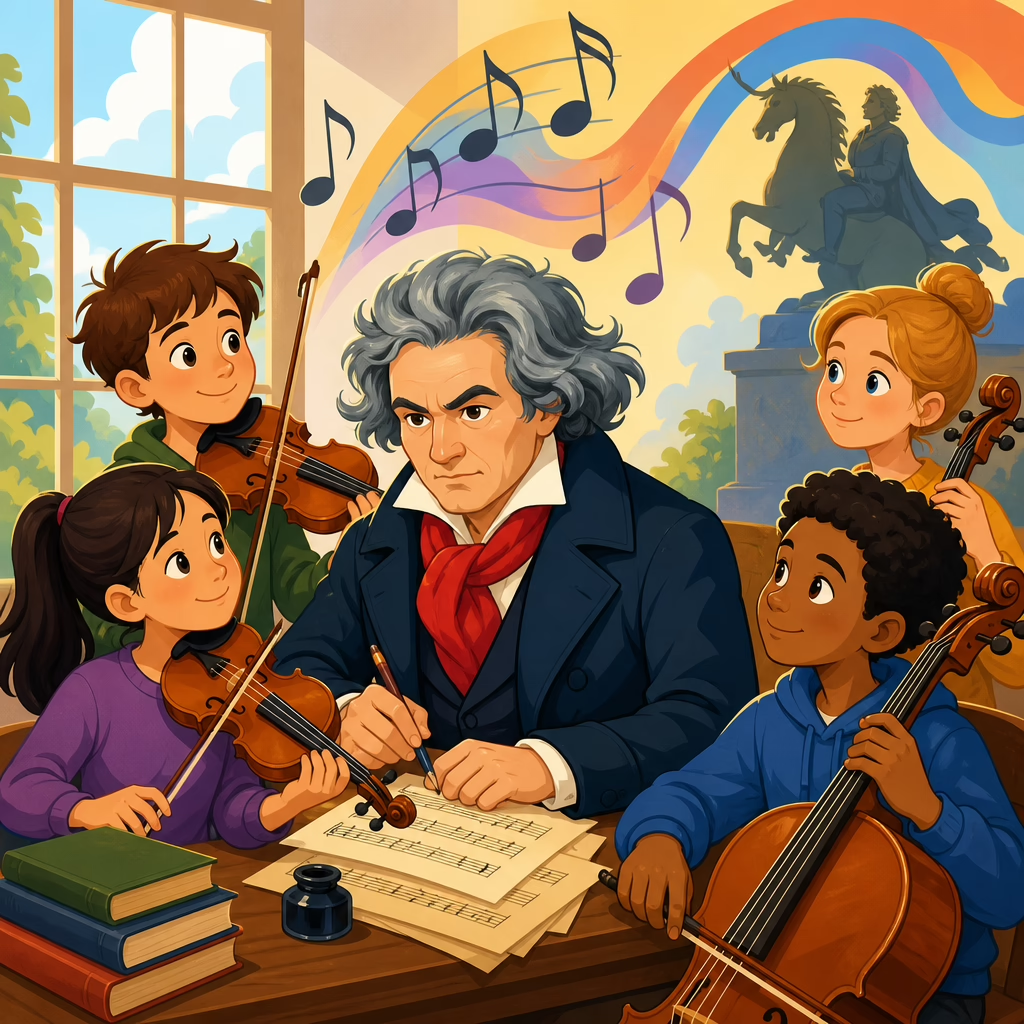
Beethoven for String Students: First Listening Repertoire
Beethoven can feel intimidating to young string players, yet he is one of the best composers for a first serious listening repertoire because his music is built on clear motives, strong contrasts, memorable rhythm, and emotional directness. For string students, “first listening repertoire” means the pieces teachers introduce early not for immediate performance, but for active listening, style recognition, ensemble awareness, and the gradual development of musical vocabulary. In practical teaching, I use this repertoire to help students identify pulse, phrase length, bow-like articulation, dynamic shape, call-and-response, and the difference between melody, accompaniment, and inner parts before those ideas appear on a stand. Beethoven matters in this setting because he sits at a useful crossroads: his music still carries Classical clarity, yet it pushes toward the expressive intensity students later meet in Romantic literature. That makes him ideal for bridging simple elementary listening work and more advanced historical understanding. A focused Beethoven listening sequence also supports ensemble culture. Students begin hearing how a quartet breathes, how an orchestra balances strings against winds, and how repeated motives create structure. Instead of presenting Beethoven as a monument, teachers can present him as audible craft: short ideas, repeated and transformed, organized with purpose. That shift helps beginners listen actively rather than passively. It also builds confidence, because students quickly discover they can recognize themes, track dynamics, and describe character in plain language. When chosen carefully, Beethoven selections give string students accessible entry points into form, phrasing, tone color, and musical storytelling without requiring advanced technical background.
Why Beethoven Works So Well for Beginning String Listening
Beethoven is especially effective for string students because his writing rewards repeated listening. Even very young players can hear the famous four-note opening of Symphony No. 5, the buoyant pulse of the Seventh Symphony, or the singing lyricism of the “Ode to Joy” theme. Those surface features are not trivial; they are the exact hooks that allow teachers to train deeper listening. Once students can identify a motive, they can notice sequence, contrast, crescendo, texture change, and return. That process mirrors how strong performers learn scores. In my own teaching, I have found Beethoven more dependable than many later composers for first listening units because students remember him after one class, and remembered music is teachable music.
Another reason is instrumentation. String students need repertoire in which bowed articulation, sustained tone, accent, tremolo, and ensemble blend are audible. Beethoven’s quartets, symphonies, and violin sonatas provide that in abundance. His string writing is rarely background decoration. The parts speak. Students can hear when violins carry a line, when violas or cellos energize rhythm, and when basses anchor harmonic motion. This is invaluable for beginners who often think only melody matters. Beethoven teaches that every section contributes to shape and momentum.
His music also invites direct questions with direct answers. What is the main idea? Usually clear. Where does the energy increase? Easy to hear. How does the second phrase differ from the first? Often through dynamics, register, or harmony. Those features make Beethoven ideal for classroom listening maps, exit tickets, and verbal reflection. Students do not need sophisticated theory terms to begin. They can start with “loud/soft,” “high/low,” “smooth/short,” and “same/different,” then gradually move toward motive, cadence, sequence, development, and coda. That progression is exactly what a first listening repertoire should support.
Best First Beethoven Pieces for String Students
The strongest starting pieces are not necessarily the most famous entire works, but the movements and excerpts with unmistakable profiles. Symphony No. 5 in C minor, first movement, is excellent for motive recognition and dynamic tension. Students can track how one short rhythmic cell drives an entire movement. Symphony No. 6 in F major, especially the “Scene by the Brook,” is better for legato phrasing, calm pulse, and listening for instrumental color within a string-centered texture. Symphony No. 7 in A major, second movement, introduces ostinato-like motion and emotional gravity without requiring students to understand sonata form.
For chamber listening, String Quartet in F major, Op. 18 No. 1, offers clear phrase structure and approachable Classical balance. I often use short excerpts rather than entire movements at first, asking students to identify who begins the musical conversation and when another instrument imitates or answers. The slow movement from String Quartet in A minor, Op. 132, while later and more inward, can be used selectively with older beginners to discuss sustained tone, expressive vibrato in professional performance, and the idea that slow music can still feel intense. Teachers should frame it carefully, because the emotional weight is substantial.
Do not overlook the Violin Concerto in D major. Its opening orchestral exposition helps students hear patience in large-scale form, and selected solo passages show cantabile violin writing at the highest level. Likewise, the Romance in F major for violin and orchestra is one of the best Beethoven entries for young players who respond to lyrical melody before dramatic development. It teaches line, breath, and tasteful shaping. For classes that sing as well as play, the “Ode to Joy” melody from Symphony No. 9 remains indispensable. Its phrase symmetry and stepwise contour make it memorable, but teachers should push past familiarity by asking how orchestration, harmony, and texture change each time the tune returns.
How to Sequence Listening So Students Actually Learn
A useful sequence moves from recognition to description to interpretation. Start with no more than thirty to ninety seconds of music. Ask one focused question: What pattern do you hear first? Then replay and ask what changes. On a third hearing, ask which string section sounds most prominent. This layered approach is far more effective than assigning a full movement and hoping students absorb it. In classroom practice, I usually teach Beethoven listening over three encounters: first for the hook, second for structure, third for expressive choices. That rhythm keeps students attentive and avoids overload.
It also helps to pair each excerpt with a single string concept. Symphony No. 5 can anchor rhythm and accent. Symphony No. 6 can anchor legato and phrase direction. A quartet excerpt can anchor chamber communication. The Romance in F can anchor singing tone. When listening has a technical purpose, students transfer what they hear into playing more readily. This is especially important for elementary and middle school strings, where abstract historical discussion rarely sticks unless it points back to sound and technique.
Teachers planning a wider unit can connect this focused repertoire to broader classroom design through the main guide at https://lvbeethoven.com/beethoven-lesson-plans-for-elementary-music-classes/. That larger resource is useful when you want to place first listening work inside a complete sequence of activities, but the listening repertoire itself should remain selective. Depth beats quantity. Four well-taught excerpts will produce more musical understanding than ten loosely sampled pieces.
| Piece or Excerpt | Best Teaching Focus | Why It Works for String Students |
|---|---|---|
| Symphony No. 5, Movement I opening | Motive, rhythm, dynamics | Short pattern is instantly recognizable and easy to track through repetition |
| Symphony No. 6, “Scene by the Brook” | Legato, tone color, calm pulse | Students hear sustained line and blend without dense technical complexity |
| Symphony No. 7, Movement II | Pulse, layering, expressive restraint | Repeated rhythmic foundation helps beginners follow longer phrases |
| Romance in F major | Singing violin tone, phrasing | Lyrical melody models beautiful line and tasteful shaping |
| String Quartet, Op. 18 No. 1 excerpt | Texture, dialogue, ensemble listening | Students can hear each instrument as an active participant |
What String Students Should Listen For in Each Excerpt
The most productive listening prompts are concrete and repeatable. Ask students to locate the beat physically by tapping a finger, then identify whether notes feel detached, accented, or connected. Have them notice whether the melody rises or falls, whether the phrase feels finished or unfinished, and whether one instrument leads while others support. These are foundational ensemble skills disguised as listening tasks. When students later struggle to enter confidently or shape a line, they already have an aural model.
In Beethoven, motive tracking is essential. Students should hear that a tiny figure can control a long stretch of music. In Symphony No. 5, for example, the famous opening is not merely an introduction; it becomes the engine of the movement. In Symphony No. 7, students should listen for the repeated rhythmic tread beneath the melody and notice how emotional weight grows through layering rather than sudden thematic replacement. In the quartets, they should listen for turn-taking. Beethoven often distributes interest across the ensemble, which is exactly the lesson young violists and cellists need.
Another important target is dynamic architecture. Beethoven’s contrasts are not random. A sudden forte, a long crescendo, or a thinning texture usually marks structure. Students can learn to hear form through energy. I often ask, “Where does the music lean forward?” or “Where does it relax?” Those questions produce better discussion than asking children to name formal sections too soon. Once they can hear tension and release, terminology can be added accurately. This preserves musical meaning instead of turning listening into a vocabulary test.
Choosing Recordings That Teach Good Habits
Recording choice matters more than many teachers realize. A first listening repertoire should use performances with clear balances, dependable tempo relationships, and audible inner voices. Historically informed performances can be extremely helpful for Beethoven because lighter articulation and leaner vibrato often clarify rhythm and texture for beginners. At the same time, some modern-instrument recordings offer warmer string tone that young players find more immediately appealing. There is no single correct choice; the best recording is the one that makes the teaching point unmistakable.
For symphonies, conductors known for structural clarity often serve beginners well. Carlos Kleiber’s Beethoven can illuminate energy and pulse, though some tempos may feel intense for first exposure. Herbert Blomstedt offers transparency and architectural strength. Nikolaus Harnoncourt and John Eliot Gardiner can reveal articulation and dramatic edge with particular vividness. For quartets, groups such as the Alban Berg Quartet, Takács Quartet, or Quatuor Mosaïques provide distinct interpretive models. Comparing two recordings of the same excerpt can be powerful if the comparison stays narrow: Which one sounds more connected? Which one makes the accompaniment easier to hear?
Students should also see that recordings are interpretations, not neutral documents. One violinist may shape the Romance in F with expansive rubato, another with steadier line. One quartet may emphasize contrast, another blend. Presenting that truth early helps students understand performance as choice within style. It also discourages imitation without listening. The goal is not to declare one recording perfect, but to train ears that can justify musical preferences with evidence.
Common Teaching Mistakes to Avoid
The first mistake is assigning Beethoven purely because he is canonical. Students do not connect with importance alone; they connect with audible features and meaningful tasks. If the only instruction is “listen to this masterpiece,” most beginners will retain very little. The second mistake is choosing excerpts that are too long. Young string students can learn a great deal from one minute of Beethoven if the question is precise. They learn much less from twelve minutes without guidance.
Another common problem is overexplaining biography at the expense of sound. Beethoven’s life matters, including his hearing loss and historical context, but first listening repertoire should begin with what students can hear now. Sound first, story second. A related mistake is using simplified classroom arrangements in place of strong recordings too early. Arrangements have value for performance access, yet they can flatten the very contrasts, textures, and balances students need to hear in the original.
Finally, avoid treating listening as a passive break from playing. In a strong string curriculum, listening is technical study by ear. When students hear articulation before bowing it, phrase shape before playing it, and bass function before counting it, rehearsal improves. That is the real payoff of a Beethoven first listening repertoire: it makes ensemble musicianship more teachable, more audible, and more durable over time.
Beethoven belongs early in string education not because students must admire him on principle, but because his music gives them reliable ways to hear how great string writing works. A well-chosen first listening repertoire introduces motive, phrase, dynamic shape, texture, and ensemble dialogue through pieces that are memorable enough to revisit and rich enough to deepen over time. Symphony excerpts build rhythmic awareness and large-scale energy. Quartets teach conversation and balance. Lyrical works such as the Romance in F major train students to value line, tone, and expressive pacing. When teachers keep excerpts short, questions specific, and goals tied to actual string skills, listening stops being a background activity and becomes one of the most efficient forms of musicianship training available.
The central benefit is transfer. Students who can hear Beethoven clearly tend to rehearse more intelligently, respond faster to conductor cues, and describe musical problems with better language. They begin to understand that every part matters, that repetition can create structure, and that expressive playing is built from audible decisions rather than vague feeling. That understanding supports both beginners and more advanced young players, especially in school programs where rehearsal time is limited and every activity must earn its place.
If you teach or guide string students, start with four or five Beethoven excerpts and revisit them consistently across the term. Listen actively, ask concrete questions, compare interpretations, and connect each excerpt to one playing skill. Done this way, Beethoven becomes less a historical obligation and more a practical teacher whose music sharpens the ear from the very first hearing.
Frequently Asked Questions
Why is Beethoven a good first listening composer for young string students?
Beethoven is an excellent first listening composer for young string students because his music is unusually clear at the surface while still offering tremendous depth underneath. Students often respond quickly to his strong rhythmic drive, bold dynamic contrasts, memorable motives, and direct emotional character. Even when they do not yet understand sonata form, harmonic tension, or large-scale structure, they can hear that something important is happening. That immediate accessibility makes Beethoven especially useful in teaching because students can begin with instinctive listening and gradually move toward more sophisticated musical understanding.
For string players in particular, Beethoven is valuable because his writing helps train the ear toward ensemble thinking. His quartets, symphonies, and orchestral string textures show how a short idea can travel between voices, how accompaniment patterns support melody, and how articulation changes character. Young violinists, violists, cellists, and bassists start to hear that music is not just about “the tune,” but about conversation, balance, pulse, and response. This is one of the most important shifts in a student’s development: learning to listen horizontally to line and vertically to texture at the same time.
Another reason Beethoven works so well is that his music rewards repeated listening. On a first hearing, students may notice energy, drama, or a beautiful melody. On later hearings, they begin to recognize recurring motives, surprising silences, sudden accents, and changes in bow-like articulation. Teachers can use this process to build musical vocabulary in a natural way. Terms such as motive, sequence, contrast, texture, phrase, crescendo, and dialogue become easier to teach when students can hear them clearly in repertoire that is vivid and memorable.
Perhaps most importantly, Beethoven helps remove the idea that classical listening must feel distant or overly intellectual. His music often sounds human, urgent, playful, noble, humorous, or deeply searching. That emotional directness gives young students permission to form reactions and ask questions. In that sense, Beethoven is not only historically important; he is pedagogically practical. He teaches students how to listen actively.
What does “first listening repertoire” mean for string students, and how is it different from performance repertoire?
“First listening repertoire” refers to music that students are introduced to early as listeners before they are ready to study or perform it themselves. The goal is not immediate technical mastery. Instead, the purpose is to build familiarity with style, sound, form, character, and ensemble relationships. For string students, this is especially important because listening development often needs to move ahead of playing ability. A student may not yet be able to perform Beethoven convincingly, but can absolutely begin learning how Beethoven sounds, how his phrases move, and how his textures are constructed.
This differs from performance repertoire in a very practical way. Performance repertoire asks, “Can the student execute this?” Listening repertoire asks, “Can the student recognize, describe, compare, and respond to this?” In teaching, those are different but related skills. A young violinist might be working on simple two-octave scales and easy concert pieces while listening to Beethoven symphonies or quartet movements in order to absorb articulation, rhythmic vitality, dramatic pacing, and the sound of motivic development. Listening plants concepts that may not appear in the student’s own playing until months or years later.
First listening repertoire also helps teachers broaden musical understanding without overloading students technically. Instead of assigning advanced Beethoven excerpts to play too soon, a teacher can guide active listening through short, focused tasks: identifying repeated motives, tapping pulse during a transition, noticing where dynamics change suddenly, or describing how the cello line supports the violins. These exercises build style recognition and ensemble awareness in a low-pressure but highly effective way.
In practical teaching, this kind of repertoire becomes a bridge between ear training, musical imagination, and future performance study. When students eventually encounter Beethoven in orchestra, chamber music, or solo literature, they do not arrive as strangers. They already know something about his language. They have heard the architecture, felt the energy, and internalized some of the expressive world. That head start makes later study more musical and less mechanical.
Which Beethoven pieces are best to introduce first to young string students?
The best first Beethoven listening pieces for young string students are usually works that combine strong character, clear structure, and immediately recognizable ideas. A very common starting point is the opening movement of Symphony No. 5, because the famous four-note motive is easy to identify and follow. Students can hear how a tiny rhythmic idea becomes the engine for an entire movement, which is one of the clearest introductions to motivic thinking in Western music. It is also excellent for discussing pulse, articulation, drama, and orchestral string involvement.
Another strong choice is Symphony No. 6, the “Pastoral,” especially movements that evoke nature through texture and mood. This symphony allows students to hear a gentler side of Beethoven and compare it with the urgency of the Fifth. Teachers can use it to discuss character, sustained line, atmosphere, and how repeated patterns create a scene or emotional setting. For string students, it is useful to notice how lower strings often provide movement and grounding while upper strings shape color and line.
Selected movements from Beethoven’s string quartets can also be very effective, particularly if chosen carefully rather than assigned as a complete listening project all at once. Early quartet movements often help students hear chamber music as conversation. They can begin to notice question-and-answer phrasing, imitation, balance among instruments, and the difference between melody and shared motivic texture. Listening to quartets is especially beneficial for young string players because it trains them to hear individual roles more clearly than in a full symphony orchestra.
Other approachable options include the Minuet or Scherzo movements from chamber or orchestral works, and selected slow movements where the singing quality of the strings is easy to follow. The “Ode to Joy” theme from Symphony No. 9 is also useful because students often recognize it quickly and can then focus on how Beethoven builds simplicity into something grand. The key is not choosing only the most famous pieces, but choosing excerpts that highlight specific listening goals: motive, contrast, phrase shape, accompaniment, ensemble interaction, and expressive character.
For most young students, shorter guided excerpts work better than asking them to absorb complete large-scale works immediately. Teachers and parents can return to the same movement several times, each time listening for something new. That repeated, focused exposure is usually far more valuable than passive one-time listening.
How can teachers and parents help string students listen to Beethoven actively instead of passively?
Active listening starts with giving students a job to do while they listen. If students are simply told to “listen to Beethoven,” many will hear sound without knowing what to notice. A better approach is to narrow the task. Ask them to raise a hand when they hear a motive return, count how many times a rhythm repeats, identify which instrument seems to lead, or describe whether the music feels smooth, accented, tense, playful, or heroic. These simple prompts turn listening into participation.
For string students, it is especially helpful to connect listening to instrumental experience. A teacher might ask, “Does this phrase sound like a long bow or a short bow?” “Where do you hear accented articulation?” “Which line feels like accompaniment, and which feels like melody?” “Can you hear the cello and viola supporting the violins, or do all parts seem equally important?” Questions like these help students link abstract listening to the physical and musical realities of string playing.
Another strong strategy is short repetition. Instead of listening to a full movement once and moving on, play a one-minute excerpt two or three times with different goals each time. On the first hearing, students identify the main mood. On the second, they track dynamics or rhythm. On the third, they listen specifically for how the parts interact. This layered method helps young musicians discover that great music reveals more with each return. It also teaches patience and concentration, both of which are essential for ensemble growth.
Teachers and parents can also encourage verbal response without demanding advanced terminology too early. A student who says, “It sounds like a storm is coming,” or “That part feels like someone interrupting,” is already listening meaningfully. Those reactions can later be connected to formal concepts such as tension, interruption, transition, sequence, or contrast. The goal is not to force technical vocabulary before understanding exists, but to let understanding lead naturally toward vocabulary.
Finally, consistency matters more than length. Five focused minutes of listening and discussion can be more educational than thirty minutes of background music. When Beethoven becomes part of regular studio life, home listening, or orchestra conversation, students begin to recognize his style almost automatically. Over time, active listening becomes a habit rather than an assignment.
What musical skills can string students develop by listening to Beethoven before they try to play him?
Listening to Beethoven before attempting to perform him helps string students develop a wide range of essential musical skills. One of the most important is motivic awareness: the ability to recognize when a small rhythmic or melodic idea returns in varied forms. Beethoven is one of the great masters of building large musical structures from compact ideas, so students who listen carefully learn that music can grow organically from a few notes. This understanding later improves phrasing, memorization, and interpretive decision-making.</p