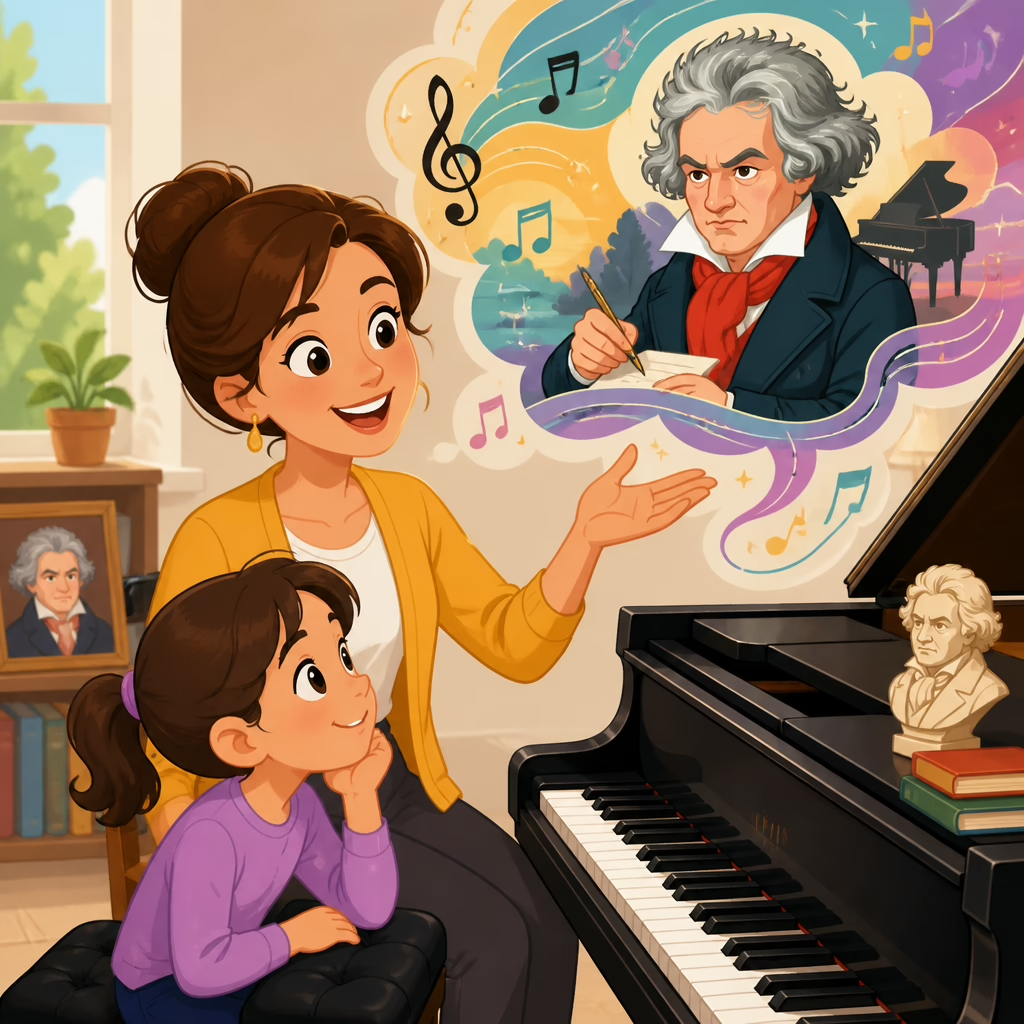
How Piano Teachers Can Introduce Beethoven Without Fear
Beethoven can intimidate piano teachers almost as much as students, yet he is one of the most teachable composers in the studio when introduced through carefully chosen repertoire, clear musical goals, and a tone of curiosity rather than reverence. “Introduce Beethoven without fear” means removing the myth that his music is only for advanced players, only for competition preparation, or only for solemn historical study. In practical teaching terms, it means presenting Ludwig van Beethoven as a composer whose rhythmic drive, motivic economy, humor, contrast, and emotional directness can be understood by children, teens, and adult beginners in age-appropriate ways. That matters because teachers shape first impressions. When a student’s earliest encounter with Beethoven is a tense warning about difficulty, the student learns avoidance. When the first encounter is a pattern, a character piece, a pulse game, or a short phrase that feels powerful under the fingers, the student learns ownership.
In my own teaching, the difference has rarely depended on the student’s raw level. It has depended on sequencing. If a teacher starts with a movement that demands mature voicing, large hand spans, and long-form concentration, Beethoven feels forbidding. If the teacher starts with a four-note motive, a strong tonic-dominant framework, or a miniature dance with obvious articulation, Beethoven becomes surprisingly accessible. Students respond well because his writing often makes structural sense quickly: repeated motives, question-and-answer phrasing, dynamic contrasts, and cadences that sound decisive. Those features give teachers many openings for explanation in plain language. They also help students hear form and style sooner than they might in more texture-heavy Romantic repertoire.
Fear around Beethoven usually comes from three sources: the cultural aura around “great masters,” the technical demands of famous sonatas, and uncertainty about stylistic teaching. All three are manageable. Beethoven’s historical importance is real, but it does not require treating every piece like a museum object. His technical writing can be demanding, but his output includes many pedagogically useful short works, dances, easy sonatinas, folk-song settings, and bagatelles. Stylistically, he sits at a fruitful point between Classical clarity and early Romantic intensity, which actually makes him easier to teach than many teachers assume. Students can feel pulse, hear sequence, notice sforzando accents, and experiment with transparent pedaling long before they are ready for “Pathétique” or “Moonlight.”
The goal is not to simplify Beethoven into bland biography or empty admiration. The goal is to give students a truthful first experience: he was rigorous, dramatic, witty, and human, and his music rewards attention at every level. Once teachers understand which musical elements to foreground and which pieces to delay, Beethoven stops being a cliff and becomes a staircase.
Start with Beethoven the storyteller, not Beethoven the monument
The safest way to introduce Beethoven is to teach him as a maker of musical decisions. Students do not need a grand lecture on genius before they play their first phrase. They need to know what to listen for. I usually begin with three concrete ideas: motive, contrast, and direction. A motive is a small musical idea that returns. Contrast is a noticeable change in loudness, register, articulation, or mood. Direction is where the line is going and how it arrives. Beethoven is ideal for this because he often builds large effects from very small cells. Even beginners can understand that a short pattern repeated with greater force creates excitement.
Biography should support musicianship, not replace it. The most useful facts are those that illuminate what students hear: he studied in Bonn and Vienna, worked during the transition from the Classical to the Romantic era, valued structure, pushed dynamic range, and continued composing while dealing with hearing loss. That final fact should be handled carefully. It is important, but it should not dominate every lesson. If overused, it turns Beethoven into a symbol of suffering rather than a living composer whose music students can analyze and perform. A better classroom question is, “What did he do in this measure to make it sound bold?” That shifts attention from legend to craft.
For teachers working in school or community settings, a helpful support resource is this broader planning guide on Beethoven lesson plans for elementary music classes. It complements one-to-one piano teaching by offering age-sensitive framing, listening ideas, and cross-curricular entry points without making the composer feel remote.
Language matters. Avoid saying, “This is very hard, but let’s try.” Students hear the warning first. Say instead, “This piece uses a strong repeated idea, so we can learn it by spotting the pattern.” That language is accurate and calming. It names a solvable task. Beethoven often rewards that approach because pattern recognition is central to successful practice. Teachers can model this process by circling repeated rhythms, marking phrase pairs, and asking students to identify where the music surprises them. Those small observations create confidence before technical demands escalate.
Choose first repertoire that teaches style without overload
Repertoire selection determines whether the introduction succeeds. For a first Beethoven experience, avoid pieces known mainly by reputation. Choose music that highlights one or two teachable style points at a time. In many studios, that means beginning with selected Ecossaises, German Dances, easy contredanses, simplified themes, short minuets commonly attributed in teaching collections, or carefully chosen bagatelles and sonatina movements. The exact edition matters. Reliable urtext publishers such as Henle, Bärenreiter, and Wiener Urtext help teachers avoid editorial excess, although younger students may still benefit from a pedagogical edition with thoughtful fingerings if the teacher explains which markings come from the editor.
A good first Beethoven piece usually has five qualities: clear phrase structure, manageable hand position shifts, limited pedaling, memorable rhythm, and obvious dynamic contrast. If the student can hear the form after one or two listens, teaching becomes easier. If the score demands continuous voicing in dense textures, it is probably not the right entry point. For elementary students, short dance pieces can work beautifully because they combine Classical symmetry with enough accent and character to feel exciting. For late beginners and adult returners, easy sonatina movements are effective because they introduce Alberti-type accompaniment, antecedent-consequent phrasing, and cadence recognition within a compact frame.
| Student profile | Strong first Beethoven option | Main teaching focus | Why it works |
|---|---|---|---|
| Elementary reader | Short dance or ecossaise | Two-bar patterns, articulation, basic dynamics | Clear pulse and repeated ideas reduce cognitive load |
| Intermediate adolescent | Easy sonatina movement | Phrase balance, cadence, left-hand support | Introduces Classical form without large technical barriers |
| Adult beginner or returner | Theme with simple variation texture | Structure, fingering logic, expressive contrast | Adults enjoy hearing architecture quickly |
| Early advanced student | Accessible bagatelle | Character, voicing, precise articulation | Small scale allows deep stylistic work |
Teachers should also think in terms of transfer. A first Beethoven piece should prepare the next one. If students learn detached versus legato touch in a dance, the next piece might add larger dynamic swells. If they learn cadence listening in a sonatina, the next piece might deepen formal awareness through exposition and recapitulation. This progression keeps Beethoven from feeling like a one-off historical unit and instead makes him part of a coherent technique-and-musicianship sequence.
Teach the signature sounds students can recognize immediately
Students relax when they can name what they are hearing. With Beethoven, several hallmarks are especially teachable. The first is motivic development: a tiny idea returns in altered form. The second is rhythmic insistence: repeated notes, repeated rhythms, and energetic pulse create momentum. The third is dynamic contrast: sudden piano and forte changes, accents, and sforzandi matter structurally, not just decoratively. The fourth is harmonic goal-setting: tension builds toward a cadence or a clear arrival point. The fifth is texture with purpose: accompaniment patterns support rhetoric rather than merely filling space.
In practical lessons, I often isolate one hallmark per week. For example, a student might tap the opening rhythm of a piece on the fallboard, then find every recurrence in the score. Another student might sing the right-hand line while the teacher plays the bass, listening for where the phrase truly ends instead of where the slur stops. When a score includes sf or fp markings, I ask, “What is Beethoven trying to underline?” This keeps notation tied to expressive meaning. Students begin to see that articulation and dynamics are not afterthoughts. They are part of the syntax.
Teachers should be explicit about pedaling. Many first Beethoven pieces need less pedal than students expect, especially if they have been playing Romantic teaching pieces with generous sustaining pedal. A clean pedal plan supports Classical clarity. Often that means no pedal at all in early repertoire, half-pedal only for color, or very brief pedal at cadences. Demonstrating both over-pedaled and clear versions is effective. Students hear immediately that too much pedal blurs accents, obscures harmonic rhythm, and weakens the music’s spine.
Tempo is another fear point. Teachers sometimes assign Beethoven too fast, believing brilliance is the point. It is not. In early stages, a slightly conservative tempo that preserves articulation, pulse, and phrase shape is far more stylistically honest than a rushed performance with dropped notes and flattened dynamics. Beethoven’s energy comes from rhythmic control, not panic. Students should feel that a steady beat gives them power.
Address technical and emotional challenges before they become barriers
Most student resistance appears in predictable places: fast repeated notes, broken-chord accompaniment with uneven balance, wide dynamic shifts, ornaments, and the mental pressure of playing “important” music. Each challenge has a practical solution. Repeated notes improve when students release from the key surface without tightening the forearm. Broken-chord accompaniment improves when the left hand is practiced in blocked shapes first, then redistributed back into pattern. Dynamic shifts improve when students rehearse silent preparation: set the hand, imagine the sound, then play. Ornaments improve when taught as rhythmic events, not decorations guessed by instinct.
The emotional barrier deserves equal attention. Students often assume Beethoven requires a grave, oversized seriousness. That assumption can make them play stiffly. Remind them that many Beethoven pieces contain wit, surprise, dance energy, or defiance rather than tragedy. If a sforzando feels like a joke, a stomp, or a sudden interruption, let students describe it in those words. Concrete imagery is not childish; it is interpretively useful. It helps students avoid generalized “expression” and choose specific character.
Performance preparation should also be scaled sensibly. Instead of assigning a full sonata movement immediately, use studio classes, informal run-throughs, or parent share days to normalize Beethoven in low-pressure settings. I have found that students gain confidence when they first present eight well-shaped measures and discuss one musical choice they made. That reframes performance as communication rather than judgment. Over time, their posture toward the repertoire changes. Beethoven becomes music they can explain, not a test they must survive.
Teachers should also acknowledge edition and instrument differences. A modern piano sustains more and projects more heavily than Beethoven’s fortepianos. That does not mean students must imitate a fortepiano badly, but it does mean they should use shorter releases, lighter bass, and more selective pedal to preserve transparency. This point is especially important on larger school grands, where young players can accidentally turn crisp textures muddy. Clear explanation here builds trust because students hear that stylistic choices are grounded in the instrument, not arbitrary rules.
Build a studio culture where Beethoven feels normal
Fear fades fastest when Beethoven appears regularly rather than ceremonially. A healthy studio culture includes short listening excerpts, theory links, historical context in moderation, and recurring language about motive and form. Teachers can program one Beethoven miniature each semester, pair him with Haydn or Clementi for Classical comparison, or connect his rhythmic drive to later composers students already enjoy. Community settings benefit from shared listening lists and collaborative events where students hear peers at different levels playing Beethoven successfully. That visible range matters. It shows that Beethoven belongs not only to the most advanced student in the room.
Parents also influence fear. If adults present Beethoven as elite music reserved for prodigies, students absorb that message quickly. A brief parent note can help: explain that the student is learning Beethoven to strengthen pattern recognition, articulation, dynamic control, and stylistic listening. Those are concrete educational reasons. They turn the assignment from status symbol to musical training. In group classes, I have seen especially strong results when students compare two recordings and discuss articulation choices. Even young learners can say which version sounds clearer, bolder, or more dance-like. That kind of guided listening develops independent judgment.
The lasting benefit of introducing Beethoven without fear is not simply that students can say they have played him. It is that they learn how to approach revered repertoire with method, curiosity, and confidence. They discover that difficult-looking music can be unpacked through patterns, sound goals, and historical awareness. They also learn that interpretation starts with evidence in the score. Those habits transfer well beyond Beethoven. If you teach him as a sequence of understandable musical problems instead of an intimidating icon, students usually respond with more engagement, better listening, and stronger practice. Start small, choose wisely, and let the music’s clarity do the convincing.
Frequently Asked Questions
Why do so many piano teachers feel intimidated by Beethoven, and how can they move past that fear?
Many piano teachers feel pressure around Beethoven because his name carries enormous cultural weight. He is often presented as a “great master” reserved for advanced students, major recitals, examinations, and highly serious study. That reputation can make teachers worry that they need to deliver a perfect historical, technical, and interpretive approach from the very beginning. In reality, that mindset can become the biggest obstacle. Beethoven is not only teachable, but often highly accessible when approached as a composer of patterns, gestures, character, humor, contrast, and clear musical intention.
The most effective way to move past the fear is to stop treating Beethoven as a monument and start treating him as a musician students can meet through sound. Teachers do not need to begin with grand narratives about genius, deafness, or masterpiece status. Instead, they can introduce short works, small forms, and manageable excerpts that reveal how Beethoven thinks musically. Students respond well when they can hear a bold opening idea, a surprising dynamic change, a repeated rhythmic motive, or a playful dialogue between hands. These are concrete features they can understand and perform.
It also helps to replace reverence with curiosity. Rather than asking, “How do I teach Beethoven correctly?” ask, “What is this piece asking the student to notice, shape, and communicate?” That shift immediately makes the work more practical. A teacher can focus on pulse, articulation, phrase direction, balance, voicing, and character. Those are familiar studio skills. Beethoven simply gives them a powerful context.
Finally, teachers should remember that introducing Beethoven does not mean assigning the most famous sonatas too early. It means creating a positive first encounter. When students experience Beethoven through repertoire they can genuinely manage, they learn that his music is vivid, logical, expressive, and rewarding. That is how fear dissolves for both teacher and student.
What kind of Beethoven repertoire works best for beginners and intermediate piano students?
The best Beethoven repertoire for developing students is repertoire that offers musical substance without overwhelming technical demands. Teachers do not need to begin with the “Moonlight” Sonata, “Pathétique,” or “Für Elise” simply because those are famous. In many cases, more successful first experiences come from shorter dances, easier sonatinas, selected bagatelles, and carefully chosen movements or excerpts that allow students to focus on style and structure without getting lost in difficulty.
For early intermediate students, simple German Dances, Ecossaises, and short pieces with clear phrasing and limited hand movement can be excellent choices. These works often introduce the student to Beethoven’s sense of rhythmic vitality and sharp character contrasts in a format that feels approachable. They are especially useful for teaching articulation, basic classical balance, and the relationship between melodic shape and accompaniment.
Intermediate students often do well with selected easier sonatinas or less demanding sonata movements, provided the teacher chooses carefully. The key is not whether a piece belongs to a prestigious genre, but whether it fits the student’s current reading level, hand coordination, technical comfort, and emotional maturity. A good first Beethoven piece should sound unmistakably Beethoven-like while still allowing the student to succeed artistically. If a student can feel the energy of the motives, hear the phrase structure, and manage the technical patterns with confidence, the repertoire choice is probably a strong one.
Teachers should also consider using excerpts strategically. A short opening theme, a manageable development passage, or a single contrasting section can serve as a style study even if the entire work is not yet suitable. This approach is especially helpful for introducing Beethoven’s motivic writing and dramatic contrasts in a focused, low-pressure way.
Most importantly, the first Beethoven pieces should build confidence rather than mythology. Students should come away feeling, “I understand how this music works,” not “This composer is beyond me.” Thoughtful repertoire selection makes that possible.
How can piano teachers introduce Beethoven’s style in a way that feels clear and engaging instead of overly solemn?
Beethoven’s style becomes much more engaging when teachers emphasize what students can hear and do immediately. Instead of framing him primarily as a historic icon, present him as a composer who loves strong ideas, conversation between voices, rhythmic insistence, dramatic surprises, and emotional contrast. Those features are vivid and easy to demonstrate at the piano. Students often respond quickly when a teacher says, “Listen to how this opening sounds like a bold announcement,” or, “Can you hear how Beethoven takes one tiny idea and keeps transforming it?”
One effective method is to teach Beethoven through gestures and character words. Ask students whether a phrase sounds confident, questioning, playful, stern, lyrical, or humorous. Beethoven is full of rhetorical energy, and that quality can make the music feel almost theatrical. When students understand that a sudden forte, a sforzando, or a silence is expressive communication rather than just a marking on the page, the music becomes more alive and less intimidating.
Teachers can also highlight Beethoven’s building blocks: short motives, repeated rhythms, sequences, dynamic contrasts, and harmonic direction. This is especially useful because Beethoven’s music often feels more manageable once students see that it grows from small, memorable ideas. Instead of reading it as a long stream of notes, they begin to recognize patterns and intentions. That clarity improves both comprehension and performance.
Another valuable strategy is comparison. A teacher might compare Beethoven’s phrasing and texture with a simpler Classical-era piece the student already knows. This helps students hear what is familiar and what is distinctive. They may notice that Beethoven can be more muscular, more abrupt, or more insistent than other composers, even within similar forms. That kind of listening builds stylistic awareness naturally.
Above all, avoid presenting Beethoven as music that must always sound heavy or noble. Some Beethoven is witty, charming, graceful, even mischievous. When teachers make room for that full expressive range, students encounter a real composer instead of a legend. That is often the moment Beethoven becomes inviting.
What technical and musical skills can students develop by studying Beethoven early in their piano education?
Studying Beethoven early can be extremely beneficial because his music strengthens core pianistic and musical skills in a direct, disciplined way. One of the biggest benefits is rhythmic clarity. Beethoven often depends on a steady pulse, precise subdivisions, and well-defined articulation. Even relatively simple pieces teach students to maintain forward motion without rushing and to give rhythmic motives consistency and purpose.
His music is also excellent for developing articulation control. Students learn to distinguish between slurs and non-slurs, detached and connected touches, accented and unaccented notes, and melodic lines versus accompaniment patterns. Beethoven rewards careful listening and physical control at the keyboard. If the student can produce clean articulations and shape phrases intentionally, the music begins to speak much more clearly.
Another major skill Beethoven develops is formal awareness. His phrases, transitions, cadences, and contrasts help students understand how music is organized. This is incredibly valuable pedagogically because students are not merely playing note by note; they are learning to hear structure. They begin to recognize opening statements, repetitions, developments, and arrivals. That structural listening improves memory, interpretation, and confidence.
Beethoven also trains dynamic range and tonal control. Students must often move quickly between different levels of sound or project a strong character without banging. They learn that a forte needs depth and focus, not harshness, and that softer passages still need direction and presence. This kind of dynamic discipline is useful across all repertoire.
In addition, Beethoven can introduce students to the idea of motivic thinking. Rather than treating each measure as separate, they learn to connect recurring ideas across a piece. That habit deepens musical understanding and encourages more mature interpretation. Even young students can begin to ask, “Where does this idea return?” or “How is this rhythm changing?” Those are sophisticated listening questions, but Beethoven often makes them accessible.
Perhaps most importantly, early Beethoven study can help students develop artistic confidence. They discover that they can handle music with real expressive and structural substance. That experience is motivating. It tells students that serious musical thinking is not something they must wait years to begin.
How can teachers keep Beethoven approachable for students who are nervous, resistant, or convinced his music is too difficult?
The first step is to control the emotional framing. If Beethoven is introduced as a test of seriousness or a major leap in status, many students will become tense before they play a single note. A more effective approach is to present him as a composer with strong musical personality and surprisingly playable pieces. Teachers can say, “Let’s explore a Beethoven piece that uses clear patterns and strong character,” instead of, “Now you are ready for Beethoven.” That subtle change removes unnecessary pressure.
Choosing the right entry point matters enormously. Students who are nervous need repertoire that lets them succeed quickly. A short piece with memorable motives, clear phrasing, and limited technical complexity is far better than a famous work they recognize but cannot yet manage well. Early success builds trust. Once students realize that Beethoven is understandable and enjoyable, they become more open to deeper study.
Teachers should also break the music into observable goals. Rather than discussing Beethoven in broad, intimidating terms, focus on practical tasks: finding the recurring rhythm, shaping a two-measure phrase, balancing melody