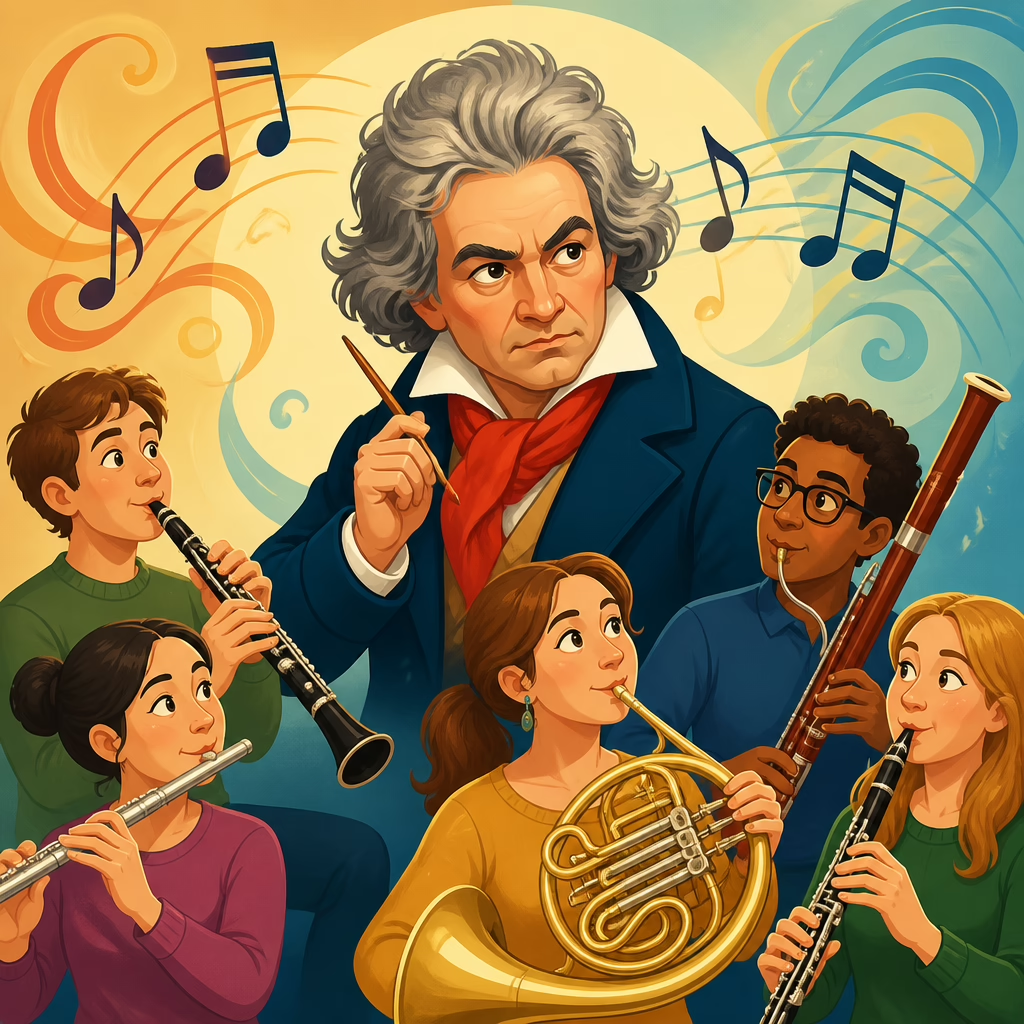
Beethoven for Wind Players: What to Listen for First
Beethoven can intimidate wind players at first because his reputation suggests granite seriousness, dense form, and string-driven writing, yet his music becomes far more approachable when you know exactly what to listen for. For flutists, oboists, clarinetists, bassoonists, horn players, and developing ensemble students, the best entry point is not abstract “genius” but identifiable musical events: the shape of a phrase, the placement of a wind color, the way a sforzando disrupts the line, or the moment a horn call changes the emotional temperature of an entire passage. In practical terms, listening with a wind player’s ear means tracking articulation, breathing logic, register shifts, orchestral balance, and the dialogue between winds and strings.
That focus matters in both community ensembles and music education. I have found that wind players often hear Beethoven more clearly once they stop asking whether a passage is “hard” and start asking what job the instrument is doing. Is the bassoon reinforcing harmony, adding wit, or sharpening a cadence? Is the clarinet smoothing a transition that would sound severe in strings alone? Is the flute brightening texture at the top of a crescendo? Beethoven wrote during a period when orchestral winds were gaining independence, and his scores document that change in real time. He inherited Classical-era conventions from Haydn and Mozart, but he pushed winds toward stronger thematic identity, more dramatic contrast, and more structural responsibility. Learning to hear those choices is the fastest way into his sound world.
Several key terms help. Timbre is the distinctive color of an instrument or section. Doubling means two instruments share the same line, often to strengthen tone or clarity. Voicing refers to how notes are distributed within a chord or texture, affecting balance and emphasis. Articulation includes slurs, staccatos, accents, and attacks. Cadence is the musical punctuation that confirms or delays closure. When wind players listen for these features, Beethoven’s music stops sounding like an unstoppable block and starts revealing decisions that are audible, teachable, and performable. The goal is not to hear everything at once. The goal is to identify the first landmarks that consistently tell you where the winds matter most.
Start with function, not just melody
The first thing wind players should listen for in Beethoven is function. A beautiful oboe line is memorable, but function explains why that line exists and why it sounds inevitable. In Beethoven, winds rarely serve only as decorative color. They clarify harmony, project rhythm, articulate transitions, and often deliver the phrase that turns a section from stable to urgent. When I coach community players through Beethoven excerpts, I ask them to mark whether each entrance is structural, supportive, or character-defining. Structural entrances announce form. Supportive entrances stabilize texture. Character-defining entrances change mood, often through color more than volume.
A clear example appears in the opening movement of Symphony No. 5. Many listeners fixate on the famous four-note motive, but wind players should notice how the winds participate in pacing and reinforcement rather than merely echoing the strings. Bassoons and clarinets help weight the harmonic floor, while winds entering in coordinated attacks sharpen the rhetorical force of the motive. The lesson is simple: Beethoven often gives winds the responsibility of making an idea sound public and unmistakable. Even when strings introduce material, winds can be the reason that material acquires breadth, authority, or menace.
The same listening strategy applies in slower movements. In Symphony No. 7, Allegretto, the winds do not simply float above an ostinato; they gradually widen the emotional field. The line may seem plain on paper, but the orchestration creates pressure through layering. Listen for when a wind entrance confirms a harmonic shift that the strings alone have prepared. That is Beethoven’s method repeatedly: tension builds in one family, and another family reveals its meaning. For educational settings, this is one reason his music works so well in sectional listening assignments. Students can learn that ensemble importance is not measured only by who has the tune.
Teachers working with younger players can connect this targeted listening to broader classroom study through resources such as this Beethoven lesson plans guide for elementary music classes, then narrow the focus to what winds actually do inside the orchestra.
Hear how Beethoven uses each wind color
Once function is clear, the next step is distinguishing Beethoven’s treatment of individual wind timbres. He did not write for “the winds” as a single blended block. He used each instrument’s natural strengths with striking precision. Flutes often add brilliance, lift cadences, or intensify upper-register expansion. Oboes can sound pastoral, penetrating, or ceremonial depending on register and articulation. Clarinets frequently provide warmth and connective tissue; in Beethoven they are especially effective in smoothing transitions between harder-edged sonorities. Bassoons may underpin harmony, shadow cello lines, or inject dry humor through pointed articulation. Horns bring breadth, hunt-call resonance, and harmonic definition, especially in exposed tonic-dominant writing.
The Pastoral Symphony is the easiest place to begin hearing this color logic. Beethoven’s scene painting is never crude imitation; instead, he suggests environment through orchestral behavior. Woodwinds contribute heavily to that effect because they can evoke distance, open air, and conversational exchange. In the “Scene by the Brook,” listen for how flute, oboe, and clarinet timbres remain distinct even when the texture feels serene and unified. The result is not a generic pretty sound. It is a carefully balanced ecology of colors. Students often recognize the bird calls at the movement’s end, but the better first lesson is hearing how Beethoven has already trained the ear to notice each instrument as a character before he makes the references explicit.
Symphony No. 6 also teaches an important caution: color in Beethoven is inseparable from rhythm and register. A horn line is not significant only because horns sound noble. It matters because its register, spacing, and rhythmic profile alter the surrounding texture. I have seen players miss this by listening for isolated “solos” instead of listening for what changes when a color enters. That difference is crucial. Beethoven’s orchestration works cumulatively. Color modifies harmony, pulse, and perceived physical space all at once.
| Instrument | What to listen for first | Representative Beethoven example |
|---|---|---|
| Flute | Brightness at cadences and upper-texture release | Symphony No. 6, “Scene by the Brook” |
| Oboe | Penetrating lyric line and rhetorical emphasis | Symphony No. 3, first movement oboe passages |
| Clarinet | Warmth, blend, and transition shaping | Symphony No. 4, slow movement |
| Bassoon | Harmonic grounding and articulate wit | Symphony No. 5, opening movement support lines |
| Horn | Harmonic pillars, calls, and expansion of space | Symphony No. 3, Scherzo horn writing |
Listen for articulation, accents, and breath logic
Wind players should next focus on articulation because Beethoven’s style depends on attack quality more than many first-time listeners realize. His accents are not interchangeable. A sforzando can sound like a blow, a flare, or a destabilizing interruption depending on context. Staccato may indicate buoyancy, irony, or compressed energy rather than lightness alone. Slurs often define motive shape and breathing hierarchy, not just smoothness. If you only hear pitches and volume, you will miss the argument inside the phrase.
For this reason, I recommend starting with Symphony No. 1 or No. 2 before tackling the late-period image of Beethoven as permanently massive. These earlier symphonies reveal how sharply he manipulates Classical articulation norms. Winds often make that manipulation audible because their attacks are inherently more individualized than a violin section’s blended onset. An oboe accent can cut through a texture and redefine the beat. A bassoon staccato can make a repeated pattern sound sly rather than dutiful. A clarinet slur can soften a harmonic edge enough to change how the phrase lands emotionally.
Breath logic is equally revealing. Beethoven often writes lines that feel vocal in contour yet instrumental in resistance. Wind players should ask: where does the phrase invite a natural breath, and where does Beethoven seem to push against that instinct? Those moments tell you a great deal about expressive intent. In the slow movement of Symphony No. 4, for instance, woodwind lines unfold with long arcs that reward disciplined air support and patient listening. Even if you are not performing the piece, hearing the implied breath plan helps you understand whether the music wants suspension, release, or contained intensity. This is one of the most practical listening skills a player can develop, because it turns passive hearing into embodied musical analysis.
Track dialogue between winds and strings
Another essential entry point is dialogue. Beethoven’s orchestral writing gains energy from exchange, not from isolated blocks taking turns. Winds answer strings, complete their thoughts, contradict them, or expose what the strings have been preparing. In rehearsal, I often tell players that Beethoven writes conversations with consequences. If one group states a figure and another group replies with altered rhythm, different articulation, or a changed register, the reply is not filler. It is the next sentence in the argument.
Symphony No. 3, the Eroica, is especially useful here. In the first movement, winds do not merely decorate heroic string material; they sharpen form and create scale. Oboe and horn contributions can widen the emotional horizon instantly, making a phrase sound less private and more civic. In the funeral march, woodwind color becomes indispensable to pacing grief. The effect comes not from sentimental melody alone but from the transfer of weight between sections. Strings can sustain mourning; winds can humanize it, comment on it, or make it feel newly exposed.
This listening habit also helps in chamber music. Beethoven’s wind writing in mixed ensembles demonstrates the same conversational discipline on a smaller canvas. In the Septet, Op. 20, for example, winds share thematic responsibility more visibly, making it easier for developing listeners to hear balance and role shifts. If a student struggles to detect orchestral texture, the Septet can function as a training ground. The principles are the same: listen for who initiates, who confirms, who colors, and who redirects the phrase.
Use a short listening path through key works
If you want a practical starting sequence, do not begin everywhere. Follow a short listening path that highlights wind roles in different settings. First, hear Symphony No. 6 for timbre and character. The bird calls are famous, but the real lesson is sustained color differentiation. Second, hear Symphony No. 5 for structural urgency and how winds reinforce motivic rhetoric. Third, hear Symphony No. 3 for scale, dialogue, and horn presence. Fourth, hear Symphony No. 4, especially the slow movement, for long-breathed woodwind phrasing. Fifth, hear the Septet for chamber-style clarity.
Use one reliable recording for each piece rather than skipping across many interpretations at first. Conductors such as Carlos Kleiber, Nikolaus Harnoncourt, John Eliot Gardiner, and Bernard Haitink offer instructive contrasts in articulation, tempo, and orchestral balance. Historically informed performances can make wind detail unusually vivid because leaner string vibrato and more pointed articulation leave additional space for woodwind and horn color. Modern symphony recordings may provide broader sonority, which can help listeners understand Beethoven’s large architecture. Both approaches are valuable. The important thing is to compare specific passages, not entire reputations.
As you listen, keep a pencil or notes app nearby and answer the same four questions every time: Which wind instrument stands out first? Is it carrying melody, harmony, rhythm, or color? What changes emotionally the moment it enters? Does the phrase feel more stable, more tense, or more spacious? Those questions are simple enough for students and serious enough for advanced players. They train attention toward audible evidence, which is exactly how better listening becomes better performing.
Beethoven becomes far easier for wind players once listening starts with purpose. Instead of hearing an overwhelming monument, you hear functions, colors, articulations, and conversations that are concrete and repeatable. Start by identifying what each wind entrance does. Then notice how timbre changes the meaning of harmony and rhythm. Listen closely to accents, slurs, and implied breath, because those details carry Beethoven’s rhetoric. Finally, follow the exchanges between winds and strings, where so much of the drama actually happens.
The benefit of this approach is immediate in community ensembles, private study, and classroom teaching. Players become more confident because they can connect what they hear to what they must perform. Students grasp that orchestral listening is not passive admiration but active recognition of role and structure. Teachers gain a focused way to introduce Beethoven without reducing him to biography or famous motifs. Most importantly, wind players begin to hear themselves inside the music’s architecture rather than at its edges.
Choose one work this week—Symphony No. 6 is the best first stop—listen for only the winds, and write down three moments where an entrance changes the entire character of the phrase. That single exercise will open Beethoven faster than any general overview.
Frequently Asked Questions
Why can Beethoven feel intimidating to wind players at first?
Beethoven can seem intimidating because his public reputation often arrives before the music itself. Many students first hear him described in terms like monumental, serious, structurally dense, and historically important, which can make the listening experience feel like a test instead of an invitation. For wind players especially, there is also a persistent assumption that Beethoven’s musical world belongs primarily to strings and that winds are secondary color rather than central expressive voices. That impression is misleading. While Beethoven absolutely builds large forms and powerful dramatic arcs, he also writes in a way that rewards very concrete listening. You do not need to begin with abstract ideas about greatness. You can begin with things you already understand as a player: phrase shape, breath timing, articulation contrast, register changes, harmonic arrivals, and moments when a wind entrance suddenly changes the emotional temperature of the music.
A good first step is to stop trying to hear everything at once. Instead, listen for one event at a time. Notice when a line feels singable, when a sforzando interrupts the flow, when a sustained wind tone stabilizes the ensemble, or when a woodwind color appears as commentary rather than accompaniment. Beethoven becomes much more approachable when you hear his music as a sequence of clear decisions instead of an intimidating wall of sound. In that sense, wind players are actually very well equipped to understand him. They are trained to hear entrances, blend, line, support, and timbral contrast. Those are exactly the tools that make Beethoven’s language easier to grasp from the first listen.
What should wind players listen for first in Beethoven’s music?
The best first listening target is the phrase. Before worrying about sonata form, motivic development, or historical significance, ask a simpler question: where is the line going? Beethoven’s phrases often feel purposeful even when they are compact. Listen for whether a line rises and presses forward, settles into cadence, gets interrupted, or repeats with more insistence the second time. Wind players understand phrasing physically through breath and direction, so this is an especially effective entry point. If you can hear where a phrase begins, where it intensifies, and where it releases, you are already hearing Beethoven in a meaningful way.
After phrase shape, listen for contrast. Beethoven loves to set up expectations and then disturb them. A sudden accent, a dynamic jolt, a surprising silence, or a sharply placed sforzando can completely change the character of a passage. For wind players, these disruptions are not decorative details; they are structural clues. They tell you where tension increases, where a musical sentence resists smooth continuation, and where the ensemble must react together. It is also helpful to listen for instrumental color as an event in itself. When an oboe, clarinet, bassoon, flute, or horn appears, ask what role it is playing in that moment. Is it doubling, answering, grounding, brightening, warning, or singing above the texture? That kind of active listening turns Beethoven from a remote historical figure into a composer whose gestures are immediate and audible.
Are the winds really important in Beethoven, or are they mostly supporting the strings?
The winds are absolutely important, and one of the most useful things a player can do is learn to hear them as structural participants rather than atmospheric decoration. Beethoven inherited Classical-era orchestral habits, so there are certainly passages where winds reinforce harmony, rhythm, or texture. But he also uses them to define character, clarify formal boundaries, intensify drama, and create contrast with exceptional precision. A single horn call, bassoon line, clarinet color, or oboe phrase can reshape how a section is perceived. Winds often function as commentators, stabilizers, provocateurs, or carriers of emotional shift. If you only listen for big string melody, you will miss much of the conversation.
For developing ensemble students, this is especially encouraging. Beethoven’s wind writing teaches how an individual line can matter even when it is not the loudest or longest idea in the room. Sometimes the winds introduce a new color that signals a change of space or mood. Sometimes they punctuate a phrase so that its architecture becomes unmistakable. Sometimes they sustain harmonic pressure underneath another section’s motion. In other places, winds emerge with a line that feels almost vocal, bringing immediacy and humanity into a broader texture. Listening this way helps players understand that importance in Beethoven is not measured only by how exposed a part is. Importance is often about timing, function, and effect. Winds are central to all three.
How can flutists, oboists, clarinetists, bassoonists, and horn players each connect with Beethoven differently?
Each wind player can use their own instrument’s strengths as a listening doorway into Beethoven. Flutists often connect first with clarity of contour, registral brightness, and the way a line can illuminate the texture without needing constant heaviness. Listening for moments when the flute either crowns a phrase or cuts through with clean direction can reveal how Beethoven shapes space and brilliance. Oboists may respond strongly to the vocal, speech-like quality of Beethoven’s writing. The oboe frequently brings definition to the top of a texture or introduces a phrase with a timbre that feels unmistakably human, almost like a speaking voice. That makes it a powerful instrument for tracking character and rhetorical emphasis.
Clarinetists can listen for warmth, flexibility, and interior lyricism. Beethoven often uses the clarinet in ways that bridge brightness and depth, which helps the player hear not only melody but also the blending function of wind color. Bassoonists are in an excellent position to hear foundation, motion, and wit. The bassoon can support harmony, reinforce rhythm, or quietly transform the energy of a passage through articulation and direction. Horn players, meanwhile, will hear Beethoven’s sense of space, nobility, and risk in especially vivid ways. Horn entrances often feel decisive, whether they are reinforcing harmony, projecting a call-like gesture, or adding breadth to a climactic moment. Across all of these instruments, the important thing is not to wait for a long concerto-style solo. Instead, listen for characteristic tasks: who launches the phrase, who stabilizes it, who colors it, who interrupts it, and who expands it. Beethoven becomes much more personal when you hear how your instrument’s family contributes to the dramatic argument.
What is the easiest way for a student ensemble player to start listening to Beethoven more effectively?
The easiest method is to listen with a narrow focus and a repeatable plan. On the first pass, choose just one thing: phrase shape, accents, wind entrances, dynamic contrast, or cadences. Do not try to decode the entire piece. For example, listen once only for moments when a wind instrument changes the color of the orchestra. On the next hearing, focus only on accents and sforzandos. Ask what they do to the line. Do they propel the phrase, fracture it, or make the music sound argumentative? On another hearing, track where the music breathes and where it refuses to breathe easily. That approach turns listening into musicianship rather than passive admiration, and it mirrors what ensemble players already do in rehearsal.
It also helps to think in terms of musical cause and effect. If the texture suddenly brightens, what caused it? If a phrase becomes tense, did that happen because of harmony, rhythm, articulation, or instrumental color? If a cadence feels especially satisfying, what prepared it? Beethoven is often easier to understand when you hear each event as part of a chain of consequences. Student players should also give themselves permission to notice concrete reactions: this entrance feels like a warning, this horn note opens the room, this bassoon line adds weight, this oboe phrase sounds like someone speaking clearly after confusion. Those impressions are not unsophisticated; they are often exactly right. Beethoven’s music is powerful because it is built from audible, physical, expressive decisions. Once wind players learn to track those decisions, the music stops feeling remote and starts feeling playable, understandable, and alive.