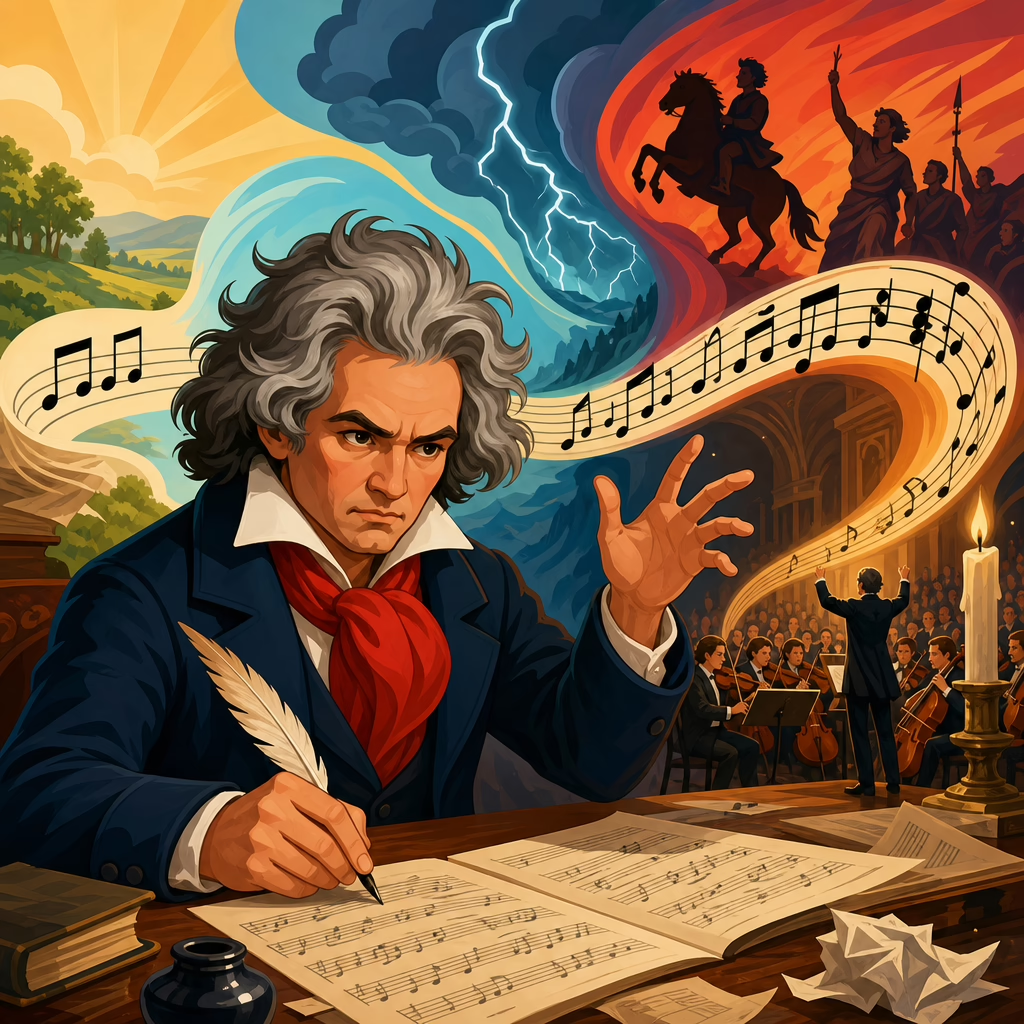
How Beethoven Turned Motive into Drama
Beethoven turned motive into drama by treating a tiny musical cell not as decoration but as the engine of conflict, momentum, and resolution. In classical theory, a motive is the smallest recognizable musical idea, often just a few notes with a distinct rhythm or interval pattern. Before Beethoven, composers certainly used motives with skill, yet they often served balance, symmetry, and graceful continuity. Beethoven kept those classical values when he wanted them, but he also made the motive behave like a dramatic character: it could insist, interrupt, fracture, expand, threaten, and finally triumph. That shift helps explain why his music feels urgent even when its materials seem almost absurdly small.
This matters because Beethoven’s most powerful movements do not depend on long melodies alone. They grip listeners through process. A short rhythmic figure, a repeated interval, or a compact turn can shape an entire movement’s emotional logic. I have found, both in score study and in rehearsal rooms, that performers understand Beethoven more quickly when they stop asking, “Where is the big tune?” and start asking, “What is this motive doing right now?” Once that question is on the table, the music’s drama becomes legible. The motive is no longer a fragment. It is the argument itself.
Beethoven’s innovation was not simply economy. Haydn could build marvels from concise ideas, and Mozart could animate a phrase with astonishing subtlety. Beethoven’s difference lies in pressure. He subjects motives to relentless development, extreme registral placement, harmonic destabilization, rhythmic displacement, and strategic silence. He also lets listeners recognize the same cell in changed conditions, which creates narrative memory inside instrumental music. A motive first heard as a declaration may return as a whisper, a threat, or a victory signal. That continuity gives abstract music a dramatic profile without requiring a storyline.
When people describe Beethoven as revolutionary, they sometimes point to size, volume, or heroic biography. Those elements can distract from the compositional mechanism that actually creates the effect. The deeper revolution is structural. Beethoven knew that if a motive is strong enough, every transition, cadence delay, sequence, and contrapuntal episode can feel necessary rather than ornamental. This article examines how he achieved that effect, focusing on the way motive becomes drama through definition, development, contrast, and large-scale form. The point is not that Beethoven invented motivic writing, but that he made it the central carrier of musical tension in a new and decisive way.
What Beethoven meant by a motive in practice
In Beethoven, a motive is usually memorable because of rhythm before pitch. The famous opening of the Fifth Symphony is the obvious example: three short notes and one long note. Its interval content matters, but its rhythmic profile is what brands itself into the ear. That distinction is crucial. Rhythmic identity allows Beethoven to move the figure through different harmonies, keys, textures, and instrumental colors while preserving recognizability. The motive survives transformation because its contour of energy remains intact.
He also preferred motives that could generate consequences. A useful Beethoven motive is not merely catchy; it is manipulable. It can be sequenced, compressed, inverted, fragmented, or layered against itself. In the “Appassionata” Sonata, Op. 57, the opening gesture contains enough instability to launch continuous unrest. In the first movement of the Eroica Symphony, the main thematic material includes cells that can be broken apart and hurled into development with unusual violence. Beethoven selected ideas that were compositionally fertile. Their dramatic power comes from what they can become.
That practical view changes how one hears thematic statements. A Beethoven theme often introduces less of a finished melody than a field of possibilities. The listener hears an initial proposition, but Beethoven hears a toolkit. This is why his openings can sound simultaneously clear and unsettled. They establish identity while inviting disruption. The drama begins at the moment of presentation because the motive already contains latent conflict.
From statement to conflict: how development creates drama
Beethoven’s central dramatic move is to turn repetition into confrontation. Repetition in his music is rarely passive. A motive returns under pressure: louder, in a more distant key, in stretto, over a dominant pedal, or with the expected continuation withheld. In practical terms, he creates tension by denying a motive comfortable completion. Instead of letting a phrase end neatly, he drives the cell into sequences, syncopations, abrupt dynamic shifts, and modulatory passages that keep the listener inside an unresolved process.
The first movement of the Fifth Symphony demonstrates this with exceptional clarity. The opening motive does not simply recur; it invades nearly everything. It appears in different instruments, fuels transitions, and shapes accompaniment figures. Because the motive is so concise, each recurrence feels both familiar and destabilizing. Beethoven intensifies the effect by controlling silence and cadence. The rests in the opening are not empty spaces. They are dramatic cuts, almost like inhalations before another blow. By the time the development section arrives, the motive has become less a theme than a force acting on the form.
This technique is equally vivid in the Piano Sonata in C minor, Op. 13, the “Pathétique.” The Grave introduction presents dotted-rhythm material with rhetorical weight, then the Allegro reworks conflict through restless motion and registral contrast. Beethoven does not separate “expressive introduction” from “working-out section” as neatly as many predecessors did. Instead, motivic identity crosses those boundaries, giving the movement a unified dramatic psychology. We hear not discrete episodes but one pressure-filled discourse.
For readers who want a broader view of Beethoven’s structural thinking in orchestral form, the main guide at https://lvbeethoven.com/how-beethoven-reinvented-the-symphony/ provides the larger context. Within the narrower question here, the key point is that motivic development is not an isolated craft detail. It is the means by which Beethoven makes form feel dramatic from the inside.
Transformation techniques Beethoven used repeatedly
Across the sonatas, quartets, and symphonies, Beethoven relied on a consistent set of methods to convert motive into unfolding action. These methods are easy to name but difficult to master because their effect depends on timing, proportion, and harmonic control. In Beethoven’s hands, they create drama by making the motive seem stable enough to recognize and unstable enough to keep changing.
| Technique | What Beethoven does | Dramatic effect | Example |
|---|---|---|---|
| Fragmentation | Breaks a theme into smaller cells | Creates urgency and obsession | Fifth Symphony, first movement development |
| Sequence | Repeats a cell at different pitch levels | Builds momentum and harmonic travel | Eroica Symphony, first movement transitions |
| Rhythmic displacement | Shifts accents or entry points | Destabilizes pulse and expectation | String Quartet Op. 59 No. 1 |
| Registral transfer | Moves a motive between low and high ranges | Changes character without losing identity | Piano Sonata Op. 57, first movement |
| Dynamic recontextualization | Recasts the same cell softly or explosively | Turns recognition into surprise | Fifth Symphony, opening recurrences |
What is striking is that these procedures are not decorative variations added after the fact. They are the plot. When Beethoven fragments a theme, he is not merely displaying craft; he is showing a musical idea under strain. When he sequences a motive through unstable harmony, he is not just filling space between landmarks; he is making the listener experience travel, uncertainty, and escalation. This is why Beethoven’s development sections often feel like the emotional core of a movement rather than a technical middle passage.
He also understood the dramatic value of limit. If everything is transformed constantly, nothing is legible. Beethoven therefore alternates transformation with blunt restatement. A motive may be violently worked over and then suddenly return in near-original profile, now carrying the memory of everything it has endured. That return is one of his strongest dramatic tools. It lets the listener hear identity surviving conflict.
Harmony, rhythm, and silence as motivic amplifiers
Motivic drama in Beethoven does not arise from pitch pattern alone. Harmony determines whether a motive sounds grounded, searching, defiant, or catastrophic. Place the same figure over tonic, and it can sound declarative. Put it over a diminished seventh or a prolonged dominant, and it becomes unstable. Beethoven exploits this constantly. In the Fifth Symphony, the famous motive gains much of its force because harmonic support and formal placement keep changing beneath it. The cell itself is concise; the surrounding context makes it dramatic.
Rhythm is even more decisive. Beethoven often compresses time by repeating a motive insistently, then releases pressure through extension or interruption. Syncopation, sforzando accents, and offbeat entries make small ideas feel physically urgent. In performance, this is where the music either lives or goes flat. If the motive is treated as a neutral pattern, the drama vanishes. If its accents, rests, and directional energy are projected clearly, the movement’s architecture becomes audible.
Silence is part of the same system. Beethoven’s rests are charged events. In the opening of the Fifth, in the “Pathétique,” and throughout many late works, silence functions like a rhetorical interruption or a cliff edge. It frames the motive, sharpens its profile, and creates expectancy. I have watched audiences lean forward at those moments because the stop itself becomes dramatic action. Beethoven knew that a motive can strike harder when air surrounds it.
Why Beethoven’s motives feel like characters
Listeners often describe Beethoven’s music in narrative terms even when they cannot explain the technical basis for that response. One reason is that his motives undergo experiences analogous to character development. They appear in identifiable form, encounter resistance, split into competing versions, reassemble, and return altered by context. None of this requires a literal program. The sense of drama emerges from memory and transformation inside the listener’s ear.
The Eroica Symphony offers a strong example. Its first movement presents material whose motivic components can support grandeur, instability, lyric expansion, and contrapuntal struggle. The development famously pushes that material through disorientation, including remote harmonic motion and massive accumulation. When familiar cells reappear, they do not feel merely repeated. They feel tested. Beethoven creates an impression of agency because the motive seems to persist through adversity.
This quality becomes even subtler in later works. In the String Quartet in C-sharp minor, Op. 131, motivic links across movements create continuity that feels psychological rather than mechanical. The listener senses that ideas belong to one expressive world. Beethoven’s mature style shows that motivic drama is not limited to explosive conflict. It can also operate through recollection, ambiguity, and transformation across larger spans of time.
What performers and listeners should listen for
To hear Beethoven’s motivic drama clearly, start by identifying the smallest recurring cell in a movement, especially its rhythm. Then track where it returns unchanged, where it is fragmented, and where it is absorbed into accompaniment or transition. Ask what harmony supports it each time and whether its dynamic level, register, articulation, or instrumentation changes its character. These questions reveal structure faster than searching for isolated melodies.
Performers should shape motives as carriers of intent, not just notes to be executed accurately. A four-note figure may need attack in one bar, suspense in the next, and grim restraint later on. The score usually provides the clues: accents, slurs, sf markings, rests, registral extremes, and harmonic placement. Conductors and chamber musicians who unify those details often make Beethoven sound inevitable. Those who smooth them out can make even great works seem merely busy.
For listeners, the reward is that Beethoven becomes more intelligible and more human at once. His drama is not mysterious if one follows the motive. Tiny ideas create large consequences. That is the compositional truth behind the emotional force.
Beethoven’s lasting innovation was to make motive the primary medium of instrumental drama. He did not abandon melody, form, or harmonic architecture; he fused them around compact cells capable of growth and confrontation. A motive in his hands could announce identity, generate instability, survive transformation, and bind an entire movement into a coherent expressive arc. That is why a few notes in Beethoven can feel more consequential than a long tune in lesser music.
The practical lesson is simple. If you want to understand why Beethoven sounds driven, listen beneath the surface for the recurring cell and follow its fate. Notice how rhythm brands it, how harmony pressures it, how silence frames it, and how development turns it from statement into action. Once you hear that process, Beethoven’s drama stops seeming abstract. It becomes audible as craft made urgent.
Return to the scores or recordings you know best, especially the Fifth Symphony, the “Pathétique,” the “Appassionata,” and the Eroica, and listen for what the motive is doing rather than merely where it appears. That single shift in attention reveals how Beethoven transformed the smallest unit of musical thought into one of the most compelling dramatic engines in Western art.
Frequently Asked Questions
What does it mean to say Beethoven turned motive into drama?
When writers say Beethoven turned motive into drama, they mean he treated a very small musical idea as the main source of tension, movement, and emotional argument in a piece. A motive is usually just a few notes marked by a recognizable rhythm, contour, or interval pattern. Earlier classical composers used motives brilliantly, but they often placed them within a larger framework built around elegance, proportion, and symmetry. Beethoven did not abandon those values, but he pushed the motive into a more active role. Instead of simply introducing a figure and repeating it attractively, he made it behave like a dramatic character that could insist, interrupt, fragment, return in altered form, and reshape the entire course of a movement.
That is why even a tiny cell in Beethoven can feel charged with purpose. He might sequence it through different keys, force it into new harmonic situations, compress it rhythmically, or set it against silence so that it strikes with greater force. The result is that listeners do not hear a motive as surface decoration. They hear it as the engine of conflict and resolution. It creates expectation, drives momentum, and helps organize the emotional logic of the music. In Beethoven’s hands, a few notes can seem to argue, struggle, resist, and finally resolve, which is what gives the music its distinctly dramatic power.
How is Beethoven’s use of motive different from what came before him?
Beethoven inherited a mature classical language from Haydn and Mozart, both of whom were already extraordinary motivic composers. They knew how to build coherence from compact ideas, how to create balance through repetition and variation, and how to make themes feel unified across a movement. Beethoven learned deeply from that tradition. The difference is not that earlier composers lacked motivic craft, but that Beethoven often intensified the role of the motive until it became the central dramatic principle of the piece.
In much eighteenth-century music, motives frequently contribute to elegance, continuity, and formal clarity. They help phrases connect, themes relate, and structures feel balanced. Beethoven certainly could write that way too, but he was more likely to put pressure on the motive. He would isolate it, hammer it, interrupt it, break it into fragments, and let it dominate transitions and developments. Rather than presenting a fully rounded melody and then accompanying it with motivic detail, he could derive large spans of music from a single cell. This creates a feeling that the entire movement grows out of one concentrated source.
That growth process is crucial. Beethoven often makes listeners aware not just of a theme itself, but of how it is being worked on in real time. We hear the motive being tested under stress, transformed by harmony, and reshaped by formal demands. This creates a more audible sense of struggle and becoming. The motive is no longer only a device of unity; it becomes a dramatic force that can make the music sound urgent, purposeful, and psychologically alive.
Why are small motives so powerful in Beethoven’s music?
Small motives are powerful because they are easy to recognize and flexible enough to transform. A short rhythmic pattern or intervallic cell can be repeated often without losing its identity, yet it can also be moved to new pitch levels, altered harmonically, compressed, expanded, inverted, or redistributed among instruments. Beethoven understood that this combination of recognizability and adaptability gives a tiny figure enormous dramatic potential. The listener remembers it quickly, so every return feels meaningful. At the same time, each transformation can suggest a new stage in the musical argument.
Another reason small motives are powerful is that they sharpen musical focus. When Beethoven builds a movement from a compact idea, the music can feel unusually concentrated. Nothing seems casual. Every repetition matters, every change has consequences, and every appearance of the motive contributes to a larger trajectory. This concentration can produce intensity even when the material itself is simple. A motive does not need to be long or ornate to be expressive; in Beethoven, simplicity often increases force because the listener can track its evolution so clearly.
There is also a rhetorical dimension. A small motive can sound like a knock, a call, a question, a challenge, or an insistence. Because it is concise, it can strike the ear with unusual directness. Beethoven often exploits that quality, using rhythm and repetition to create an almost physical sense of propulsion. The motive becomes memorable not only as a melodic unit but as an action. That is one reason his music can feel dramatic at the most basic level: the smallest idea already carries energy, direction, and the possibility of conflict.
Can you hear motivic drama in famous Beethoven works even without reading music?
Yes, absolutely. One of the remarkable things about Beethoven’s motivic writing is that it often communicates very clearly to listeners who do not analyze scores. The most famous example is the opening of the Fifth Symphony, where a tiny rhythmic cell becomes the basis for enormous stretches of the movement. Even if a listener cannot name the intervals or describe the formal plan, they can hear the insistence of the pattern, its repeated returns, and the way it seems to push the music forward. That is motivic drama in action: a small figure feels unavoidable, almost fateful, because it shapes everything around it.
You can also hear this process in piano sonatas, string quartets, and overtures. Listen for short ideas that keep coming back in different forms rather than long melodies that simply recur unchanged. Notice whether a figure appears in multiple voices, in different keys, at varying dynamic levels, or with altered rhythms. Beethoven often makes the motive travel through the ensemble and through the structure itself, so the listener senses continuity even when the surface changes dramatically. That continuity is not static repetition; it is developmental repetition, where each return adds pressure or opens a new possibility.
A helpful listening strategy is to focus on rhythm first. Beethoven’s motives are often memorable because of their rhythmic identity as much as their pitch pattern. If a rhythm keeps reappearing, ask what role it is playing. Is it intensifying the passage? Interrupting a lyrical line? Driving a transition? Returning at a climactic moment? Once you begin listening this way, it becomes easier to hear how Beethoven turns a tiny musical idea into a dramatic thread that binds the whole work together.
How did Beethoven’s motivic approach influence later composers and musical thought?
Beethoven’s treatment of motive had a lasting effect because it offered a powerful model of how large-scale form could emerge from small-scale material. Later composers saw that a movement did not have to rely mainly on contrast between long, self-contained themes. It could instead derive much of its unity, momentum, and expressive force from the continuous transformation of a compact idea. This insight became central to nineteenth-century musical thinking and helped shape how composers approached sonata form, thematic development, and organic unity.
Composers after Beethoven absorbed this lesson in different ways. Some extended his developmental intensity, building whole movements from a few germinal cells. Others took inspiration from his ability to make recurrence feel dramatic rather than merely repetitive. His example also influenced music theory, especially the idea that coherence in a work can come from the unfolding and transformation of basic motivic material. Analysts, performers, and listeners alike learned to pay close attention to how small figures generate large structures.
Just as importantly, Beethoven changed expectations about expression. He showed that deep drama does not require constant novelty or decorative abundance. It can arise from relentless focus on a single idea that is made to evolve under pressure. That concept resonates far beyond his own era. Whether in romantic symphonies, chamber music, or even later modernist approaches to thematic economy, the Beethovenian lesson remains clear: a motive is not merely a fragment of melody, but a seed from which an entire emotional and structural world can grow.