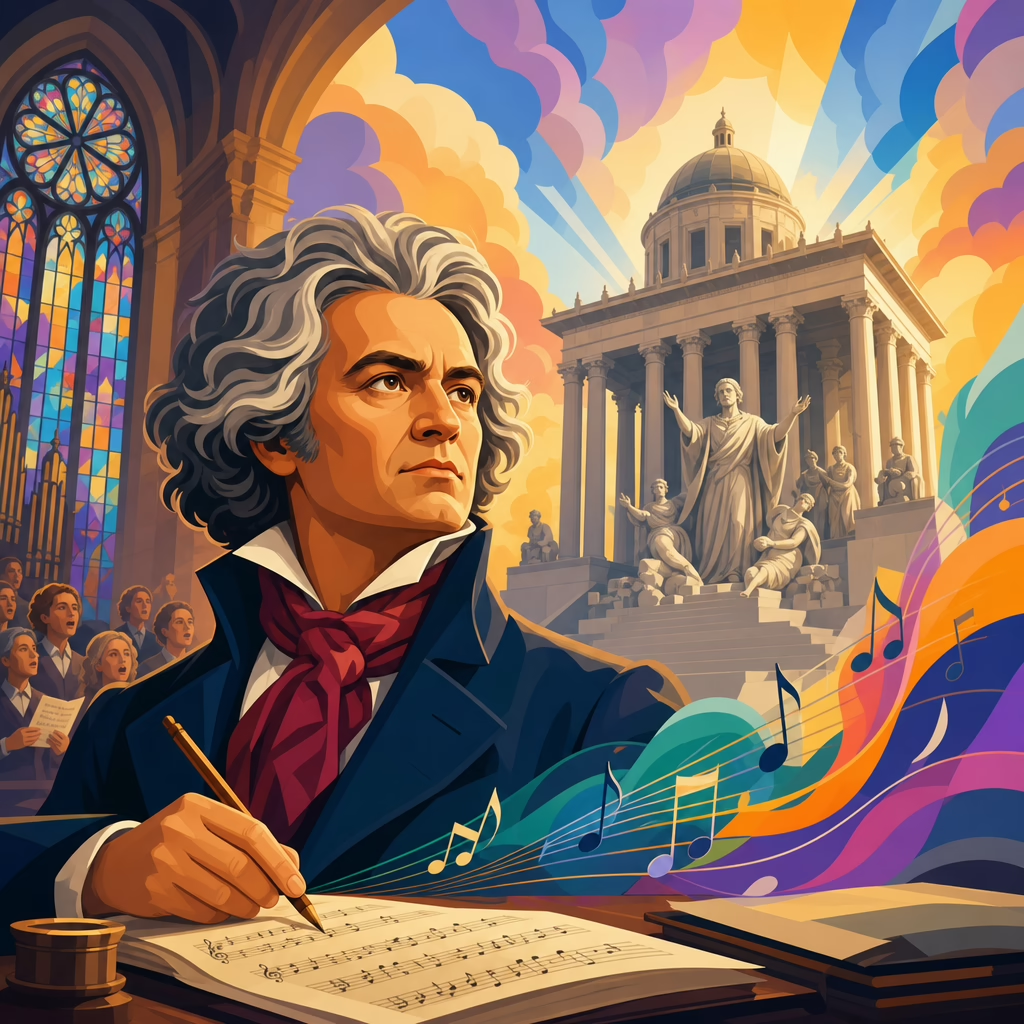
Beethoven and the Reinvention of Sacred Monumentality
Beethoven and the reinvention of sacred monumentality begins with a paradox: the composer most associated with heroic struggle and symphonic disruption also transformed the sound, scale, and spiritual ambition of sacred music. Sacred monumentality, in this context, means more than large forces or ceremonial grandeur. It refers to music that creates an overwhelming sense of public significance while still addressing inward belief, doubt, awe, and moral aspiration. Before Beethoven, sacred masterworks by composers such as Handel, Haydn, and Mozart already united liturgical function with expressive splendor. Yet Beethoven altered the terms of that union. He treated the Mass and the sacred oratorio-like tradition not as inherited containers for piety, but as sites where humanity, transcendence, history, and artistic architecture could meet on unprecedented terms.
This matters because Beethoven’s sacred writing stands at the center of a larger nineteenth-century shift in how monumental art was conceived. In earlier church music, grandeur often served ritual, court ceremony, or devotional clarity. Beethoven expanded grandeur into a total expressive design. He made sacred music symphonic in argument, dramatic in tension, and philosophical in scope, without reducing it to opera or abstract instrumental display. I have found that listeners who know the Eroica, the Fifth, or the Ninth are often startled to hear how directly the same constructive energy enters the Mass in C major, the oratorio Christus am Ölberge, and above all the Missa solemnis. The surprise comes from recognizing that Beethoven’s sacred style is not a side path. It is one of the clearest places where his ambition to remake musical scale became spiritually charged.
Understanding Beethoven’s contribution requires defining three linked ideas. First, monumentality in music is not just length or volume; it is the shaping of time so that each section feels necessary within a larger moral and emotional arc. Second, sacred expression in Beethoven is not merely confessional. It includes reverence, terror, supplication, thanksgiving, and the search for inward peace. Third, reinvention implies continuity as well as departure. Beethoven did not abandon liturgical texts, counterpoint, or older church styles. He absorbed them, then recast them through expanded form, intensified motivic development, sharper orchestral rhetoric, and a new seriousness about what public sacred music could mean in the modern age.
From Classical liturgy to a new sacred scale
To see what Beethoven changed, it helps to start with the late eighteenth-century Mass tradition he inherited. Haydn’s late masses, including the Nelson Mass and Harmoniemesse, already used brilliant orchestration, festive choral writing, and strong symphonic integration. Mozart’s C minor Mass and Requiem pushed sacred drama further, fusing contrapuntal inheritance with operatic immediacy. Beethoven learned from both composers. He understood how a Kyrie could balance humility with ceremonial presence, how a Gloria could unfold through contrasted subsections, and how fugal writing could confer both discipline and magnificence. But he was less willing than his predecessors to keep sacred decorum within accepted proportions.
The Mass in C major, Op. 86, written in 1807 for Prince Nikolaus Esterházy, shows the first major stage of that departure. Contemporary reactions were mixed, partly because Beethoven did not deliver the expected Haydnesque brilliance. Instead he wrote a Mass whose emotional profile is searching, abrupt, and at times unsettlingly personal. The Kyrie does not simply bow before divine order; it pleads. The Credo is not smooth declaration but active profession. Even where the work remains relatively compact by Beethovenian standards, he treats liturgical text as a field of psychological and structural contrasts. I hear in this piece the beginning of his refusal to separate devotional music from existential seriousness.
That shift parallels what Beethoven was doing in instrumental genres. His middle-period works enlarge form by making conflict and resolution more consequential. Readers interested in that broader transformation can trace it in the symphonic sphere through the main guide at how Beethoven reinvented the symphony. In the sacred domain, however, the enlargement has a special consequence: it turns liturgical words into the basis for a vast communal meditation. Instead of illustrating text politely, Beethoven asks how music can embody belief under pressure. That question becomes decisive in the Missa solemnis, where inherited ritual language is made to bear modern emotional and architectural weight.
The Missa solemnis as Beethoven’s central act of reinvention
Composed mainly between 1819 and 1823 and associated with the installation of Archduke Rudolph as Archbishop of Olomouc, the Missa solemnis in D major, Op. 123, is Beethoven’s supreme sacred statement. He famously inscribed the score with the aspiration “From the heart—may it return to the heart,” a remark that captures both intimacy and public address. Although tied to a ceremonial occasion, the work outgrew practical liturgical function. Its duration, interpretive difficulty, orchestral demands, and conceptual reach place it closer to a sacred monument for contemplation and performance than to ordinary service music. This is precisely where Beethoven reinvented sacred monumentality: he created a Mass that remains rooted in canonical text while exceeding conventional ecclesiastical use.
Every movement contributes to that reinvention. The Kyrie opens not with decorative piety but with grave invocation. Beethoven uses spacious pacing, weighty harmonic motion, and vocal writing that combines vulnerability with structural control. The Gloria then erupts as a world of praise in motion, but its excitement is never merely festive. The movement continually escalates, fragments, regroups, and culminates in a vast fugue on “In gloria Dei Patris, Amen,” where learned counterpoint becomes a vehicle for overwhelming affirmation. The Credo is even more radical. Beethoven treats belief as proclamation tested through repetition, contrast, and cumulative design. When “Et incarnatus est” arrives, the texture changes with a sense of suspension; when “Et resurrexit” breaks forth, it does so with kinetic certainty rather than decorative uplift.
The Sanctus and Benedictus reveal another dimension of monumentality: transcendence achieved through concentration. The orchestral prelude to the Benedictus creates a rarefied atmosphere, and the extended violin solo has often been understood as an emblem of descent from above. Whether one accepts that image literally or not, the musical effect is unmistakable. Beethoven suspends earthly weight without abandoning formal purpose. The Agnus Dei then introduces one of the work’s boldest ideas: peace is not passively granted. The plea for mercy and peace is interrupted by militaristic sounds, rhythmic alarms, and conflict-laden orchestral gestures. In my experience working through the score, this passage changes the meaning of the whole Mass. It makes sacred music answer history. “Dona nobis pacem” becomes urgent because peace exists under threat.
| Movement | Traditional liturgical role | Beethoven’s monumental expansion |
|---|---|---|
| Kyrie | Prayer for mercy | Transforms supplication into a large dramatic invocation with symphonic weight |
| Gloria | Hymn of praise | Builds praise through cumulative architecture, stark contrasts, and a vast concluding fugue |
| Credo | Statement of belief | Treats doctrine as active proclamation shaped by repetition, propulsion, and dramatic pivots |
| Sanctus/Benedictus | Sanctification and blessing | Creates suspended transcendence through orchestral space and the celebrated violin solo |
| Agnus Dei | Plea for mercy and peace | Links peace to worldly danger through martial disruption and unresolved tension |
How Beethoven fused counterpoint, drama, and symphonic architecture
Beethoven’s sacred monumentality depends on technique as much as aspiration. One reason the Missa solemnis sounds unprecedented is that Beethoven integrates old and new methods without compromise. He uses stile antico associations, especially in fugues and imitative textures, to invoke authority and continuity. At the same time, he subjects these materials to the pressure of motivic development and long-range tonal planning learned from instrumental composition. This fusion matters because it prevents the work from splitting into archaic reverence on one side and modern subjectivity on the other. Instead, both become parts of one architectural language.
His counterpoint is often discussed as a scholarly achievement, and it is that. Beethoven studied Bach and Handel intensely, especially in his later years, and the Missa solemnis shows how seriously he treated fugal design. But the counterpoint is never academic display. In the Gloria and Credo fugues, entries accumulate like public testimony. Dissonance, stretto, registral expansion, and orchestral reinforcement create a physical sense of massed conviction. That is monumentality at the level of texture: many independent lines combine into collective force. At the same time, Beethoven’s harmonic strategy remains exploratory. He uses remote turns, delayed cadences, and destabilized transitions to keep sacred certainty dynamically alive rather than rhetorically fixed.
Orchestration also plays a central role. Unlike many earlier masses in which instruments largely support or crown the chorus, Beethoven often makes the orchestra an equal participant in meaning. Timpani, trumpets, and winds can intensify ceremonial brilliance, but they also introduce anxiety, propulsion, and symbolic contrast. In the Agnus Dei, military coloration is not incidental. It is semantically charged. Beethoven effectively imports public danger into liturgical space, suggesting that prayer for peace must confront the realities of war and political disorder that defined post-Napoleonic Europe. This is one reason the work feels modern. It acknowledges that sacred utterance occurs inside history, not outside it.
Interior devotion and public grandeur in tension
A defining innovation in Beethoven’s sacred style is the refusal to choose between private spirituality and public monument. Earlier sacred music could combine both, of course, but Beethoven heightens the tension until it becomes structurally generative. The Missa solemnis is full of colossal choruses, ceremonial trumpet writing, and grand fugues, yet some of its most affecting moments are quiet, exposed, and intimate. This contrast is not decorative. It enacts a theological and human truth: faith is professed by communities but experienced by persons.
The Benedictus is the clearest example. After the Sanctus projects awe, the violin solo enters with an almost unearthly poise. Conductors and scholars have long debated tempos, articulation, and balance here, but the underlying effect is stable across interpretations: Beethoven carves out a zone of inward listening inside a monumental structure. Likewise, in the Kyrie, solo voices and chorus interact in ways that suggest individual and collective prayer rather than simple alternation. Even the forceful Credo gains power because its repeated “Credo” figures sound like conviction renewed, not merely announced once. Beethoven repeatedly turns ritual formula into lived utterance.
This tension also explains why some early listeners found the work difficult. It did not provide easy devotional accessibility, nor did it flatter ceremonial expectations. Beethoven asks performers and listeners to inhabit extremes of scale, energy, and concentration. The challenge remains real today. Major ensembles such as the Vienna Philharmonic, the Berlin Philharmonic, and historically informed groups using research into period instruments and performance practice all approach the piece differently, yet all confront the same fact: its monumentality is inseparable from its inward demands. A successful performance cannot rely on volume and grandeur alone. It must sustain line, text, and spiritual pressure across the entire design.
Legacy: why Beethoven’s sacred monumentality changed later music
Beethoven’s reinvention had lasting consequences for nineteenth-century sacred composition. Composers after him could no longer treat the large-scale Mass merely as functional liturgical music adorned by concert techniques. The genre had become a site for world-sized statement. Berlioz responded with masses and requiem settings of unprecedented scale, including the Grande messe des morts, where ceremonial sound became architectural spectacle. Liszt’s sacred works pursue a similarly heightened seriousness, though in a different harmonic language. Bruckner, perhaps the most direct heir in the Mass tradition, absorbed Beethoven’s combination of contrapuntal gravity, orchestral mass, and spiritual intensity. Even Verdi’s Requiem, though theatrical in ways Beethoven would not have embraced, reflects the now unavoidable expectation that sacred text can sustain symphonic and dramatic totality.
The influence extends beyond direct imitation. Beethoven altered audience expectations about what sacred music could ask of public culture. A Mass could now be heard in the concert hall as a major artistic event without losing its relation to worship text. That shift helped define the nineteenth-century choral festival tradition, the prestige of large amateur choral societies, and the programming of sacred masterworks as central repertory. It also shaped critical language. Writers increasingly evaluated sacred works not only by decorum or doctrinal appropriateness but by architectural coherence, expressive truth, and philosophical depth. Those criteria remain active in how the Missa solemnis is discussed today.
Beethoven reinvented sacred monumentality by proving that liturgical form could sustain the full force of modern musical thought. He did not abandon tradition; he intensified it until it spoke with new urgency. In the Mass in C major he began loosening inherited expectations. In the Missa solemnis he created a sacred work whose scale, counterpoint, orchestral rhetoric, and emotional range transformed the Mass into a monumental encounter between inner belief and public history. That achievement still matters because it shows how sacred art can be both reverent and restless, disciplined and visionary. If you want to understand Beethoven’s deepest innovations, listen closely to the Missa solemnis and follow the score movement by movement. Few works reveal more clearly how he turned inherited forms into instruments of spiritual magnitude.
Frequently Asked Questions
What does “sacred monumentality” mean in relation to Beethoven?
In Beethoven’s case, “sacred monumentality” refers to a new way of making sacred music feel immense in meaning without reducing it to mere spectacle. It is not simply a matter of writing for bigger choirs, louder orchestras, or more ceremonial occasions. Rather, it describes Beethoven’s ability to create music that feels publicly significant, morally weighty, and spiritually searching all at once. His sacred works do not only decorate worship or provide devotional atmosphere; they confront listeners with questions of human dignity, transcendence, suffering, hope, and collective aspiration.
This is one of the central paradoxes of Beethoven’s output. He is often remembered as the composer of symphonic struggle, revolutionary energy, and heroic individuality, yet those same qualities become crucial in his sacred music. Instead of treating the sacred as remote, fixed, and purely liturgical, he animates it with dramatic tension and inner conflict. The result is music that sounds as though it belongs both to the church and to humanity at large. It addresses God, but it also addresses the conscience of the listener.
That is why the term “monumentality” is especially useful. Beethoven’s sacred writing often gives the impression of architectural scale, like a vast structure built from sound, but within that large frame he preserves intimacy and vulnerability. The listener senses not only grandeur but also uncertainty, pleading, reverence, and moral seriousness. Sacred monumentality, then, is the fusion of collective grandeur with inward spiritual experience, and Beethoven helped redefine that balance in a way that deeply influenced the nineteenth century.
How did Beethoven change the tradition of sacred music that came before him?
Before Beethoven, many traditions of sacred music were shaped by clear liturgical functions, stylistic decorum, and inherited models of church composition. Even in impressive masses and oratorios of the eighteenth century, there was often an understood balance between beauty, devotion, and ritual suitability. Beethoven did not discard those traditions, but he stretched them dramatically. He brought into sacred music the same enlarged sense of form, emotional intensity, and structural ambition that had already transformed his symphonies, sonatas, and chamber works.
One of his major innovations was to treat sacred text not as a stable framework to be respectfully set, but as material for deep interpretive engagement. He could linger on a phrase, intensify its emotional force, or shape entire sections around its spiritual implications. This gave sacred music a new dramatic and philosophical dimension. Instead of merely supporting liturgical action, the music itself became a site of reflection, struggle, and revelation.
He also expanded the expressive range of sacred composition. In Beethoven, prayer can sound urgent, joy can feel hard-won, and faith can emerge through tension rather than simple affirmation. This marks a significant shift from a more convention-bound sacred style toward one in which subjective experience matters profoundly. At the same time, Beethoven never turns sacred music into private confession alone. He preserves a sense of the public and universal, making his sacred works feel like statements about humanity as much as about doctrine.
In practical musical terms, he altered expectations of scale, duration, harmonic force, and formal complexity. His sacred works ask more of performers and listeners alike. They demand concentration, intellectual engagement, and emotional openness. That is one reason they were so consequential: they suggested that sacred music could be monumental not just because of tradition or institution, but because of the depth of spiritual and artistic thought embedded within it.
Why is the Missa Solemnis so important to Beethoven’s reinvention of sacred monumentality?
The Missa Solemnis stands at the center of any discussion of Beethoven and sacred monumentality because it is one of the most ambitious sacred compositions in Western music. Beethoven himself regarded it as among his greatest achievements, and it represents his mature attempt to unite liturgical form, personal spirituality, intellectual rigor, and overwhelming sonic scale. Rather than composing a mass that simply fulfills ceremonial expectations, he created a work that probes the meaning of the text with extraordinary seriousness.
Each section of the mass becomes a vast expressive world. The Kyrie is not just a formal opening plea for mercy; it unfolds as an act of reverent searching. The Gloria radiates exaltation, yet its brilliance is shaped by intensity rather than ease. The Credo turns the declaration of belief into something almost existential, as though faith must be affirmed through effort and conviction. In the Sanctus and Benedictus, Beethoven reaches toward a level of transcendence that feels suspended between ritual and visionary experience. Even the Agnus Dei does not conclude in uncomplicated peace, because the work acknowledges the fragility of peace in human history.
What makes the Missa Solemnis monumental is not only its length or difficulty, though both are considerable. Its true monumentality lies in its moral and spiritual ambition. Beethoven writes as if sacred music must carry the full burden of human longing, fear, reverence, and ethical hope. He elevates the mass from a genre associated with worship and occasion into a profound artistic meditation on belief itself.
This work also demonstrates Beethoven’s broader historical importance. After the Missa Solemnis, sacred composition could no longer be understood only in conventional liturgical terms. Beethoven showed that a mass setting could be symphonic in scope, philosophically charged, and emotionally complex without ceasing to be sacred. That redefinition had lasting consequences for later composers who sought to make sacred music both spiritually meaningful and artistically monumental.
How does Beethoven balance public grandeur with private spirituality in his sacred works?
Beethoven’s genius lies in his refusal to choose between the communal and the personal. His sacred music often sounds as though it were written for humanity assembled, for a public gathered around ideals larger than itself. At the same time, it speaks in accents of solitude, prayer, uncertainty, and inward need. This duality is one of the defining features of his reinvention of sacred monumentality.
He achieves that balance in several ways. First, he uses large musical forms and powerful choral-orchestral textures to create a sense of collective significance. When Beethoven builds climaxes, layers voices, or expands a section over a broad span of time, the effect can feel civic, ceremonial, even historical. The music seems to represent a whole community of feeling. Yet within those large constructions, he inserts moments of remarkable tenderness and introspection. A solo line, a transparent orchestral passage, or a sudden harmonic turn can make the monumental seem deeply personal.
Second, Beethoven treats sacred text as both shared declaration and individual utterance. A phrase like a plea for mercy or a proclamation of faith can feel simultaneously like the voice of the church and the voice of one soul under pressure. This ambiguity is powerful because it mirrors the actual experience of religion for many people: belief is communal, but it is also tested privately. Beethoven’s music gives form to that tension rather than smoothing it away.
Finally, his harmonic language and rhythmic energy often prevent sacred feeling from becoming passive or merely decorative. There is motion, resistance, striving. Even moments of beauty are rarely static. That quality makes his spirituality feel lived rather than inherited. The sacred, in Beethoven, is not simply presented as an unquestioned given; it is approached through effort, aspiration, and sometimes struggle. As a result, the grandeur never feels empty, and the inwardness never feels isolated. They depend on one another.
What influence did Beethoven’s sacred music have on later composers and the broader idea of spiritual art?
Beethoven’s impact was enormous because he expanded the very terms on which sacred music could be understood. Later composers inherited from him the idea that sacred art could be formally vast, emotionally intense, and intellectually serious while still claiming spiritual authority. He opened a path for nineteenth-century and later musicians who wanted sacred works to function not only within worship but also within the concert hall, the public sphere, and the wider culture of moral reflection.
Composers after Beethoven increasingly treated sacred genres as places for large-scale artistic statements. His example encouraged them to think beyond liturgical usefulness and toward spiritual experience as something that could be dramatized, questioned, and universalized through music. This influence can be felt in major masses, requiems, and oratorios of the Romantic era, where sacred texts often become vehicles for meditations on suffering, redemption, history, and human destiny. Beethoven helped authorize that broader ambition.
Just as important, he influenced the idea of spiritual art beyond specifically religious composition. His sacred works suggest that music can create a sense of transcendence through structure, intensity, and ethical seriousness, even when listeners do not share the same confessional framework. In other words, he contributed to a modern understanding of the sacred as something that can be encountered aesthetically as well as devotionally. That does not make the music less religious; it makes its reach wider and more complex.
His legacy also includes a heightened expectation that truly great sacred music should engage the listener at multiple levels: ritual, emotional, philosophical, and communal. Beethoven did not simply add grandeur to church music. He transformed sacred composition into a field