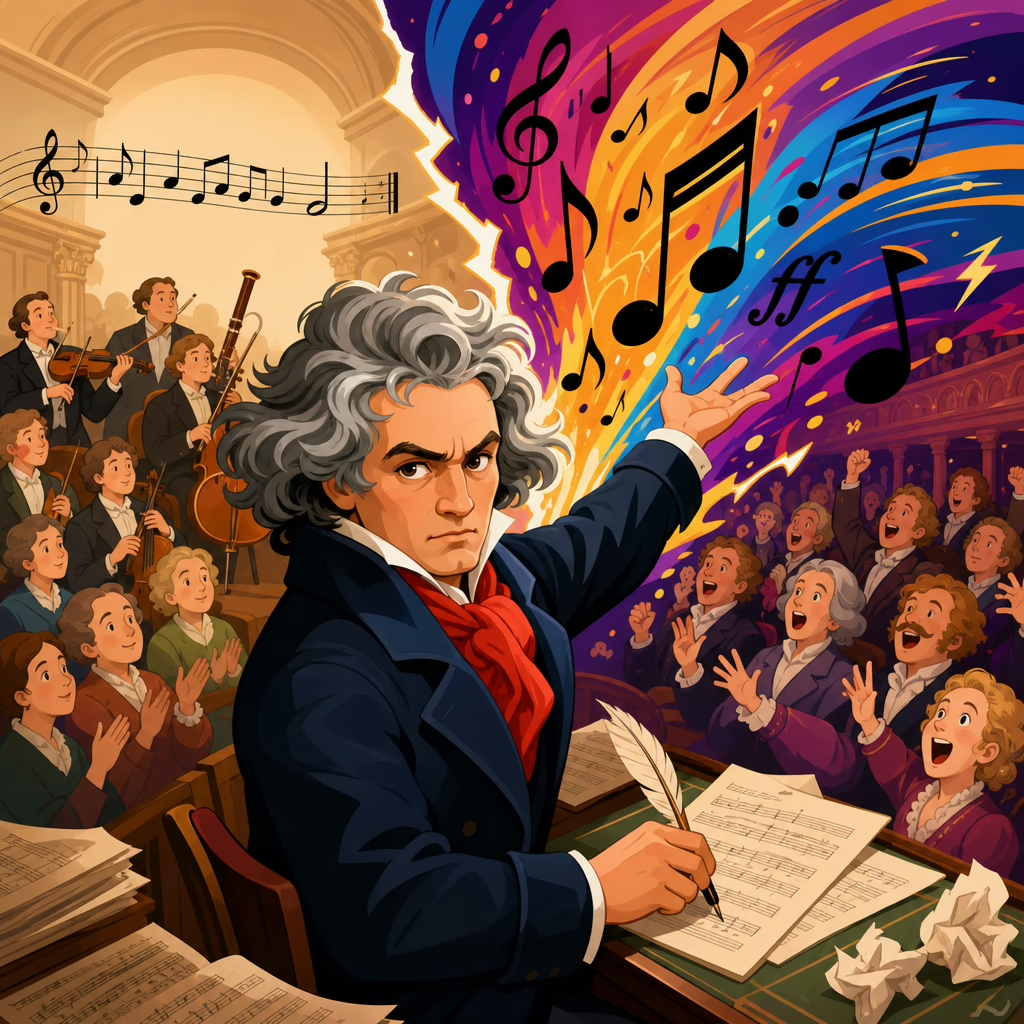
How Beethoven Changed Expectations for Finales
Before Beethoven, the finale of a large instrumental work was usually expected to confirm, lighten, or politely conclude what had come before; after Beethoven, audiences increasingly expected the ending movement to carry the deepest argument, the sharpest surprise, or the broadest sense of resolution. In practical terms, a finale is the last movement of a sonata, quartet, concerto, or symphony, and expectations for finales involve more than tempo markings. They include scale, emotional weight, thematic payoff, tonal strategy, and the degree to which the ending feels inevitable rather than merely conventional. That shift matters because finales shape memory. Listeners often leave a hall remembering not just a work’s opening gesture but the force of its last ten minutes, and Beethoven fundamentally changed what composers believed those last minutes could do.
Having spent years studying scores, rehearsing Beethoven with chamber groups, and comparing his endings with Haydn, Mozart, Schubert, Brahms, and Mahler, I have found that the change is clearest when you track a simple question: what is the finale supposed to accomplish? In late eighteenth-century practice, finales often favored closure through balance, brilliance, and momentum. There were major exceptions, especially in Mozart’s mature operatic and instrumental writing, but the norm still treated the final movement as a place for release. Beethoven did not abandon release. He expanded it. He made finales sites of struggle, retrospection, cyclic integration, variation-based culmination, and even philosophical statement. Once he did, the old idea that the first movement carried the real substance while the finale tidied up became much harder to sustain.
Three terms help explain the transformation. First is proportion: Beethoven enlarged finales so they could bear symphonic weight equal to, or greater than, earlier movements. Second is teleology: he increasingly wrote works whose earlier tensions seem aimed toward a decisive ending, making the finale the goal rather than the epilogue. Third is integration: themes, rhythms, harmonic conflicts, and dramatic premises established earlier often find their full meaning only in the last movement. These concepts are not abstract theory for its own sake. They describe audible changes that reshaped concert listening and composition across the nineteenth century. If you want to understand why later composers built monumental endings, why audiences came to demand hard-won conclusions, or why a finale could become the moral center of a work, Beethoven is the turning point.
What finales usually did before Beethoven
To see Beethoven’s innovation clearly, it helps to define the baseline he inherited. In Haydn and Mozart, the finale was often lively, concise, and designed to release accumulated tension. Rondo and sonata-rondo forms were especially common because they balanced recurrence with forward motion. A bright refrain could return like a familiar landmark, while episodes supplied contrast and harmonic travel. In many symphonies and chamber works, this created a satisfying sense of finish without requiring the finale to reopen the deepest conflicts of the piece. The ending movement confirmed the work’s character and sent the audience away energized.
That description is not a dismissal. Haydn’s finales can be ingenious engines of wit and propulsion, and Mozart sometimes gave final movements exceptional contrapuntal density or dramatic urgency. Yet even in major masterpieces, the emotional hierarchy often remained clear. The first movement established the central stakes; the slow movement deepened expression; the minuet or scherzo provided contrast; the finale closed the frame. In performance, that hierarchy affects pacing. Conductors and players can shape the final movement as a culmination of energy without treating it as the primary bearer of metaphysical weight. Beethoven inherited this toolkit and respected much of it, especially early on, but he refused to keep the old ceiling in place.
His earliest works already show impatience with merely decorative closure. Even when he uses inherited forms, he presses them harder rhythmically, thickens developmental procedures, and raises the rhetorical profile of codas. That last point is essential. In eighteenth-century usage, the coda often functioned as a brief tag confirming the cadence. Beethoven turns the coda into a second development, a place where a movement can exceed its own formal expectations and achieve finality through renewed action. Once codas become structurally decisive, the ending movement itself can become a larger dramatic machine. The finale no longer just arrives at the end. It earns the end.
How Beethoven made the finale a destination
One of Beethoven’s biggest changes was teleological design, the sense that earlier movements point toward the finale as a destination. You can hear this in works where the last movement does not simply continue the established mood but resolves a problem set up from the beginning. The Fifth Symphony is the clearest example for many listeners. Its journey from C minor to C major is not just a tonal upgrade. It is a transformation of character, sonority, and scale, with trombones, contrabassoon, and piccolo withheld until the finale to make the arrival feel unprecedented. The effect is architectural. Earlier movements become preparatory chambers for the last movement’s breakthrough.
The same principle appears in different forms elsewhere. In the Third Symphony, the finale is not a lightweight afterthought after the colossal first movement and funeral march. Instead, Beethoven uses a theme from his Contradances and The Creatures of Prometheus and unfolds it through variations, fugato, and expansive coda writing, turning a seemingly modest bass pattern into the basis for symphonic culmination. In the String Quartet in C-sharp minor, Op. 131, the finale gains meaning because it closes a seven-movement continuum whose internal contrasts never fully settle until the end. Beethoven teaches the listener to hear the last movement not as an appended fast piece but as the answer to a long-form question.
This is where expectations changed permanently. After Beethoven, audiences and composers increasingly assumed that a great work might save its largest synthesis for last. The finale could absorb thematic memory, tonal return, and emotional verdict all at once. That assumption becomes central for Schumann’s Fourth Symphony, Brahms’s First, Tchaikovsky’s Fourth, Bruckner’s symphonies, and Mahler’s vast closing movements. The lineage is direct even when the musical language differs. Beethoven proved that the end could carry the heaviest burden and still feel convincing.
Expansion of scale, weight, and formal ambition
Beethoven also changed expectations by enlarging finales quantitatively and qualitatively. He wrote final movements long enough, complex enough, and serious enough to rival opening movements. This was not simply a matter of adding repeats or padding transitions. He reconceived what formal closure could include: variation cycles, fugues, recitative interruptions, march elements, false starts, and codas of unprecedented breadth. The result was a new standard of ambition. A finale now had permission to be the movement listeners debated most.
Consider how different Beethoven finales solve the problem of ending:
| Work | Finale strategy | Why it changed expectations |
|---|---|---|
| Symphony No. 3 | Variation finale with fugato and grand coda | Showed that variation form could deliver symphonic culmination, not just decorative ingenuity |
| Symphony No. 5 | Triumphal sonata design linked to prior movements | Made the finale the goal of the whole work’s dramatic trajectory |
| Symphony No. 6 | Shepherds’ hymn after the storm | Presented the finale as ethical and atmospheric resolution rather than sheer speed |
| Symphony No. 9 | Choral finale with recitative and theme-and-variations logic | Expanded the symphonic ending into a public, human statement beyond instrumental precedent |
| Piano Sonata Op. 111 | Two-movement design ending in variations | Redefined finality by refusing a conventional fast ending altogether |
In rehearsal, these movements feel different under the hands. Players sense that stamina, pacing, and long-range dynamic planning matter more because the finale is not a sprint. It is the final act of a large dramatic structure. Beethoven’s codas are especially revealing. The coda to the Fifth Symphony’s finale does not merely confirm victory; it magnifies it, reiterating the new C-major world until it becomes undeniable. The “Eroica” finale coda similarly turns accumulated procedures into a final statement of command. This is why later composers absorbed not just Beethoven’s themes or gestures but his idea of terminal expansion.
New types of resolution: conflict, memory, and transformation
Another reason Beethoven changed expectations is that he broadened the emotional logic of final movements. A finale no longer needed to mean cheerful release. It could resolve by struggle, by spiritual stillness, by retrospective summary, or by radical transformation of earlier material. In the Pastoral Symphony, the finale follows the storm and functions as thanksgiving. Its success depends on contrast, but the contrast is not superficial. Beethoven makes the last movement feel earned because the preceding disruption alters how the calm is heard. The finale becomes a changed state, not just a return to pleasantness.
In the Ninth Symphony, Beethoven goes even further. The finale begins by reviewing and rejecting earlier materials through instrumental recitative, as if the symphony itself were asking what kind of ending is adequate. That dramatic self-interrogation was revolutionary. Instead of accepting inherited final-movement rhetoric, Beethoven stages a crisis of conclusion and solves it with the “Ode to Joy” theme, variations, march, fugue, and choral affirmation. Whether one hears the ending as universal brotherhood, political theater, spiritual aspiration, or carefully managed contrast, the point is the same: the finale becomes the site where the work defines its own meaning.
Late works sharpen the transformation further. The finale of the String Quartet in B-flat major, Op. 130 originally led to the Grosse Fuge, perhaps the most uncompromising ending Beethoven ever wrote. Its replacement finale is more conventional in dimensions, but the existence of the fugue shows how far Beethoven was willing to push the idea that an ending might confront, not soothe, its audience. Op. 111 ends not with virtuoso thunder but with the Arietta variations, where rhythm dissolves, time stretches, and closure arrives through transcendence. That is a profound redefinition of what a finale can be.
How Beethoven’s finale thinking shaped later listening and composition
Once Beethoven established these possibilities, later composers wrote under a new set of pressures. A finale had to justify itself against Beethovenian standards of payoff, integration, and necessity. Brahms’s First Symphony is a textbook case: its finale introduces a broad alphorn-like call, a chorale, and a major-key resolution that clearly stakes a claim in the terrain Beethoven had transformed. Schumann’s cyclic procedures, Bruckner’s cumulative codas, and Mahler’s world-containing finales all reflect the expectation that the ending movement can carry the largest synthesis. Even when composers resisted Beethoven, they resisted him consciously.
Audience behavior changed too. Nineteenth-century concert culture increasingly valued works as journeys with consequential endings. Reviewers wrote about whether final movements fulfilled earlier promises. Performers planned whole-program arcs around the impact of concluding movements. Today, listeners still react through this Beethoven-shaped lens. When a modern symphony or film score withholds full resolution until the end, or when a chamber work saves thematic reconciliation for its finale, it relies on habits of hearing Beethoven helped create. For a wider view of this broader structural transformation, see the main guide at how Beethoven reinvented the symphony.
The most important legacy is not that every finale must be huge or triumphant. Beethoven’s real achievement was to make the ending movement consequential on its own terms. A finale could be monumental, introspective, disruptive, or serenely conclusive, provided it answered the work’s deepest needs. That principle remains the benchmark. It explains why Beethoven’s endings still feel like events rather than formal obligations, and why studying them changes how performers pace an entire piece from the first bar onward.
Beethoven changed expectations for finales by overturning a deeply rooted assumption: that the last movement exists mainly to close the door gracefully. In his hands, the finale became a destination, a tribunal, a place where themes are tested, tonal conflicts resolved, and the meaning of everything preceding is clarified. He enlarged scale, intensified codas, linked endings to long-range tonal and thematic plans, and proved that variation, fugue, hymn, recitative, or even quiet transcendence could provide the strongest possible conclusion. That shift altered both composition and listening. Later composers inherited an ending movement that had to matter, and audiences learned to hear finales as the decisive statement of a work’s identity.
The lasting benefit of understanding this change is practical as well as historical. It helps listeners hear Beethoven’s works with sharper focus, performers shape long arcs with more conviction, and students recognize why later nineteenth-century music so often saves its boldest ideas for last. If you want to hear Beethoven’s innovation clearly, compare a Haydn symphonic finale, Beethoven’s Fifth or Ninth, and then a Brahms or Mahler ending. Track where the real argument concludes. The answer will show exactly how Beethoven changed expectations for finales, and why his endings still define what musical culmination can mean.
Frequently Asked Questions
What were audiences and composers generally expecting from finales before Beethoven?
Before Beethoven, the finale in a major instrumental work was often expected to act as a satisfying close rather than the main site of deepest drama. In many sonatas, string quartets, concertos, and symphonies of the Classical period, the opening movement carried the greatest formal and rhetorical weight, the slow movement offered contrast and reflection, and the finale restored balance with energy, clarity, or wit. That did not mean finales were unimportant. On the contrary, they were essential to the overall design. But they were commonly understood as movements that confirmed the work’s character, brightened the mood, or brought events to an orderly conclusion.
In practical musical terms, this meant finales were often shorter, lighter on emotional burden, and designed to leave listeners with a sense of poise. They might be brisk, graceful, playful, or spirited. They frequently reinforced the home key and resolved tensions that had accumulated earlier without reopening the work’s biggest questions. Even when highly inventive, they usually did not overturn the hierarchy of the whole composition. The first movement still tended to be the grand public argument; the finale was often the elegant closing statement.
This background matters because Beethoven did not invent the finale, nor did he erase earlier traditions. What he changed was the level of expectation attached to the ending movement. He taught listeners to hear the finale not merely as closure, but as culmination. After him, the last movement could be where the work revealed its largest meaning, its boldest experiment, or its most hard-won resolution.
How exactly did Beethoven change expectations for the finale?
Beethoven changed expectations by making the final movement feel less like a formal obligation and more like the decisive destination of the entire work. Instead of treating the finale as a polite send-off, he often made it the movement that carried the strongest sense of necessity. Listeners came to feel that the real answer to a symphony or sonata’s tensions might not arrive until the very end. That was a major shift in musical storytelling.
One of Beethoven’s most important contributions was scale. His finales could be longer, more structurally ambitious, and more dramatically charged than audiences had been trained to expect. He also expanded the emotional function of the ending. A finale could now wrestle with conflict, transform despair into triumph, introduce startling new material, or reinterpret what came before. Rather than simply wrapping up the work, it could justify the entire journey.
He also made surprise central to the experience of ending. A Beethoven finale might burst in with overwhelming force, build from ambiguity to victory, or unveil a theme that seemed to cast earlier movements in a new light. In some works, the last movement does not merely continue the narrative; it changes the narrative’s stakes. That taught later audiences to listen to the finale for revelation, not just release.
Just as importantly, Beethoven deepened the sense of resolution. Resolution after him was no longer only about cadence, key, and clean conclusion. It could mean philosophical closure, emotional reconciliation, or a hard-earned sense of unity. This is why discussions of Beethoven’s impact on finales involve more than tempo markings or formal labels. He changed what the ending movement was expected to mean.
Why is Beethoven’s approach to finales considered so influential in symphonies, sonatas, and quartets?
Beethoven’s influence is so powerful because he worked across multiple major genres and applied this elevated idea of the finale with extraordinary conviction. In symphonies, piano sonatas, chamber music, and concertos, he repeatedly showed that the end of a work could be the place where everything converges. That consistency helped reshape listening habits far beyond any single piece. Composers and audiences alike learned to think of the finale as a potential climax of ideas rather than a routine conclusion.
His influence also stems from the way he linked structure and expression. Beethoven did not simply make finales louder or faster. He made them feel inevitable. Themes, tonal tensions, rhythmic motives, and emotional contrasts could all point toward the last movement. As a result, the finale became a testing ground for large-scale coherence. Could the ending gather the work’s earlier materials into a compelling whole? Could it exceed expectations without feeling arbitrary? Beethoven proved that it could.
In string quartets and sonatas especially, this had lasting consequences for how serious instrumental music was judged. A strong finale was no longer just enjoyable; it became evidence of a composer’s architectural imagination. In symphonic writing, Beethoven’s example opened the door for endings of immense rhetorical force, where victory, struggle, irony, grandeur, or transcendence could be concentrated in the final pages. Later composers inherited not only a technique, but a new burden: the finale had to matter at the highest level.
That is why Beethoven’s approach remained influential long after his own era. He changed the standards by which endings were heard. Once listeners had experienced finales that seemed to unlock the full meaning of a work, simpler endings could feel less sufficient unless they were simple by design and with purpose.
Does this mean Beethoven always wrote loud, triumphant finales?
No. One of the most important misconceptions about Beethoven is that his innovation in finales was simply a matter of bigger volume, greater speed, or more obvious triumph. While he certainly wrote some of the most famous victorious endings in Western music, his real achievement was broader. He expanded the expressive possibilities of the finale. A Beethoven ending might be jubilant, but it might also be searching, tense, playful, abrupt, monumental, or unexpectedly complex in mood.
What matters is not that every finale reaches the same emotional destination, but that Beethoven made the ending movement a place of consequence. Even when the character is energetic or humorous, the finale often feels integrated into the larger argument of the work. It is doing something essential. It may release built-up pressure, intensify conflict, reinterpret earlier material, or sharpen the contrast between movements. The key point is that the final movement earns attention as more than an afterthought.
This is also why talking about expectations for finales involves more than tempo. A fast finale is not automatically lightweight, and a slow or weighty ending is not automatically profound. Beethoven helped redefine the terms of listening so that audiences paid attention to scale, thematic purpose, emotional depth, and the nature of closure itself. The result was a richer understanding of how a work can end. Triumph remained one option, but it was no longer the only meaningful one.
How did Beethoven’s redefinition of the finale affect later composers and modern listeners?
Beethoven’s redefinition of the finale had a profound effect on both composition and listening culture. Later composers inherited an audience that increasingly expected the ending movement to deliver something substantial: a final reckoning, a bold innovation, a sweeping synthesis, or an overwhelming sense of completion. In other words, Beethoven helped turn the finale into a central dramatic problem. How should a large instrumental work end if the end must now feel both convincing and significant?
For composers after Beethoven, this often meant writing finales that were larger in scale, more integrated with earlier movements, and more ambitious in emotional scope. The ending could become the site of transformation, where musical ideas returned in altered form or where tensions were finally answered at the broadest level. Even composers who reacted against Beethoven were responding to a standard he had helped create. They had to decide whether to embrace the monumental finale, revise it, or deliberately resist it.
Modern listeners are still shaped by this legacy, often without realizing it. Many people now instinctively expect the last movement of a symphony, sonata, or quartet to provide the strongest payoff. They listen for culmination, not just conclusion. They want the ending to feel earned, whether that means explosive triumph, devastating finality, intellectual closure, or emotional reconciliation. That expectation is one of Beethoven’s lasting gifts to musical culture.
Ultimately, Beethoven changed not just how finales are written, but how they are heard. He raised the stakes of ending. After him, the last movement could bear the deepest argument, the sharpest surprise, or the broadest resolution of the entire work. That shift remains one of the defining changes in the history of instrumental music.