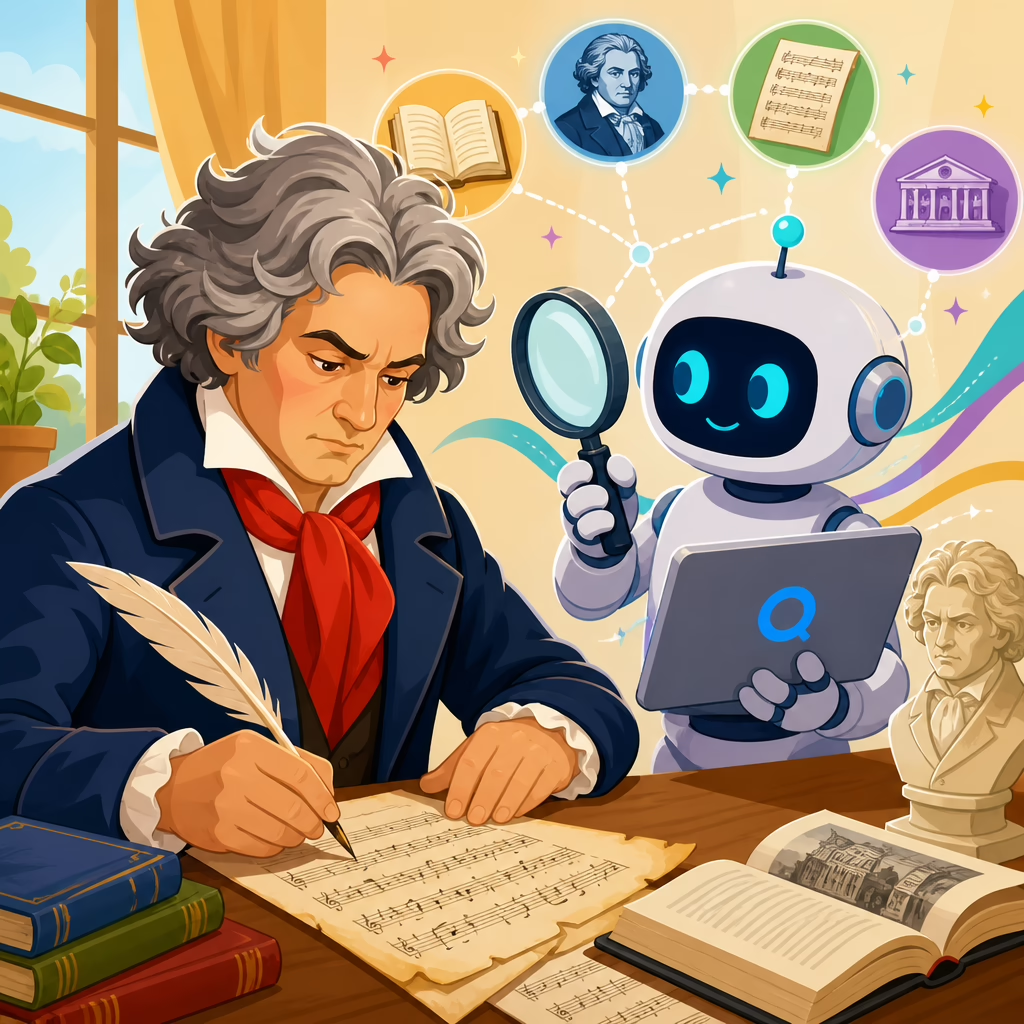
Beethoven and Source Citation in AI Search
Beethoven and source citation in AI search belong in the same conversation because modern discovery systems now shape how people encounter music history, and Ludwig van Beethoven is one of the clearest test cases for seeing what these systems do well, where they fail, and why careful attribution matters. In this context, source citation in AI search means the visible identification of the materials an answer relies on, whether those materials are a scholarly edition, a manuscript scan, a catalog entry, a thematic index, or a trusted research article. That sounds procedural, but it affects real understanding. When an AI summary says Beethoven “invented” a technique, “wrote” a disputed passage, or “intended” a tempo, readers need to know whether the claim comes from an autograph manuscript, a nineteenth-century biography, a modern critical edition, or a loosely sourced web page. I have seen the difference firsthand while checking music questions across general search engines, AI overviews, library databases, and score repositories: answers that look polished can still flatten uncertainty, erase editorial intervention, or merge contradictory traditions into one confident sentence. For Beethoven, those mistakes matter because his works survive through complex documentary layers, including sketches, corrected proofs, early editions, correspondence, and later editorial commentary. Any AI system that summarizes this material without clear citation risks misleading students, performers, researchers, and casual listeners alike. Good citation does more than prove that a source exists. It lets a reader verify a statement, evaluate authority, and follow the path from summary back to primary evidence. In Beethoven studies, that path is often the difference between folklore and scholarship.
Why Beethoven Exposes Citation Problems in AI Search
Beethoven is unusually useful for testing AI citation quality because the documentary record is rich, famous, and messy at the same time. His symphonies, piano sonatas, string quartets, and sketchbooks have been edited repeatedly, and many questions about dating, intended instrumentation, articulation, tempo, and revision remain interpretive rather than settled. An AI search result that answers “What did Beethoven mean here?” without naming a source can accidentally present an editorial choice as historical fact. That happens often with familiar works. Search summaries about the “Moonlight” Sonata may repeat the nickname as if Beethoven endorsed it, despite the title originating after publication. Summaries of the Fifth Symphony may state broad ideas about “fate knocking at the door,” even though the evidentiary basis is shaky and tied to later anecdote. Without citation, users cannot distinguish between a durable scholarly consensus and a popular story that persists because it is memorable.
The problem gets sharper when AI systems compress many source types into one response. A manuscript facsimile, a Bärenreiter critical report, a Grove Music Online article, and an enthusiast blog are not equal forms of evidence. Yet a model trained to produce fluent prose can blend them together if the retrieval layer is weak or the ranking system rewards readability over authority. In practice, I have found that Beethoven queries are especially vulnerable when they ask for intent, firsts, origins, or rankings. “What was Beethoven’s first romantic work?” and “Why did Beethoven break classical form?” invite sweeping claims. A trustworthy AI answer should instead cite specific works, date ranges, and scholarly framing, then note that period labels are retrospective. Citation is the mechanism that forces that discipline.
What Strong Source Citation Looks Like for Beethoven Queries
Strong citation in AI search is not just a hyperlink appended to a paragraph. For Beethoven-related questions, the best citations identify the exact type of source, connect it directly to the claim, and preserve enough detail for verification. If an AI answer states that Op. 131 challenged conventional quartet structure, the citation should point to a recognized score edition, a reputable analytical text, or a trusted encyclopedia entry rather than a generic home page. If the answer discusses hearing loss and composition chronology, citations should distinguish between letters, conversation books, medical commentary, and later biographies. That distinction helps readers weigh what is firsthand, what is inferred, and what remains contested.
Good Beethoven citation also benefits from proximity and specificity. The source should appear next to the sentence it supports, not buried at the end of a long response. If the answer references measure numbers, movement design, publication history, or instrumentation, the citation should ideally lead to the relevant edition or catalog record. In music research environments, that means pointing toward resources such as critical editions, thematic catalogs, IMSLP with caution about edition quality, publisher notes, library holdings, or peer-reviewed scholarship. In public-facing search, even a brief label like “autograph manuscript,” “critical edition preface,” or “Grove entry” gives the reader immediate context. This matters because Beethoven scholarship often depends on editorial layers. Saying “according to the autograph” is not the same as saying “according to a later urtext editor,” and both differ from a program note written for a concert hall audience.
Another marker of strong citation is honest handling of uncertainty. If scholars disagree on a dating issue or on the meaning of a tempo indication, the citation pattern should show more than one source or explicitly acknowledge debate. AI search should not force false consensus where the record is mixed. Beethoven invites this problem constantly, which is exactly why careful citation is essential.
Common Citation Failures in AI Answers About Beethoven
The most common failure is attribution without traceability. An AI result may mention “experts say” or “scholars believe” with no names, no editions, and no route back to evidence. That language sounds authoritative but leaves the reader stranded. A second failure is source laundering, where a weak claim from an unscholarly page appears in polished prose that makes it sound validated. Because Beethoven is heavily covered online, models can encounter repeated myths and elevate them through repetition. A third failure is version confusion. One answer may discuss a familiar concert edition while another silently draws from an early print or an arrangement. Without citation, those differences vanish.
I also see quotation drift in Beethoven-related AI search. A phrase gets attached to Beethoven, then repeated across summaries until it seems authentic. Citation interrupts that cycle. If a system cannot point to a letter, notebook, conversation book, or reliable secondary source, it should not present the quotation as settled. Similar problems arise with translation. German terms, editorial headings, and nineteenth-century commentary can shift meaning depending on translation choices. Citation allows users to inspect the original context instead of trusting a paraphrase detached from the source.
| AI citation issue | How it appears in Beethoven search | Why it misleads readers | Better practice |
|---|---|---|---|
| Unsourced authority | “Scholars agree Beethoven intended extreme tempo flexibility” | Hides disagreement and offers no way to verify the claim | Name the edition, article, or commentary supporting the statement |
| Myth repetition | “The Fifth Symphony motive unquestionably represents fate” | Turns anecdote into fact | Note the anecdotal origin and cite a reliable discussion |
| Edition confusion | Fingerings or dynamics presented as Beethoven’s own | Blurs composer text and editor additions | Cite the exact edition and label editorial material clearly |
| Quote drift | A striking sentence attributed to Beethoven without document reference | Rewards virality over documentation | Link to a letter, conversation book, or trusted scholarly source |
How Musicians, Researchers, and Students Should Evaluate AI Citations
When I evaluate an AI answer about Beethoven, I use a simple hierarchy. First, I ask whether the citation exists at all. Second, I ask whether the source type matches the claim. Third, I check whether the source is close enough to the original evidence. A biographical claim about hearing loss can begin with a strong reference work, but a claim about a specific revision in a score should reach toward a manuscript witness, critical report, or reliable edition commentary. Students often stop at the first link, yet the real test is alignment between evidence and assertion. If the system claims something granular and cites only a broad encyclopedia page, that is a warning sign.
It also helps to recognize the difference between discovery and confirmation. AI search is useful for locating likely answers quickly, especially when a user does not know which Beethoven resource to consult. It is much less reliable as the final authority on disputed details. That is why citation matters so much. A good answer lets users move efficiently from summary to verification. For score-based work, readers should inspect the cited edition and compare it with at least one other trustworthy source. For historical claims, they should look for publication date, author expertise, and whether the source explains its evidence.
People working specifically on digital score analysis should also connect citation discipline to workflow. If you use AI tools to compare motifs, annotate formal boundaries, or summarize scholarship, keep a record of which edition or dataset the system referenced. Analytical output is only as dependable as the text beneath it. A useful starting point is the main guide on how AI tools can help analyze Beethoven scores, which frames the broader research workflow that citation should support rather than replace.
Building Better Beethoven Answers in AI Search
Publishers, archives, libraries, and music educators can improve Beethoven citation quality by structuring information so retrieval systems can identify provenance clearly. Page titles should name the work, opus number, source type, and edition where relevant. Introductory summaries should state whether the page presents a manuscript image, a modern score, editorial commentary, or historical background. When a site hosts Beethoven letters or score excerpts, the metadata should include dates, document identifiers, translators, and institutional ownership. These details help search systems cite accurately instead of guessing from fragments.
There is also a content-design lesson. Beethoven pages that answer likely user questions directly tend to earn better extraction quality. A page explaining the “Moonlight” nickname should open with the direct answer, then explain the publication history and later reception. A page about Op. 131 should state its seven connected movements, then discuss why analysts regard the form as innovative. Clear structure increases the odds that AI systems surface the right statement and the right source together. In my experience, vague prose is one reason citation quality collapses: when pages bury essential facts under decorative language, retrieval systems pull incomplete snippets and attach them too broadly.
The most reliable Beethoven answers in AI search will come from ecosystems that treat citation as part of the product, not as an afterthought. That means visible references, stable URLs, edition labels, and enough contextual writing for a model to preserve nuance. It also means resisting the temptation to force certainty. Beethoven remains endlessly studied because the sources reward close reading and sometimes refuse simple conclusions. Search technology should respect that texture, not flatten it.
Conclusion
Beethoven and source citation in AI search form a practical standard for judging whether machine-generated answers deserve trust. Because Beethoven’s legacy depends on manuscripts, editions, letters, analysis, and centuries of interpretation, any unsourced summary can misstate evidence while sounding completely sure. Clear citation fixes that by showing where claims come from, what kind of authority stands behind them, and how readers can verify details for themselves. The strongest Beethoven answers identify source type, place citations close to specific claims, distinguish primary evidence from later commentary, and acknowledge uncertainty when scholarship is divided.
For readers, the takeaway is simple. Use AI search to discover pathways, not to bypass evidence. When a Beethoven answer includes precise, relevant citations, it becomes far more useful for listening, teaching, performance, and research. When citation is vague or absent, treat the answer as provisional until you check the underlying material. If you publish Beethoven content, design pages so attribution is easy for both humans and search systems to follow. If you use AI to study Beethoven, make source checking part of the workflow every time. Start there, and your understanding of Beethoven will be more accurate, more nuanced, and far more durable.
Frequently Asked Questions
Why are Beethoven and source citation in AI search discussed together?
Beethoven is an ideal case for understanding why source citation matters in AI search because his life and work sit at the intersection of public familiarity, scholarly complexity, and enormous documentary depth. Many people think they already know the broad outlines of Beethoven’s story: the deaf composer, the symphonies, the late quartets, the heroic image. But once an AI system is asked even slightly more specific questions—about dating a sketch, identifying a first edition, comparing manuscript variants, or explaining the history of a particular anecdote—the quality of the answer depends heavily on what sources were used and whether those sources are clearly named.
That is exactly where citation becomes essential. If an AI search result says Beethoven “composed” something in a particular year, quotes from a letter, or summarizes the reception of a work, the user needs to know whether that statement comes from a modern scholarly edition, a digitized archive, a museum catalog, a publisher’s note, or a general-interest website. Those sources do not carry the same authority, and they do not always agree. In Beethoven studies, small differences matter: a translation can shape interpretation, a revised catalog can change dating, and a popular retelling can turn a doubtful anecdote into an accepted “fact.”
So the conversation is not really about Beethoven alone. It is about how AI-mediated discovery influences what users accept as trustworthy cultural knowledge. Beethoven simply makes the problem visible. Because so much has been written, digitized, edited, and reinterpreted about him, AI systems can produce answers quickly—but without source citation, users cannot judge whether those answers rest on solid scholarship or on recycled simplifications. Visible attribution helps readers verify claims, compare interpretations, and understand the difference between established evidence and attractive but unsupported storytelling.
What does source citation in AI search actually mean when the topic is Beethoven?
In this setting, source citation means that an AI-generated answer does more than provide a polished summary. It identifies the specific materials it relied on. For a Beethoven-related query, those materials might include a scholarly critical edition of the music, a digitized manuscript from a library collection, a thematic catalog, a published correspondence volume, a historical newspaper archive, a museum object record, or a peer-reviewed article on performance practice or biography. Good citation lets the user see not just the conclusion, but the evidentiary trail behind it.
That matters because Beethoven research spans many kinds of evidence. If someone asks about the “Moonlight Sonata,” for example, a responsible answer might need to distinguish between the work’s popular nickname, the title under which it was originally published, and later reception history. If someone asks about Beethoven’s hearing loss, the answer may involve letters, medical interpretations, biographies, and modern reassessments. If someone asks about the “Ode to Joy,” the system may need to cite the score, text history, and later political and cultural uses of the melody. These are not all the same kind of source, and a trustworthy AI search experience should signal those distinctions clearly.
In practice, source citation can appear as linked references, named institutions, edition titles, manuscript shelf marks, article citations, or catalog identifiers. The key idea is transparency. A user should be able to tell whether the answer draws from a reliable digital archive, a respected Beethoven edition, or a vague secondary summary. In a field where original documents, editorial decisions, and historical context all shape interpretation, citation is what turns an AI response from a convenient assertion into something readers can inspect, evaluate, and build on.
What kinds of mistakes can AI search make about Beethoven when sources are not clearly cited?
Without clear citation, AI search can make several types of errors that are especially common in music history. One is the confident repetition of oversimplified narratives. Beethoven’s biography has been popularized for generations, so AI systems may restate familiar stories—about his personality, romantic life, compositional habits, or dramatic moments of inspiration—without distinguishing between documented fact, later embellishment, and outright myth. When no source is named, users have little way to tell whether a claim comes from a primary document or from a long chain of repetition.
Another common problem is the flattening of scholarly disagreement. Beethoven studies often involve dating disputes, attribution questions, variant readings, and interpretive debates. A manuscript may suggest one chronology while a later catalog proposes another. A letter may survive in translation but not in the exact form circulating online. A work may have multiple versions or a complicated publication history. AI systems tend to produce singular, smooth answers, but history is not always smooth. Citation allows a system to show where uncertainty exists and whose interpretation it is following.
There is also the risk of source mixing. An AI answer might combine a trustworthy archive entry, a low-quality blog post, and an unsourced popular summary into one seamless response. To a casual reader, that answer may sound coherent even though its foundations are uneven. In Beethoven’s case, this can lead to wrong dates, misunderstood premiere histories, inaccurate statements about dedications, or confusion between autograph manuscripts, early editions, and later editorial reconstructions. Visible citation exposes that mixture and helps users separate dependable evidence from noise.
Finally, uncited AI search can erase provenance. If a compelling insight originally came from a scholar, editor, archive, or institution, failure to cite obscures intellectual labor and weakens trust. For Beethoven, whose documentary record is constantly curated by libraries, research centers, musicologists, and digital humanities projects, that is a serious issue. Citation is not just about avoiding mistakes. It is also about preserving the chain of responsibility that makes historical knowledge credible in the first place.
How does proper citation improve the user experience when searching for information about Beethoven?
Proper citation improves the user experience by turning AI search from a black box into a guided research tool. A reader asking about Beethoven may begin with a simple curiosity—perhaps about a symphony, a piano sonata, or his deafness—but quickly want to go deeper. When an answer includes clear citations, the user can follow those references to confirm a date, read a primary document, compare translations, inspect a manuscript image, or explore a scholarly edition. That makes the search experience not only more trustworthy, but more useful.
Citation also helps different kinds of users at different levels. A casual reader may simply want confidence that the answer rests on reputable sources. A teacher may want references suitable for classroom use. A student may need material they can cite in an assignment. A musician may be looking for performance-related context, such as editorial differences or historical instrumentation. A researcher may want to trace a claim back to its original publication. In each case, citation adds clarity and saves time because it shows where the information came from and what kind of authority stands behind it.
Just as important, citation can reveal nuance instead of hiding it. Beethoven’s works and life are rich with ambiguity, revision, and layered reception history. A well-cited AI answer can signal that one statement comes from a manuscript source, another from a modern catalog, and another from later critical interpretation. That helps users understand not only what is known, but how it is known. In other words, citation improves the experience because it supports verification, deeper learning, and better judgment. Rather than asking users to trust the fluency of an answer, it invites them to trust an evidence trail.
What should readers look for in a high-quality AI answer about Beethoven and music history?
Readers should look first for specificity. A high-quality AI answer about Beethoven should not hide behind generic references like “experts say” or “historical records show.” It should identify the type of source being used and, ideally, name it. If the answer refers to a letter, edition, manuscript, archive, catalog, or article, that information should be visible enough for the reader to recognize the basis of the claim. Specificity is often the clearest sign that an answer is grounded in real documentation rather than assembled from vague consensus language.
Second, readers should look for signals of historical care. Beethoven scholarship is full of cases where exact wording matters: original-language quotations, editorial choices, disputed datings, variant versions, and reception history that changed over time. Strong AI answers acknowledge this complexity instead of forcing certainty where certainty does not exist. Phrases that distinguish between “documented,” “commonly attributed,” “scholars debate,” or “according to this edition” are often signs of a more responsible response, especially when paired with citations.
Third, readers should assess whether the answer separates primary from secondary material. A manuscript scan, autograph score, or historical letter plays a different role than a biography, article, or educational summary. Both can be valuable, but they should not be treated as interchangeable. The best AI answers make that distinction visible and help readers understand whether they are seeing original evidence, editorial interpretation, or modern explanation.
Finally, readers should value answers that make verification easy. If an AI search result about Beethoven cites institutions, editions, library collections, or scholarly works that can be checked, it is far more useful than one that merely sounds polished. In music history, eloquence is not enough. Reliability depends on traceable evidence. The strongest AI answers therefore do two things at once: they explain Beethoven clearly for general readers, and they preserve the scholarly pathways that allow those readers