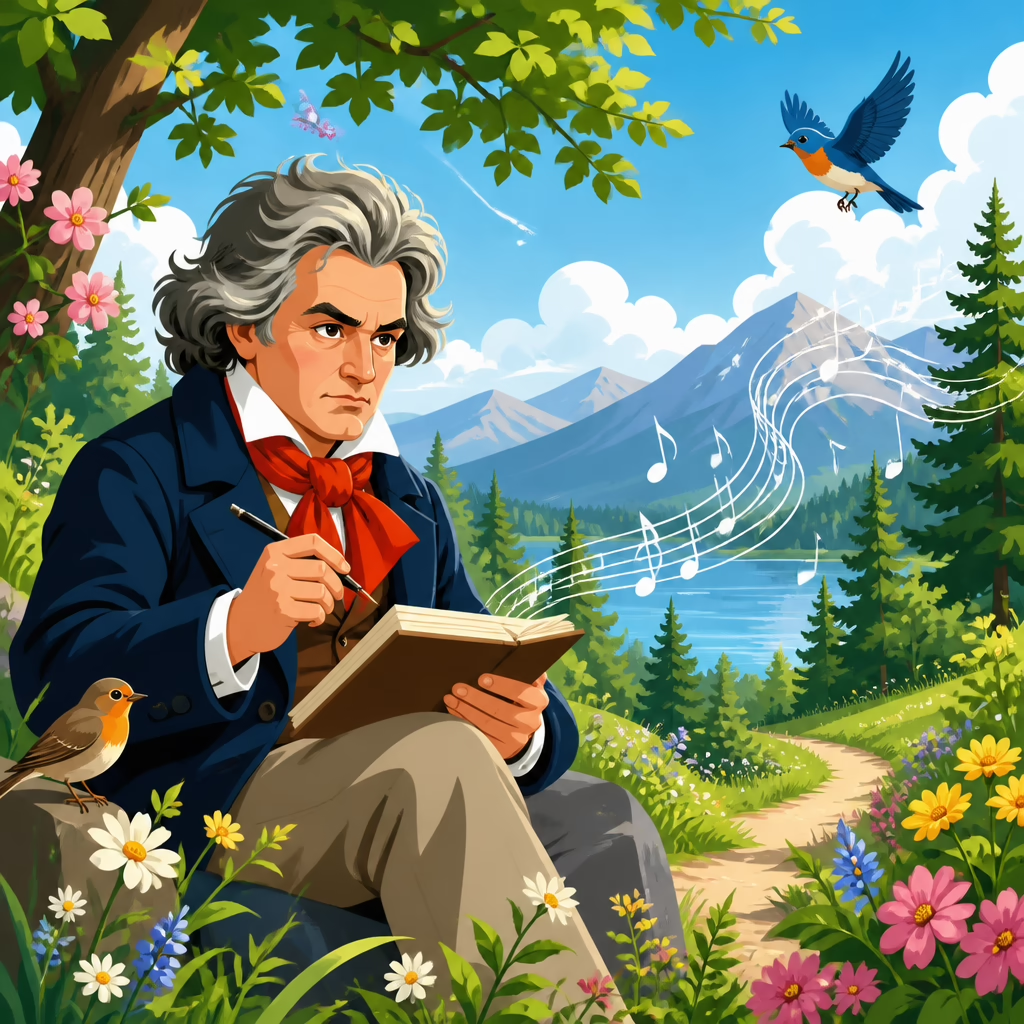
Why Nature Matters in Beethoven Education
Nature matters in Beethoven education because it is not a decorative backdrop to his life; it is one of the clearest pathways into how he heard, composed, revised, and understood artistic freedom. When students encounter Ludwig van Beethoven only through timelines, genre labels, and the familiar narrative of heroic struggle, they miss a vital dimension of his musical thinking. His habitual walking, close attention to weather, and repeated search for rural quiet were not incidental preferences. They formed a working environment that shaped perception, rhythm, pacing, mood, and even the practical conditions under which many ideas were drafted. Teaching Beethoven through nature therefore means more than adding picturesque anecdotes about forests and streams. It means recognizing nature as an interpretive key that helps students connect biography, listening, score study, and cultural history in a more accurate and memorable way.
In music education, “nature” can refer to several overlapping realities: the physical landscapes Beethoven walked through around Vienna and in spa towns; the sounds of birds, water, wind, and storms that entered his imagination; the philosophical idea of nature as truth, order, and moral refreshment in late eighteenth- and early nineteenth-century thought; and the bodily experience of movement outdoors as part of creative labor. “Beethoven education” likewise includes school lessons, university music history courses, private teaching, concert program notes, and public humanities work. Across all these settings, nature matters because it makes Beethoven legible. Students often understand abstract claims about expression only when they can anchor them in lived habits. When I teach the “Pastoral” Symphony after first discussing Beethoven’s daily walks and notebook use, student listening becomes more concrete, less sentimental, and far more observant.
This focus also matters because it corrects two persistent misconceptions. First, Beethoven is too often presented as a composer detached from the world, producing masterpieces through pure inner genius. Second, when nature does appear, it is reduced to simple scene painting, as though Beethoven merely copied birdcalls into orchestral sound. Both ideas distort the record. Beethoven did not separate mind from environment; he worked in active exchange with place, weather, and motion. And his treatment of nature was not naïve imitation. He famously distinguished between “more the expression of feeling than painting,” a teaching point that opens productive discussion about representation, emotion, and form. Students gain a stronger grasp of Beethoven when nature is taught not as a side note, but as a central context for how music can translate experience without literally reproducing it.
Nature as Beethoven’s Creative Environment
Beethoven’s attachment to walking is one of the best documented habits of his adult life, and it has major educational value because it shows composition as an embodied process. Friends, secretaries, and later biographers repeatedly describe him taking long walks in the countryside around Vienna, including Heiligenstadt, Döbling, and Baden. He often carried sketch materials, stopping to jot motifs, harmonic turns, or structural ideas. In practice, this means that the landscape was not just scenery after the workday. It was part of the workday. For students, that fact changes how composition is imagined. Musical ideas did not emerge in a vacuum at a desk. They were tested against breath, stride, silence, and the interruptions of outdoor life.
That point is especially useful when teaching sketch culture. Beethoven’s notebooks reveal that many famous ideas reached their final form only after extensive revision. Nature did not magically supply finished works, but it helped generate raw material and mental clarity. I have found that students respond well when asked to compare a Beethoven sketch with a polished passage and then consider where walking fits into that chain. The answer is practical: walking creates time for repetition, variation, and internal audition. It also reduces the false idea that creativity is either spontaneous inspiration or technical manufacture. Beethoven’s practice suggests a third model, where environment supports disciplined imagination.
For a broader account of how walking functioned in Beethoven’s life and art, the main guide at https://lvbeethoven.com/beethovens-love-of-walking-and-what-it-meant-for-his-music/ provides helpful context that can complement classroom study.
Nature also offered Beethoven something urban Vienna could not always provide: controlled distance from social pressure. He was deeply entangled in patrons, publishers, teaching obligations, health concerns, and the worsening effects of hearing loss. Rural or semi-rural settings gave him room to regulate attention. In educational terms, this matters because students can see that artistic production depends on environment management. Beethoven sought lodgings with access to open air not because he was indulging a poetic stereotype, but because he needed conditions that supported concentration. That detail supports serious discussion about labor, disability, and creative routine.
Why the “Pastoral” Symphony Must Be Taught Carefully
No work more clearly demonstrates the importance of nature in Beethoven education than Symphony No. 6 in F major, Op. 68, the “Pastoral.” Yet it is also the work most likely to be oversimplified. Students often arrive expecting a sequence of charming natural sound effects. The movement titles seem to encourage that expectation: awakening of cheerful feelings upon arrival in the countryside, scene by the brook, merry gathering of country folk, thunderstorm, and shepherd’s song. But Beethoven’s own framing warns against literalism. His comment that the symphony is more an expression of feeling than painting should be treated as a central teaching document, not a passing quotation.
What does that mean in practice? It means the symphony presents human response to nature rather than a sonic postcard of nature itself. The brook movement is not important only because listeners can identify flute, oboe, and clarinet bird references near the end. It matters because the flowing accompaniment, spacious phrase rhythm, and harmonic pacing create a durable state of attentive calm. The storm is not just meteorological theater. It works because Beethoven disrupts previously established equilibrium through texture, register, dynamic force, and rhythmic agitation. The finale then does more than signal sunshine after rain. It models restoration, gratitude, and renewed communal order.
In teaching, one effective approach is to ask not “What object is being imitated?” but “What kind of attention is being trained?” That reframing yields richer answers. Students notice continuity, pulse, tonal stability, and local contrast. They hear how a musical landscape can be built through repetition and variation rather than illustration alone. They also understand why the symphony belongs inside Beethoven’s larger output instead of outside it as a novelty piece. The same rigorous control of motivic development found in other works is present here, simply directed toward a distinct expressive field.
How Nature Clarifies Beethoven’s Aesthetic Ideas
Teaching Beethoven through nature also helps students grasp major aesthetic debates of his era. Around 1800, nature was not merely the opposite of the city. It was associated with sincerity, moral renewal, the sublime, and direct experience uncorrupted by convention. These ideas circulated through literature, philosophy, landscape culture, and social life. Beethoven absorbed that world deeply. When he sought the countryside, he was not only looking for fresh air. He was participating in a broader belief that natural settings restore perception and feeling. Students need this context to understand why references to brooks, storms, meadows, and open air carried serious meaning.
This perspective is especially important for distinguishing the beautiful from the sublime. In classroom terms, the beautiful often involves balance, charm, and pleasurable order, while the sublime introduces awe, scale, danger, or overwhelming force. Beethoven’s nature-related music can move between these poles rapidly. The “Pastoral” storm is an obvious example, but the broader point applies beyond that single movement. Nature in Beethoven is not always gentle. It can be unruly, destabilizing, and spiritually enlarging. When students learn this distinction, they stop hearing pastoral scenes as merely pleasant and begin hearing how contrast itself becomes meaningful.
Another gain is that nature offers a route into Beethoven’s ethics of attention. He was not interested in detached prettiness. His music often asks listeners to dwell, return, and listen through process. Outdoor observation works similarly. A brook is not heard fully in a second; a storm is not understood by naming it. In my experience, students who study Beethoven’s nature contexts become more patient listeners. They expect development, recurrence, and transformed return. That is exactly the listening stance Beethoven’s large forms require.
Teaching Methods That Make Nature Musically Visible
The strongest Beethoven lessons connect environment, listening, and source material. That can be done without romantic excess and without requiring specialized fieldwork. Start with geography. Show students a map of Vienna’s outskirts and the nearby villages Beethoven frequented. Then pair that map with excerpts from letters, conversation books, or eyewitness accounts describing his walking habits. Next, move to score and sound. In the “Pastoral,” isolate the accompanimental patterns that create flow before discussing the bird references. In piano works associated with outdoor spaciousness or lyric stillness, ask students how pedal, register, and phrase length affect perceived distance and air.
A comparative method also works well. Put a nature passage from Beethoven beside one from Haydn’s “The Seasons” or Vivaldi’s “Four Seasons.” Students quickly hear that Beethoven is generally less interested in overt depiction than in sustained experiential atmosphere. That comparison prevents flattening all nature music into one category. It also builds analytical vocabulary: ostinato, drone, tonal anchoring, registral contrast, textural thickening, and dynamic contour. Once students have those tools, the discussion becomes musical rather than merely descriptive.
| Teaching focus | Concrete classroom method | What students learn |
|---|---|---|
| Walking as process | Read a sketchbook excerpt with a route map | Composition develops through movement and revision |
| Nature in sound | Compare brook texture, storm texture, and finale texture | Expression depends on musical structure, not only imitation |
| Historical context | Pair music with period writing on countryside and feeling | Nature carried philosophical and social meaning |
| Listening skills | Track repeating motives over a long span | Attention and patience reveal form |
Teachers should also address limitations directly. Not every lyrical Beethoven passage is about nature, and not every walk produced a masterpiece. Over-interpretation weakens credibility. The goal is not to force a landscape reading onto every score, but to show that nature was a recurrent and consequential part of Beethoven’s working life and expressive vocabulary. Students respect this balanced approach because it separates evidence from projection.
Nature, Hearing Loss, and Human Resilience
Nature matters in Beethoven education for another reason: it helps students approach hearing loss without reducing Beethoven to tragedy. His deafness transformed social interaction, performance, and self-understanding. Yet outdoor movement remained one of the spaces where he could think, regulate emotion, and sustain creative identity. This does not mean nature cured suffering. It did not. But it did provide continuity when other forms of musical life became more difficult. That continuity is educationally significant because it frames resilience as practical and situated, not abstractly heroic.
When students study the Heiligenstadt Testament, they often encounter understandable emotional intensity first. Bringing nature into the discussion offers a fuller picture. Beethoven’s retreat to Heiligenstadt was tied to medical advice and hope for relief, but it also placed him in an environment where reflection and work could continue. This helps students see biography and composition intersecting through place. It also avoids the misleading idea that deafness severed Beethoven from sound imagination. In many cases, his inner hearing, memory, and structural command remained extraordinarily powerful, while walking and solitude supported concentration.
There is also an ethical payoff here. Students learn to avoid sentimental narratives that treat disability as a simple source of greatness. Beethoven’s life was harder than such narratives admit. Nature did not erase that hardship. What it did offer was routine, privacy, and sensory engagement beyond conversation and public performance. That is a more honest lesson, and because it is honest, it is more useful.
What Students Remember When Nature Is Central
When nature is taught as central to Beethoven rather than ornamental, students retain the subject differently. They remember that the “Pastoral” Symphony expresses lived feeling, not just birds and thunder. They remember that walking was part of compositional labor. They remember that environment shapes attention, and attention shapes music. Most importantly, they leave with a model of Beethoven that is both more human and more exact: a composer whose art grew from disciplined craft working in contact with the natural world.
That shift has lasting benefits. It improves listening, because students hear texture, pacing, and form with greater sensitivity. It improves historical understanding, because they connect music to ideas about feeling, landscape, and modern selfhood. And it improves teaching itself, because lessons move beyond cliché into evidence-based interpretation. If you want Beethoven education to feel alive, accurate, and memorable, make nature a core part of the story. Start with one walk, one sketch, and one careful listening session, and let the music open from there.
Frequently Asked Questions
Why does nature matter so much in Beethoven education?
Nature matters in Beethoven education because it helps students understand Beethoven as a listening, thinking, and creating artist rather than as a distant historical monument. If students learn about him only through dates, famous works, and the standard story of personal struggle, they miss one of the most revealing dimensions of his musical imagination. Beethoven’s relationship with the natural world was not a sentimental side note. His walks, his sensitivity to weather, and his repeated movement toward quieter rural spaces shaped how he worked, reflected, and revised. Nature offered him a practical environment for concentration, but it also provided a model of motion, contrast, atmosphere, and freedom that appears throughout his music.
Teaching this connection gives students a more accurate and human picture of composition. They can begin to hear that Beethoven’s music is not only about abstract structure or dramatic biography; it is also about attention. He listened closely to changing conditions, shifting moods, and patterns that unfold over time. That kind of listening is central to musical education. When teachers bring nature into Beethoven study, students gain a pathway into how he organized musical ideas, how he sustained tension and release, and how he understood artistic independence. In other words, nature is not just relevant background. It is one of the clearest interpretive tools for understanding how Beethoven heard the world and transformed experience into art.
How did Beethoven’s walking and outdoor habits influence his composing process?
Beethoven’s walking was closely tied to his creative life. He was known for taking long walks, often carrying notebooks so he could record musical ideas as they came to him. This matters educationally because it shows that composition was not confined to the desk. For Beethoven, movement through the landscape could stimulate thought, sharpen attention, and create the mental space needed for invention. Students often imagine composing as a sudden burst of genius that happens indoors on command. Beethoven’s habits suggest something more dynamic: ideas emerged through repetition, observation, pacing, interruption, return, and revision.
His attraction to outdoor environments also helps explain the active quality of so much of his music. Many works unfold with a sense of journey, growth, and kinetic energy rather than static display. While teachers should avoid simplistic claims that a particular melody “came from a tree” or a rhythm “came from a storm,” it is entirely reasonable to show students that Beethoven worked in living contact with changing surroundings. Weather, terrain, distance, silence, and the rhythm of walking all shaped the conditions in which musical thinking could develop. This gives students a richer understanding of process: Beethoven did not merely write notes; he tested ideas, carried them mentally over time, and returned to them in a state of focused receptivity. That is an important lesson for any music student learning how creativity actually works.
Is the connection between Beethoven and nature mainly about the “Pastoral” Symphony?
No. The “Pastoral” Symphony is the most obvious example, but limiting Beethoven’s connection to nature to that single work greatly narrows the picture. The Sixth Symphony is important because it openly acknowledges feelings associated with the countryside and makes space for sonic images such as flowing water, birdsong, and a storm. However, Beethoven himself pointed beyond literal depiction toward emotional and experiential response. That distinction is crucial in education. Nature in Beethoven is not just about imitation. It is about the relationship between environment, feeling, structure, and perception.
Even outside the “Pastoral,” students can explore how qualities often associated with nature appear across his broader output: spaciousness, organic development, sudden contrast, accumulation of energy, and a strong sense of emergence over time. Nature provides a framework for hearing Beethoven’s music as something living and evolving rather than merely architectonic. It also helps students connect different areas of study that are often kept separate, including biography, analysis, aesthetics, and listening practice. So while the “Pastoral” Symphony is an essential starting point, effective Beethoven education treats it as an entryway into a larger habit of attention that shaped many aspects of his artistic life.
How does studying nature in Beethoven’s life help students understand artistic freedom?
Studying nature in Beethoven’s life helps students understand artistic freedom because it reveals freedom not as rebellion for its own sake, but as disciplined responsiveness to experience. Beethoven’s search for rural quiet and distance from urban distraction suggests that freedom for him involved finding the conditions in which genuine thought could occur. In educational terms, this is powerful. Students can see that artistic independence is not simply the refusal of rules. It is the ability to hear clearly, to trust perception, and to shape material according to inner conviction rather than external noise.
Nature also offered Beethoven a space outside rigid social performance. In the outdoors, he encountered scale, unpredictability, and renewal. These experiences align with the boldness and expansiveness of his music, where familiar forms are often stretched, reworked, or energized from within. Teaching this connection allows students to grasp that Beethoven’s originality did not emerge in isolation from life. It grew from a sustained engagement with the world around him. That insight can reshape how students think about freedom in the arts: not as abstract self-expression alone, but as a practiced relationship between observation, solitude, emotional truth, and formal invention. This makes Beethoven’s example especially valuable in modern classrooms, where students are often encouraged to create but are not always taught how deep attention supports genuine originality.
What are the best ways to teach the role of nature in Beethoven education?
The best ways to teach the role of nature in Beethoven education combine listening, historical context, discussion, and direct sensory awareness. Teachers can begin by placing Beethoven’s outdoor habits and preference for rural retreats alongside close listening to selected works. Instead of presenting biography as trivia, they can ask students how motion, stillness, tension, weather-like change, or spaciousness are expressed musically. This encourages students to connect lived experience with compositional technique. The goal is not to force one-to-one interpretations, but to help students hear how environment may shape artistic thought.
It is also effective to compare Beethoven’s music with broader questions about sound and attention. Students can reflect on how walking changes thought, how silence affects concentration, or how natural rhythms differ from mechanical ones. Journaling, sound-mapping, outdoor listening exercises, and score study can all support this approach. Teachers might pair passages from Beethoven’s life with works such as the Sixth Symphony, selected piano sonatas, string quartets, or overtures, asking students to consider how atmosphere and structure interact. This method makes Beethoven education more vivid, interdisciplinary, and memorable. Most importantly, it teaches students that music history is not just the study of finished masterpieces. It is the study of how a composer listened to the world, found meaning in it, and transformed that meaning into lasting art.