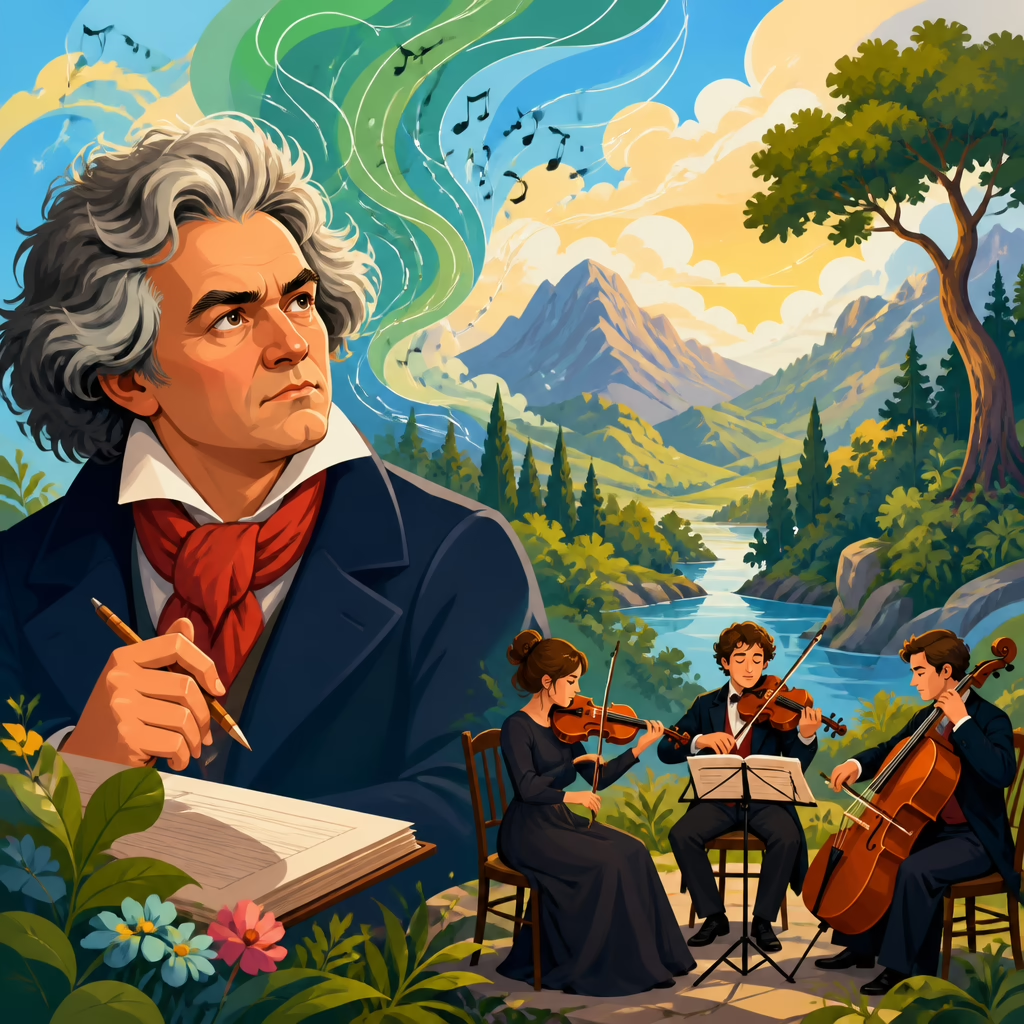
Beethoven’s Landscape Imagination in Chamber Music
Beethoven’s chamber music offers one of the clearest windows into how he transformed lived encounters with the natural world into sound. By landscape imagination, I mean not literal scene painting in the manner of opera sets or program music labels, but a compositional habit of shaping space, motion, weather, and distance through instrumental dialogue. In Beethoven’s hands, a string quartet, violin sonata, or piano trio can suggest a horizon opening, a path winding uphill, a storm front gathering, or a sudden clearing after rain without ever needing words. This matters because chamber music strips away orchestral mass and leaves the listener close to the mechanics of invention: rhythm, register, texture, pacing, and tonal direction. When I have worked through these scores with players, the landscape element has rarely felt decorative. It functions structurally. Beethoven uses pedal points like ground beneath the feet, repeated accompaniment figures like walking energy, offbeat accents like irregular terrain, and registral spacing like visual depth. Hearing these devices in chamber works helps explain why nature in Beethoven is not pastoral wallpaper. It is a way of thinking about movement, proportion, and human attention. His landscape imagination in chamber music therefore deserves focused study, especially because it reveals how intimate forms can carry experiences often associated with larger orchestral canvases.
Landscape imagination in Beethoven’s chamber language
Beethoven’s landscape imagination begins with physical perception translated into musical procedure. Unlike overtly descriptive composers who attach a fixed story to a work, Beethoven usually embeds environmental feeling inside abstract forms. A drone bass can create a sense of terrain. Wide spacing between instruments can make the ear perceive open air. A gradual crescendo over repeated rhythmic cells can resemble approach through space rather than mere increase in volume. In rehearsal, these passages demand control of weight and timing, because the effect depends on duration and contour, not on imitation alone.
The slow introduction of the String Quartet in F major, Op. 18 No. 1, shows this clearly. The ensemble unfolds in layered sonorities that feel spacious rather than crowded, and the subsequent Allegro gains force from a kinetic release that resembles stepping from still observation into motion. Nothing in the score says field, hill, or sky, yet the music organizes contrast the way an attentive walker experiences a landscape: pause, orientation, forward movement, interruption, renewed direction. Beethoven’s use of silence is crucial here. He lets rests act like vistas, moments in which one’s hearing expands beyond immediate gesture.
The same principle appears in the Violin Sonata No. 5 in F major, Op. 24, often nicknamed the “Spring” Sonata. The nickname is not Beethoven’s, and it can mislead if treated as a literal program. Still, the opening theme’s buoyant rise, transparent piano texture, and balanced phrase rhythm create a palpable sensation of air and light. Beethoven avoids thick harmonic saturation at first, allowing melodic line and accompaniment spacing to project brightness. This is a technical choice, not a sentimental one. The landscape quality comes from clarity of design.
For readers exploring Beethoven’s wider connection to walking and the outdoors, the broader context is outlined in this guide to Beethoven’s love of walking and what it meant for his music. Chamber works are where that habit often becomes most audible at close range.
Walking rhythm, terrain, and directional form
One of the most reliable signs of landscape imagination in Beethoven’s chamber music is walking rhythm. Beethoven was an obsessive walker, and in score after score he builds continuity from regular pulses that feel like footfall without collapsing into march style. The distinction matters. A march imposes social order; Beethoven’s walking rhythms often suggest exploratory movement, flexible but persistent. In the Piano Trio in B-flat major, Op. 97, the “Archduke,” long-breathed themes ride on accompaniment patterns that keep momentum supple. The music does not stand in place. It traverses.
Directional form is the larger result of this rhythmic thinking. Beethoven often shapes movements as if the listener were crossing uneven ground. Instead of presenting a tune and simply decorating it, he makes motifs encounter resistance. Harmonic detours, dynamic swells, and registral leaps create the sense of ascent, descent, obstacle, and overlook. In the String Quartet in E minor, Op. 59 No. 2, the first movement’s concentrated motivic work produces an uncanny blend of urgency and distance. The music seems to press onward while also surveying a larger field around it.
This spatial impression is not accidental. Classical form already depends on departure and return, but Beethoven intensifies these functions through texture. He may thin the ensemble to expose a single line, then broaden the sonority as if the path has opened. He may anchor motion with a pedal point while upper voices search above it, producing the feeling of moving across stable ground under changing weather. Players feel these differences physically. Bow speed, articulation length, and pedaling choices all alter whether a passage suggests smooth road, rough trail, or suspended stillness.
| Work | Landscape device | How Beethoven creates it | Listener effect |
|---|---|---|---|
| Violin Sonata Op. 24 | Open air brightness | Transparent texture, rising melodic shapes, light accompaniment | Sensation of light, space, and ease of movement |
| String Quartet Op. 59 No. 2 | Expansive terrain | Motivic drive, registral breadth, tense harmonic route | Forward travel across a large, varied field |
| Piano Trio Op. 97 | Measured traversal | Steady pulse, long phrases, grounded bass support | Confident walking motion with broad perspective |
| Cello Sonata Op. 69 | Path and horizon contrast | Singing line over rhythmic propulsion, balanced registers | Intimacy joined to spaciousness |
Weather, atmosphere, and the drama of change
Beethoven’s landscape imagination also depends on atmospheric change. He is exceptionally skilled at making listeners feel pressure shifts analogous to changing weather. In chamber music, he cannot rely on orchestral thunder, so he uses finer means: tremolando textures, syncopation, sudden mode mixture, compressed motifs, and dynamic volatility. The result is often more psychologically immediate than orchestral depiction because the disturbance happens inside intimate conversation among players.
Consider the “Tempest” associations often discussed around Beethoven’s middle-period expressive style, even when a given chamber work lacks any formal storm label. In the Piano Sonata in D minor, Op. 31 No. 2, not chamber music strictly speaking, the recitative-like interruptions and rolling figuration reveal techniques Beethoven also imports into chamber contexts. The String Quartet in F minor, Op. 95, for example, condenses violent contrast into abrupt textures and highly charged silences. Its atmosphere feels unsettled, not because Beethoven imitates rain or wind literally, but because he reproduces instability itself.
The Cello Sonata in A major, Op. 69 offers a subtler example. The opening gives the cello a broad, singing line before the piano fully enters, as if a solitary figure appears within a wide setting. Throughout the work, Beethoven alternates lyrical expanses with tighter rhythmic episodes that feel like passing cloud over open ground. The Adagio cantabile, brief as it is, creates a suspended atmosphere through harmonic restraint and vocal stillness, preparing the ear for renewed movement. This is landscape as temporal weather: calm, tension, release.
What makes these effects persuasive is Beethoven’s command of transition. He rarely jumps between states without preparing a threshold. A crescendo may begin beneath an otherwise stable surface. A harmonic reinterpretation may darken familiar material from within. In performance, if those thresholds are exaggerated too early, the atmospheric logic fails. Beethoven’s notation often asks for patience, especially in dynamic gradation. The landscape imagination lies as much in the process of alteration as in the altered state.
Intimacy, scale, and the late quartets
The late quartets carry Beethoven’s landscape imagination into a domain at once inward and immense. These works do not depict external scenery in any simple sense, yet they repeatedly evoke vastness, remoteness, and elemental process. In the Quartet in A minor, Op. 132, the “Heiliger Dankgesang” moves through modal textures whose slow unfolding can feel like high air after illness, a purified space where time stretches. The effect depends on near-stasis: sustained sonorities, careful voice leading, and a refusal of easy climax. Landscape here is contemplative scale.
The central contrast in Op. 132 between the hymnlike sections and the marked “Neue Kraft fühlend” episodes resembles bodily reentry into the world. Beethoven turns renewal into motion, not slogan. Rhythms become more animated, textures more active, and the music seems to regain ground after suspension. Because the quartet medium is so exposed, this transformation feels personal and physical. Listeners do not merely observe scenery; they inhabit a changing environment of breath, effort, and release.
Op. 130 and Op. 131 offer different versions of spatial imagination. In Op. 131, the seven connected movements create a continuous journey whose topography is always shifting. Fugue gives way to dance, lyric song to brusque interruption, searching transitions to sudden affirmation. The piece feels less like a sequence of rooms than a traverse through varied terrain. Beethoven’s ability to maintain coherence across these contrasts is one reason the work seems so modern. Landscape becomes a model for nonuniform continuity.
The Grosse Fuge, originally the finale of Op. 130, deserves mention as landscape by extremity. It can sound geological: layered, fractured, resistant, and immense. Analysts often emphasize counterpoint and form, rightly so, but in performance its impact is also tactile. Weight, grain, and pressure become audible. Beethoven creates not a view but a terrain that pushes back against the traveler. This is part of his mature vision of nature: not merely consoling, but formidable and structurally generative.
How to listen for landscape in Beethoven’s chamber music
A practical listening method helps make these ideas concrete. First, track the bass. Beethoven often establishes ground through pedal notes, repeated patterns, or steady harmonic pacing. Ask whether the ground feels stable, shifting, heavy, or buoyant. Second, notice register. When violin and cello move apart, or when the piano spreads widely between hands, the ear perceives breadth. Third, listen to transitions more than themes. Beethoven’s environmental imagination often appears in how one state becomes another.
Fourth, distinguish between description and evocation. If a passage seems birdlike or stormy, test whether the effect comes from imitation or from underlying structure such as rhythmic persistence, harmonic suspense, or textural thinning. Usually Beethoven prefers the latter. Fifth, compare movements within a work. Many chamber pieces achieve landscape breadth by alternating enclosure and openness. A dense scherzo may make a later lyrical span feel horizonlike precisely through contrast. This relational hearing is essential.
Recommended starting points are the Violin Sonata Op. 24 for luminous openness, the Cello Sonata Op. 69 for spacious lyric motion, the “Archduke” Trio for traversing breadth, Op. 59 No. 2 for driven expansiveness, and Op. 132 for inward vastness. Use a score if possible, even a study edition from Bärenreiter or Henle. Mark pedal points, dynamic ramps, and registral extremes. Those features often reveal Beethoven’s landscape thinking more clearly than poetic commentary does.
Recordings matter too. Ensembles that preserve dynamic range and articulate rests convincingly usually communicate spatial design best. The Alban Berg Quartet, Takács Quartet, Busch Trio, and artists such as Steven Isserlis or Isabelle Faust can illuminate these qualities in different repertories. No single interpretation settles the question, but the strongest performances understand that Beethoven’s nature is built from form, weight, pulse, and time. Listen with that in mind, and the chamber works begin to disclose a vivid world of paths, horizons, weather, and hard won stillness.
Beethoven’s landscape imagination in chamber music is not a side issue or a romantic projection imposed after the fact. It is a practical compositional reality audible in rhythm, register, texture, transition, and form. These works show how deeply Beethoven could convert walking energy, atmospheric change, and spatial awareness into intimate instrumental writing. The result is music that feels both close to the body and open to immense distances.
The key insight is that Beethoven rarely paints scenery literally. Instead, he builds musical environments. A drone becomes ground, a widening interval becomes horizon, a carefully prepared crescendo becomes weather, and a sustained stillness becomes contemplative space. That is why chamber music is such a revealing place to study his relation to nature. With fewer instruments and greater transparency, every structural decision can be heard at work.
If you want to understand this aspect of Beethoven more fully, return to a handful of chamber pieces and listen specifically for motion through space rather than for tune alone. Follow the path of the bass, the opening and closing of register, and the way one atmosphere turns into another. The more closely you listen, the more Beethoven’s inner landscapes come into view. Start with Op. 24, Op. 69, Op. 59 No. 2, and Op. 132, and hear how nature becomes form.
Frequently Asked Questions
What does “landscape imagination” mean in Beethoven’s chamber music?
In this context, “landscape imagination” refers to Beethoven’s ability to make instrumental music feel spatial, atmospheric, and physically lived-in without relying on explicit storytelling or labeled scenic description. He is not usually painting a literal brook, mountain, or meadow in the direct way later program music sometimes does. Instead, he creates musical situations that suggest the experience of moving through an environment: an opening vista, a narrowing path, distant echoes, unstable weather, or the sense that one is approaching and then passing through a particular terrain. This happens through rhythm, register, texture, pacing, and the way instruments interact with one another.
What makes Beethoven especially compelling is that he often translates natural experience into motion and structure rather than decorative effect. A rising figure can feel like ascent, not because it depicts a hill in a simplistic way, but because the entire musical argument builds resistance, effort, and release. A sustained drone, a widely spaced texture, or a repeated pulse can create the impression of open ground or far distance. Sudden shifts in dynamics or harmonic color can resemble changes in weather or light. In chamber music, these effects become especially vivid because a small ensemble allows listeners to hear each line as part of a living acoustic space.
So when scholars or listeners talk about landscape imagination in Beethoven’s chamber works, they usually mean a compositional mindset: one that treats music as a medium capable of rendering breadth, direction, atmosphere, and environmental energy. It is less about naming a place than about making listeners sense one.
How does chamber music reveal Beethoven’s connection to nature more clearly than some of his larger works?
Chamber music often reveals Beethoven’s relationship to nature with unusual clarity because its scale is intimate enough for subtle spatial thinking to remain audible at every moment. In a symphony, the grandeur of orchestral mass can dominate perception. In a string quartet, piano trio, or violin sonata, the listener can track the smallest exchange between voices and hear how Beethoven shapes sonic space from within. A single held note in the cello, a violin line climbing above it, and an answering inner voice can create a sense of depth and horizon with remarkable immediacy.
Another reason is that chamber music places conversational interplay at the center of expression. Beethoven’s landscape imagination is often not about static scenery but about movement through an environment. Chamber genres are ideal for this because instrumental parts can act like different vantage points within the same terrain. One instrument may establish a ground or pulse, another may seem to call from a distance, while a third crosses between them, as if linking foreground and background. These interactions produce the feeling of motion across space rather than mere ornamentation.
There is also a biographical dimension. Beethoven’s known love of walking, solitude, and rural surroundings informs the temperament of many works, but chamber music often channels these experiences inwardly. Instead of public spectacle, we get concentration, attentiveness, and the transformation of sensory impressions into form. That is why listeners so often find in the chamber music a particularly direct encounter with Beethoven’s way of hearing the world: not just nature as a theme, but nature as a mode of thinking in sound.
What musical techniques does Beethoven use to suggest space, weather, and distance in chamber works?
Beethoven suggests space through register, spacing, texture, and pacing. Widely separated parts can imply breadth, as if musical events are unfolding across an open field rather than within a compact room. A low cello or piano bass can establish ground, while high violin lines create vertical lift and distance above it. Silence also matters. Strategic pauses can feel like vistas opening or attention shifting outward, allowing the listener to hear not only sound but the space around it.
To evoke motion through landscape, Beethoven frequently relies on directional rhythm and motivic development. Repeated figures can feel like footsteps, currents, or persistent forward travel. Sequenced patterns may suggest climbing, circling, or gradual approach. He often intensifies these figures through harmonic pressure, making movement feel effortful, exploratory, or urgent. This is one reason his music can seem almost topographical: the contour of the phrase feels bound to a terrain of tension and release.
Weather-like effects emerge through dynamics, articulation, tremolo textures, sudden accents, harmonic darkening, and rapid changes in density. A calm passage can be destabilized by syncopation, thickened accompaniment, or a tonal shift that clouds the musical atmosphere. Storm is rarely just loudness in Beethoven; it is a process of gathering force. The listener senses pressure accumulating before any outburst arrives. Likewise, distance can be suggested by echo effects, soft repetitions, fragmentary calls, or lines that seem to answer one another from different registers. In chamber music, these gestures remain transparent enough that their expressive purpose is easy to hear, even when Beethoven never labels them as landscape imagery.
Are there specific Beethoven chamber works that are especially useful for hearing this landscape imagination?
Yes, several chamber works are particularly rich in this respect. The String Quartet in E minor, Op. 59 No. 2, for example, often creates striking contrasts between stillness and propulsion, darkness and sudden expansion. Its textures can feel vast even within the economy of four instruments, and Beethoven’s control of pacing gives certain passages the sensation of traversing changing terrain. Likewise, the String Quartet in F major, Op. 59 No. 1 contains moments where breadth, rhythmic persistence, and registral layering produce a distinctly outdoor sense of scale.
The “Spring” Sonata for violin and piano, Op. 24, is an obvious but worthwhile example, not because it is simplistic pastoral writing, but because of its freshness of gesture, spacious lyricism, and buoyant motion. The sonata’s melodic ease and transparent interplay can create an impression of light, air, and open movement. Beethoven’s Piano Trio in B-flat major, Op. 97, the “Archduke,” also deserves attention for the noble spaciousness of its writing. Its broad unfolding phrases and carefully balanced instrumental perspectives often generate a sense of panoramic extension rather than confined chamber intimacy.
Listeners should also consider the late quartets, where landscape imagination becomes more inward, abstract, and spiritually charged. In these works, the idea of environment is not always pastoral or scenic. Instead, one hears immense distances, suspended time, and abrupt atmospheric transformation. The landscape is no longer merely external; it becomes a field of thought, memory, and metaphysical space. Taken together, these works show that Beethoven’s engagement with nature in chamber music ranges from kinetic and physical to contemplative and visionary.
How should listeners approach Beethoven’s chamber music if they want to hear its environmental or landscape qualities?
A good approach is to listen for process rather than for literal depiction. Instead of asking, “What exact scene is Beethoven portraying?” ask, “How does this passage make space feel?” or “What kind of movement does this rhythm imply?” Notice whether the music seems to open outward, compress inward, climb, hover, drift, or break suddenly into turbulence. Beethoven’s landscape imagination usually emerges through relationships: between high and low, motion and stillness, density and transparency, nearness and remoteness.
It also helps to follow the roles of individual instruments. In chamber music, each line can contribute to a spatial impression. The cello may act like ground or depth, the viola like an interior contour, the violin like wind or distant call, and the piano like both terrain and weather depending on the passage. These are not fixed meanings, of course, but listening this way makes Beethoven’s textural intelligence easier to appreciate. He often constructs an environment through dialogue, with one instrument initiating a gesture and another reframing it from a different angle.
Finally, allow for ambiguity. Beethoven’s most powerful nature-inflected writing is rarely reducible to a single image. A passage may feel at once like walking, striving, remembering, and witnessing a change in light. That complexity is part of the point. His chamber music does not simply describe the natural world; it reimagines how human perception moves through it. The more closely you attend to form, timing, and instrumental interaction, the more vividly that world begins to emerge.