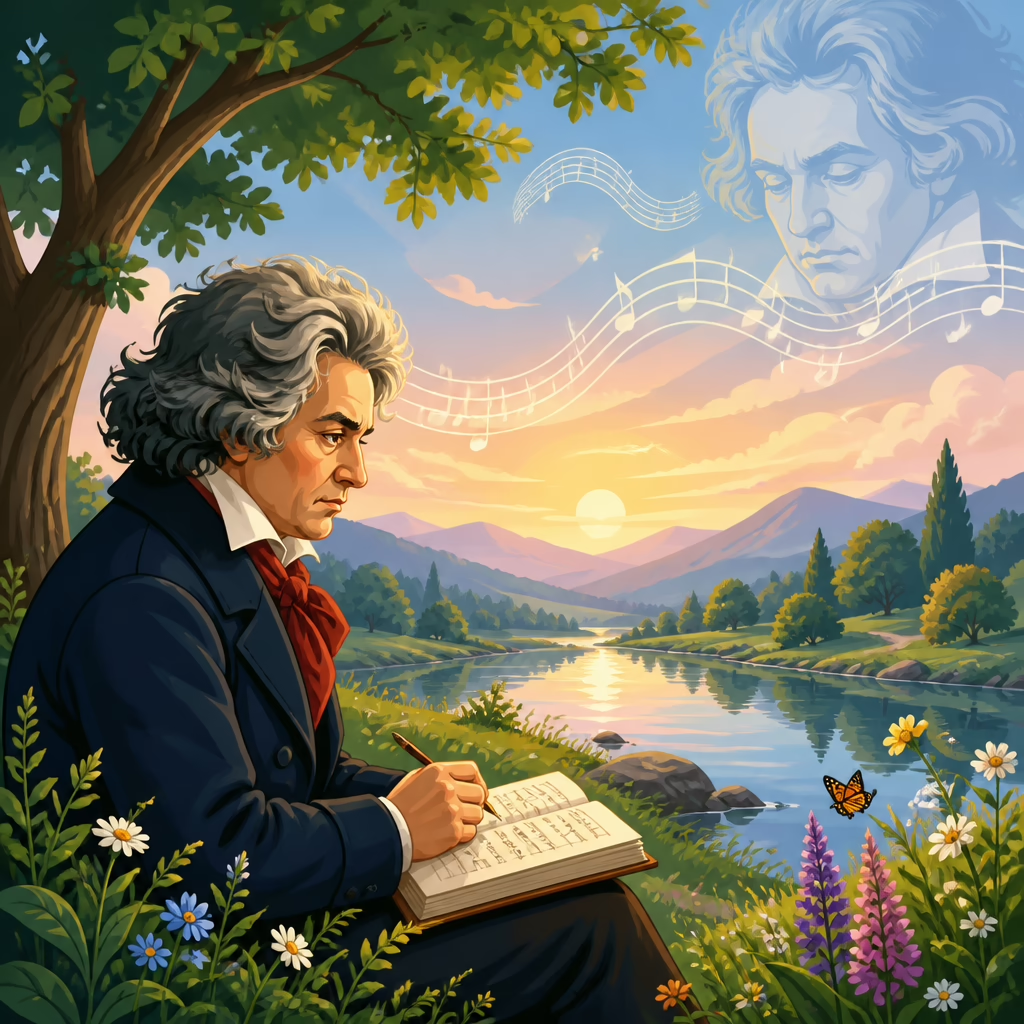
Nature as Memory in Beethoven’s Slow Movements
Beethoven’s slow movements often sound less like descriptions of landscape than acts of remembering it, and that distinction is essential to understanding how nature functions in his music. In this focused view, nature as memory means that birdsong, flowing water, open air, storm light, and pastoral stillness are not simply painted in sound; they are absorbed, recollected, and transformed into inward musical experience. Listeners commonly approach Beethoven and nature through the obvious examples, especially the “Pastoral” Symphony, yet his deeper achievement lies in the Adagio, Largo, and Andante movements where external sensation becomes reflection. I have spent years comparing sketches, scores, and performance traditions, and again and again the same pattern emerges: Beethoven uses slow tempo, sustained harmony, registral spacing, and recurring rhythmic cells to suggest not the immediate field or forest, but the mind returning to those places after the fact. That matters because it changes how we hear expressive time in Beethoven. A slow movement is not merely contrast between fast outer movements. It is a chamber of recollection, where memory softens contour, enlarges silence, and turns physical environment into moral and emotional substance. This article examines how that process works in selected slow movements, why it differs from literal tone painting, and how Beethoven’s habits of walking and solitary observation fed this music at the compositional level. The result is a more precise account of pastoral expression: not scenery for its own sake, but remembered nature shaping form, harmony, and inner speech.
What “nature as memory” means in Beethoven
To call nature a memory in Beethoven is to say that natural experience enters the music after being filtered through time, feeling, and reflection. Beethoven himself distinguished expressive evocation from mere imitation. That distinction helps explain why many of his slow movements feel pastoral without containing obvious pictorial markers. Instead of copying birds or thunder, he often writes textures that resemble the way memory works: fragments recur slightly altered, accompaniments pulse with bodily regularity like footsteps, and harmonies linger as if the mind is reluctant to leave a remembered scene. In practical terms, this means long pedals, repeated-note figures, gently rocking meters, and transparent spacing across registers become structural signs of recollection.
This is especially important in Beethoven because his mature style frequently treats memory as a compositional engine. A theme returns not as identical repetition but as recognition. In slow movements, that recognition can feel environmental. The listener senses distance, air, and horizon even when no explicit program is given. I hear this most strongly when Beethoven thins texture and allows a melodic line to arise over murmuring accompaniment. The effect resembles hearing an inner voice against the persistence of the natural world. Such writing does not trap the music in sentimentality. On the contrary, it creates tensile depth, because memory in Beethoven is rarely passive. It is searching, sometimes consoling, sometimes painful, often poised between rest and unresolved longing.
The “Pastoral” Symphony: scene remembered, not merely described
The obvious center of this discussion is the slow movement of the Sixth Symphony, “Scene by the Brook.” Yet even here, Beethoven’s method is subtler than many listeners assume. The movement’s famous murmuring accompaniment suggests water, but its real power lies in continuity and suspension. The brook is less an object than a medium of thought. The long-breathed melody unfolds with unusual patience, and the harmonic rhythm is broad enough to create a sense of contemplative duration. Rather than directing attention outward toward changing events, Beethoven invites the listener into a state of recollection, where steady motion allows memory to circulate.
Even the bird calls near the end, often treated as proof of direct depiction, arrive after an extended span of inwardness. They function almost like remembered details that surface at the edge of consciousness: named, distinct, but framed by a larger atmosphere that matters more than the local image. In performance, when conductors avoid fussiness and preserve the movement’s flowing line, the result is unmistakable. We are not standing beside a brook hearing random sounds; we are dwelling in the afterlife of that experience. This is why the movement remains moving even for listeners who know nothing of its title.
For readers interested in the broader context of Beethoven’s outdoor habits and their artistic significance, the main guide at Beethoven’s love of walking and what it meant for his music gives the larger frame. Here, the key point is narrower: walking furnished repeated sensory impressions, and repeated impressions are the raw material of memory. The Sixth Symphony’s slow movement turns that raw material into musical time.
Piano sonatas: inward landscapes and remembered air
Beethoven’s piano sonatas provide some of the clearest evidence that pastoral memory can exist without overt program. Consider the opening Adagio sostenuto of the “Moonlight” Sonata. Whatever romantic myths later attached to it, the movement’s texture is defined by a continuous triplet motion over which a restrained melodic line emerges almost reluctantly. The sound world is not a painted night scene. It is an interiorized environment, a remembered stillness shaped by resonance and distance. The sustaining pedal, when used with stylistic intelligence on modern instruments, can help preserve that sense of blurred recollection. The movement’s emotional force comes from the way memory and grief seem fused; nature appears here as atmosphere retained in the mind, not as visible setting.
An equally revealing case is the Adagio un poco mosso of the “Pastoral” Sonata, Op. 28. The nickname is not Beethoven’s, but the movement does support it in a qualified sense. Its calm melodic profile, spacious accompaniment, and unforced pacing suggest open air recollected rather than theatrically represented. The music avoids overt drama. Instead, it creates an impression of grounded serenity, as though the keyboard were recalling the bodily rhythm of walking and the restorative order of the countryside. I have found that performers who phrase this movement as song alone often miss its broader spatial quality. The rests and accompaniment patterns matter because they imply environment.
Other sonata slow movements complicate the picture. The Arioso dolente in Op. 110 is not pastoral on the surface, yet its expressive design still resembles memory’s operation: interruption, return, and transformed recurrence. Beethoven had learned by this late stage that recollection could be broken and yet remain coherent. Nature as memory here is not peaceful scene but lost equilibrium. That nuance is crucial. In Beethoven, remembered nature can console, but it can also measure absence.
String quartets and the late style of recollection
The slow movements of the late quartets deepen the connection between memory and nature by stripping away almost everything decorative. In the C-sharp minor Quartet, Op. 131, the variations-based Andante ma non troppo e molto cantabile unfolds with organic inevitability. Its transformations feel less like formal exercises than like living recollections changing shape as they are revisited. The theme itself has a plainness that invites comparison with folk-like utterance, but Beethoven subjects it to subtle rhythmic and textural reinterpretation, creating the impression of remembered material seen under different weather conditions of the soul.
The “Heiliger Dankgesang” from Op. 132 goes further. Its Lydian-inflected chorale is often discussed in spiritual or medical terms because Beethoven linked it to recovery from illness. Both are relevant, but the movement also sounds like restored contact with the natural order. The alternation between the grave hymn sections and the “new strength” episodes resembles the body relearning vitality through rhythm, breath, and motion. Nature is present not as depiction but as remembered health, remembered sunlight, remembered bodily ease. When I have coached ensembles on this piece, the decisive interpretive issue is pacing the transitions so that the faster sections feel like reawakened life rather than mere contrast. That dramatic logic depends on memory: the music remembers weakness while moving toward renewed animation.
| Work and movement | Nature marker | How memory is conveyed |
|---|---|---|
| Symphony No. 6, II | Murmuring brook texture | Continuous flow and suspended harmony create reflective distance |
| Piano Sonata Op. 27 No. 2, I | Atmospheric stillness | Blurred accompaniment suggests inward recollection rather than scene painting |
| Piano Sonata Op. 28, II | Pastoral calm | Walking-like pulse and spacious phrasing imply remembered open air |
| Quartet Op. 132, III | Restored natural order | Alternation of frailty and renewed motion embodies remembered health |
Compositional techniques that turn landscape into recollection
Several repeatable techniques allow Beethoven to transform natural impression into remembered experience. First is pedal organization. Sustained bass notes or prolonged harmonic support create a sonic ground analogous to environmental continuity. A brook, breeze, or distant horizon is not heard as event but as unbroken presence. Second is rhythmic regularity. Rocking accompaniment patterns, triplet currents, and walking pulses tie musical time to bodily movement. This is one reason Beethoven’s slow movements often feel inhabited rather than staged.
Third is registral design. Beethoven frequently places melody above a spacious middle or low register field, producing air between layers. That air is psychologically potent. It suggests distance and makes melody feel like thought emerging from environment. Fourth is motivic return with slight variation. Memory rarely replays exact originals; it revisits them selectively. Beethoven’s altered repetitions capture that truth with exceptional precision. Fifth is controlled harmonic delay. By postponing cadence, he keeps the listener inside a reflective present, where arrival matters less than dwelling.
These techniques are concrete, not speculative. Analysts can point to them in the score, and performers must make decisions about them in tempo, articulation, pedal, vibrato, and balance. They also explain why literalist readings fall short. If one hears only representation, one misses how carefully Beethoven aligns musical syntax with mental recollection. That alignment is the real source of the music’s natural feeling.
Why this matters for listening and performance
Hearing nature as memory changes interpretation. Conductors and instrumentalists should resist exaggerating picturesque details at the expense of long continuity. In the Sixth Symphony’s brook scene, for example, overemphasizing local motifs can fracture the larger meditative arc. In the piano sonatas, too much rubato can turn recollection into mannerism. Beethoven’s slow movements usually require steadiness with suppleness: pulse remains alive, while phrasing breathes within it. That balance preserves the sense that memory is unfolding organically.
For listeners, this approach clarifies why these movements remain compelling outside their historical moment. Modern audiences do not need to share early nineteenth-century pastoral conventions to understand them. Everyone knows the experience of carrying a place inwardly after leaving it. Beethoven gives that experience form. He shows how remembered nature can steady grief, measure solitude, and restore proportion. The slow movement becomes a site where the outer world, once internalized, continues to shape consciousness. That is one reason his music feels both personal and universal.
Beethoven’s slow movements reveal nature most profoundly when they stop trying to show it and begin to remember it. Across the “Scene by the Brook,” the reflective sonata adagios, and the late quartet meditations, he converts outdoor experience into inward duration, using pedal points, walking rhythms, spacious registers, and transformed recurrence to make memory audible. This reading explains why the music feels pastoral even when explicit depiction is minimal: the natural world survives in contour, pulse, atmosphere, and return. It also explains why these movements carry unusual emotional authority. They do not offer scenic escape. They show how recollected nature becomes part of thought, grief, healing, and self-command.
That insight sharpens both scholarship and listening. Instead of treating Beethoven’s nature references as decorative program or biographical anecdote, we can hear them as structural forces within his slow style. His walks mattered because they furnished repeatable experiences of motion, air, stillness, and renewal; his art mattered because he transformed those experiences into musical memory. The benefit of hearing him this way is simple: the slow movements become richer, more coherent, and more human. Return to a few of them with this idea in mind, follow the continuity beneath the surface details, and notice how often Beethoven is not painting a landscape at all. He is remembering one, and inviting you to do the same.
Frequently Asked Questions
What does “nature as memory” mean in Beethoven’s slow movements?
In this context, “nature as memory” means that Beethoven’s slow movements often do not present the natural world as a direct sonic picture, as though the listener were standing outdoors hearing birds, wind, or water in real time. Instead, nature appears as something inwardly retained, emotionally filtered, and artistically transformed. The music suggests recollection rather than literal description. A singing line may evoke open air, a gently pulsing accompaniment may recall flowing water, or a luminous harmonic shift may feel like changing light, but these gestures function less as imitation than as remembrance.
This distinction matters because it changes how the music should be heard. Rather than asking, “What exact scene is Beethoven depicting?” it is often more productive to ask, “What kind of remembered experience is this music reshaping?” In many slow movements, the atmosphere is intimate, reflective, and deeply interior. Nature is not merely external scenery; it has been absorbed into consciousness. What the listener encounters is not landscape alone, but landscape recollected through feeling, time, and human thought. That is one reason these movements can feel so personal and profound even when they seem to draw on pastoral or elemental imagery.
How is remembering nature different from musically depicting nature?
Musical depiction usually implies some degree of representation: a composer uses recognizable effects to suggest birdsong, thunder, running water, or shepherd pipes. That approach is often called tone painting, and it invites listeners to connect specific sounds with specific natural phenomena. Beethoven certainly knew how to use such devices, and audiences frequently approach his music through obvious examples of pastoral association. But in the slow movements especially, the more revealing question is not whether he can depict nature, but how he transforms it into an inward musical language.
Remembering nature is subtler. A remembered stream does not need to sound exactly like water; it may appear instead as a steady rhythmic undulation that creates mental spaciousness. A recollected birdsong may survive only as contour, delicacy, or fleeting ornament. A sense of open air may be conveyed through harmonic breadth, registral distance, and suspension of tension rather than through overt imitation. In other words, memory loosens the tie between object and sound. The result is often richer than direct depiction because it allows nature to merge with mood, longing, serenity, grief, consolation, and spiritual reflection. Beethoven’s slow movements are so compelling partly because they inhabit this border between sensory image and inner life.
Why are Beethoven’s slow movements especially important for understanding his relationship to nature?
The slow movements are crucial because they give Beethoven room to dwell, meditate, and reshape experience over time. Fast movements can certainly suggest energy, weather, motion, or rustic vitality, but slow movements tend to reveal what nature means after it has passed through memory and emotion. Their pacing allows small gestures to acquire unusual weight: a held note can feel like suspended air, a repeated accompaniment can suggest continuity or distance, and a gradual harmonic turn can resemble the dawning of recollection itself. These are ideal conditions for presenting nature not as spectacle, but as inward presence.
They are also important because Beethoven’s expressive world in slow tempo is rarely superficial. Even when the music sounds calm, it is often charged with reflection, tenderness, solitude, or hard-won peace. That emotional density helps explain why references to the natural world in these movements frequently seem spiritualized. Nature becomes a medium through which Beethoven explores memory, vulnerability, and renewal. The listener senses fields, light, silence, and elemental motion, but not as decorative backdrop. Instead, these qualities are woven into the music’s emotional and structural fabric. For that reason, the slow movements often provide a clearer path into Beethoven’s deepest artistic thinking about nature than the more obvious moments of scenic evocation.
Does this idea relate only to the “Pastoral” Symphony, or does it apply more broadly across Beethoven’s music?
It applies much more broadly. The “Pastoral” Symphony is the work most listeners naturally think of because it openly invites connections to the countryside and includes explicit references that seem to encourage pictorial hearing. Yet focusing only on that example can narrow our understanding of Beethoven. The larger pattern across his output shows that nature is not confined to one programmatic composition. In many slow movements for piano, chamber ensemble, sonata, quartet, and symphony, Beethoven creates sound worlds that evoke stillness, breadth, organic motion, atmospheric change, and contemplative distance without turning those qualities into literal scene painting.
That broader perspective is valuable because it reveals continuity in Beethoven’s imagination. Nature appears not just as subject matter, but as a way of organizing feeling. He often composes textures that breathe, unfold, and return in ways that resemble recollection rather than narration. The sense of pastoral stillness, open space, storm-cleared calm, or flowing continuity may emerge without any explicit label at all. When heard this way, Beethoven’s engagement with nature becomes less about isolated illustrative moments and more about an enduring habit of musical thought: external experience becomes internal resonance. That is why the concept of nature as memory can illuminate works far beyond the most famous pastoral reference points.
What musical features help listeners hear nature as inward memory in Beethoven’s slow movements?
Several recurring features can guide the ear. One is accompaniment patterning: rocking figures, sustained pedals, soft pulsations, and gently circulating rhythms often create an impression of ongoing natural process without naming it directly. Another is melodic shape. Beethoven’s slow-movement melodies frequently unfold with vocal breadth, patient spacing, and expressive restraint, which can make them feel like recollection rising gradually into awareness. Harmony also plays a major role. Unexpected modulations, distant key areas, and radiant moments of release can produce sensations akin to remembered light, changing weather, or sudden emotional clarity.
Texture and register are equally important. Widely spaced sonorities can suggest openness and air; quiet high-register details may hint at fragility or birdsong-like delicacy; darker inner voices can introduce the shadow that memory often carries. Silence matters too. Pauses, hesitations, and suspended cadences can make the music feel reflective, as though it were listening to itself. Most importantly, these elements usually work together rather than in isolation. Beethoven does not need to quote nature literally for listeners to feel its presence. He can imply it through atmosphere, pacing, contour, and transformation. When heard attentively, the music often sounds like a mind revisiting the natural world and discovering that what remains is not raw image, but emotional truth shaped by memory.