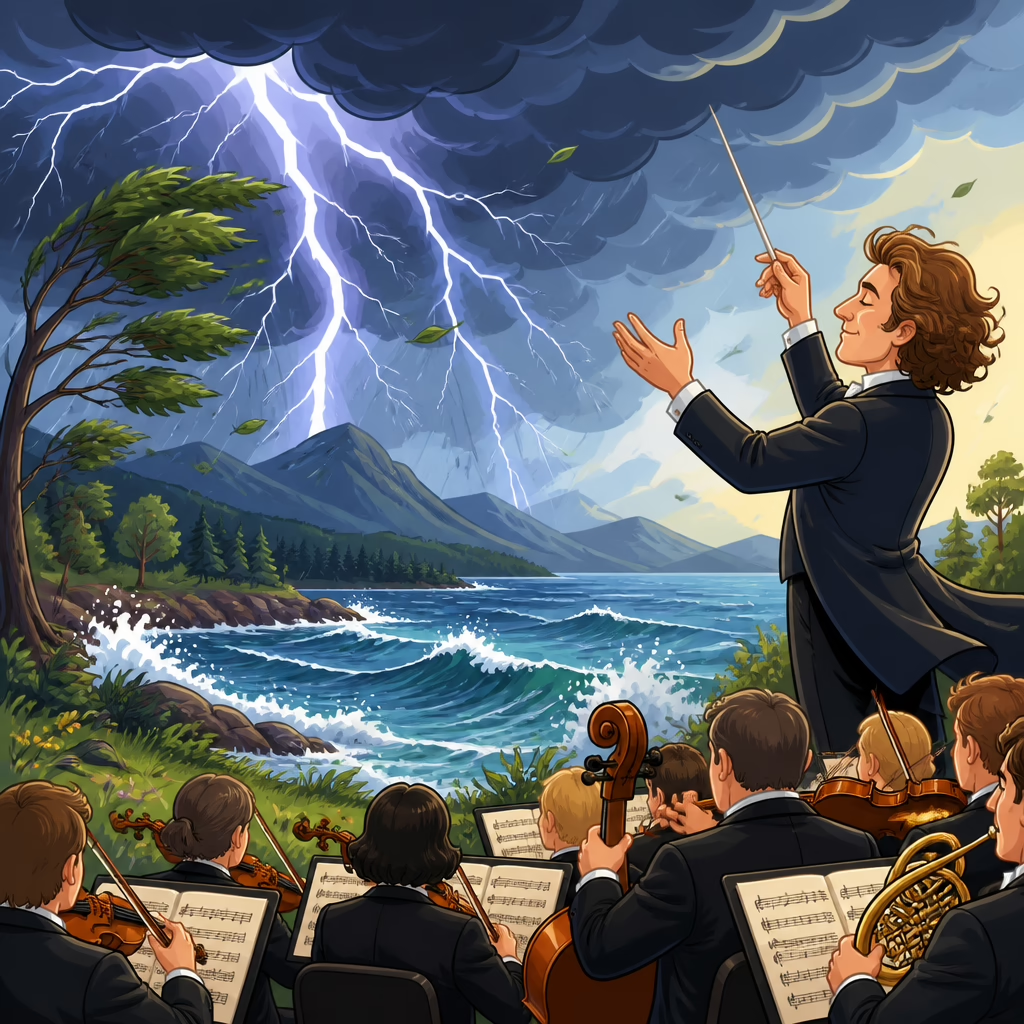
The Storm Scene in Symphony No. 6 Explained
Beethoven’s Storm scene in Symphony No. 6 is one of the clearest examples in classical music of how sound can depict weather without becoming mere noise. Found in the fourth movement of the “Pastoral” Symphony, this short but electrifying episode translates gathering clouds, thunder, wind, and rain into orchestral terms with remarkable precision. To explain it properly, it helps to define two key ideas. First, Symphony No. 6 in F major, Op. 68, is a programmatic symphony, meaning it follows an extra-musical idea rather than relying only on abstract musical development. Second, the Storm scene, marked “Gewitter, Sturm,” is not a detached tone poem inserted for effect. It is part of a continuous five-movement design that moves from rural calm to human celebration, sudden disruption, and finally thanksgiving after danger passes.
That context matters because Beethoven himself resisted the idea that the “Pastoral” was simple scene painting. He wrote that the symphony was “more the expression of feeling than painting.” In practice, that means the Storm scene does imitate nature, but always through human perception. We do not hear a meteorological chart translated into notes. We hear a storm as experienced by a listener in the countryside after moments of rest, observation, and communal joy. Having worked closely with this score in rehearsal rooms and at the piano, I can say the scene only makes full sense when heard as a rupture in emotional balance. Beethoven prepares the storm carefully, controls its force with unusual discipline, and then releases tension in a way that makes the final movement’s gratitude feel earned rather than decorative.
For listeners, students, and performers, the movement matters because it shows Beethoven at his most economical and vivid. In just a few minutes he expands orchestral color, intensifies rhythm, and uses harmony to create genuine fear without losing formal coherence. It also reveals how deeply he understood nature as a lived experience, not a backdrop. If the earlier movements present brook, dance, and open air as spaces of renewal, the Storm scene reminds us that nature is never only gentle. Its power can interrupt human pleasure instantly. That tension between delight and vulnerability is exactly what gives the “Pastoral” its staying power.
Where the Storm scene sits in the symphony
The Storm is the fourth movement, placed directly after the peasants’ merry gathering and before the shepherds’ song of thanksgiving. Beethoven links these movements without a full stop, so the storm feels like an event breaking into real time rather than a new chapter politely announced. The third movement, a rustic dance, builds rustic energy through repeated figures and uneven accents. Then the mood darkens. The transition is one of Beethoven’s smartest dramatic moves: instead of announcing catastrophe with a grand opening gesture, he lets instability creep in. Rhythms tighten, textures shift, and the floor seems to drop away beneath the dancers.
This placement is essential to interpretation. If the Storm stood alone, it would be a strong descriptive piece. Embedded between communal festivity and thanksgiving, it becomes a narrative hinge. We hear people enjoying the countryside, then scrambling as weather changes, then recovering emotionally after the danger passes. That is why the scene never sounds like empty spectacle. Beethoven understood sequence. Peace first, then interruption, then relief. The emotional logic is simple enough for any listener to follow, yet sophisticated enough to sustain close analysis. The pastoral world is not destroyed by the storm; it is tested by it. That distinction shapes the movement’s character from first rumble to final dissipation.
Anyone exploring Beethoven’s relationship with outdoor experience will also hear how naturally this episode fits into his larger imaginative world. A useful broader companion is this guide to Beethoven’s love of walking and what it meant for his music, which helps explain why weather, terrain, motion, and changing light feel so physically grounded in the “Pastoral.” In the Storm scene specifically, the countryside is not an idealized painting. It is a place where exposure matters.
How Beethoven builds a storm in sound
Beethoven uses several musical parameters at once to create the illusion of an approaching and then raging storm: orchestration, register, rhythm, dynamics, articulation, and harmony. None of these elements is novel on its own. The brilliance lies in coordination. Lower strings and tremolos suggest unsettled atmosphere before the full force arrives. Rapid figures in the violins can read as wind or pelting rain depending on context. Sudden dynamic surges create lightning-like shocks, while timpani and low brass add the unmistakable sense of thunder.
One reason the movement remains so effective is that Beethoven does not overdescribe every detail. He selects a few high-impact devices and uses them with timing that feels inevitable. The piccolo, trombones, and timpani are especially important. Their appearance is dramatic because they expand the symphony’s sound world at the exact moment nature turns dangerous. In many performances, the entrance of piccolo cuts through the texture like a flash across dark sky, while trombones add weight that earlier movements deliberately avoid. The timpani do not merely mark rhythm; they function as atmospheric force.
Harmony also does crucial work. Beethoven destabilizes the tonal comfort established earlier in the symphony. The listener senses pressure not only because the music gets louder, but because harmonic footing grows less secure. Dissonances bite harder, phrases feel less settled, and cadences lose their reassuring finality. This is how Beethoven turns descriptive writing into genuine drama. We do not only hear external weather. We feel structural disturbance.
| Musical element | How Beethoven uses it | What the listener perceives |
|---|---|---|
| Tremolo strings | Repeated rapid bowing in lower and middle textures | Distant rumble, unstable air, rising tension |
| Piccolo | Bright high register cutting through full orchestra | Wind gusts or lightning-like brilliance |
| Timpani | Forceful strokes supporting climaxes | Thunder and physical shock |
| Trombones | Added only in the storm’s expanded palette | Mass, darkness, and elemental power |
| Syncopation and driving rhythm | Accents displaced against the beat | Loss of balance, panic, forward pressure |
| Harmonic instability | Tension-filled progressions and delayed resolution | Unease, danger, and emotional dislocation |
Instrumentation and why it sounds so vivid
The orchestration of the Storm scene deserves special attention because Beethoven uses the orchestra almost theatrically while remaining symphonic in method. Symphony No. 6 is scored for pairs of winds, horns, strings, and then, crucially for the storm, piccolo, two trombones, and timpani. Those last instruments are withheld until needed, which magnifies their impact. This is not constant coloristic luxury in the later Romantic sense. It is strategic deployment.
In rehearsal, one of the first things players notice is how carefully balance must be managed. If the brass dominate too early, the storm becomes blunt. If the strings underplay their agitation, the approach lacks suspense. Beethoven wants gradation. The storm should accumulate, burst, and then recede. Conductors who shape the movement best usually preserve textural transparency even at climactic moments, allowing listeners to hear layers rather than a generalized roar.
Historically informed performances often sharpen this effect. Natural brass and harder timpani sticks can make attacks more pungent and less cushioned than in plush modern orchestral style. Leaner string vibrato can also clarify the grain of tremolos and repeated notes, making the weather feel rougher. Yet modern instruments can be equally persuasive when articulation remains taut. The point is not antiquarian purity. It is dramatic function. Every color in the movement should sound necessary.
The piccolo’s role is especially telling. Beethoven does not use it simply because storms are loud and high notes pierce. He uses it because the ear interprets brilliant upper-register sound as exposure. It gives the sensation of sky opening above the orchestra. Likewise, trombones deepen the sonic horizon. Their presence broadens the storm from surface disturbance into something monumental. Beethoven’s instinct for physical scale here is masterly.
Rhythm, form, and the feeling of danger
Listeners often describe the Storm scene mainly in terms of orchestral imitation, but its real force comes from rhythm and form. Beethoven knows that fear is not just loudness. Fear is acceleration, unpredictability, interrupted expectation, and the sense that stable patterns are being overwhelmed. Throughout the movement, short motives are driven insistently rather than developed expansively. This compression gives the music urgency. It feels as though events are happening faster than people can react.
At the same time, Beethoven never abandons control. The scene has an arc. It begins with signs, intensifies through accumulation, reaches powerful climaxes, and then thins out. This disciplined curve is why the movement remains convincing after repeated listening. Many lesser storm depictions in eighteenth- and nineteenth-century music rely on stock devices but lack architecture. Beethoven’s scene works because every gesture belongs to a larger trajectory. The storm arrives from somewhere and goes somewhere.
That architecture also supports the transition into the fifth movement. The danger does not simply stop. It passes. Beethoven writes the recession with as much care as the outbreak. Textures lighten, pressure eases, and the music begins to breathe again. This is psychologically accurate. Real storms often leave a charged silence before normal life resumes. Beethoven catches that sensation in purely musical terms. The final movement’s famous serenity is therefore not a reset button; it is emotional afterweather.
For students analyzing the score, this is the key point: the Storm scene is descriptive because it is structural. Its meaning comes from position, pacing, and consequence. Remove those, and you reduce it to effects. Keep them, and it becomes one of the most persuasive narrative movements in the symphonic literature.
What the Storm scene means inside the “Pastoral”
The strongest interpretation of the Storm scene is not that Beethoven is painting nature as enemy. Rather, he is acknowledging nature’s full range. The symphony’s earlier movements celebrate ease, gratitude, and immersion in the countryside. The storm introduces risk, which prevents the pastoral world from becoming sentimental. In my experience, this is why the movement feels modern. It recognizes that closeness to nature includes uncertainty.
Beethoven’s own subtitle for the finale, “Shepherds’ song; happy and thankful feelings after the storm,” confirms this reading. The emotional destination is not triumph over nature, as if humans have conquered it. It is thankfulness after surviving it. That nuance matters. The symphony does not dramatize domination. It dramatizes dependence, exposure, and renewed humility. The countryside in Symphony No. 6 is a place of consolation, but also a place where human beings are small.
This perspective also explains Beethoven’s remark about feeling rather than painting. The storm is not just an acoustic picture of rain. It is the crisis point that makes gratitude sincere. Without interruption, thanksgiving would be generic. With interruption, it becomes specific. The listener has passed through tension into release. In that sense, the fourth movement is spiritually functional. It purifies the symphony’s emotional language by testing it.
There is also a social dimension. Coming after the peasants’ gathering, the storm disrupts communal enjoyment, not solitary contemplation alone. Beethoven presents nature as something shared by a group of people whose pleasures are ordinary and embodied: dancing, gathering, moving outdoors. When the weather turns, everyone is implicated. That makes the scene humane rather than abstract. We can imagine actual bodies in an actual place reacting to actual danger. Few passages in Beethoven combine pictorial vividness and human truth so economically.
How to listen to the movement closely
If you want to hear the Storm scene with maximum clarity, focus on sequence rather than isolated noise. First, listen for the transition from the third movement and notice how instability enters before full violence. Second, track the orchestra by layers: low string agitation, wind interjections, brass expansion, timpani shocks, and the piercing top line of the piccolo. Third, pay attention to how often Beethoven withholds full resolution. Your ear will register threat partly because closure keeps being delayed.
It also helps to compare different recordings. Some conductors make the storm heavy and monumental; others stress speed, nervousness, and transparency. A broad approach can emphasize elemental grandeur, while a leaner one can make the music feel alarmingly immediate. Neither is automatically correct. The best performances, however, preserve motion. If the pulse turns sluggish, the storm loses danger and starts sounding ceremonial.
Finally, do not separate the movement from what follows. The most revealing listening strategy is to hear the fourth and fifth movements together. Only then can you appreciate Beethoven’s full design: disturbance giving way to gratitude. That arc is the real explanation of the Storm scene’s greatness. It is not famous merely because it sounds like thunder. It endures because Beethoven makes weather serve feeling, structure, and meaning at once. Listen again with those relationships in mind, and the movement opens up far beyond its surface drama. The storm becomes a lesson in how Beethoven turns nature into lived musical experience. Return to the score or a favorite recording and hear how every rumble prepares thanksgiving.
Frequently Asked Questions
What is the Storm scene in Beethoven’s Symphony No. 6?
The Storm scene is the fourth movement of Beethoven’s Symphony No. 6 in F major, Op. 68, widely known as the “Pastoral” Symphony. Its full descriptive title is often translated as “Thunderstorm” or “Storm,” and it appears after the peaceful country gathering of the third movement and before the grateful calm of the finale. That placement matters because Beethoven did not treat the storm as an isolated display of orchestral power. Instead, he made it part of a larger dramatic and emotional sequence: rural joy, sudden disturbance, then restoration and thanksgiving.
This movement is one of the most famous examples of programmatic writing in classical music. A programmatic symphony is a work that follows an extra-musical idea, story, scene, or mood, and the “Pastoral” does exactly that by evoking aspects of life in the countryside. In the Storm scene, Beethoven uses instrumental color, rhythm, dynamics, and harmony to suggest natural events such as gathering clouds, gusting wind, heavy rain, lightning, and thunder. The remarkable achievement is that the music remains fully structured and expressive as symphonic writing while still sounding vividly descriptive. It never collapses into random effects. That balance is exactly why the movement is so often discussed as a masterclass in musical depiction.
How does Beethoven musically depict a thunderstorm in the fourth movement?
Beethoven builds the storm gradually rather than announcing it all at once. The movement begins with uneasy rhythmic activity and darker orchestral coloring that suggest the first signs of atmospheric change. Listeners often hear this as the moment when the sky starts to shift and tension enters the landscape. He then layers the orchestra more densely, increases dynamic force, and intensifies harmonic pressure so the storm feels as if it is truly gathering overhead. This sense of escalation is crucial. The storm does not simply appear; it forms.
He also assigns different musical functions to different orchestral elements. Low strings and bass instruments can imply rumbling distance, while agitated figures in the violins and woodwinds resemble wind-driven motion or sheets of rain. Sudden accents and forceful outbursts contribute the feeling of lightning flashes and thunderclaps. Beethoven’s use of timpani is especially important because it gives the storm a physical, percussive presence that audiences immediately associate with thunder. Brass instruments add weight and menace, making the sound world broader and more overwhelming as the movement reaches its peak.
What makes this depiction so convincing is precision. Beethoven does not rely on a single trick or one obvious sound effect. Instead, he coordinates tempo, texture, register, orchestration, and dynamic contrast so that each musical choice contributes to the image of unstable weather. The result feels dramatic but never chaotic in an unshaped way. The storm has contour, climax, and release, just as an actual storm does, and that architectural control is a major reason the movement remains so compelling.
Why is the Storm scene considered program music rather than just dramatic orchestral writing?
The key difference is intention. Program music is written to evoke something outside the music itself, such as a natural scene, poetic image, narrative sequence, or emotional journey tied to a specific subject. Beethoven identified the “Pastoral” Symphony with scenes and feelings associated with the countryside, and the Storm movement is explicitly part of that concept. It is not merely intense music that listeners later decided sounded stormy. Beethoven framed it as storm music within a larger pastoral design.
That said, Beethoven was careful about how literal he wanted to be. He famously suggested that the symphony expressed “more the expression of feeling than painting.” This idea helps explain why the Storm scene works so well artistically. Beethoven is not trying to imitate weather in a crude, theatrical way. He is translating the experience of a storm into symphonic language. The listener senses fear, disruption, energy, and awe, not just a checklist of meteorological details. In other words, the movement is descriptive, but it is also deeply expressive.
This distinction matters because it shows why the Storm scene has lasting musical value. If it were only an audio illustration of thunder and rain, it might impress briefly and then lose significance. Instead, Beethoven makes the storm part of a broader emotional arc about nature, vulnerability, and relief. That is the essence of successful program music: the scene is vivid, but the meaning extends beyond the scene itself.
What instruments stand out most in Beethoven’s Storm scene, and what do they represent?
Several instrumental groups play especially memorable roles in the movement. The timpani are perhaps the most obvious because they strongly suggest thunder through deep, forceful, repeated strikes. Beethoven uses them not as decorative punctuation but as an essential structural and atmospheric element. Their impact gives the storm weight and immediacy, helping the listener feel the physical violence of the weather.
The strings are equally important, especially in creating motion. Rapid figures can sound like driving rain, swirling air, or trembling agitation in the environment. Beethoven often uses the string section to keep the texture alive and unsettled, so even before the loudest moments arrive, there is a sense that the atmosphere is unstable. Woodwinds add flashes of color and unpredictability, contributing to the feeling of gusts, shifting currents, and sudden changes in intensity. Their timbres can cut through the texture in a way that feels like nature interrupting calm.
Brass instruments reinforce the storm’s grandeur and danger. They broaden the sound and make the climaxes feel larger than human scale, which is exactly right for a natural force that overwhelms the pastoral setting established earlier in the symphony. Lower instruments, including cellos, basses, and bassoons, help create the ominous undercurrent that suggests distant rumbling before the storm fully breaks. Beethoven’s genius lies in how these instrumental roles interact. No single instrument “is” the storm by itself. The storm emerges from the orchestra as a total system of carefully coordinated sound.
Why is the Storm scene so important in the overall meaning of the “Pastoral” Symphony?
The Storm scene is important because it provides the central disruption in the symphony’s emotional and narrative flow. The “Pastoral” is not just a sequence of pleasant rustic images. It presents nature as something beautiful, immersive, and also powerful enough to unsettle human life. By placing the storm after scenes of country calm and festivity, Beethoven shows that pastoral experience includes vulnerability as well as delight. The countryside is not a decorative backdrop. It is a living environment governed by forces beyond human control.
The movement also gives the finale its emotional significance. After the storm passes, the last movement feels like more than a simple return to pleasant music. It becomes a response of relief, gratitude, and renewed peace. Without the storm, that closing thanksgiving would not feel as earned or as profound. Beethoven uses contrast to deepen meaning: serenity is more moving after turmoil, and gratitude is more convincing after danger.
From a historical and artistic standpoint, the Storm scene also demonstrates how far Beethoven expanded the expressive possibilities of the symphony. He showed that orchestral music could depict specific natural events while still maintaining formal coherence and serious artistic purpose. That achievement influenced later composers who wrote descriptive and narrative orchestral works. In that sense, the Storm scene matters not only within the “Pastoral” Symphony itself but also in the broader development of program music in the nineteenth century and beyond.