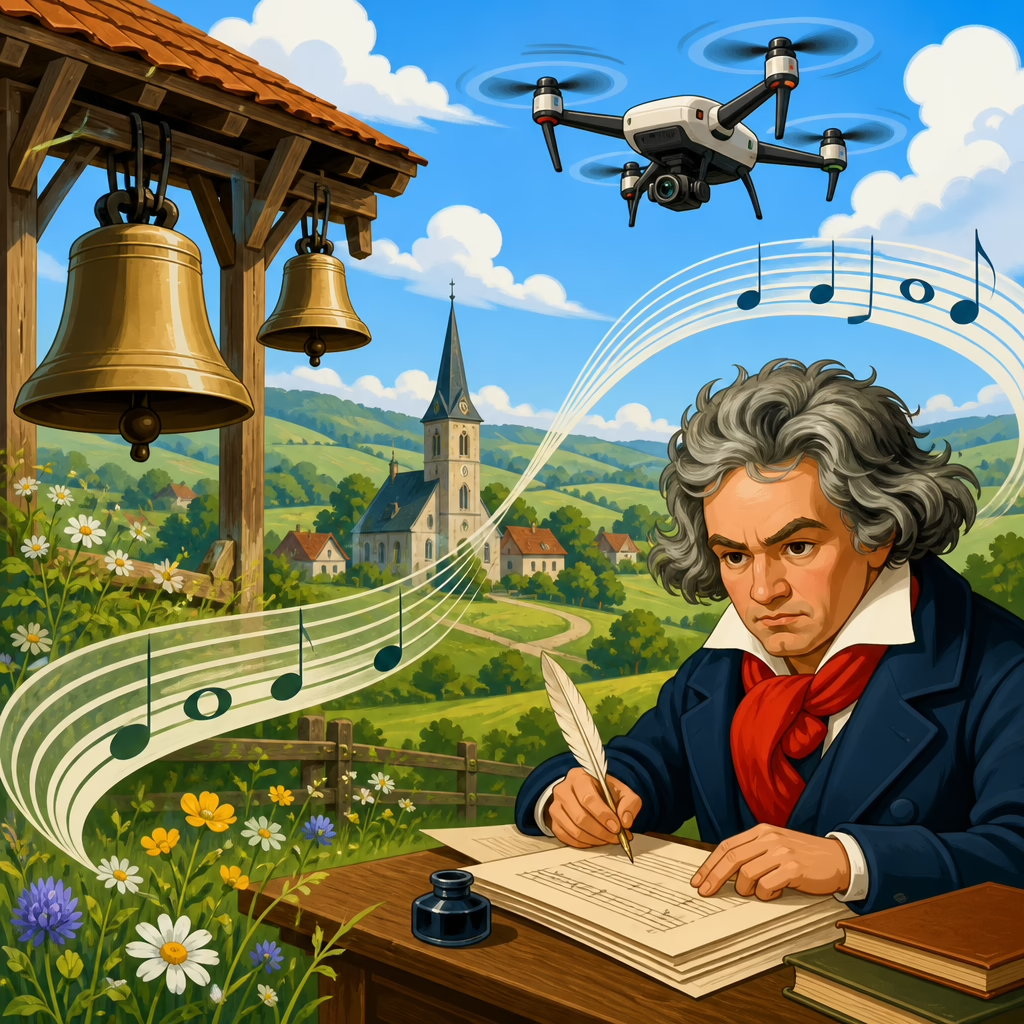
Rural Bells Drones and Open Fifths in Beethoven
Beethoven’s use of rural bells, drone basses, and open fifths is one of the clearest ways he translated outdoor sound into art music. In this narrow corner of his style, he did not merely imitate nature; he chose elemental intervals, static pedal points, and bell-like spacing to evoke distance, stillness, village ritual, and the acoustic world of the countryside. “Open fifths” refers to the interval formed by a note and its fifth without the third that would define major or minor quality. A “drone” is a sustained or repeated pitch, often in the bass, that anchors changing harmonies above it. “Rural bells” describes passages that recall church bells, herd bells, or simple peasant sonorities through repeated notes, bare intervals, registral separation, and rhythmic regularity. These devices matter because they reveal how Beethoven built a musical language of landscape using structure rather than decorative effects.
I have spent years studying Beethoven scores at the keyboard, and these textures always stand out because they feel physically different under the hands. They are sparse, resonant, and often deliberately unrefined. Instead of dense motivic argument, Beethoven sometimes strips the musical surface to a few tones that ring like signals across a valley. In performance, those moments alter the listener’s sense of space: harmony seems to pause, time broadens, and the music suggests hearing from afar rather than speaking directly. That effect is not accidental. Beethoven knew that bells and drones carry over distance, and he adapted that acoustic fact into compositional practice. When he wanted to suggest pastoral life, memory, or elemental groundedness, open fifths became a reliable tool.
This topic is especially important within Beethoven and nature because it shows that his pastoral imagination was concrete. He did not treat nature as a vague mood. He listened to actual sonic environments: village bands, church towers, shepherd calls, hurdy-gurdy drones, bagpipe-like basses, and the hollow resonance of simple intervals outdoors. In a composer often celebrated for dramatic development and harmonic force, these passages remind us of another discipline: restraint. Beethoven understood that a bare fifth can evoke more landscape than a full orchestral paragraph if it is placed with precision. To grasp his nature writing fully, it is necessary to hear how these rural sonorities function technically and expressively.
What Open Fifths and Drones Mean in Beethoven’s Musical Language
Open fifths are powerful because they are harmonically incomplete yet acoustically stable. By omitting the third, Beethoven avoids committing the sonority immediately to major or minor. That ambiguity is useful when the goal is atmosphere rather than harmonic declaration. The interval also resembles the overtone structure listeners naturally perceive in resonant sound, which helps explain why it feels ancient, plain, and outdoor-facing. In Beethoven, open fifths often appear in low registers, spread octaves, horn-like calls, or repeated accompanimental figures. They can suggest rustic instruments, especially pipes and bagpipes, whose tuning and sustaining behavior favor simple intervallic support over chromatic definition.
Drones serve a related purpose. A drone creates continuity beneath melodic movement, allowing the ear to experience place before progression. In practical terms, when Beethoven sustains tonic or dominant pitches under changing upper voices, he reduces the sense of urban harmonic motion and replaces it with something more spatial and cyclical. This is one reason pastoral passages often seem to “stand” rather than “go.” A drone says that the ground remains fixed while life unfolds above it. Folk traditions across Europe use this principle constantly, and Beethoven absorbed it into art music without flattening it into cliché. His drones can be literal pedals, oscillating fifths, repeated tonic-dominant patterns, or long-held orchestral foundations.
Bell effects overlap with both techniques. Real bells often emphasize strong partials and can obscure triadic definition, especially at a distance. Beethoven recreates this through repeated dyads, tolling rhythms, registral gaps, and non-legato articulation. Importantly, he rarely treats bells as pure sound effects. They become compositional signals. A bell-like figure may establish locale, suspend motion, mark ritual time, or frame a memory of rural order against more complex surrounding material. In Beethoven’s best examples, bells, drones, and open fifths are not surface ornaments. They are structural images embedded in harmony, texture, and rhythm.
The “Pastoral” Symphony as the Central Example
No work is more important here than the Sixth Symphony, Op. 68. Although Beethoven famously wrote that it was “more the expression of feeling than painting,” he filled it with highly specific sonic cues. The first movement’s accompanimental patterns frequently lean on simple intervallic supports that avoid heavy chromatic pressure. They create breadth and ease, the sense of walking into open country rather than entering a salon. Even when the harmony is fully tonal, Beethoven often spaces it so that fifths and pedal tones remain audible as a basic floor. That matters because the rustic character comes as much from spacing and persistence as from melody.
The second movement, “Scene by the Brook,” uses sustained tones and gently repeated figures to create environmental continuity. Listeners often focus on the famous bird calls near the end, but the deeper pastoral craft lies in the held supports and quietly circling accompaniment. The effect resembles nature heard over an unchanged ground. Beethoven avoids restless bass behavior, and the result is a sonic image of place. In rehearsals, conductors often emphasize this by keeping the bass line unhurried and transparent, allowing the pedal-like resonance to function as landscape rather than mere harmony.
The fifth movement, the “Shepherd’s Song,” is the clearest fusion of rural bells, drone logic, and open intervals. After the storm, Beethoven restores order through textures associated with peasant thanksgiving. The bass often behaves like a grounded drone, and melodic writing above it has the simplicity of communal music making. The orchestration reinforces the effect: winds and strings are balanced to suggest air, distance, and uncomplicated sonority rather than metropolitan polish. If you want a broader context for how walking, outdoor listening, and landscape fed these choices, see the main guide at Beethoven’s love of walking and what it meant for his music.
How Beethoven Suggests Bells Without Literal Imitation
Beethoven’s bell writing is most convincing when he avoids making it too pictorial. Instead of reproducing a peal exactly, he captures the conditions under which bells are heard: repetition, intervallic simplicity, and resonance across space. In piano music, this can appear as repeated notes separated by empty intervals, creating a tolling profile. In orchestral music, he may distribute the pitches across instrumental families so the ear perceives strikes and lingering resonance. The key point is that bells are rarely harmonically busy. Their power lies in recurrence and decay, and Beethoven composes those qualities directly into rhythm and texture.
One practical hallmark is registral separation. A low bass note or fifth may act as the tower’s weight, while upper repeated notes suggest the strike and after-ring. Another is metric regularity. Rural bells organize communal time: prayer, work, warning, celebration. Beethoven mirrors that social function with pulse patterns that feel inevitable rather than rhetorical. Even when the surrounding music grows animated, bell figures maintain impersonal steadiness. That contrast is expressive. Human emotion moves around them, but the bell stands outside individual feeling, representing place, ritual, or memory.
He also understands that bell sonority can be emotionally double-edged. It can be peaceful, but it can also be uncanny. Because open fifths lack the third, they can feel pure or stark depending on context. In some Beethoven passages, a tolling interval sounds consoling, as if heard from a village below. In others, the same emptiness can suggest remoteness. This ambiguity is one reason the technique remains compelling. It is not naive rusticism. Beethoven uses the rural signal to open emotional space, not to shut complexity down.
Key Works and Techniques at a Glance
Across Beethoven’s output, these devices appear in varied forms rather than a single formula. The table below summarizes the main patterns musicians listen for when identifying rural bell, drone, and open-fifth writing.
| Work or context | Technique | What listeners hear | Expressive result |
|---|---|---|---|
| Symphony No. 6, outer movements | Bass pedals, open spacing, repeated simple accompaniments | Bagpipe-like grounding and rustic breadth | Stable pastoral setting |
| Symphony No. 6, finale | Drone-based bass behavior with hymn-like melody | Village thanksgiving after storm | Communal relief and renewal |
| Piano textures in moderate tempo | Repeated notes with wide interval gaps | Tolling or distant bell resonance | Memory, distance, ritual time |
| Horn-like orchestral calls | Bare fifths and octave reinforcement | Outdoor signal rather than indoor harmony | Landscape and summons |
| Folk-inflected accompaniment patterns | Tonic-dominant oscillation without full triadic filling | Drone substitute in art-music texture | Rustic simplicity with formal control |
Notice that none of these techniques depends on quotation of an actual folk tune. Beethoven can imply the countryside with interval, register, and persistence alone. That is why analysts who focus only on melody miss part of the picture. The bass plan and spacing often carry the pastoral code more decisively than the tune. In performance, if those foundational intervals are buried under pedal, overblended strings, or excessively romantic phrasing, the rural image weakens. Clear voicing restores it.
Why These Sounds Feel Rural: Instruments, Acoustics, and Cultural Memory
The association between drones, open fifths, and rural life did not arise arbitrarily. It comes from instruments and environments common in Beethoven’s world. Bagpipes and hurdy-gurdies sustain simple pitch centers. Natural horns favor open harmonics. Church and herd bells project partial-rich tones that are identifiable over long distances even when harmonic detail is reduced. Outdoor music making also rewards intervals that remain intelligible in open air. A compact chromatic sonority can blur outside; a fifth carries. Beethoven’s writing aligns with those realities so closely that the effect feels earned rather than invented.
Cultural memory matters too. By the late eighteenth and early nineteenth centuries, urban listeners already recognized certain “pastoral” signs. Composers before Beethoven had used drones and simple meters to suggest shepherd scenes. What Beethoven changed was the weight and seriousness of the technique. He integrated it into large-scale symphonic form and gave rustic sonority structural dignity. The pastoral in his hands is not comic interlude. It is a way of hearing human life in relation to land, weather, labor, and gratitude. The humble fifth becomes philosophically charged because it represents a ground older than sophisticated society.
This explains why the sound remains immediate today. Even modern listeners with no direct contact with village bells still perceive these intervals as spacious and elemental. Film composers continue to rely on similar methods when suggesting open landscapes or inherited tradition. The reason is not nostalgia alone. Open fifths reduce harmonic information while increasing acoustic clarity, and the brain interprets that balance as distance, origin, or atmosphere. Beethoven grasped that intuitively and deployed it with unusual discipline.
Interpretation, Limits, and What Musicians Should Listen For
Performers should not exaggerate these passages into caricature. The goal is not to make Beethoven sound primitive. It is to preserve the plainness he deliberately composed. On piano, that means clean pedaling, careful release, and voicing that lets repeated notes ring without blur. In orchestra, it means transparent bass foundations, restrained vibrato where appropriate, and enough rhythmic steadiness for tolling or drone effects to register. Conductors who hurry pastoral finales often erase the sense of grounded communal music. The bass must feel inhabited, not merely functional.
There are also analytical limits worth stating clearly. Not every open fifth in Beethoven is rural, and not every pedal point evokes nature. Sometimes a fifth is simply efficient voice leading, a horn gesture, or a dramatic starkness unrelated to landscape. Context decides meaning. The surrounding rhythm, orchestration, tempo, and formal placement determine whether a listener hears village resonance or something more abstract. Good analysis therefore avoids automatic symbolism. The claim is not that these sonorities always mean countryside, but that Beethoven repeatedly uses them as part of a recognizable rural vocabulary.
The most useful listening question is simple: does the texture make harmony behave like place? When bass pitches persist, thirds recede, and repeated tones toll above spacious registers, Beethoven invites us to hear environment as structure. That is the essence of rural bells, drones, and open fifths in his music. They ground feeling in sound that seems older than individual emotion, and they let landscape enter composition without mere imitation. Listen for those moments in the Sixth Symphony and related passages, then follow how little material Beethoven needs to create an entire world. Once you hear that craft clearly, his nature writing becomes more precise, more human, and far more profound.
Frequently Asked Questions
What do “open fifths,” drones, and rural bells mean in Beethoven’s music?
In Beethoven’s musical language, these three devices are closely related ways of suggesting the sound world of the countryside. An open fifth is the interval between a note and its fifth without the third that would normally identify the harmony as major or minor. Because that defining third is missing, the sound feels bare, spacious, and elemental. It can seem older than common-practice harmony, almost like a musical foundation before emotional color has been added. A drone is a sustained or repeatedly sounded bass note, or sometimes a pair of notes, that remains fixed while other material unfolds above it. That kind of static underpinning evokes bagpipes, hurdy-gurdies, rustic fiddling traditions, and outdoor music-making more generally.
“Rural bells” refers less to literal bell transcription than to a cluster of compositional effects: repeated pitches, simple intervallic shapes, open spacing, resonance, and a sense of sound carrying across a distance. Beethoven often relied on these stripped-down sonorities when he wanted to suggest village life, pastoral stillness, or ritualized communal sound. The important point is that he was not simply copying noises from nature. He was turning recognizable acoustic impressions into art music by choosing intervals and textures that listeners would associate with open air, simplicity, and remoteness. In that sense, open fifths, drones, and bell-like sonorities are not decorative details in Beethoven; they are highly controlled expressive tools.
Why did Beethoven use open fifths and drone basses to evoke the countryside?
Beethoven understood that rural sound is often defined by stability rather than rapid harmonic change. In urban or courtly music, harmonic motion can be elaborate and constantly directional. By contrast, the soundscape of the countryside is frequently built from repetition: church bells sounding the same pitch pattern, rustic instruments sustaining a tonic, folk-like playing over a fixed bass, and sounds heard at a distance where detail is softened. Open fifths and drones let Beethoven recreate that effect with remarkable economy. A single pedal point can suspend time, while an open fifth removes the emotional specificity of major or minor and replaces it with a broad, almost physical sense of space.
That choice also allowed him to distinguish pastoral atmosphere from ordinary lyricism. He did not need to paint every bird, stream, or bell literally. Instead, he could suggest the larger acoustic environment through harmonic reduction. The resulting music feels grounded, patient, and external, as though it belongs to fields, hills, roads, and village rituals rather than interior drama. This matters because Beethoven’s pastoral writing is rarely naive. Even when the surface sounds simple, the effect is carefully crafted. He uses drones and open fifths not because they are primitive in a crude sense, but because they are capable of conveying distance, timelessness, and the shared memory of outdoor sound with extraordinary directness.
How are bell-like effects different from direct imitation in Beethoven’s pastoral style?
Beethoven’s most effective bell-like writing works through suggestion rather than strict reproduction. Direct imitation would mean trying to copy the exact acoustic behavior of bells: their attack, overtone profile, irregular decay, and mechanical patterning. Beethoven usually aimed for something more musically integrated. He distilled the qualities listeners associate with bells—repetition, resonance, spacing, and ceremonial simplicity—into textures that function inside a larger composition. That is why his bell effects often feel both vivid and stylized. They belong to the world of memory and atmosphere, not laboratory realism.
This distinction is central to understanding his art. When Beethoven places static bass support under widely spaced intervals or repeats notes in a way that recalls pealing bells, he is creating an imaginative equivalence. The music does not say, “Here is a literal bell.” It says, “Here is the emotional and spatial impression of bell sound in a rural environment.” That approach gives the music greater expressive flexibility. Bell-like sonorities can imply worship, distance, calm, communal routine, or even suspension of time, depending on context. Rather than trapping himself in mere sound effects, Beethoven transforms familiar outdoor signals into structural musical elements, allowing them to shape atmosphere, pacing, and meaning at the same time.
What emotional or dramatic effect do these rural sonorities create in Beethoven’s music?
The emotional effect is often one of stillness, breadth, and release from tension, but the result is richer than simple peacefulness. Open fifths can sound stable without feeling fully resolved in the conventional harmonic sense, because the absent third leaves the sonority emotionally open. That ambiguity is one reason they are so effective. They suggest a world beyond personal agitation, something impersonal, ancient, or natural. Drone basses deepen that impression by reducing harmonic urgency. Instead of pushing the music forward through constant chord changes, Beethoven lets the listener dwell inside a sonorous field. The experience can feel meditative, ceremonial, or gently archaic.
Bell-like writing adds another layer: distance and social meaning. Bells are not just sounds; they imply gathering, timekeeping, worship, labor, and village identity. When Beethoven evokes them, he often taps into a communal rather than purely individual emotional register. The music can feel as if it belongs to a landscape inhabited by people, customs, and recurring rituals. At times these sonorities provide calm after conflict; at other times they frame a scene with a kind of timeless objectivity. In either case, the effect comes from restraint. Beethoven often achieves enormous expressive power not by increasing complexity, but by stripping music down to intervals and patterns that seem fundamental, audible across space, and deeply rooted in lived experience.
Why are rural bells, drones, and open fifths important for understanding Beethoven’s style as a whole?
They matter because they reveal Beethoven’s ability to make the simplest materials carry profound expressive weight. He is often remembered for dramatic contrast, motivic development, and heroic struggle, all of which are essential to his reputation. But this narrower pastoral technique shows another side of his genius: his capacity to reduce musical language to basics and still create a highly specific world. A held bass, a bare fifth, or a bell-like spacing can become the basis for atmosphere, form, and meaning. That is not a minor effect. It demonstrates how carefully Beethoven controlled the relationship between sonority and idea.
These devices also show that Beethoven’s engagement with nature was not superficial scene-painting. He did not merely insert rustic color for variety. He identified the structural features of outdoor sound—stasis, resonance, intervallic clarity, and repetitive patterning—and integrated them into serious compositional thinking. This helps explain why his pastoral passages often feel convincing even when they are highly stylized. They are built from musical principles that correspond to real listening experience. More broadly, studying these sonorities reminds us that Beethoven’s originality often lies in transformation: he takes familiar materials from the acoustic world of bells, folk instruments, and open-air hearing, and refashions them into art music that remains immediate, memorable, and deeply evocative.