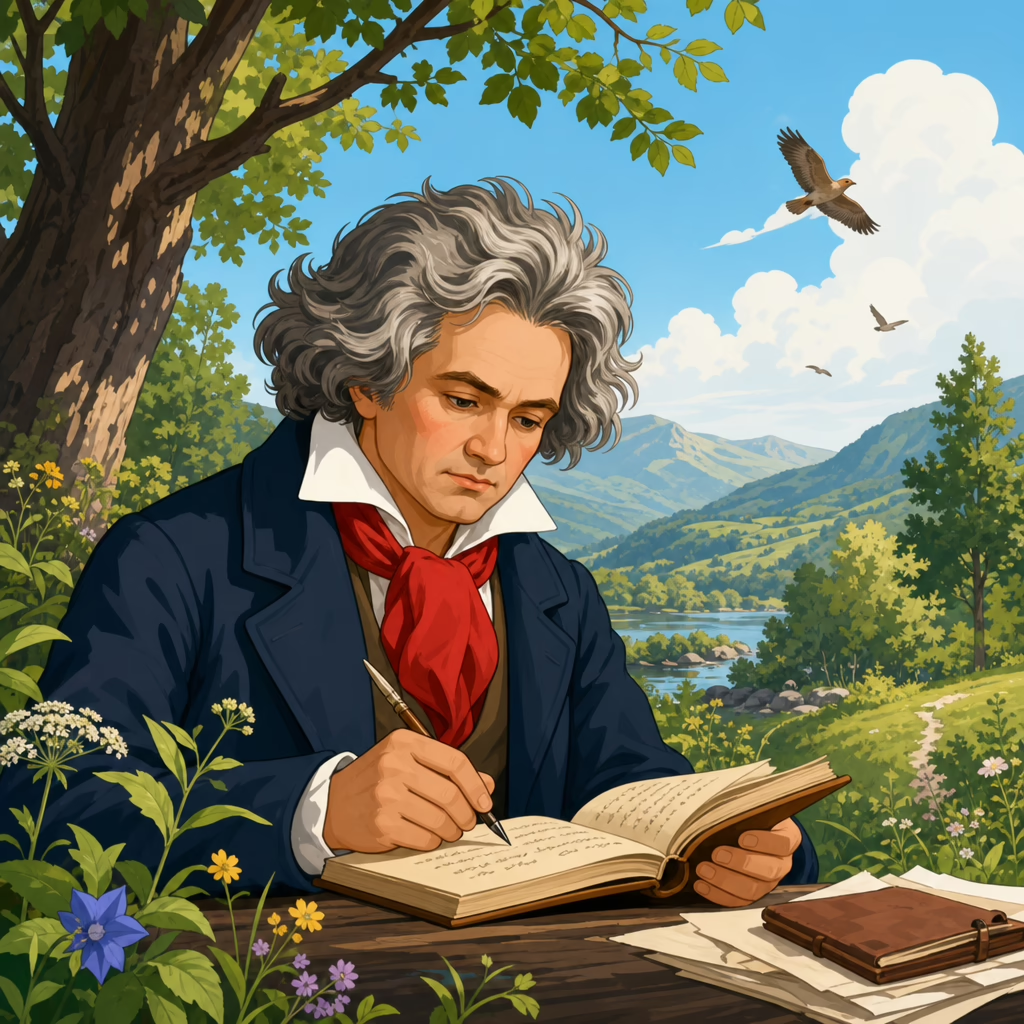
Beethoven’s Nature Writings in Letters and Notebook Entries
Beethoven’s relationship with nature is often described through his music, especially the Sixth Symphony, yet his letters and notebook entries reveal the subject in a more intimate, verifiable way. These documents show not an abstract admiration for landscapes but a working habit of attention: weather, trees, birdsong, streams, rural quiet, and the restorative value of long walks appear as recurring realities in his daily thought. When historians speak of Beethoven’s “nature writings,” they do not mean a separate literary project. They mean scattered comments preserved in correspondence, conversation books, memoranda, and notebooks that together form a documentary record of how he experienced the natural world.
That record matters because it clarifies a persistent question: was Beethoven merely using pastoral imagery as an artistic convention, or did nature genuinely shape his inner life and compositional process? After years of reading these sources alongside sketch material, the answer is clear. Nature was not decorative background. It was part of his routine, his self-treatment, his spiritual vocabulary, and at times his compositional trigger. His own remarks repeatedly connect outdoor movement with mental clarity, consolation, and creative renewal.
These fragments also require careful reading. Beethoven was not a systematic diarist in the way of later Romantic writers. His surviving comments are uneven, occasional, and filtered through practical circumstances. Some are direct declarations in letters; others are compressed jottings; still others come from the conversation books of his deaf years, where visitors wrote to him and he responded orally. The evidence is therefore dispersed, but it is strong. When gathered, it shows a composer who treated fields and wooded paths as necessities rather than luxuries, and who heard in natural phenomena something morally serious.
For readers interested in Beethoven and nature, the letters and notebook entries are the best place to see his outlook without later mythmaking. They preserve voice, context, and timing. They show what he noticed, when he sought the countryside, and how he framed those experiences in relation to health, solitude, and work.
What the letters actually show about Beethoven and nature
Beethoven’s letters consistently present the countryside as a place of relief from urban pressure and physical suffering. This is especially important because much of his adult life was marked by worsening hearing loss, digestive problems, headaches, and irritability. In that context, references to walking outside were not sentimental flourishes. They were practical statements about survival. He repeatedly arranged summer stays in villages outside Vienna, including Heiligenstadt, Döbling, Baden, Mödling, and other nearby areas where he could combine lodging, treatment, and long daily walks.
One of the clearest examples appears in the 1802 Heiligenstadt Testament, addressed to his brothers. Although the document is famous for its account of despair over deafness, it also frames nature as one of the few remaining ties binding him to life. Beethoven explains that only his art held him back from suicide, but the setting matters: he was in the country on medical advice, trying to recover through quiet and fresh air. The text does not offer scenic description for its own sake. Instead, it shows a man seeking in rural surroundings a form of equilibrium that city life could not provide.
His ordinary correspondence reinforces that picture. Beethoven often mentions lodgings selected for air, peace, and access to walking routes. He praises particular locations for their environment, complains when noise intrudes, and treats seasonal migration out of Vienna as a practical necessity. This pattern was common among Viennese elites and artists, but in his case the language is unusually insistent. He wanted seclusion without isolation, movement without interruption, and landscapes that could sustain concentrated thought.
That is why modern readers should resist reducing these remarks to “inspiration from nature.” Inspiration is too vague. The letters show a repeatable operating method: remove himself to the outskirts, walk for hours, carry ideas mentally, and return to the desk to work them out. For a broader account of that routine and its musical consequences, the main guide at Beethoven’s love of walking and what it meant for his music provides useful context. The letters are the close-up view of that same habit.
Notebook entries, memoranda, and the language of observation
Beethoven’s notebooks do not function like polished essays on nature, but their value lies precisely in their immediacy. Short entries reveal what occupied him before ideas were smoothed into public language. In these materials, nature appears less as rhetoric and more as contact: places to visit, routes to take, conditions to seek, sensations remembered. The famous statement associated with him, “No one can love the country as much as I do,” survives in this documentary world of direct utterance. Whether encountered in correspondence or related records, the sentiment matches the broader pattern too closely to dismiss as casual exaggeration.
Another important strand is his habit of connecting natural setting with gratitude and transcendence. Here Beethoven’s wording often approaches devotional language, though not always in conventional church terms. He could treat a tree, valley, or open sky as evidence of order and benevolence. This does not mean he was writing nature mysticism in the later literary sense. It means that for him, outdoor experience could prompt moral seriousness, humility, and inward steadiness. That nuance matters because it prevents a simplistic reading of Beethoven as merely “pastoral.” His comments are usually firmer than that: nature restores because it places the self in a larger frame.
These records also show restraint. Beethoven rarely lingers over decorative description. He notices effects rather than painting elaborate verbal scenes. Silence, air, shade, distance from noise, and the possibility of uninterrupted motion matter more than picturesque detail. In my experience working through collections of his documents, that economy is one of the strongest signs that the feeling is genuine. People inventing literary nature poses usually embellish. Beethoven, by contrast, sounds like a man making note of conditions that help him function.
| Source type | What appears in it | What it tells us |
|---|---|---|
| Letters | Requests for rural lodgings, complaints about noise, praise of quiet air | Nature was tied to health, work conditions, and daily routine |
| Notebook entries | Brief personal reflections, practical reminders, compressed observations | Outdoor life mattered before public presentation or later myth |
| Conversation books | References to outings, health regimens, locations, and visitors’ written remarks | Nature remained central even in the deaf years |
| Testamentary writing | Emotional confession framed by rural retreat and attempted recovery | Nature functioned as consolation under extreme distress |
How deafness changed the meaning of nature in the documents
Beethoven’s hearing loss changed not only his career but also the way nature appears in his writings. Before severe deafness, one can imagine birdsong, wind, and water as acoustic experiences among many others. As his hearing deteriorated, the countryside took on additional meanings. It offered freedom from humiliating social situations, escape from urban conversation he could not easily follow, and a setting where silence was less oppressive. That is a crucial distinction. Nature did not simply replace lost sound; it created a space in which the loss of sound became more bearable.
The documentary record from the later years supports this reading. The conversation books show a man still deeply concerned with movement, weather, health routines, and excursions. Visitors wrote suggestions, questions, or logistical notes; Beethoven replied aloud. Even in this mediated form, the persistence of outdoor references is striking. He remained oriented toward baths, country air, and walking opportunities. Baden, in particular, became one of the centers of this rhythm, combining therapeutic culture with landscapes suitable for extended solitary wandering.
It is tempting to romanticize this as heroic communion with nature beyond sound, but that would miss the harder truth visible in the documents. Beethoven’s attachment to natural settings was partly compensatory. The countryside was where he could manage pain, reduce social friction, and preserve working concentration. In other words, nature helped him adapt. That makes the evidence stronger, not weaker. Real dependence is more convincing than poetic posturing.
At the same time, his comments never present nature as cure in an absolute sense. Fresh air and walking did not reverse deafness, eliminate financial anxiety, or solve domestic conflict. The documents are balanced on this point. He sought relief, not miracles. That sobriety is one reason the letters deserve more attention than generalized anecdotes. They show exactly what nature could do for him, and just as importantly, what it could not.
Rural retreats, walking routes, and compositional discipline
When Beethoven wrote about country lodgings, he was usually making a practical composer’s calculation. He needed affordable rooms, a reliable piano or access to one, manageable travel to Vienna, and terrain suitable for exercise. Villages around Vienna offered these advantages. Heiligenstadt and nearby districts were early examples; later, Baden became especially important. The letters show him evaluating places in terms that blend health resort logic with artistic logistics: clean air, fewer disturbances, access to baths, and enough solitude to think.
This habit connects directly to notebook evidence of disciplined self-management. Beethoven was not simply strolling until a melody arrived. He built repetition into his days. Multiple witnesses describe him walking with sketch materials, stopping to jot ideas, then returning home to develop them. Although every anecdote about genius with a notebook should be checked carefully, the broader pattern is firmly supported. The written record shows a man who used walking as structured cognitive work.
That structure helps explain the plainness of many nature references. He was not trying to become a descriptive prose writer. He was organizing conditions that enabled composition. A stream, grove, or open path mattered because it permitted sustained concentration and rhythmic bodily movement, both of which aided musical thought. Modern cognitive research on walking and creativity points in the same direction: moderate physical motion can improve idea generation and associative thinking. Beethoven obviously did not know that literature, but his practice anticipated it.
Specific places mattered, too. He did not speak of “nature” only in universal terms. He returned to named localities, revisited routes, and cultivated seasonal habits. That specificity gives the documents historical weight. We are not dealing with vague Romantic scenery. We are dealing with a working map of the Vienna hinterland as lived by a composer who depended on it.
What these writings do and do not prove
The strongest conclusion supported by Beethoven’s letters and notebook entries is straightforward: he loved the countryside, relied on walking, and associated natural settings with health, calm, and creative readiness. The documents also support a second claim: his language about nature often carries ethical or spiritual force, suggesting reverence rather than mere recreation. These are not speculative readings. They are consistent across decades and across different source types.
What the writings do not prove is equally important. They do not let us map every passage in a composition onto a specific landscape encounter. They do not justify inflated claims that Beethoven copied birds literally from fields into scores except where evidence is direct, as in the explicitly labeled bird calls of the “Pastoral” Symphony. Nor do they show a naïve worship of untouched wilderness. The countryside around Vienna was cultivated, inhabited, worked land. His experience of nature was shaped by roads, villages, inns, baths, and social networks.
That mixed environment is exactly why the documents are so useful. They reveal Beethoven’s nature not as fantasy but as practice. He moved through managed landscapes, found there a degree of freedom, and translated that freedom into durable artistic labor. Readers looking for the real Beethoven should start here, with the terse requests, the health complaints, the expressions of delight in country life, and the repeated return to paths outside the city. These writings are small in scale but large in significance. Read together, they show that nature was not an accessory to his genius. It was one of the conditions that helped make his work possible.
The key takeaway is simple: Beethoven’s letters and notebook entries offer the most trustworthy evidence for his bond with nature because they capture habit rather than legend. They show a composer who sought rural quiet for physical relief, mental order, and creative continuity. They also show that his love of the countryside was concrete. It involved lodgings, walking routes, weather, health regimens, and repeated seasonal returns, not just elevated sentiment.
They also sharpen how we read his public image. Instead of treating nature as a symbolic backdrop imported by critics, we can see it as part of his lived method. The documents reveal a disciplined person using outdoor movement to think, recover, and endure. That makes his musical engagement with natural feeling more credible because it rests on repeated documented behavior.
If you want to understand Beethoven’s connection to nature with precision, begin with these primary sources and follow the pattern they establish. Read the letters for circumstance, the notebooks for immediacy, and the conversation books for persistence across his deaf years. Taken together, they provide a grounded portrait of how the countryside sustained one of history’s greatest composers. Then use that portrait as your starting point for deeper study of the music itself.
Frequently Asked Questions
What do scholars mean by Beethoven’s “nature writings” in letters and notebook entries?
When scholars refer to Beethoven’s “nature writings,” they are usually not describing a single literary work devoted to landscapes or a polished set of philosophical essays about the natural world. Instead, they mean scattered but revealing references found throughout his correspondence, conversation books, notebooks, and related personal documents. These mentions include comments about weather, rural walks, trees, fields, fresh air, birdsong, streams, and the emotional or physical relief he associated with being outdoors. Taken together, they form a documentary record of how nature entered his daily life and thinking.
This is important because it gives historians something more concrete than later legend. Beethoven’s music, especially the “Pastoral” Symphony, has long encouraged listeners to imagine him as a solitary prophet of nature. But the letters and notebook entries show a more practical and intimate reality. Nature appears there not simply as poetic inspiration, but as a recurring habit of attention. He noticed seasonal change, sought out the countryside for health and peace, and repeatedly linked walking outdoors with restoration, reflection, and creative energy.
In that sense, his “nature writings” are less a formal genre than a pattern of evidence. They help us see that his connection to the natural world was not merely symbolic or retrospective. It was embedded in ordinary routines, emotional self-care, and the working conditions of his life as a composer. That is why these fragments matter so much: they allow modern readers to move beyond myth and into verifiable experience.
How do Beethoven’s letters and notebooks change our understanding of his relationship with nature?
They make it more personal, more specific, and more historically trustworthy. Many discussions of Beethoven and nature begin with his music, where nature can seem grand, spiritual, and even abstract. His letters and notebooks, by contrast, show him responding to actual environments: a particular day’s weather, the quiet of the countryside, the pleasure of a walk, or the relief he felt when leaving the city behind. These are not generalized Romantic gestures. They are firsthand traces of lived experience.
The documents also show that nature was woven into his daily habits rather than reserved for exceptional moments of inspiration. He did not merely admire “nature” as an idea. He returned to it repeatedly as something restorative and necessary. Long walks, especially in rural settings, appear as part of a pattern of self-regulation and mental renewal. For a man coping with illness, isolation, and progressive deafness, that matters. Nature was not only aesthetically meaningful; it was also therapeutic.
Just as significantly, the letters and notebook entries help correct exaggerated interpretations. They do not support the simplistic image of Beethoven as someone who dissolved entirely into mystical landscape reverie. Instead, they show a disciplined observer whose engagement with nature could be attentive, grateful, practical, and emotionally intense all at once. That combination makes his relationship with nature more human and more compelling than the myth alone.
What kinds of natural details appear most often in Beethoven’s personal writings?
Several recurring details stand out. Weather is one of the most consistent. References to changing conditions, air, seasons, and atmosphere suggest that Beethoven was strongly responsive to his surroundings. He also refers to walking in the countryside, which points to a regular bodily relationship with landscape rather than a distant admiration for scenic beauty. Trees, fields, rural quiet, and streams belong to this same sphere of recurring attention.
Birdsong is another especially meaningful detail. In discussions of Beethoven, birds are often associated with the “Pastoral” Symphony, but the broader documentary record helps show that attentive listening to the natural world was not merely a compositional device. Even as his hearing deteriorated, the idea and memory of natural sound retained importance. References to birds and other outdoor sounds help illuminate how deeply the sensory world remained tied to his imagination.
What is striking is that these details are rarely ornamental in the documents. They tend to appear as part of real life: where he walked, how he felt, what kind of setting he preferred, what brought him calm, or what helped him think. That practical quality is precisely what gives the writings their authority. They present nature not as decorative background, but as an active presence in his routine, mood, and creative life.
Is there a direct connection between Beethoven’s nature writings and the “Pastoral” Symphony?
Yes, but it should be understood carefully. Beethoven’s letters and notebook entries do not function as a simple key that decodes the Sixth Symphony movement by movement. They do not reduce the work to autobiography, nor do they turn it into a sonic diary of one specific walk or one exact landscape. What they do provide is valuable context. They confirm that his engagement with nature was deep, habitual, and sincere, which supports the idea that the “Pastoral” grew out of real experience rather than purely artistic convention.
This matters because Beethoven himself drew a distinction between imitation and feeling in relation to the symphony. His personal writings help explain that distinction. The natural world, as it appears in his letters and notebooks, is not just a collection of things to copy acoustically. It is a setting for sensation, reflection, relief, memory, and inward response. That aligns well with the character of the “Pastoral,” which is less about literal scene-painting than about the emotional life awakened by being in nature.
So the connection is best described as documentary and interpretive rather than mechanical. The personal writings anchor the symphony in lived habit and observed reality. They suggest that the work’s atmosphere of gratitude, calm, motion, and renewal came from a genuine relationship with the countryside. At the same time, they remind us that Beethoven transformed experience into art. Nature in the documents is immediate and everyday; nature in the symphony is shaped, expanded, and composed into something universal.
Why are Beethoven’s letters and notebook entries so important for historians studying nature in his life and work?
They are important because they offer primary evidence. Historians are always trying to distinguish between legend and documentation, and Beethoven is a composer around whom legend has accumulated for two centuries. Later biographers, admirers, and even performers have often portrayed him in highly dramatic ways. Letters and notebook entries help bring the discussion back to what can actually be shown. They preserve his own references, habits, concerns, and preferences with far greater reliability than romanticized anecdotes alone.
These sources are especially useful because they reveal continuity. A single pastoral remark might be incidental, but repeated references to walks, country settings, weather, quiet, and restoration create a meaningful pattern. Historians can then place that pattern alongside his music, health, social world, and working methods. This allows for a fuller portrait of Beethoven as someone whose relationship with nature was experiential, embodied, and sustained over time.
Finally, these writings matter because they humanize him. They show that his engagement with nature was not only a grand artistic theme but also a daily resource. He turned to the outdoors for calm, perspective, and strength. For readers and scholars alike, that is one of the most persuasive aspects of the record. It reveals Beethoven not just as the composer of monumental works about human struggle and transcendence, but as a person who repeatedly found renewal in trees, open air, flowing water, and the quiet of the countryside.