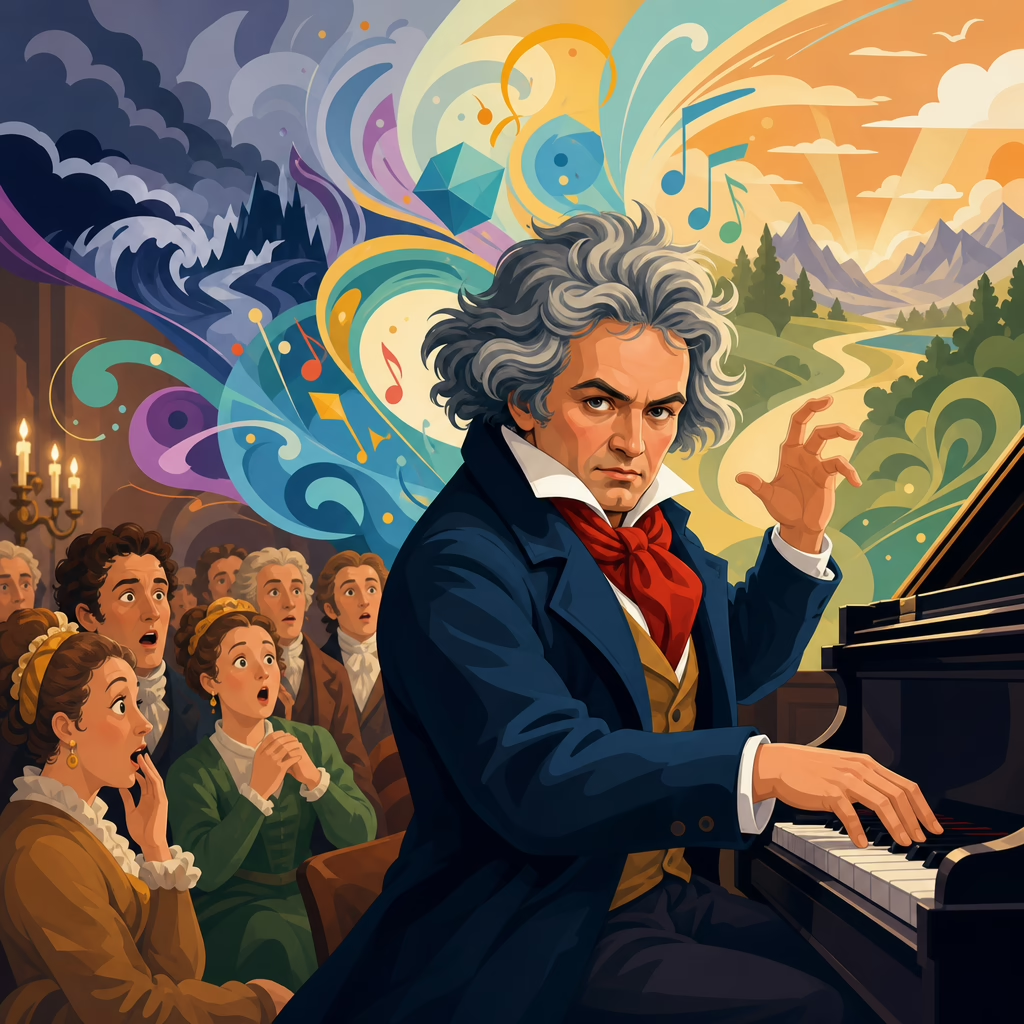
Why Beethoven’s Middle Period Felt New to His First Audiences
Beethoven’s middle period felt new to its first audiences because it changed not just the sound of concert music, but the listener’s expectations of what a symphony, concerto, quartet, or sonata could do over time. In music history, “middle period” usually refers to the years from about 1803 to 1812, the stretch that produced the “Eroica” Symphony, the “Appassionata” Sonata, the “Razumovsky” Quartets, the Fourth and Fifth Piano Concertos, the Violin Concerto, the Fifth and Sixth Symphonies, and the Seventh Symphony. These works did not emerge from nowhere. Beethoven inherited a Classical language shaped by Haydn and Mozart: balanced phrases, clear tonal plans, and proportions that generally confirmed a listener’s sense of order. What first audiences encountered in Beethoven’s middle years was a composer who kept that language recognizable while pushing every structural pressure point inside it.
That is why the music could feel shocking even when its materials were simple. A scale, a repeated note, a triad, or a short rhythmic cell might be ordinary on paper, yet Beethoven treated these elements with unusual insistence, expansion, and dramatic consequence. He stretched introductions, magnified codas, intensified transitions, and made motivic development a main event rather than a connecting passage. He also wrote with a new public rhetoric. His music seemed to argue, resist, and overcome. Early nineteenth-century listeners did not need modern textbooks to hear the difference; they heard larger spans, stronger contrasts, heavier orchestral weight, and a sense that instrumental music could project the seriousness formerly associated with tragedy, epic, or political speech.
The novelty mattered because audiences around 1800 were living through rapid change. The French Revolution, Napoleonic wars, new civic identities, and the growth of public concert life altered how art was understood. Beethoven’s middle-period works met that moment. They sounded disciplined yet volatile, formally controlled yet emotionally risky. Having rehearsed and studied this repertoire, I have found that its originality becomes clearest when one asks a practical question: what would a well-informed Viennese listener have expected in 1800, and where did Beethoven deliberately frustrate or enlarge that expectation? The answer lies in scale, rhythm, harmony, instrumental treatment, and in a new idea of musical narrative that made abstract forms feel urgent.
He Expanded Classical Forms Until They Carried New Dramatic Weight
The most immediate reason Beethoven’s middle period sounded new was size. The Symphony No. 3 in E-flat major, “Eroica,” premiered in 1805 and ran far longer than the symphonies many listeners knew. Length by itself does not guarantee innovation, but in Beethoven’s case the added duration came from expanded argument. The first movement does not merely present themes and decorate them; it subjects tiny motives to sustained development, unexpected harmonic turns, and textural accumulation. What audiences heard was not a polite succession of themes but a large-scale process that demanded concentration. Reviewers who found the work long were responding to this unfamiliar density of thought.
Just as important, Beethoven redistributed formal emphasis. In late eighteenth-century practice, codas often confirmed what had already been established. Beethoven’s middle-period codas frequently act like second developments. In the “Eroica” first movement and the finale of the Fifth Symphony, the coda becomes a decisive phase of drama rather than a conventional sign-off. This made endings feel earned and monumental. Likewise, slow introductions became places of suspense, not mere ceremonial openings. The introduction to the Fourth Symphony creates harmonic uncertainty so effectively that the bright Allegro seems to burst into view.
Listeners also sensed novelty in the treatment of inner movements. The “Eroica” replaces the expected slow movement type with a funeral march of extraordinary public gravity. The Seventh Symphony’s Allegretto likewise gives unusual centrality to a processional rhythmic design that first audiences found immediately compelling. Beethoven was not abandoning form; he was proving that inherited forms could absorb a wider emotional range. For a concise overview of how this broader transformation shaped the symphony as a whole, see the main guide at https://lvbeethoven.com/how-beethoven-reinvented-the-symphony/. Within the middle period specifically, form became dramatic architecture, and that was new enough to unsettle experienced listeners.
He Made Rhythm a Structural Force, Not Just Surface Decoration
If one feature explains Beethoven’s immediate impact on first audiences, it is rhythm. Earlier Classical composers used memorable rhythmic figures, but Beethoven turned rhythm into an engine of continuity and conflict. The famous opening of the Fifth Symphony is the obvious example: a four-note pattern so compact that it can be recognized in countless transformations. The innovation lies less in the motive itself than in the relentless way it governs the movement’s identity. Audiences heard unprecedented concentration. A tiny pattern could generate tension across an entire sonata form, making the movement feel inevitable and tightly coiled.
Rhythmic insistence also changed the listener’s bodily experience. In the finale of the Seventh Symphony, repeated dactylic figures create propulsion that many nineteenth-century writers described in physical terms, almost as dance transformed into obsession. The scherzos of the middle period often depend on disruptive accents, metric ambiguity, and sudden dynamic shifts that blur the line between wit and force. Even in lyrical works such as the Violin Concerto, the opening timpani taps establish an unusual rhythmic signature before the soloist appears. This was a fresh way of claiming attention: rhythm announced character before melody fully unfolded.
In rehearsal, these passages still reveal why they startled early audiences. Players cannot rely on elegance alone; they must sustain pulse under pressure, articulate accents with precision, and maintain long-range direction. Beethoven often writes syncopations across bar lines or drives repeated accompaniment figures longer than expected, creating tension between what the meter says and what the ear feels. That tension would have registered clearly in halls where listeners were accustomed to more symmetrical phrase behavior. His middle-period rhythm was not simply energetic. It was argumentative, cumulative, and often uncompromising, giving instrumental music a new kind of public urgency.
He Pushed Harmonic Expectation Without Breaking Tonal Coherence
Another reason Beethoven’s middle period felt new is that it unsettled tonal expectation while remaining firmly within a tonal world. This balance matters. First audiences were not hearing atonality or the collapse of key; they were hearing a composer delay, redirect, and intensify tonal arrival with unusual boldness. The first movement of the “Waldstein” Sonata, Op. 53, is exemplary. Beethoven minimizes the expected full cadence in the home key, propelling the music through bright harmonic space and withholding the kind of closure listeners were trained to anticipate. The result is exhilaration mixed with instability.
He also favored remote harmonic color at strategically dramatic points. In the “Eroica,” notorious dissonances and sudden shifts were not accidents but rhetorical events. In the Fourth Piano Concerto, the relation between soloist and orchestra feels novel partly because harmonic pacing shapes a dialogue of intimacy and interruption rather than a straightforward public display. The slow movement’s stark contrasts led later listeners to hear an Orpheus myth, but even without that association, early audiences would have noticed the concentrated opposition of sonority and harmonic stance.
Beethoven’s harmonic innovation was inseparable from voice leading and texture. He could intensify a dominant for an extraordinary span, use deceptive motion to create fresh continuation, or place a destabilizing note where convention suggested reassurance. Yet he generally made these events legible inside a strong tonal frame. That is why the music felt daring rather than chaotic. It tested the listener’s predictive habits. In my experience coaching students through these scores, the moment they stop hearing harmony as background color and begin hearing it as dramatic timing, the middle period snaps into focus. That temporal use of harmony is exactly what first audiences perceived as new.
He Reimagined Instrumental Character and the Sound of the Orchestra
Middle-period novelty was also audible in sheer sonority. Beethoven treated orchestral and chamber instruments less as interchangeable participants in polite balance and more as distinctive agents inside a drama. The “Eroica” horn calls, the Fifth Symphony’s expanded brass presence, the piccolo, contrabassoon, and trombones in the finale of the Fifth, and the earthy winds of the “Pastoral” all made listeners aware of instrumental color in a more theatrical way. These choices were not random additions. They marked structural thresholds, altered weight, and intensified contrast.
In chamber music, the “Razumovsky” Quartets, Op. 59, enlarged the expressive burden on each player. Longer spans, denser development, and more exposed writing meant that quartet conversation could sound almost orchestral in ambition while remaining intimate in medium. Contemporary players often complained that Beethoven wrote awkwardly or impossibly, a reaction that itself indicates novelty. He was asking instruments to project more force, sustain more tension, and articulate more extreme character than many musicians had previously encountered.
The same is true at the keyboard. The “Appassionata” and “Waldstein” sonatas exploit the capabilities of newer pianos with broader range and stronger action. Beethoven’s writing does not merely add notes; it seeks resonance, attack, and dynamic extremes that transform the instrument from salon voice to dramatic protagonist. First audiences would have recognized this as modern sound. The table below shows how several middle-period works translated innovation into audible effect.
| Work | Feature that felt new | What first audiences likely heard |
|---|---|---|
| Symphony No. 3 “Eroica” | Expanded first movement, funeral march, huge coda | A symphony with epic scale and public seriousness |
| Symphony No. 5 | Motivic compression, relentless rhythm, finale expansion | Unusual unity and a sense of hard-won arrival |
| Symphony No. 6 “Pastoral” | Linked scenes, storm painting, continuous expressive plan | Programmatic clarity without losing symphonic rigor |
| Violin Concerto | Timpani-led opening, long lyrical spans | A concerto driven by breadth and nobility, not display alone |
| “Razumovsky” Quartets | Symphonic scale in chamber form | Quartet writing that felt intellectually and technically demanding |
He Gave Instrumental Music a Narrative of Struggle and Transformation
Perhaps the deepest reason Beethoven’s middle period felt new is that it encouraged audiences to hear instrumental music as a narrative of becoming. This does not mean every work tells a literal story. Rather, Beethoven made contrast, development, interruption, and return feel like stages in a purposeful journey. The Fifth Symphony is the textbook case because nineteenth-century listeners quickly attached ideas of darkness and victory to it, but the effect goes beyond any later slogan. The work’s progression from C minor to C major, from compressed motive to blazing finale, is staged so persuasively that listeners experience change as drama.
That sense of transformation appears across the period. The “Leonore” and “Fidelio” overtures compress rescue, danger, memory, and triumph into instrumental form. The “Emperor” Concerto begins by overturning expectations of orchestral introduction: the soloist enters immediately with grand flourishes, as if authority has already shifted. The “Pastoral” Symphony presents scenes of nature, yet Beethoven famously insisted it was “more the expression of feeling than painting.” That statement helps explain his novelty. Even when he used descriptive titles, he was less interested in imitation than in shaping an inward experience through structure.
First audiences were ready for expressive music, but Beethoven’s middle-period works demanded a more active kind of listening. One had to remember motives, register deferred resolutions, and perceive how a movement’s end altered the meaning of its beginning. In effect, he raised the cognitive stakes of concert listening. This was not abstraction for its own sake. It made instrumental music feel morally and emotionally consequential. Listeners sensed effort, resistance, release, and renewal. That is why the works could seem difficult on first hearing yet compelling enough to return to. Their novelty lay in making process itself the drama.
Why Some Listeners Resisted the Music Before They Admired It
Innovation rarely feels comfortable at first, and Beethoven’s middle period produced resistance for understandable reasons. Reviews complained about excessive length, learned complexity, roughness, and eccentricity. Those criticisms were not merely conservative reflexes. Performers faced genuine technical challenges, and audiences accustomed to lighter textures and clearer periodicity sometimes found the music hard to follow. The “Eroica” was criticized for diffuseness; the “Razumovsky” Quartets puzzled players; even admired works could be described as strange before they became canonical.
Yet resistance itself shows what was new. Beethoven was changing the contract between composer, performer, and audience. Performers could no longer coast on graceful delivery; they had to solve structural and technical problems in real time. Audiences could no longer treat a symphony as background elegance; they had to track argument and endure tension over longer spans. Publishers and patrons, meanwhile, were confronted with works that assumed lasting value rather than immediate convenience. Beethoven wrote for the present, but he also wrote against the short horizon of disposable entertainment.
Over time, the very features that disturbed first listeners became the basis of admiration. Length came to signify grandeur, motivic concentration became a model of organic unity, and bold sonority became a standard for orchestral power. That historical reversal is crucial. The middle period felt new not because it discarded the past, but because it forced inherited forms to carry more meaning than audiences had been trained to expect.
Beethoven’s middle period felt new to its first audiences because it enlarged form, intensified rhythm, sharpened harmonic suspense, transformed instrumental color, and gave abstract music the force of lived drama. Listeners around 1800 heard familiar genres behaving in unfamiliar ways. Symphonies became longer arguments, codas became climaxes, rhythms became engines, and tonal plans became journeys whose outcomes mattered. The shock was not novelty for novelty’s sake. Beethoven remained grounded in tonal structure and Classical craft, which is exactly why his departures landed so powerfully.
For anyone studying Beethoven and innovation, this period is the clearest demonstration that musical revolution often happens from inside a tradition. Beethoven did not reject the symphony, the sonata, the concerto, or the quartet. He made each form speak with greater urgency, scale, and consequence than first audiences expected. That is why the music could puzzle, overwhelm, and ultimately persuade. If you want to understand how that change reshaped listening itself, return to these middle-period works and follow the moments where expectation is stretched into discovery.
Frequently Asked Questions
What does Beethoven’s “middle period” mean, and why is it so important?
Beethoven’s middle period usually refers to the years from roughly 1803 to 1812, and it matters because this is the phase in which his music began to sound unmistakably larger in ambition, scale, and emotional reach than what many listeners had previously expected from instrumental concert music. Earlier Classical works by composers such as Haydn and Mozart certainly had drama, wit, elegance, and depth, but Beethoven’s middle-period works often made audiences feel as though a symphony, sonata, concerto, or string quartet had become a more public, urgent, and transformative kind of statement. This was the era of the Eroica Symphony, the Appassionata Sonata, the Razumovsky Quartets, the Violin Concerto, the Fourth and Fifth Piano Concertos, and the Fifth and Sixth Symphonies, among other landmarks.
What made the period so important was not just that Beethoven wrote famous pieces, but that he altered the perceived purpose of form itself. Instead of treating a movement as a refined design to be completed gracefully, he often treated it as a dramatic journey in which themes could struggle, evolve, return in altered form, and generate tension over a much longer timespan. For first audiences, that could feel startlingly new. A symphony no longer seemed merely to present attractive material in balanced proportion; it could now suggest conflict, aspiration, victory, memory, nature, or psychological intensity on a scale that felt almost novelistic. In that sense, Beethoven’s middle period became a turning point not simply in his own career, but in the broader history of musical expectation.
Why did Beethoven’s middle-period music feel new to listeners hearing it for the first time?
It felt new because Beethoven changed the listener’s sense of how musical time could work. First audiences were not only hearing unusual themes or louder climaxes; they were experiencing pieces that seemed to demand greater attention over longer spans. Beethoven often built movements from small, memorable motives and then subjected them to relentless development, suspense, interruption, expansion, and return. That meant listeners could not always relax into predictable patterns. Instead, they were drawn into a process. Music became something unfolding with unusual inevitability and pressure, as though every gesture had consequences.
He also enlarged the scale of major genres. The Eroica Symphony, for example, astonished listeners partly because of its length, complexity, and force. It did not behave like a polite extension of familiar symphonic models; it seemed to redefine what a symphony might be capable of expressing. The same was true in other genres. His concertos gave the soloist a more commanding, integrated role in the musical argument. His quartets sounded more expansive and intellectually charged. His piano sonatas could feel orchestral in weight and dramatic in trajectory. Even when audiences admired the music, they often sensed that its proportions, demands, and emotional seriousness were pushing beyond accepted norms. That combination of innovation in form, scale, and expressive intent is a major reason the middle-period works felt genuinely new.
How did works like the “Eroica,” Fifth Symphony, and “Appassionata” challenge older musical expectations?
These works challenged older expectations by transforming familiar forms into vehicles for sustained drama and heightened expressive contrast. In the Eroica, Beethoven took the symphony beyond elegance and entertainment into something monumental. The first movement alone unfolds with exceptional breadth and developmental intensity, and the funeral march second movement gave audiences a depth of tragic seriousness that was unusual in the genre. Rather than presenting contrast as a decorative principle, Beethoven made contrast feel existential: triumph and collapse, motion and interruption, grandeur and instability all seemed bound up in the structure itself.
The Fifth Symphony challenged listeners in a different but equally radical way. Its famous opening motive is so concentrated that it becomes the seed of the entire work’s identity. Beethoven uses that motive not simply as a catchy beginning, but as a force that shapes the symphony’s momentum, coherence, and psychological tension. This gave audiences a new sense that a whole large-scale work could grow from a tiny musical cell. The symphony’s trajectory from tension toward affirmation also contributed to the feeling of large-scale purpose, making the work seem less like a sequence of separate movements and more like a unified dramatic arc.
The Appassionata Sonata similarly expanded what listeners expected from a piano sonata. Instead of refined salon brilliance or balanced domestic form, audiences encountered music of turbulence, compression, and explosive power. Beethoven treated the piano not merely as a vehicle for beautiful texture, but as an instrument capable of profound urgency and orchestral force. The result was that older expectations about decorum, scale, and genre boundaries began to feel too small. These works did not reject Classical forms outright; they stretched them until audiences could hear new possibilities inside them.
Was the novelty only about louder sound and bigger emotion, or was there something deeper going on?
There was definitely something deeper going on. Louder dynamics, stronger contrasts, and more dramatic emotional effects were part of the story, but the real novelty lay in Beethoven’s control of structure, continuity, and transformation. He made listeners hear form as drama. A theme might enter not just as a tune to be enjoyed, but as a character-like force that would be tested, fragmented, resisted, or reborn over the course of a movement. This gave his music a sense of inner necessity that many first audiences found compelling, and sometimes unsettling.
Another deeper innovation was the way Beethoven expanded the expressive range of instrumental music without relying on words. Even in works with no explicit program, he often created a feeling of conflict, striving, release, and resolution that listeners could perceive almost narratively. That did not mean every piece told a literal story, but it did mean that audiences increasingly experienced instrumental works as meaningful journeys rather than as beautifully arranged patterns alone. In addition, Beethoven’s treatment of transitions, codas, and developmental passages often gave supposedly secondary parts of a form unusual importance. He could turn a coda into a climactic destination or make a transition feel like a crisis point. Those choices changed the architecture of expectation itself, which is why the innovation ran far deeper than surface intensity.
How did Beethoven’s middle period influence later composers and the future of concert music?
Beethoven’s middle period became a model for what large-scale instrumental music could aspire to be, and its impact on later composers was immense. After these works, it was much harder to think of a symphony as merely a well-made formal exercise or a concerto as simply an elegant showcase. Composers inherited from Beethoven the idea that instrumental music could carry extraordinary intellectual weight, emotional seriousness, and public significance. The symphonies of Brahms, the tone of heroic or fate-driven Romantic orchestral writing, and the expectation that a major chamber work or piano sonata could embody profound artistic argument all owe a great deal to the example set in these years.
Just as important, Beethoven’s middle-period works changed listeners as much as they changed composers. Audiences gradually came to expect stronger long-range coherence, more intense development, bolder contrast, and a larger expressive horizon. The concert hall itself became a place where listeners might encounter not just pleasure and refinement, but challenge, struggle, and revelation. That shift in expectation is one reason the middle period remains so central in music history. It marks the moment when established Classical forms began to feel newly expansive from the inside, opening the path toward the Romantic era while still remaining firmly grounded in disciplined craft. That balance of innovation and structural command is why Beethoven’s middle period felt new to its first audiences and continues to feel decisive today.