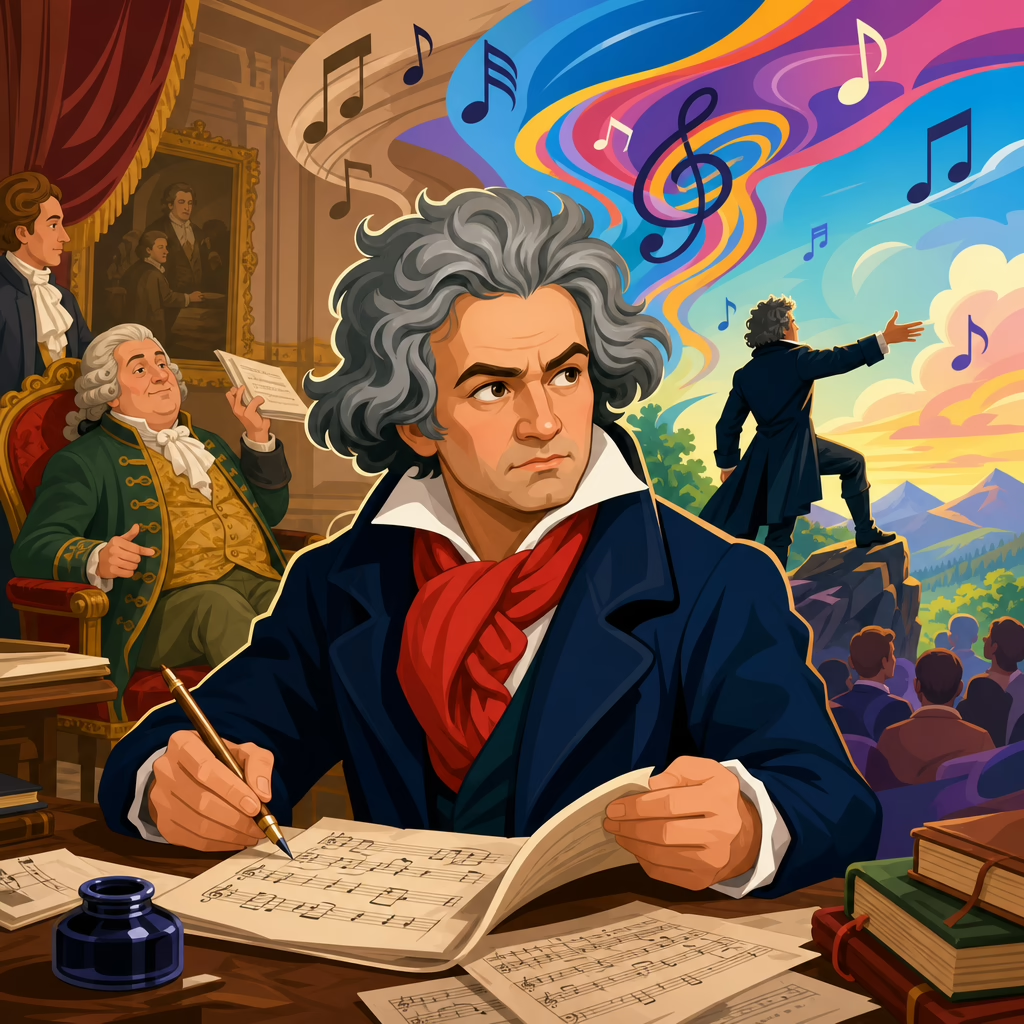
Beethoven’s Role in the History of Musical Autonomy
Beethoven’s role in the history of musical autonomy is central because his career crystallized a decisive change in how Western art music understood itself, its makers, and its listeners. Musical autonomy, in this context, means the idea that music can claim value on its own terms rather than serving primarily as accompaniment to worship, court ritual, dance, or theater. Before 1800, even the greatest composers usually worked within systems that tied composition to clear external functions: Mass settings supported liturgy, operas served theatrical institutions, divertimenti animated social gatherings, and court music displayed aristocratic prestige. Beethoven did not invent the possibility of self-sufficient instrumental art, but he made it newly audible, socially visible, and historically unavoidable.
That shift matters because it reshaped nearly every later debate about serious music. When critics, performers, and audiences speak of a symphony as a world unto itself, or of a string quartet as demanding concentrated listening rather than casual background attention, they are participating in a culture Beethoven helped consolidate. In my own work with scores, concert programs, and nineteenth-century criticism, I repeatedly see his name appear at the point where practical music making becomes an argument about artistic freedom. Beethoven’s music invited listeners to treat instrumental works not as elegant products for consumption, but as statements requiring interpretation, memory, and repeated hearing. That expectation altered composition, concert life, publishing, criticism, and the status of the composer.
The concept is often misunderstood. Musical autonomy does not mean that music has no social context, no politics, or no economic basis. Beethoven depended on patrons, publishers, performers, and paying audiences throughout his life. His works also responded to the French Revolution, Napoleonic Europe, Viennese institutions, and changing middle-class taste. Autonomy instead names a claim about artistic authority: music can organize meaning internally through thematic process, tonal architecture, rhythm, texture, and form, and therefore need not justify itself by depicting a story, flattering a patron, or fulfilling a practical occasion. Beethoven’s achievement lies in making that claim persuasive at the highest public level, especially in instrumental genres.
From service music to self-justifying art
To understand Beethoven’s historical importance, it helps to define the world he inherited. Haydn and Mozart had already elevated instrumental composition, especially the symphony, quartet, and piano sonata. Haydn’s London symphonies and Mozart’s late chamber works demonstrate extraordinary structural concentration and expressive range. Yet both composers still worked in cultures where function remained visible. Haydn spent decades in Esterhazy service, writing for a court calendar; Mozart balanced freelance ambition with theatrical and pedagogical demands. Their instrumental masterpieces later became monuments, but they were produced within systems where utility and occasion still mattered.
Beethoven entered Vienna in the 1790s at a moment when those systems were weakening. Aristocratic patronage still existed, but public concerts, music publishing, piano sales, and urban amateur culture were expanding. This mixed economy gave him room to maneuver. He could dedicate works strategically, negotiate fees with publishers in several cities, and cultivate a public image not reducible to salaried service. The famous 1809 annuity agreement with Archduke Rudolph, Prince Kinsky, and Prince Lobkowitz is often cited for good reason: it was not complete independence, but it symbolized a new arrangement in which patrons supported a composer precisely so he would not have to enter conventional employment.
That social change alone did not create musical autonomy. What made Beethoven pivotal was the way his compositional practice aligned with it. He wrote pieces whose value seemed to exceed any immediate function. The Eroica Symphony no longer sounded like ceremonial orchestral entertainment; it demanded sustained attention to large-scale argument, motivic transformation, and heroic crisis. The Fifth Symphony turned a compact rhythmic cell into the engine of an entire drama. The late quartets challenged players and listeners with discontinuity, abstraction, and inwardness that no court occasion could easily explain. In each case, the music appeared to justify itself through the force of its own organization.
How Beethoven’s style made autonomy audible
Beethoven’s contribution was not merely biographical or institutional. It was written into the notes. One hallmark of autonomous art is organic coherence, the sense that a work generates consequences from its own material. Beethoven developed this principle with unusual rigor. In the first movement of the Fifth Symphony, the opening four-note motive is not just a catchy gesture. It governs accompaniment patterns, transitional drive, codas, and even the listener’s memory of what counts as continuity. Analysts from E.T.A. Hoffmann to Donald Francis Tovey and later theorists recognized that Beethoven’s thematic economy made form feel internally necessary rather than conventionally assembled.
He also enlarged the temporal horizon of listening. Earlier classical forms certainly created expectation and return, but Beethoven intensified long-range teleology. In the Eroica, harmonic delay, metric disruption, and developmental expansion produce a sense that the movement is striving toward outcomes not yet secure. The result is a new kind of listening in which the audience follows process, not just surface pleasure. This matters for musical autonomy because a work that commands such concentrated temporal investment appears to possess an inner law. It asks to be heard as an argument unfolding according to its own premises.
Another crucial feature is expressive ambiguity. Autonomy does not require emotional neutrality; Beethoven is often intensely expressive. But his instrumental works resist stable verbal paraphrase. The slow movement of the Seventh Symphony can sound funereal, processional, devotional, or abstractly architectural depending on context and performance. That resistance to fixed description encouraged the belief that instrumental music reached beyond language. Hoffmann’s celebrated review of the Fifth Symphony in 1810 helped codify this response by presenting Beethoven’s instrumental music as the highest form of romantic art, precisely because it opened a realm not confined by words or visible representation.
Formal experimentation reinforced the point. Beethoven stretched sonata form, blurred genre boundaries, and recast the coda as a site of structural climax rather than routine closure. The Hammerklavier Sonata’s first movement, the Diabelli Variations, and the String Quartet in C-sharp minor, Op. 131, all challenge inherited expectations while remaining disciplined. They do not reject form; they make form itself the drama. That is a decisive ingredient in autonomy. Music becomes compelling because of how it thinks through its own materials.
Public reception, criticism, and the new composer image
Beethoven’s role in the history of musical autonomy also depends on reception. Aesthetic ideas become historically effective only when listeners, critics, and institutions absorb them. Around Beethoven, a new discourse formed that treated the composer as a singular creative intelligence rather than a highly skilled supplier of works. Critics increasingly described his music as profound, difficult, and worthy of study. Difficulty, in this setting, was not simply a complaint; it became evidence of depth. The more a work seemed to reward repeated hearing, the more it was treated as autonomous art rather than disposable entertainment.
Concert culture changed accordingly. Programs gradually shifted from mixed-use social events toward occasions for attentive listening. Beethoven’s symphonies and overtures became repertory pieces repeated across years, not merely one-time novelties. This repetition is historically important. Autonomy requires works that survive their first occasion and invite renewed interpretation. Beethoven’s music did exactly that. It encouraged the rise of the canon, the museum-like concert ideal, and the notion that masterworks demand fidelity from performers and seriousness from audiences.
The relationship between score and performance also tightened. Beethoven was famously exacting about articulation, dynamics, tempo character, and continuity, even if metronome debates remain contentious. His increasing notational specificity signaled that the work possessed an identity not exhausted by any single event. That identity lived in the score, yet needed realization in performance. Later nineteenth-century culture built heavily on this model. The authority of the written work, the prestige of faithful interpretation, and the reverence surrounding complete cycles of sonatas or quartets all owe much to Beethoven’s example. For a broader account of that transformation in orchestral thought, see this guide to how Beethoven reinvented the symphony.
Where autonomy appears most clearly in Beethoven’s major genres
Autonomy did not emerge equally in every repertory. Beethoven’s stage works, songs, and occasional pieces remain important, but the strongest historical evidence appears in instrumental genres where external text or function recedes. The table below shows where his impact on musical autonomy is most visible and why later musicians treated these works as models.
| Genre | Representative work | Autonomy marker | Historical effect |
|---|---|---|---|
| Symphony | Symphony No. 3 “Eroica” | Expanded scale, motivic integration, developmental weight | Recast the symphony as a serious public statement |
| Piano sonata | Op. 106 “Hammerklavier” | Extreme formal ambition and technical demands | Elevated the sonata into a philosophical and virtuoso genre |
| String quartet | Op. 131 | Seven connected movements, inward logic, radical continuity | Established chamber music as a peak site of artistic experiment |
| Variations | Diabelli Variations | Transformative play from trivial theme to large-scale design | Showed variation form could sustain autonomous complexity |
| Concerto | Piano Concerto No. 4 | Dialogic balance between soloist and orchestra | Shifted concerto focus from display toward structural integration |
These examples matter because they changed expectations from within established forms. Beethoven did not simply create new genres and declare them independent. He entered inherited conventions and demonstrated that they could sustain unprecedented density, continuity, and seriousness. Later composers from Schubert and Mendelssohn to Brahms, Wagner, and Schoenberg had to position themselves in relation to that achievement, whether by extension, revision, or refusal.
Limits, tensions, and the myth of pure independence
A balanced account must acknowledge that Beethoven’s autonomy was never absolute. He continued to write occasional works, depend on aristocratic networks, and engage genres shaped by text and politics. Fidelio is inseparable from dramatic narrative and contemporary ideals of justice. The Ninth Symphony’s choral finale explicitly breaks the boundary of purely instrumental discourse. Even the Eroica originally carried Napoleonic associations before Beethoven withdrew the dedication. These facts do not invalidate autonomy; they show that the concept emerged through tension rather than isolation.
There is also a risk in turning Beethoven into a solitary genius outside history. That image was cultivated in the nineteenth century and still distorts scholarship. Beethoven built on Haydn, Mozart, C.P.E. Bach, French revolutionary music, Italian vocal style, and practical Viennese performance traditions. He revised obsessively, borrowed techniques, and tested ideas in a real marketplace. Autonomy, then, should not be romanticized as freedom from all conditions. It is better understood as a historically powerful claim that music can transcend immediate utility by intensifying internal relations. Beethoven made that claim convincing without escaping society.
His deafness further complicated the story. Later writers often used it to symbolize pure inward creation, as if sensory isolation guaranteed autonomy. The reality is more complex. Deafness altered Beethoven’s working life, social behavior, and performance role, but it did not remove him from material processes of copying, rehearsal, negotiation, and revision. Still, the late works composed under those conditions powerfully fed the belief that the highest music answers to an inner necessity beyond public demand. That belief became one of the most enduring legacies of Beethoven’s career.
Why Beethoven remains the turning point
Beethoven remains the turning point in the history of musical autonomy because he united social change, compositional innovation, and critical reception more completely than any predecessor. Others prepared the ground, and many successors extended the consequences, but Beethoven made the autonomous work the central prestige object of modern musical culture. He proved that instrumental music could bear the weight once reserved for epic poetry, religious art, or political oratory. He gave later generations a model of the composer as an independent authority, the score as a durable work, and listening as an act of sustained interpretation.
The enduring benefit of understanding this history is clarity. It helps explain why concert halls still revolve around symphonies, sonatas, and quartets treated as masterpieces; why analysis focuses on motivic development and form; and why Beethoven continues to anchor debates about artistic freedom. His role was not to sever music from life, but to redefine how music claims meaning within life. If you want to understand why Western art music came to prize internal coherence, seriousness, and repeatable depth, start with Beethoven’s autonomous ideal and follow its consequences through the repertory.
Read his middle and late instrumental works with this question in mind: how does the music justify itself through its own materials? That single habit of listening reveals why Beethoven changed not just composition, but the very idea of what music can be.
Frequently Asked Questions
What does “musical autonomy” mean, and why is it important in Beethoven’s historical context?
Musical autonomy refers to the idea that music can possess meaning, value, and artistic authority on its own terms, rather than deriving its importance mainly from an external function such as religious ceremony, courtly display, social dance, or dramatic storytelling. In earlier European traditions, even highly sophisticated music was often judged according to how well it served a specific purpose: a Mass supported worship, an opera advanced a stage drama, a dance suite accompanied movement, and ceremonial works reinforced political hierarchy. This does not mean pre-1800 music lacked depth or beauty; rather, it usually circulated within systems that defined its role in advance.
Beethoven stands at the center of a major shift in that system. In his career, music increasingly came to be understood as an independent art capable of commanding concentrated listening without needing to justify itself through text, ritual, or spectacle. His instrumental works in particular helped strengthen the belief that a symphony, sonata, quartet, or concerto could be treated as a serious intellectual and spiritual achievement in its own right. That was historically important because it changed not only composition, but also criticism, patronage, publishing, concert culture, and audience expectations. Listeners were encouraged to hear music as something to contemplate, interpret, and revisit, not merely something functional or decorative. Beethoven did not invent this idea by himself, but his output gave it unusually powerful artistic form and lasting cultural legitimacy.
Why is Beethoven often seen as the key figure in the rise of autonomous instrumental music?
Beethoven is often treated as a defining figure because his instrumental music made an especially compelling case that music without words could sustain profound expressive, structural, and philosophical weight. Earlier composers, including Haydn and Mozart, had already elevated genres such as the symphony, string quartet, and piano sonata. Beethoven inherited those traditions, but he expanded their scale, dramatic intensity, formal ambition, and cultural status. His works often seem to unfold as if they are arguing, struggling, transforming, and resolving according to purely musical logic. That quality encouraged generations of listeners and critics to regard instrumental music as capable of saying something essential even when it did not literally “represent” a narrative.
His symphonies are especially important here. They were not heard simply as elegant entertainment for aristocratic occasions, but increasingly as major artistic statements demanding serious public attention. The same is true of his piano sonatas and string quartets, which came to be treated as works for deep study rather than disposable occasion pieces. Beethoven’s music also helped establish the now-familiar concept of the enduring masterpiece: a work preserved, repeated, analyzed, and canonized across time. In that sense, his role in musical autonomy was not only compositional but institutional. He became a model for how a composer could create works that seemed to transcend immediate use and enter a realm of lasting aesthetic significance.
How did Beethoven’s career differ from the older system in which composers mainly served church, court, or theater?
Beethoven’s career unfolded during a transitional moment when the older patronage system was weakening and a more modern musical marketplace was emerging. Before this shift, many composers depended on stable employment under a church institution, an aristocratic court, or an opera house. Their output was often shaped by the needs of employers, calendars, ceremonies, and local performance requirements. Beethoven certainly still relied on aristocratic support, commissions, subscriptions, and publishers, so he was not completely outside the traditional order. However, he cultivated a public identity that was less that of a servant fulfilling assigned functions and more that of an independent artist whose creative authority deserved respect.
This distinction mattered enormously for the history of musical autonomy. Beethoven negotiated with patrons instead of simply obeying them, published widely, built a reputation beyond a single court or chapel, and increasingly composed works aimed at a broader public sphere. His image as a serious artist answerable first to artistic vision rather than immediate utility became central to later understandings of the composer. Even when his music was commissioned or dedicated, it often exceeded the narrow expectations of occasional use. That helped redefine the social place of composition itself. The composer was no longer seen merely as a skilled artisan supplying functional works, but as a creator of autonomous artworks whose value could outlast the circumstances of their origin.
Did Beethoven believe music should be completely separate from politics, society, or personal expression?
No, and this is an important nuance. Musical autonomy does not mean Beethoven wrote music in a vacuum or imagined art as disconnected from life. His work is deeply entangled with personal struggle, Enlightenment ideals, changing political realities, concepts of heroism, and the cultural upheavals of his age. The “Eroica” Symphony, for example, cannot be fully understood without recognizing its political horizon, even though it remains an instrumental work. Likewise, the Ninth Symphony engages public and humanistic themes quite openly through its choral finale. Beethoven’s music is full of expressive force, ethical aspiration, and social resonance.
What autonomy means in this context is something more specific: the idea that music does not need to be reduced to a practical function in order to matter. A Beethoven symphony can be connected to history and still be valued as a self-sustaining artistic structure. His music can express struggle, triumph, grief, and transcendence without being confined to a single literal program or occasion. That balance is one reason Beethoven became so influential. He demonstrated that music could be historically engaged and emotionally powerful while still claiming a special kind of independence. Later critics sometimes exaggerated this into the notion of “absolute music,” but Beethoven himself is best understood as a composer whose art was autonomous in status, not isolated from human meaning.
How did Beethoven’s legacy shape later ideas about the composer, the concert experience, and the musical canon?
Beethoven’s legacy helped transform nearly every major institution surrounding Western art music. First, he elevated the cultural image of the composer. After Beethoven, composers were increasingly imagined as original, inward, even visionary figures whose works embodied singular artistic identities. This romanticized model shaped how later composers such as Schumann, Wagner, Brahms, and many others were received. Second, Beethoven changed the concert experience. His works encouraged attentive listening, repeated hearings, and reverential silence, contributing to the idea of the concert hall as a place for concentrated aesthetic encounter rather than primarily social display.
Third, Beethoven became foundational to the very concept of the musical canon. His symphonies, sonatas, concertos, and quartets were not treated as temporary repertory but as permanent benchmarks against which later music would be measured. That had immense consequences for music education, criticism, performance traditions, and cultural memory. Conservatories taught Beethoven as a standard of form and expression; critics used him as a reference point for artistic seriousness; audiences came to expect repertories built around enduring masterpieces from the past. In this way, Beethoven’s role in the history of musical autonomy extends far beyond his own compositions. He helped establish the framework in which Western art music could be understood as a domain of lasting works, serious listening, and artistic self-legitimation.