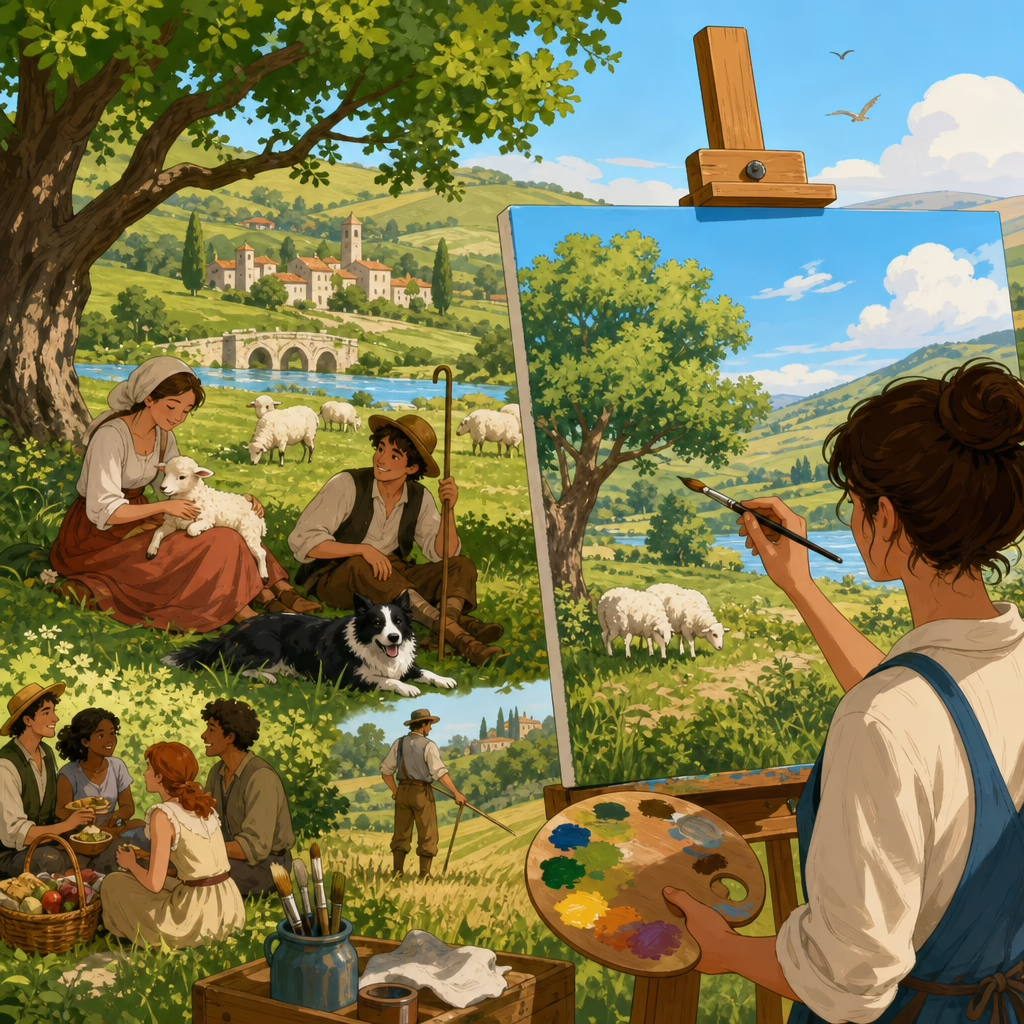
Why the Pastoral Is Not Just Landscape Painting
The pastoral is often mistaken for a simple picture of fields, streams, shepherds, and distant hills, yet in music, poetry, and painting it names a richer mode: an artistic shaping of human feeling through imagined rural life. That distinction matters especially when discussing Beethoven and nature, because the word “pastoral” in his world did not mean “descriptive landscape” in any narrow sense. It referred to a long cultural tradition, one with conventions, symbols, ethical implications, and emotional expectations. When listeners approach the “Pastoral” Symphony as if it were only scenic illustration, they miss the deeper claim Beethoven makes about memory, mood, society, and the place of human beings within the natural world.
In my own work reading Beethoven’s letters, sketchbooks, and the broader eighteenth-century context around them, I have found that confusion between pastoral and landscape is one of the biggest obstacles to understanding this music clearly. Landscape painting usually centers the visible arrangement of natural forms. The pastoral, by contrast, stages a relationship between people and nature. It may include landscape, but it is never limited to topography. It can be idealized, reflective, dramatic, even critical. The sheep, brook, storm, dance, and song are not there only to be seen or heard; they carry social and emotional meaning. That is why the pastoral persists across media so effectively.
At its core, the pastoral is a stylized representation of rural existence used to think about human concerns. Classical poets such as Theocritus and Virgil helped establish its grammar: shepherd figures, song contests, leisure, retreat from urban pressures, and a simplified countryside that is less documentary fact than imaginative space. Later writers, painters, and composers inherited those patterns and altered them for their own times. By Beethoven’s era, the pastoral already signaled more than nature description. It suggested repose, moral renewal, simplicity contrasted with artifice, and a testing ground for sincere feeling. It also carried tensions, because cultivated city audiences consumed “rural simplicity” through highly sophisticated art.
This matters because Beethoven openly told listeners not to hear his Sixth Symphony as mere depiction. The heading “mehr Ausdruck der Empfindung als Malerei,” usually translated as “more an expression of feeling than painting,” is not a decorative subtitle. It is a compositional instruction and an interpretive boundary. He is not rejecting nature sounds; he includes recognizable gestures such as bird calls and flowing-water figuration. But he frames them within a larger argument: the countryside awakens states of mind that music can embody more profoundly than a visual snapshot can. Understanding that point changes how we hear the entire work, and more broadly, how we define the pastoral itself.
Pastoral as a Mode, Not a View
If landscape painting asks, “What does this place look like?” the pastoral more often asks, “What kind of life, feeling, or value does this place symbolize?” That difference is fundamental. A painted landscape can be topographically accurate, concerned with light, weather, perspective, and terrain. The pastoral may borrow all those features, but it organizes them around human use and meaning. Shepherds, flutes, rustic dances, quiet streams, and storms are conventions, not random decorations. They belong to a vocabulary that audiences learned to read. Even when no literal shepherd appears, pastoral style evokes a world of respite, order, vulnerability, and renewal.
In eighteenth-century music, that vocabulary was remarkably stable. Composers used compound meters such as 6/8 or 12/8, drone basses resembling bagpipes, lilting melodies, simple harmonic pacing, and gently rocking accompaniment patterns to suggest rustic ease. These signs did not function as realistic field recordings. They were comparable to stage costume in opera: coded markers that activated a recognizable setting and mood. Handel used them, so did Vivaldi, Haydn, and countless lesser-known composers. Beethoven inherited these devices fully aware of their associations. When he uses them, he is entering a discourse, not merely imitating sounds from a walk in the woods.
The distinction becomes clearer if we compare pastoral art with pure scenic representation. In a landscape, a storm may be interesting because of atmospheric drama and visual force. In pastoral tradition, a storm often interrupts fragile human happiness and reveals dependence on natural powers. The storm has narrative and ethical function. Likewise, a brook in a landscape can be a compositional line leading the eye into depth. In pastoral art, the brook often becomes a site of reflection, listening, courtship, or contemplative solitude. Nature is not just out there; it mediates inner life. That is exactly the territory Beethoven claims in the Sixth Symphony.
Pastoral therefore belongs to genre history as much as to natural imagery. It blends idealization and structure. Rural life in actual Austria around 1800 involved labor, scarcity, disease, and social hierarchy. Pastoral art routinely softens those realities, yet that softening is not simply escapist failure. It creates an imaginative distance through which audiences can examine civility, emotional authenticity, and the costs of urban modernity. Beethoven’s Vienna was politically unsettled and acoustically crowded. For him, walks beyond the city were not only visual pleasures; they were a practical and psychological refuge. The pastoral gave form to that refuge without pretending it was literal documentary realism.
Beethoven’s Sixth Symphony Shows Why the Category Matters
The Sixth Symphony, completed in 1808, is the most famous case study because it places pastoral meaning in plain view. Each movement title directs the listener toward experience rather than scenery alone: “Awakening of cheerful feelings on arriving in the country,” “Scene by the brook,” “Merry gathering of country folk,” “Thunderstorm,” and “Shepherd’s song; cheerful and thankful feelings after the storm.” Notice how often feeling is named explicitly. Even the apparently descriptive titles are embedded in human response. Beethoven is careful: arrival produces cheerfulness, the storm threatens communal life, and the ending resolves not with meteorology but gratitude.
That sequence would be unnecessary if Beethoven merely wanted to paint a landscape in sound. Instead, he creates a pastoral arc of encounter, disturbance, and renewal. The first movement does not map a precise route through a specific valley. Its repeating rhythmic cells and broad harmonic breathing establish settled joy, the sensation of entering a space where the body relaxes and attention widens. In rehearsal rooms, conductors often discover that forcing too much pictorial detail here makes the music rigid. It works best when phrased as a lived change of state, from social compression toward expansive ease.
The second movement, “Scene by the brook,” is frequently reduced to bird imitation because Beethoven labels nightingale, quail, and cuckoo near the end. Yet those details occupy only a tiny portion of the movement. The larger design is one of sustained temporal suspension. Flowing accompaniment figures create continuity, while melodic lines unfold with unusual patience. This is not a sonorous postcard. It is an anatomy of attentive listening. Anyone who has spent long periods walking in quiet countryside knows that water does not simply appear as an object; it regulates breathing, pace, and thought. Beethoven composes that immersive effect with extraordinary control.
The peasant merrymaking of the third movement also resists picturesque simplification. Rustic dance topics in art music often involve deliberate roughness: off-balance accents, repeated notes, drone effects, and humorous orchestral textures. Beethoven deploys those elements vividly, but he is not mocking rural people from a distance, nor merely sketching village entertainment. He dramatizes collective energy and social embodiment. The pastoral here includes community, not just private contemplation. That matters because the countryside in pastoral tradition is often the setting where society can be imagined in less artificial forms, however stylized that ideal may be.
Then the storm breaks with shocking force, not as a detachable weather scene but as the structural crisis of the symphony. Beethoven’s orchestration expands, tremolos intensify, and harmonic instability surges. Listeners feel vulnerability before power beyond human control. That is a central pastoral theme inherited from earlier art: nature consoles, but it also exceeds us. The finale’s shepherd-like song answers that crisis with thanksgiving, not triumph. Gratitude is a specifically human and relational response. The closing pages therefore confirm that the work is not landscape painting in orchestral disguise. It is pastoral meditation shaped through dramatic experience.
How the Pastoral Differs from Landscape Across the Arts
The difference between pastoral and landscape becomes even sharper when we look across media. In painting, a landscape by Jacob van Ruisdael may focus on sky, terrain, and light with little idealized rural theater. A pastoral painting by Claude Lorrain or François Boucher, by contrast, often arranges figures, grazing animals, ruins, and luminous distance into an emblematic rural harmony. The goal is not neutral observation. It is an image of ordered leisure and cultivated simplicity. Even when the natural setting dominates, the scene is composed around human value and implied narrative.
Poetry makes the contrast clearer still. A descriptive poem can catalog woods, rivers, mountains, and weather in detail. A pastoral poem places speakers inside a conventional rural world where song, loss, friendship, and longing unfold through shepherd identities or related substitutes. Milton’s “Lycidas,” for example, is pastoral elegy, not because it reports farming life accurately, but because it uses pastoral codes to process grief and vocation. Beethoven’s pastoral imagination works similarly. He does not need actual shepherds in every bar. He needs the mode’s capacity to transform nature into a language of feeling and reflection.
Opera and instrumental music did the same thing through topic and affect. A “pastoral” movement could appear in a Christmas setting, suggesting shepherds at the Nativity, or in a secular work signaling innocence and repose. Audiences recognized the signs immediately. This is why reducing Beethoven’s Sixth to “music that sounds like nature” is historically thin. His listeners heard genre markers with social memory attached to them. They would have understood the countryside not simply as viewable space but as a repository of meanings: innocence, devotion, freedom from etiquette, and sometimes nostalgia for something modern life had displaced.
For readers wanting a broader foundation for Beethoven’s outdoor habits and their artistic consequences, the main guide at Beethoven’s love of walking and what it meant for his music provides useful context. That context supports an essential point here: Beethoven’s engagement with nature was active and bodily. He walked, listened, sketched ideas, and used rural surroundings as part of his working rhythm. The pastoral, therefore, was not an abstract label pasted onto his music. It was a cultural form capable of translating repeated lived experience into an intelligible artistic language.
Key Differences at a Glance
When I teach this topic, a concise comparison helps prevent the most common interpretive mistake. Landscape and pastoral overlap, but they are not interchangeable categories. One can contain elements of the other, yet their priorities differ in consistent ways.
| Aspect | Landscape | Pastoral |
|---|---|---|
| Main focus | Visual setting, terrain, atmosphere | Human feeling and value mediated through rural setting |
| Relation to reality | Can be observational or topographical | Usually stylized, conventional, often idealized |
| Typical elements | Trees, rivers, mountains, skies, weather | Shepherd imagery, song, dance, repose, storm, gratitude |
| Core question | What does nature look like? | What does rural nature mean for human life? |
| In Beethoven’s Sixth | Brook, birds, storm imagery | Arrival, communal festivity, vulnerability, thanksgiving |
This distinction is not academic hair-splitting. It changes performance, listening, and criticism. A conductor who treats the symphony as scenic illustration may overemphasize sound effects and underplay long emotional spans. A listener who expects only representation may miss why the finale feels morally weighted rather than merely pleasant. And a writer who calls the piece “landscape painting in music” risks flattening Beethoven’s own statement about expression. Precision in genre terms leads to precision in hearing.
Why Misreading the Pastoral Leads to Bad Beethoven Interpretation
Misreading the pastoral as landscape painting creates three recurring problems. First, it narrows Beethoven’s artistic ambition. The Sixth becomes a novelty piece full of charming effects instead of a sophisticated symphonic argument about human feeling in nature. Second, it isolates individual moments—the bird calls, the thunder, the peasant dance—from the larger continuity that gives them meaning. Third, it encourages modern listeners to judge the work by standards of realism that Beethoven never accepted. Of course a symphony does not reproduce an actual storm accurately. It is not supposed to.
I have seen this problem in program notes that praise the work’s “cinematic” nature painting while overlooking its titles, formal balance, and emotional progression. That approach can make the piece seem easier than it is. In reality, the Sixth is one of Beethoven’s most disciplined achievements. The transitions between movements three, four, and five are especially instructive: festivity, danger, and relief are fused without applause breaks because the pastoral experience is continuous. Human beings gather, are disrupted by forces outside themselves, and emerge into renewed thankfulness. That is genre thinking, not isolated illustration.
The corrective is simple. Hear the pastoral as relational art. Nature in this mode is neither raw data nor decorative backdrop. It is the medium through which inner and communal life become audible. Beethoven knew that music could suggest water, birds, and thunder, but he also knew those signs become trivial unless ordered by feeling and form. His famous subtitle is therefore a warning against superficial listening. Take him at his word, and the Sixth expands from pretty scene-painting into one of his clearest statements about how the natural world shapes human consciousness.
The pastoral is not just landscape painting because it is not primarily about depicting scenery. It is a mode that interprets the bond between human beings and the countryside through convention, emotion, and dramatic structure. Landscape may show us a place; the pastoral asks what that place does to perception, memory, community, vulnerability, and gratitude. Once that distinction is understood, Beethoven’s “Pastoral” Symphony comes into focus with far greater clarity. Its brook, storm, dances, and bird calls matter, but they matter as parts of a lived emotional sequence, not as detachable ornaments or tests of sonic realism.
Within the Beethoven and nature conversation, this is the key point to keep firmly in view. Beethoven does not offer a neutral natural scene. He shapes rural experience into musical thought. He draws on a centuries-old pastoral tradition, adapts its signs for symphonic purposes, and insists that feeling stands above mere pictorial imitation. That is why the work remains so powerful. It speaks not only to what nature looks or sounds like, but to what happens when a person enters it attentively and returns changed.
If you want to understand Beethoven’s relationship to nature more accurately, stop asking whether the Sixth “paints” a landscape and start asking how it transforms rural encounter into meaning. Listen for emotional pacing, communal life, crisis, and thanksgiving. Read the movement titles carefully. Follow the genre conventions he inherited, and notice where he deepens them. That shift in approach will make the “Pastoral” Symphony sound less quaint and far more profound, which is exactly how Beethoven designed it to be heard.
Frequently Asked Questions
What does “pastoral” actually mean if it is not just landscape painting?
The pastoral is not simply a visual record of countryside scenery. It is a broader artistic mode that uses imagined rural life to explore human emotions, moral ideals, social tensions, and ideas about nature. In painting, poetry, and music, pastoral works may include fields, shepherds, streams, flocks, and open skies, but those features are usually symbolic rather than merely descriptive. They create a setting in which artists can stage reflections on innocence, simplicity, peace, memory, loss, leisure, or harmony between human beings and the natural world.
That is why the pastoral should be understood as a cultural tradition rather than a category of scenery. It comes with inherited conventions: idealized shepherd figures, musical pipes, village dances, gentle landscapes, moments of repose, and a certain distance from urban life and political complexity. At the same time, the pastoral is rarely as simple as it first appears. It often contains an element of artifice, because the “rural world” it presents is usually shaped by imagination. The countryside in pastoral art is not only a place; it is a poetic framework for thinking and feeling.
In other words, a landscape painting can show nature, but the pastoral interprets nature through human values and artistic tradition. The difference matters because a painting of hills and trees may be primarily topographical or observational, while a pastoral work invites audiences to enter a carefully composed emotional and symbolic world. The rural setting becomes a medium for meaning, not just a subject to be depicted.
Why is it important to distinguish the pastoral from descriptive landscape when discussing Beethoven?
This distinction is essential because Beethoven’s use of the word “pastoral” places him inside a long-established artistic tradition, not outside it as a literal sonic reporter of outdoor scenes. When people hear “Pastoral,” they often assume that the goal is straightforward representation: birds sounding like birds, storms sounding like storms, and music functioning almost like a painted panorama in sound. But in Beethoven’s cultural world, “pastoral” signaled something much richer. It referred to a mode of feeling, a convention of expression, and a tradition of associating rural life with reflection, calm, gratitude, festivity, and human relation to nature.
This is especially relevant to Beethoven’s Sixth Symphony, the “Pastoral” Symphony. The work certainly contains recognizable references to country life, including a brook, bird calls, a peasant gathering, and a storm. Yet Beethoven himself famously emphasized that the symphony was “more the expression of feeling than painting.” That statement does not reject nature; it clarifies how the music works. He is not trying to provide a literal acoustic illustration of the countryside. Instead, he is transforming encounters with nature into an expressive experience shaped by the pastoral tradition.
Understanding this prevents a common misunderstanding. If listeners approach the work as if it were mainly descriptive landscape, they may reduce it to charming sound effects. If they approach it as pastoral, they can hear something deeper: a musical meditation on human inwardness, gratitude, repose, vulnerability, and renewal in relation to the natural world. The pastoral label tells us that Beethoven is not merely showing nature. He is using a culturally meaningful image of rural life to express what nature awakens in the human spirit.
How does the pastoral tradition work across music, poetry, and painting?
The pastoral tradition is remarkably adaptable because it is defined less by medium than by structure, mood, and symbolism. In poetry, pastoral often appears through shepherd dialogues, songs of rural leisure, laments, idealized landscapes, or contrasts between courtly life and country simplicity. The point is not documentary realism. Poets use rustic settings to speak about love, mortality, politics, memory, or the longing for a less corrupted life. The countryside becomes a stylized stage on which complex human concerns can be expressed indirectly.
In painting, pastoral scenes may include shepherds resting with flocks, travelers under trees, soft atmospheric distances, ruins in nature, or communities living in apparent balance with the land. Again, the purpose is not always to depict an actual place with geographic precision. Painters often arrange figures, weather, light, and terrain to evoke harmony, ease, reflection, or fleeting tranquility. Even when the imagery seems natural, it is usually carefully composed according to artistic conventions that audiences would recognize.
In music, the pastoral relies on analogous conventions rather than literal images. Composers may suggest rural calm through lilting meters, drone basses, simple melodic contours, gentle repetition, pipe-like timbres, dance rhythms, or open, spacious textures. These devices call up an imagined countryside and the feelings associated with it. What matters is that across all three arts, the pastoral is not just “about nature.” It is about nature as mediated through culture, memory, and idealization. Each art form translates that shared tradition into its own language, but the underlying aim remains similar: to shape emotional and imaginative experience through the idea of rural life.
Is the pastoral always idealized, or can it include tension and complexity?
The pastoral is often idealized, but it is rarely naive. One of its most interesting features is that it can hold calm and tension together. On the surface, pastoral art may present a world of peace, leisure, and natural beauty. Yet beneath that surface there is often a strong awareness that such harmony is fragile, temporary, or imagined. This gives pastoral works their depth. They are not only celebrations of simple life; they are also reflections on what modern, urban, political, or historical life seems to have lost.
Because of that, pastoral can include contrasts and disturbances. Storms interrupt calm. Festivity can border on disorder. Solitude can shade into melancholy. The rural setting may suggest innocence, but it can also expose vulnerability. In poetry, pastoral speakers often mourn absence or change. In painting, idyllic scenes may carry undertones of transience or nostalgia. In music, a serene atmosphere can be disrupted by dramatic episodes that make the return of calm feel earned rather than automatic.
This complexity is especially important when reading major artists. They use pastoral conventions not to escape reality in a simplistic way, but to rethink it from another angle. The pastoral can critique social ambition, question artificiality, or imagine better relations between humans and the world around them. Its beauty is part of its meaning, but not the whole of it. The mode becomes powerful precisely because it balances idealization with awareness of disturbance, distance, and loss.
What ethical or philosophical ideas are tied to the pastoral tradition?
The pastoral has always carried ethical and philosophical weight because it asks how human beings should live in relation to nature, labor, community, leisure, and desire. At one level, it often elevates simplicity over excess. Rural life, whether realistically or imaginatively rendered, can represent moderation, contentment, and a release from the pressures of ambition or social competition. That makes the pastoral more than decorative. It becomes a way of thinking about values.
The tradition also raises questions about authenticity. Is the peace of the countryside genuine, or is it a fantasy created by those at a distance from rural labor? That tension is built into much pastoral art. On the one hand, it proposes an image of harmony between people and environment. On the other, it reminds us that such harmony is often constructed, selective, and shaped by cultural longing. This does not make the pastoral meaningless. It makes it intellectually rich. The mode reveals as much about human hopes and anxieties as it does about nature itself.
In philosophical terms, the pastoral often explores the relationship between outer world and inner feeling. Nature is not presented as neutral scenery but as a partner in reflection. The countryside becomes a setting in which gratitude, humility, repose, vulnerability, and renewal can be felt more intensely. This is exactly why the tradition matters for artists like Beethoven. The pastoral gives them a language for expressing the moral and emotional significance of nature without reducing art to literal description. It preserves the idea that encounters with the natural world can shape character, deepen feeling, and invite contemplation about what constitutes a good human life.