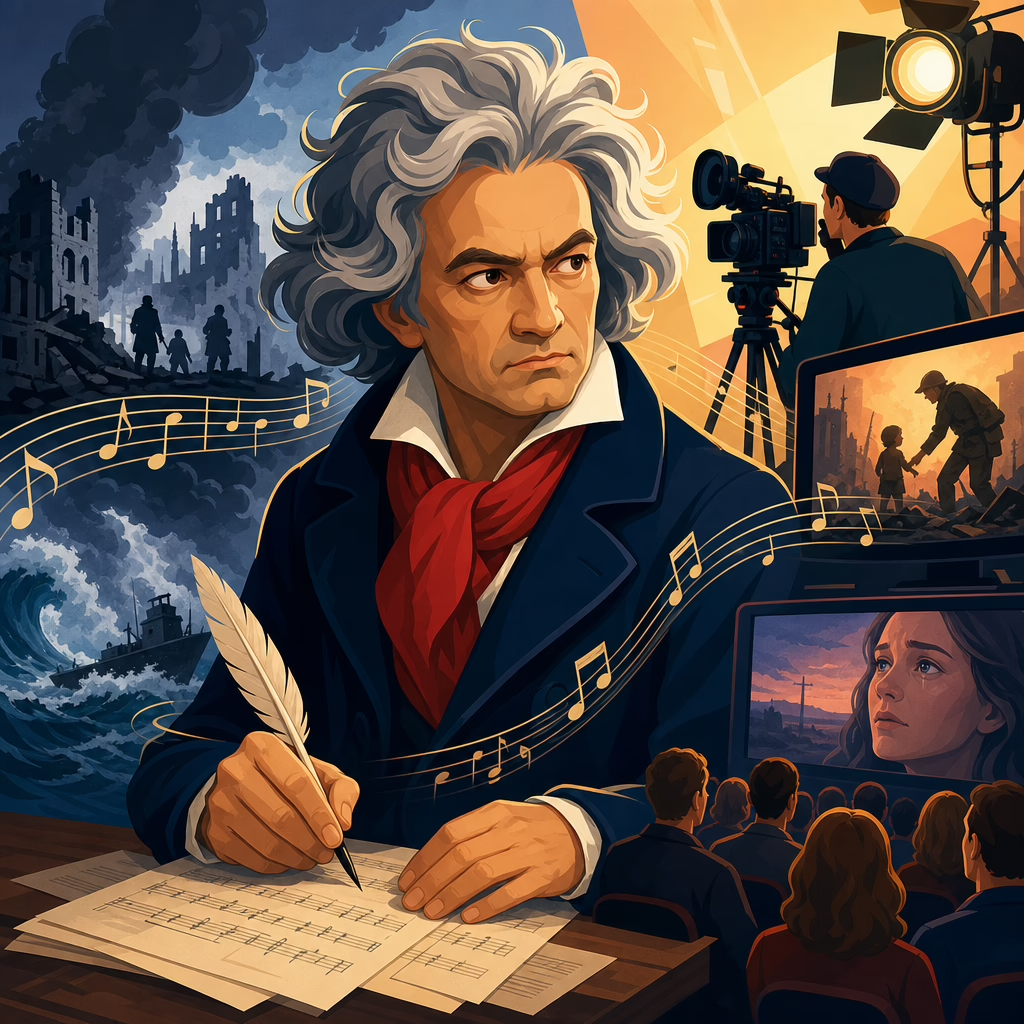
Why Filmmakers Return to Beethoven in Moments of Crisis
When filmmakers need music that can signal collapse, moral pressure, endurance, or the possibility of transcendence, they return to Beethoven with striking regularity. In production meetings, edit suites, and temp-track sessions, Beethoven often becomes the shorthand for crisis because his music carries a rare combination of cultural familiarity, structural tension, and emotional authority. “Crisis” in film does not mean only explosions or war. It includes private breakdowns, political reckoning, ethical conflict, grief, obsession, and the terrifying instant when a character realizes life cannot continue on its previous terms. Beethoven’s music fits these moments because it was built from conflict: rhythmic insistence, destabilized harmony, dramatic silence, and hard-won release. Directors and music supervisors know audiences may not identify a specific opus number, yet they recognize the weight immediately.
That recognition matters because crisis scenes must do several jobs at once. They need to intensify emotion, clarify stakes, and often lift a scene from the personal to the universal. Beethoven can do this faster than most composers because his works already occupy a cultural position somewhere between intimate confession and public monument. I have seen this logic firsthand in score discussions: when an editor wants music that feels both psychologically charged and historically consequential, Beethoven appears on the shortlist almost automatically. He offers prestige, but more importantly, he offers a dramatic engine. A single movement can imply resistance, fate, spiritual struggle, or communal survival without additional explanation.
Filmmakers also return to him because Beethoven’s biography shadows the listening experience. Audiences bring assumptions about deafness, perseverance, revolutionary fervor, and uncompromising artistic vision into the theater. Even when a film never mentions those facts, they color the cue. The result is unusually dense meaning packed into familiar sound. This article examines why Beethoven remains a go-to choice in moments of crisis, how specific musical features create that effect, what filmmakers gain from using him, and where the strategy can fail. The pattern is not accidental. It comes from the way Beethoven’s music stages conflict so clearly that cinema can borrow its force almost instantly.
Beethoven’s Musical Language Turns Inner Conflict Into Audible Drama
The first reason filmmakers return to Beethoven is technical: his music is exceptionally cinematic before it ever reaches a screen. Beethoven specialized in converting instability into form. He starts with terse motifs, repeats them with pressure, interrupts momentum, expands dynamic range, and drives toward cadences that feel earned rather than decorative. For a crisis scene, that matters. A filmmaker does not need wallpaper; a filmmaker needs a structure that can hold escalation. The opening motive of the Fifth Symphony is the classic example, not because it is famous, but because it behaves like a dramatic problem. It knocks, persists, mutates, and refuses to disappear. On screen, that persistence can mirror panic, fate, or obsessive thought.
His slow movements are just as useful. Many crisis scenes are not loud. They are suspended, grief-stricken, morally exhausted. In those cases, Beethoven’s adagios provide emotional gravity without sentimentality. He often creates tension by withholding resolution, placing fragile melody over uneasy accompaniment, or stretching silence so that every entrance feels consequential. Editors value this because it allows performance and score to breathe together. A close-up can sit inside Beethoven’s pacing and feel deepened rather than overdetermined. The music gives shape to thought.
Another practical advantage is rhythmic clarity. Beethoven’s pulse is usually strong enough to cut around. Action editors and drama editors alike can align image changes with accents, sforzandi, or phrase peaks. This makes the music highly usable in montage and confrontation sequences. Even when a cue is repurposed far from its original context, its architecture remains legible. That legibility is why Beethoven survives temp tracks, recuts, and last-minute musical experimentation better than many lush late-Romantic alternatives.
Cultural Memory Gives Beethoven Crisis-Level Authority Immediately
Music in film never arrives as pure sound. It arrives with history attached. Beethoven carries an extraordinary amount of cultural memory, and that memory helps filmmakers communicate crisis quickly. His music has long been associated with struggle, heroic resistance, solemn public ritual, and the dignity of suffering. Those associations were shaped by concert tradition, education, political usage, advertising, and earlier films. By the time a Beethoven cue enters a new movie, it is already carrying accumulated meaning.
This is one reason directors choose him when a scene must feel larger than one character’s private pain. Beethoven can make a domestic argument feel tragic, a courtroom scene feel civilizational, or a final march feel historically weighted. The effect does not depend on listeners knowing sonata form. It depends on broad cultural literacy. Viewers hear Beethoven and infer seriousness, scale, and consequence. In a crowded media environment, that kind of instant authority is valuable.
His image as an artist who turned personal affliction into monumental art intensifies the effect. Filmmakers often want crisis scenes to suggest that suffering reveals character rather than merely interrupts plot. Beethoven’s public myth supports that reading. This is part of the broader story of his symbolic power in modern culture, explored in the pillar guide at why Beethoven became a global cultural icon. In film, that symbolism becomes a tool. A cue can imply endurance before a character has earned the words to say it.
| Beethoven work type | Common crisis effect in film | Why it works on screen |
|---|---|---|
| Symphonic opening with strong motif | Impending danger, fate, obsession | Immediate rhythmic identity and escalating tension |
| Slow movement or adagio | Grief, moral reckoning, suspended time | Emotional weight without melodrama |
| String quartet or late piano sonata passage | Interior collapse, existential isolation | Intimacy paired with formal seriousness |
| Choral finale or large public statement | Collective crisis, sacrifice, historical turning point | Moves from individual emotion to communal meaning |
Directors Use Beethoven to Bridge Personal Breakdown and Public Disaster
A recurring filmmaking problem is scale. A script may depict one person in a room, but the scene needs to imply national trauma, social decay, or irreversible moral consequence. Beethoven solves that problem better than most canonical composers because his music often sounds both subjective and public at once. In practical terms, a piano sonata can frame a solitary mind under pressure, while a symphonic passage can expand that pressure into something collective. The bridge between inner and outer crisis is built into the music.
Stanley Kubrick understood this principle clearly. In A Clockwork Orange, Beethoven is not neutral background but psychological amplification. The music binds ecstasy, violence, aesthetic intensity, and social disorder into one disturbing package. Kubrick uses the cultural prestige of Beethoven to make the crisis more unnerving, not more noble. That distinction matters. Filmmakers return to Beethoven not only for uplift, but because his music can expose the dangerous grandeur of a mind in extremis.
Other directors deploy Beethoven more tragically. In war films, political dramas, and historical thrillers, his music often appears when institutions crack and individuals confront the cost. The cue can frame the scene as a test of moral stamina. Because Beethoven’s musical arguments tend to move through friction rather than around it, the score supports narratives of ordeal. Even when another composer writes the original score, editors may temp with Beethoven because his dramatic syntax clarifies what the scene should become.
Specific Works Keep Reappearing Because They Encode Different Kinds of Crisis
Not all Beethoven cues do the same job. Filmmakers choose specific works because each one carries a distinct dramatic profile. The Fifth Symphony suggests confrontation with relentless force. Its compact motifs and charged transitions fit pursuit, institutional pressure, or existential dread. The Seventh Symphony, especially the Allegretto, serves a different purpose. It is one of cinema’s most durable cues for grief under discipline. The repeated rhythmic tread creates motion, but the harmonic darkening keeps the emotion unresolved. That combination makes it ideal for scenes of mourning, aftermath, and stoic endurance.
The Ninth Symphony has perhaps the widest symbolic range and therefore the highest risk. Its choral finale can represent human solidarity, triumph after catastrophe, or irony when a film wants to question those ideals. Used sincerely, it elevates crisis into a collective horizon. Used critically, it exposes the gap between lofty rhetoric and brutal reality. Directors choose it because no other Beethoven work moves so quickly from tension to public declaration.
Late quartets and late sonatas occupy another category entirely. They are less common in mainstream crisis scenes, but when used well they convey spiritual fracture, estrangement, and difficult introspection. These works do not merely heighten drama; they complicate it. Their shifting textures and unusual formal turns can suggest that a character has moved beyond ordinary emotional language. For art-house cinema, that ambiguity is a feature, not a flaw.
Beethoven Helps Editors Shape Time, Not Just Mood
One mistake in writing about film music is assuming that composers are chosen only for emotion. In the editing room, shape matters as much as feeling. Beethoven is valuable because his music offers strong temporal design. Phrases announce themselves, developments intensify, transitions pivot decisively, and climaxes land with unmistakable force. An editor can build a scene around those markers. When a crisis sequence needs to tighten from hesitation to action, Beethoven’s formal momentum can provide the roadmap.
I have seen sequences improve simply because a Beethoven temp track revealed where dramatic turns were missing. A confrontation that felt static suddenly gained contour when cut against a movement with real developmental pressure. The music showed where a glance needed to hold longer, where a line should land before the cadence, and where silence should interrupt rather than continue underscoring. This is one reason Beethoven remains useful even when the final score is original. He helps filmmakers hear structure.
There is also the question of contrast. Beethoven can make silence more potent because his gestures are so defined. After a forceful phrase, cutting to ambient room tone can feel like an emotional vacuum. That technique is common in crisis scenes involving shock, death, or recognition. The music does not merely tell viewers what to feel; it creates a before-and-after state that sharpens the image.
The Strategy Works Best When Filmmakers Respect Its Risks
Beethoven is powerful, but power invites misuse. The first risk is cliché. If a director drops in the Fifth or the “Ode to Joy” without a clear dramatic reason, the cue can feel borrowed rather than earned. Audiences know this music well enough to detect lazy prestige signaling. The second risk is overstatement. Beethoven can overwhelm performance if the scene itself has not built sufficient emotional pressure. In that case, the music appears to be compensating for missing drama.
There are also tonal risks. Because Beethoven is saturated with cultural meaning, he can steer interpretation too aggressively. A morally ambiguous scene may become falsely noble. A small-scale human conflict may seem inflated. Smart directors manage this by controlling placement, orchestration, and duration. Sometimes a fragment works better than a full statement. Sometimes diegetic use, such as music heard from a radio, creates productive distance. Sometimes the best choice is to invoke Beethoven indirectly through a newly composed score that borrows his logic of tension and release without quoting him.
The enduring lesson is simple: filmmakers return to Beethoven in moments of crisis because his music makes conflict intelligible. It gives shape to fear, gravity to grief, and scale to moral pressure. Just as important, it arrives with centuries of cultural authority, allowing a scene to speak both personally and historically at once. Used well, Beethoven does not decorate crisis; he reveals its architecture. That is why directors, editors, and audiences keep finding their way back to him.
If you want to understand how film transforms classical music into narrative meaning, start by studying the Beethoven cues that appear when characters face the point of no return. Listen for motif, pacing, silence, and cultural memory. The pattern will become impossible to miss, and so will the reason it endures.
Frequently Asked Questions
Why do filmmakers so often choose Beethoven when a story reaches a moment of crisis?
Filmmakers return to Beethoven in moments of crisis because his music can communicate pressure, conflict, and emotional scale almost instantly. Directors and editors often need music that tells the audience, without explanation, that something decisive is happening internally or externally. Beethoven is unusually effective here because his work combines dramatic structure with cultural recognition. Even viewers who cannot name a specific sonata or symphony often recognize the emotional world his music creates: struggle, escalation, resistance, and the possibility of breakthrough.
That makes Beethoven useful in many kinds of cinematic crisis. A scene does not have to involve battle or catastrophe. Crisis in film can mean a private moral collapse, a courtroom revelation, political reckoning, grief, obsession, endurance under pressure, or a final decision that changes everything. Beethoven’s music often feels built for such turning points because it moves with clear momentum. It can sound as if it is pushing against fate, wrestling with instability, or forcing clarity out of confusion. In practical filmmaking terms, that gives a scene shape. The music does not merely decorate the drama; it helps define it.
There is also a shorthand quality at work. In production meetings and temp-track sessions, Beethoven can serve as a fast, efficient reference for intensity with dignity. His music suggests that the crisis matters not only to the character but to a larger moral universe. That combination of emotional force and cultural authority is rare, which is why filmmakers keep returning to him when the story needs to signal collapse, endurance, or transcendence all at once.
What is it about Beethoven’s music itself that makes it so effective in scenes of collapse, pressure, or endurance?
Much of Beethoven’s cinematic power comes from the way his music is constructed. His compositions frequently develop through tension rather than simply presenting a mood. He takes small musical ideas and subjects them to pressure, repetition, interruption, expansion, and confrontation. That process can feel intensely dramatic on screen because it mirrors what crisis looks like in narrative form: a problem emerges, resists easy resolution, intensifies, and demands transformation.
Rhythm is one major factor. Beethoven often writes with a sense of drive that feels urgent and inevitable. Pulses can sound relentless, motifs can strike with near-physical insistence, and transitions can feel like hard turns in thought or destiny. Harmony is another reason. His music often creates suspense by delaying release, darkening expected pathways, or making the arrival of resolution feel earned rather than automatic. In film, that is invaluable because scenes of crisis thrive on suspended certainty. The audience needs to feel that something is hanging in the balance.
Just as important is Beethoven’s range. He can sound stormy and monumental, but he can also sound intimate, exposed, fragile, or spiritually searching. That allows filmmakers to use him for different types of crisis. A symphonic movement might underscore public collapse or historical upheaval, while a piano sonata can suggest private anguish or moral isolation. His music can also pivot from darkness to defiance or from pressure to release, which helps filmmakers portray endurance rather than despair alone. In other words, Beethoven is not just useful because he sounds intense. He is useful because his music dramatizes the experience of being tested.
Does using Beethoven in a film automatically make a scene feel more serious or prestigious?
Not automatically, but it often does add a layer of seriousness because Beethoven carries strong cultural associations. His music has long been linked with artistic gravity, historical importance, intellectual ambition, and emotional depth. When a filmmaker uses Beethoven, the audience may feel that the film is asking them to read the moment as significant, not incidental. That can be highly effective when the story genuinely reaches a point of ethical, political, or emotional consequence.
However, the effect depends on context and execution. Beethoven is powerful precisely because he brings so much meaning with him, but that also means he can overwhelm a scene if used carelessly. If the performance style, visual rhythm, or dramatic stakes do not support the music, the result can feel imposed or overly self-important. In some films, that tension is used deliberately. A director might choose Beethoven to create irony, to expose a character’s grandiosity, or to contrast elevated music with human failure. In such cases, the music does not simply confer prestige; it complicates the scene.
For experienced filmmakers, Beethoven is not a shortcut to “importance” so much as a precise tool. His music can enlarge a scene, but it can also sharpen contradictions within it. A moment may feel more serious because Beethoven makes visible the gap between what a character wants to believe and what reality allows. That is one reason his music remains so valuable in cinema. It does not only add emotional weight; it can reveal the moral and psychological architecture of a crisis.
Why is Beethoven often used for personal or moral crises, not just large-scale disasters or war scenes?
Because Beethoven’s music is deeply connected to inner struggle, filmmakers often use it to score crises of conscience as effectively as crises of spectacle. Cinema does not define crisis only by scale. A confession, betrayal, breakdown, failed act of courage, or irreversible realization can carry more dramatic weight than an explosion if the story has prepared it well. Beethoven works in those moments because his music frequently sounds like thought under pressure. It can feel argumentative, searching, torn between forces, or painfully resolved.
That quality makes his music especially effective for scenes in which the real conflict is ethical rather than physical. A character deciding whether to tell the truth, sacrifice power, endure humiliation, or face guilt may not be moving through an action set piece, but the stakes can still be enormous. Beethoven helps filmmakers express that invisible intensity. The audience hears not just sadness or fear, but effort, resistance, and the burden of consequence. His music often suggests that the character is confronting something larger than immediate emotion: principle, fate, mortality, or the cost of self-knowledge.
There is also a psychological intimacy in many Beethoven works that suits modern filmmaking. Close-ups, sparse dialogue, and restrained performances often benefit from music that can carry internal conflict without spelling everything out. Beethoven can do that elegantly. He can imply fracture without chaos, determination without sentimentality, and transcendence without easy comfort. That is why filmmakers use him not only when cities are burning, but when a single human being reaches the edge of what they can morally or emotionally bear.
How does Beethoven function in the editing room and temp-track process when filmmakers are shaping a crisis scene?
In the editing room, Beethoven is often valuable because his music provides immediate dramatic architecture. Editors and directors commonly use temp tracks to test how a scene breathes, where tension should rise, when a cut should land, and how long a moment can be held before release. Beethoven is especially useful in that phase because many of his works already contain strong internal logic: build, interruption, escalation, suspension, breakthrough. That structure can help filmmakers discover the rhythm of a crisis scene before a final score is written or licensed.
His music also works as a reference language in collaborative settings. If a director tells a composer or editor that a sequence needs “Beethoven-like” force, they are often describing more than volume or classical style. They may mean moral seriousness, mounting inevitability, compressed tension, or the sensation that a private event has universal consequences. Beethoven becomes a shared code for a particular emotional design. That can save time and clarify intention during production, especially when many departments need to align around the same dramatic goal.
At the same time, temping with Beethoven can be both helpful and dangerous. It helps because it reveals whether a scene truly has the shape and gravity the filmmakers want. It is dangerous because Beethoven is so effective that he can temporarily make a weak scene seem stronger than it is. Skilled editors know this and use his music diagnostically, not just cosmetically. If a sequence only works because Beethoven is carrying all the emotional weight, the scene may need revision. But if the music exposes and amplifies drama that is already present, it confirms why filmmakers so often return to Beethoven when shaping moments of crisis.