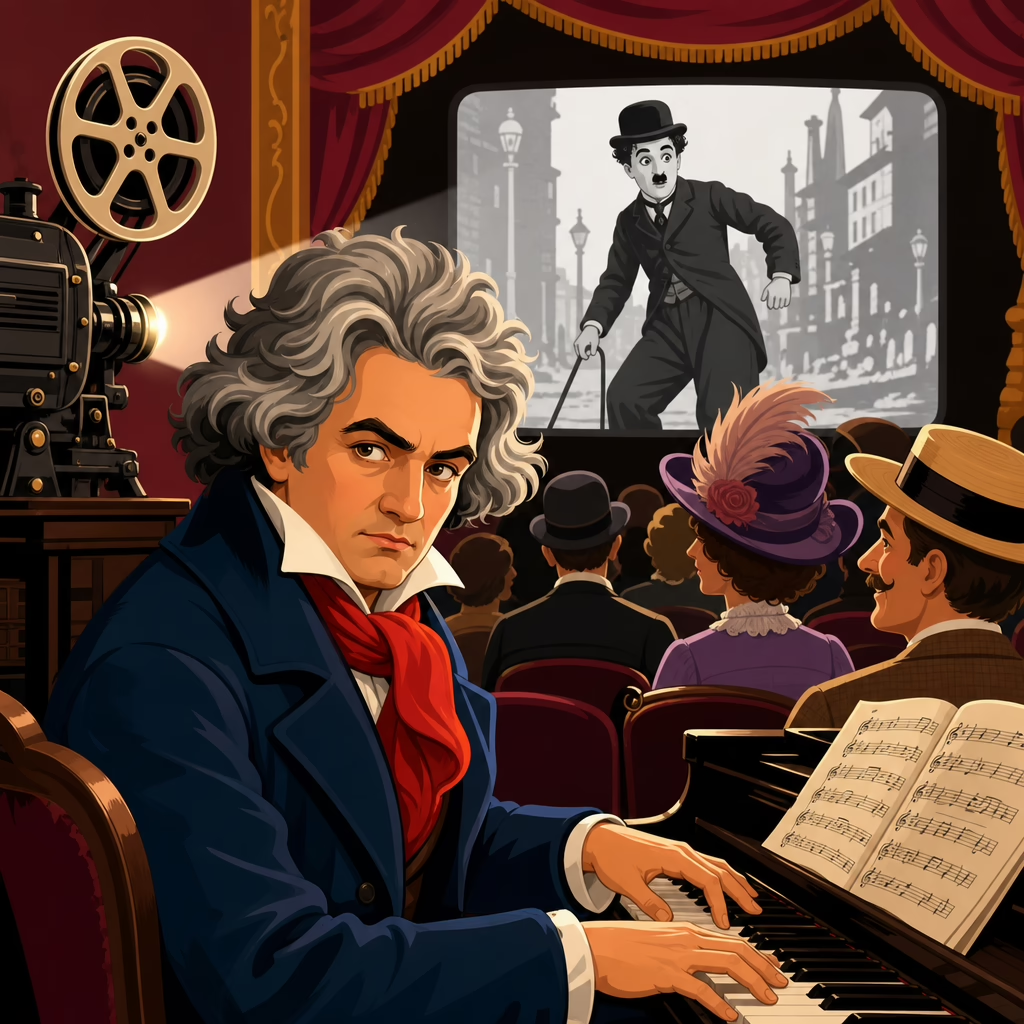
Beethoven in Silent Cinema and Early Film Culture
Beethoven entered silent cinema long before synchronized dialogue because filmmakers, exhibitors, and audiences already treated his music and image as shorthand for genius, struggle, destiny, and moral seriousness. In early film culture, “silent” never meant mute: screenings were accompanied by pianists, organists, chamber ensembles, or full orchestras, and Beethoven’s symphonies, sonatas, overtures, and funeral marches circulated constantly through cue sheets, photoplay albums, concert programs, and publicity copy. To understand Beethoven in silent cinema and early film culture, it helps to define three connected practices. First, there was direct musical accompaniment, when theaters played Beethoven during screenings to color emotion or elevate prestige. Second, there was visual citation, when films used busts, portraits, manuscripts, or the familiar wild-haired profile to signify artistic authority. Third, there was narrative appropriation, when plots borrowed the “heroic Beethoven” story: the misunderstood creator, tested by suffering, redeemed through inner vision. This matters because early cinema was not merely borrowing famous music for decoration. It was building cultural legitimacy by attaching a new mass medium to one of Europe’s most revered composers, while also reshaping Beethoven into something portable, dramatic, and globally recognizable for modern audiences.
In archives of trade journals and theater programs, I repeatedly see Beethoven functioning as a practical solution to a central problem of silent exhibition: how to give moving images emotional depth without spoken words. Exhibitors needed music that audiences already understood, and Beethoven offered themes loaded with associations. The Fifth Symphony suggested fate and conflict; the Moonlight Sonata implied introspection and melancholy; the Funeral March from the “Eroica” carried grief and public mourning. Because these meanings were widely shared, Beethoven became useful not only in elite urban picture palaces but also in smaller houses where a single pianist had to create instant atmosphere from familiar repertory. At the same time, his presence helped producers and critics argue that film could be art rather than fairground novelty. Silent cinema’s relationship with Beethoven therefore reveals both cultural ambition and commercial calculation, making it one of the clearest windows into how early film sought status, emotion, and narrative authority.
Why Beethoven fit the needs of silent film exhibition
Beethoven fit silent film culture because his music was structurally dramatic, publicly recognizable, and flexible enough to be excerpted. Accompanists needed pieces that could support chase scenes, love scenes, tragic revelations, ceremonial entrances, and endings. Beethoven’s catalog, though not written for film, supplied strong rhythmic profiles, clear contrasts, and memorable motifs that could survive reduction for solo piano or organ. In practice, theater musicians rarely performed complete works during ordinary screenings. They used selected passages, arranged excerpts, or Beethovenian paraphrases drawn from anthologies such as Giuseppe Becce’s Kinothek, Erno Rapée’s motion picture guides, and house cue sheets distributed by studios and music publishers. These materials classified music by mood and situation, and Beethoven often appeared in categories linked to pathos, grandeur, agitation, and nobility.
There was also a social reason. Around 1908 to 1928, as feature films lengthened and movie palaces expanded, exhibitors competed to attract middle-class patrons who valued respectability. Programming Beethoven before the film, during intermissions, or at gala premieres signaled refinement. I have seen period advertisements that boasted of “symphonic” accompaniment not because every patron could identify a specific movement, but because the name Beethoven itself conveyed seriousness. This mirrored broader efforts to align cinema with opera, theater, and the concert hall. The strategy worked especially well because Beethoven was famous across national borders. Unlike a local stage celebrity, he could travel through posters, reviews, schoolbooks, and popular biography. His prestige was instantly exportable, which made him ideal for an international film industry trying to standardize emotional meaning while selling cultural uplift.
How accompanists and music directors actually used Beethoven
In most silent-era venues, Beethoven was heard less as a complete composer than as a repertory resource. A pianist might open with the “Pathétique” Sonata for a serious domestic drama, pivot to an arrangement of the Fifth Symphony during a moment of pursuit or crisis, and close with a softened Beethoven excerpt to dignify reconciliation. Large urban theaters did something more ambitious. Music directors assembled compiled scores, combining classics, salon music, marches, and original connecting material. Beethoven pieces gave these compilations weight. The best directors matched tempo, phrase length, and orchestration to screen action, but they also used Beethoven symbolically. A courtroom scene scored with Beethoven implied moral gravity. A mother’s death underscored with the Funeral March from the “Eroica” transformed private grief into public tragedy.
Trade literature confirms how systematic this practice became. Erno Rapée, who later worked at the Capitol Theatre and Roxy in New York, emphasized the value of familiar classics for conveying emotion efficiently. Publishers issued anthologies with pre-arranged selections that could be adapted to different ensemble sizes, since many theaters lacked a full orchestra. Beethoven’s music was especially suitable because reductions still retained identity. Even when heavily cut, the dotted rhythms, dramatic openings, and singing slow movements remained legible. This practical durability explains why Beethoven appeared in everything from prestige historical dramas to melodramas and newsreels. He was not reserved only for “high art” films. He circulated through everyday exhibition, where musicians treated him as reliable emotional infrastructure rather than sacred untouchable repertoire.
| Beethoven work or type | Typical silent-era use | Why exhibitors chose it |
|---|---|---|
| Symphony No. 5 opening | Crisis, pursuit, threat, fateful turning point | Instantly recognizable rhythmic urgency |
| “Moonlight” Sonata | Night scenes, solitude, memory, romantic loss | Atmosphere and familiar melancholy |
| “Eroica” Funeral March | Death, public mourning, sacrifice | Grave dignity and ceremonial scale |
| Egmont Overture excerpts | Conflict, resistance, political danger | Heroic momentum and sharp contrasts |
| Pastoral-style excerpts or arrangements | Nature, countryside, calm transition | Broad lyrical color even in reduction |
Beethoven as image, character, and cultural symbol on screen
Early film culture did not rely on music alone. Beethoven’s face and life story were cinematic assets. His portrait, especially the severe expression and unruly hair derived from nineteenth-century iconography, appeared in films, lobby displays, and magazine illustrations as a visual guarantee of artistic depth. A set decorated with a Beethoven bust immediately coded a character as cultivated, aspiring, or spiritually serious. This was common in melodramas about musicians, teachers, and bourgeois families, where domestic interiors used canonical composers as moral furniture. Viewers did not need explanatory titles. The symbol was already readable.
Biographical films and composer dramas deepened this process. European silent cinema, particularly in Germany and Austria, repeatedly turned to composer biographies as a respectable genre. These films often compressed Beethoven’s life into recognizable episodes: youth and ambition, unrequited love, deafness, struggle with patrons, triumphant creation. Historical accuracy was secondary to emotional mythmaking. The point was to make artistic suffering visible. Silent cinema excelled at close-ups of isolation, gestures of listening and not hearing, and the spectacle of inward concentration. Beethoven’s deafness, in particular, offered filmmakers a paradox they found irresistible: a silent medium depicting a composer who could no longer hear. That irony gave silent-era Beethoven films unusual symbolic force.
For readers exploring the wider cultural process that made this symbolism so durable, the broader context is outlined in this guide to why Beethoven became a global cultural icon. In silent film, that global iconography was distilled into quickly legible signs: the suffering genius, the revolutionary artist, the moral titan. Those signs could be inserted into fiction features, educational shorts, newsreels, and promotional rhetoric with equal efficiency.
Prestige, education, and the campaign to legitimize cinema
One of the most important functions Beethoven served in early film culture was institutional legitimation. Reformers, critics, and exhibitors worried that cinema was associated with noise, cheap sensation, and working-class amusement. Invoking Beethoven helped answer those criticisms. Music directors promoted screenings as quasi-concert experiences. Urban palaces hired orchestras, printed elaborate programs, and framed attendance as cultured leisure. If an evening at the movies included Beethoven, managers could claim continuity with established musical life rather than rupture from it. This was not purely cynical branding. Many theater musicians were conservatory trained, and some genuinely believed film could educate public taste by exposing large audiences to canonical music.
Educational discourse reinforced the point. Newspapers and fan magazines praised films that cultivated appreciation for “great music” or “great men.” Schools, women’s clubs, and civic groups often supported screenings with historical or literary themes, and Beethoven references fit those uplift agendas perfectly. In this environment, even a selective, rearranged, or sentimentalized use of Beethoven could be defended as beneficial. The tradeoff, of course, was simplification. Complex works became emotional shorthand. Musical form was subordinated to scene changes. Yet that very simplification expanded Beethoven’s reach. Silent cinema introduced his sounds and his legend to audiences who might never attend a symphony concert, and it did so repeatedly, across ordinary weekly programs rather than rare special events.
National styles, transatlantic circulation, and the limits of authenticity
Beethoven’s role was not identical everywhere. German-language film culture often treated him as a national inheritance and a heroic figure bound to ideas of Geist, artistic autonomy, and historical destiny. French and British contexts more often emphasized prestige and educational uplift, while American exhibition adapted Beethoven with striking pragmatism, using him freely inside mixed compiled scores. Across all these contexts, however, the same tension remained: authenticity versus utility. Purists objected to fragmenting symphonic music for incidental use, and some critics mocked the indiscriminate playing of famous classics under banal scenes. They were not entirely wrong. I have encountered period complaints about pianists dropping the Moonlight Sonata into almost any sentimental passage, whether or not the dramatic fit was convincing.
Still, the criticism can obscure how skilled the best silent-era musicians were. In top houses, Beethoven was not simply pasted onto images. Directors and conductors studied leitmotivic recurrence, tonal relationships, and rhythmic synchronization. Some premieres featured specially prepared arrangements designed around a film’s narrative arc. Others used Beethoven sparingly so that a major quotation would land with force. The broader record shows a spectrum from routine cliché to sophisticated interpretation. That range is essential. Silent cinema did not “misuse” Beethoven in one uniform way; it repurposed him under varied industrial conditions, and those conditions shaped what audiences heard. The early film Beethoven was therefore both canonical and mutable, revered and radically practical.
Lasting influence on film music and Beethoven’s modern screen identity
The silent era established patterns that outlived silence itself. Later sound films inherited a ready-made vocabulary in which Beethoven signaled seriousness, genius, turmoil, or moral scale. Biopics, cartoons, war films, and psychological dramas all drew from codes developed when accompanists and exhibitors first paired his music and image with moving pictures. The Fifth Symphony remained cinematic shorthand for fate and struggle. The Moonlight Sonata continued to mark interiority. The image of the isolated, tempestuous composer became one of the most durable myths in screen culture. Even when later directors used Beethoven ironically, they depended on associations that silent cinema had helped normalize.
This legacy matters because it reminds us that film culture does not merely reflect musical reputation; it manufactures and stabilizes it. Silent cinema turned Beethoven into an everyday media presence by repeating fragments, stories, and visual cues across thousands of screenings. In doing so, it narrowed some dimensions of his art while amplifying others that worked especially well on screen. The result was a powerful public Beethoven: dramatic, legible, emotionally immediate, and available to mass audiences across class lines. If you want to understand why Beethoven became so effective in visual media, start with silent cinema’s practical needs and symbolic ambitions. They show exactly how a composer entered popular consciousness not just through concert halls, but through the flicker of early film and the musicians who gave that flicker its voice.
Frequently Asked Questions
Why was Beethoven so important in silent cinema if films had no synchronized sound?
Beethoven mattered enormously in silent cinema precisely because early filmgoing was never actually silent. Before synchronized dialogue became standard, screenings were almost always accompanied by live music, whether from a single pianist, an organist, a small ensemble, or a full orchestra in major urban theaters. In that environment, Beethoven’s music was a powerful and flexible resource. His symphonies, sonatas, overtures, and funeral marches were already familiar to broad audiences, and they carried strong cultural meanings that filmmakers and exhibitors could draw on immediately. A passage associated with grandeur, fate, struggle, triumph, mourning, or moral seriousness could shape the emotional interpretation of a scene without a word being spoken.
Just as important, Beethoven functioned as a cultural symbol as well as a composer. His image and reputation stood for genius, adversity, inner conflict, and artistic elevation. In early film culture, that made him useful both musically and visually. His works could accompany dramatic or tragic scenes, while references to his persona could lend prestige to films and filmgoing itself. At a time when cinema was still seeking cultural legitimacy, Beethoven helped connect the new medium to established traditions of “serious” art. So even without synchronized soundtracks, Beethoven was deeply embedded in the silent-era film experience through live performance practices, exhibition culture, and shared audience assumptions about what his music meant.
How was Beethoven’s music actually used during silent film screenings?
Beethoven’s music entered silent film exhibition through several practical channels. Theater musicians often relied on cue sheets, photoplay albums, stock music anthologies, and their own repertories to match music to mood, pace, and narrative action. Beethoven’s works were frequently mined for exactly those purposes. A solemn march might underscore death, sacrifice, or public grief; a stormy orchestral passage could intensify scenes of conflict or emotional crisis; a noble or triumphant theme could elevate climactic resolutions. In larger venues, orchestras might perform more substantial excerpts, while in smaller houses a pianist or organist might adapt Beethoven in abbreviated or rearranged form to suit the film and available resources.
Use varied widely by location and budget. Prestigious theaters might advertise distinguished Beethoven selections as part of the attraction, presenting the screening almost like a hybrid of concert and cinema event. Elsewhere, musicians played fragments, paraphrases, or familiar motifs recognized by audiences even if they did not hear an entire movement. Beethoven was also present beyond the moment of accompaniment itself: in printed programs, publicity materials, and educational or prestige framing around film exhibitions. In all of these contexts, his music offered exhibitors a ready-made emotional vocabulary and a mark of cultural authority. The result was not a single standardized silent-film “Beethoven,” but a broad and adaptable practice shaped by local musicians, theater traditions, and audience expectations.
What did Beethoven symbolize to filmmakers and audiences in early film culture?
To early filmmakers and audiences, Beethoven symbolized much more than a famous classical composer. He represented a cluster of ideas that were especially useful to silent-era storytelling: genius born through struggle, the power of destiny, deafness overcome by inner strength, profound emotional depth, and uncompromising artistic seriousness. Those associations had been built over the nineteenth century through biography, criticism, portraiture, concert life, and popular myth. By the time cinema emerged, Beethoven’s public image was already highly legible. A reference to him could instantly signal a character’s aspiration, a film’s artistic ambition, or the gravity of a dramatic situation.
This symbolic force mattered because silent films depended heavily on visual shorthand and widely understood cultural references. Beethoven could be invoked as a kind of moral and emotional index. His likeness, his name, or his music could suggest that a story was not merely entertaining but spiritually elevated or psychologically profound. That made him especially valuable in films dealing with suffering, sacrifice, inspiration, historical seriousness, or the redemptive power of art. Audiences did not need a lecture to understand the implication. Beethoven already stood in the public imagination as a figure of heroic creativity and human endurance, and silent cinema repeatedly drew on that symbolic reservoir.
Did Beethoven help give silent films cultural prestige?
Yes, very much. In the early decades of cinema, one of the industry’s recurring challenges was to prove that film could be more than novelty or mass amusement. Aligning motion pictures with respected cultural figures and established artistic traditions was one way to do that, and Beethoven was one of the strongest names available. His presence in accompaniment programs, theater advertising, and the broader discourse around film exhibition helped frame cinema as an art form capable of seriousness, refinement, and intellectual depth. For exhibitors especially, Beethoven could signal that a screening was worthy of educated, middle-class, or aspirational audiences.
This prestige function operated on multiple levels. Musically, using Beethoven linked film presentation to the concert hall and the canon of European art music. Socially, it reassured patrons that attending the cinema could be an edifying experience rather than a merely commercial one. Aesthetically, it encouraged viewers to approach films with greater attentiveness to emotion, structure, and moral implication. Even when Beethoven was used selectively or in excerpted form, his name carried symbolic weight. In that sense, he helped bridge older hierarchies of culture and the newer world of moving images. Silent cinema did not simply borrow Beethoven for decoration; it used him to claim seriousness, legitimacy, and artistic ambition in a competitive cultural landscape.
Why does Beethoven’s place in silent cinema matter for film history today?
Beethoven’s place in silent cinema matters because it corrects a common misunderstanding about early film history. People often imagine silent film as visually rich but acoustically empty, when in fact it was built around dynamic musical practices. Studying Beethoven in this context reveals how central live accompaniment was to interpretation, mood, pacing, and audience response. It also shows that early cinema was never isolated from broader cultural traditions. From the beginning, film interacted with concert culture, popular music circulation, celebrity biography, visual iconography, and debates about artistic value. Beethoven sits at the crossroads of all those histories.
His role also helps historians understand how meaning was produced collaboratively in early film culture. Filmmakers, distributors, exhibitors, conductors, pianists, critics, and audiences all participated in making Beethoven signify within cinema. There was no single fixed soundtrack; there were many performances and many local decisions. That variability is historically important because it reminds us that silent film was a live event as much as a reproducible text. Finally, Beethoven’s recurring presence demonstrates how quickly cinema learned to appropriate established cultural symbols in order to deepen narrative emotion and elevate its public image. Looking at Beethoven in silent cinema therefore opens a wider window onto exhibition practice, cultural prestige, audience literacy, and the intertwined evolution of music and film.