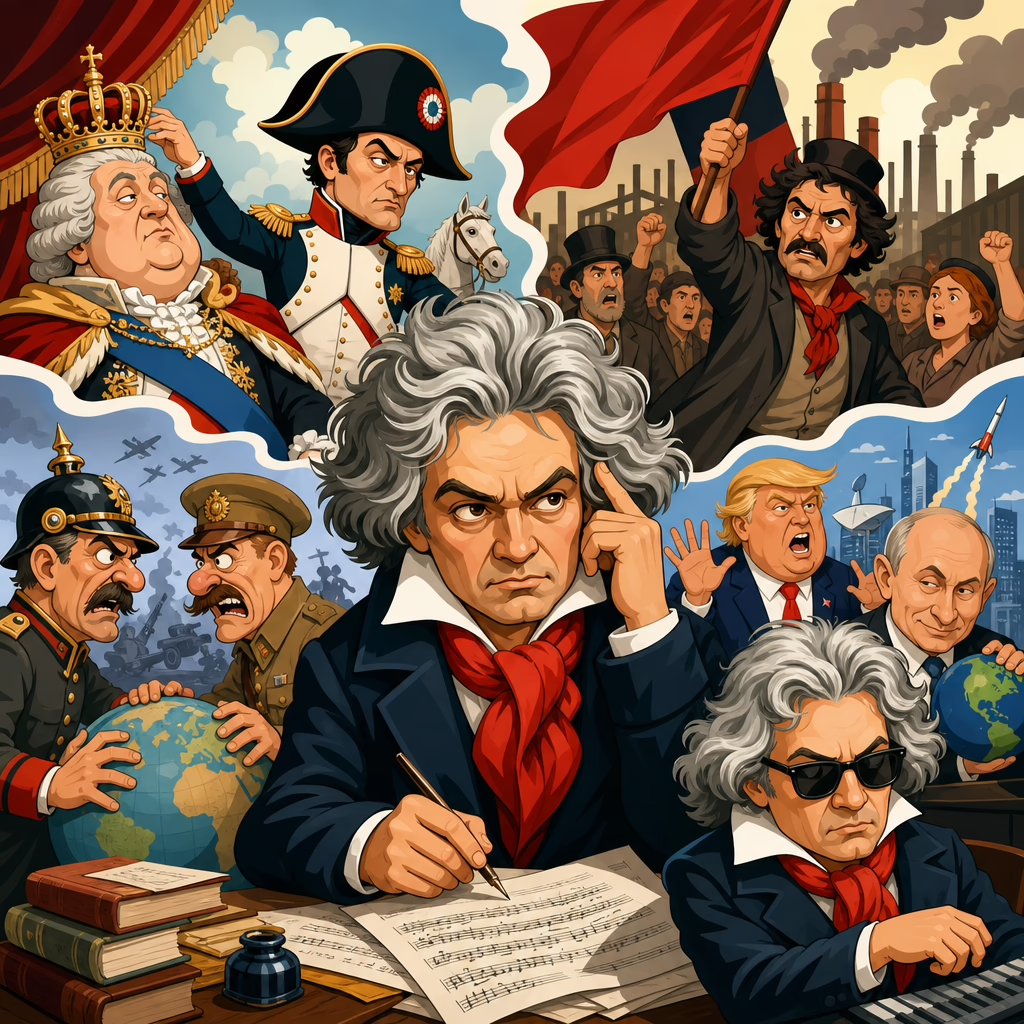
Beethoven in Political Cartoons Through the Centuries
Beethoven has appeared in political cartoons for more than two centuries because his face, hair, and reputation form an instantly readable symbol of genius, struggle, authority, and noise. In editorial art, few composers are as visually useful. The wild mane, stern stare, and association with monumental music allow cartoonists to compress a complex political message into a single recognizable figure. When a state claims cultural greatness, when a leader is portrayed as overbearing, or when public life becomes deaf to dissent, Beethoven becomes a potent shorthand.
In this context, political cartoons are not casual jokes about classical music. They are visual arguments published in newspapers, magazines, pamphlets, and later digital media to shape public opinion. A political cartoon uses exaggeration, symbolism, captions, and allusion to comment on power. Beethoven enters that tradition as both a historical person and a cultural icon. Cartoonists rarely aim for biographical accuracy. Instead, they borrow selected traits: the heroic profile, the notion of misunderstood genius, the Fifth Symphony’s pounding inevitability, the Ninth Symphony’s utopian chorus, and his well-known hearing loss.
I have spent years studying how music symbols migrate into public commentary, and Beethoven is one of the most durable examples because he can signify opposite things at once. He can stand for liberty or authoritarian appropriation, enlightened humanism or pompous cultural prestige, disciplined form or explosive anger. That range explains why Beethoven remains visible in political satire long after many once-famous statesmen have vanished from popular memory. Understanding his cartoon afterlife reveals how societies use high culture to fight ordinary political battles.
Why Beethoven became cartoon shorthand
Beethoven became unusually useful to cartoonists because his image stabilized early. By the nineteenth century, portraits by Joseph Karl Stieler and others had fixed the familiar look: intense eyes, untamed hair, severe expression, and manuscript in hand. Even readers with little concert experience could identify him. That immediate recognizability matters in editorial art, where meaning must land in seconds. Cartoonists need figures that can survive distortion. Beethoven’s face does.
His symbolic range is just as important. Napoleon disappointed him; the “Eroica” story linked him to ideals betrayed by power. The Fifth Symphony suggested fate, struggle, and victory. The Ninth invited readings about brotherhood, Europe, and universal aspiration. His deafness added a second layer: the irony of a master of sound who could not hear. Political artists repeatedly exploit that contradiction to depict governments deaf to citizens, parliaments deaf to warning, or elites loudly celebrating culture while ignoring social crisis.
Another reason is class reach. Beethoven belongs to elite concert culture, but melodies associated with him circulate widely in film, advertising, schools, and public ceremonies. That broad recognition lets a cartoon appeal upward and downward at once. A learned reader may catch an “Eroica” or “Ode to Joy” reference, while a casual reader still understands that Beethoven represents greatness under pressure. That flexibility made him reusable in monarchies, republics, dictatorships, and democracies.
Nineteenth-century origins: caricature, nationalism, and the heroic artist
In the nineteenth century, Beethoven first entered political caricature through the broader European culture of satirical print. Journals such as Punch in Britain, Le Charivari in France, and Fliegende Blätter in the German lands normalized visual commentary on public affairs. During this period, Beethoven was still close enough to living memory to carry biographical force. Cartoonists used him not only as a generic composer but as the archetype of the serious modern artist confronting vulgar society and unstable politics.
After the revolutions of 1848 and during later nationalist movements, Beethoven’s music was increasingly treated as a treasury of German cultural prestige. Cartoons responded by presenting him as a tutelary spirit hovering over debates about nationhood, education, and artistic standards. In some images, politicians invoke Beethoven to flatter themselves as heirs of civilization. In others, satirists puncture that claim by placing his imposing bust above ridiculous parliamentary squabbles. The joke is simple and effective: a culture that boasts of Beethoven may still behave badly.
Late nineteenth-century cartooning also sharpened a pattern that would persist: the contrast between monumental music and petty politics. A minister waves a baton like a conductor but cannot manage a coalition. A legislature attempts a symphony and produces cacophony. Beethoven serves as the benchmark against which public disorder is measured. This was especially common in periods of urban modernization, when industrial noise, press sensationalism, and political fragmentation encouraged comparisons between harmony and social chaos.
Beethoven in wartime propaganda and ideological struggle
The two world wars intensified political uses of Beethoven because belligerent nations competed over the meaning of German culture. During World War I, British and French cartoonists could portray Germany as hypocritically claiming Beethoven while practicing militarism. The implicit argument was that the nation of great music had betrayed its own highest tradition. German images, by contrast, could depict Beethoven as proof of spiritual depth against supposedly materialist enemies. In both cases, he functioned as contested cultural property.
Under National Socialism, Beethoven became even more politically charged. The regime elevated him within an official lineage of German greatness, emphasizing monumentality, discipline, and national destiny while suppressing more inconvenient associations with individual freedom and cosmopolitan reception. Anti-Nazi cartoonists outside Germany answered by turning that appropriation into satire. One recurring device showed dictators draping themselves in Beethoven’s prestige like borrowed costume. The message was that genuine art outlived propaganda and exposed its theft.
During the Second World War and early Cold War, the Ninth Symphony acquired exceptional cartoon value. Because “Ode to Joy” could be framed as universalist, democratic, European, socialist, or merely ceremonial, cartoonists used it to test political sincerity. If leaders proclaimed brotherhood while building blocs and arsenals, Beethoven became a witness against them. In East and West alike, editorial artists paired his exalted ideals with scenes of rubble, censorship, or military posturing to reveal the gap between rhetoric and reality.
| Period | Typical Beethoven Cartoon Use | Political Point |
|---|---|---|
| 19th century | Heroic composer versus petty officials | Culture exposes mediocrity in public life |
| World War I | Claimed as national treasure by rival sides | Great art is used to justify conflict |
| Nazi era | Appropriated as symbol of German destiny | Authoritarian power borrows cultural legitimacy |
| Cold War | Ninth Symphony invoked in peace rhetoric | Leaders often betray the ideals they quote |
| Contemporary era | Meme-like icon of noise, genius, and Europe | Classical prestige still shapes political messaging |
Postwar Europe: Beethoven as a symbol of unity and bureaucracy
After 1945, Beethoven’s role in political cartoons shifted again as European reconstruction and integration gathered force. The adoption of the “Ode to Joy” theme by the Council of Europe in 1972, and later by the European Communities and European Union, gave cartoonists a ready-made emblem. From that point onward, Beethoven could stand not just for Germany or high culture but for Europe itself. That widened his relevance dramatically.
Cartoonists used the European Beethoven in two opposing ways. Supportive images showed him conducting quarrelsome national leaders toward harmony, suggesting that integration was difficult but civilizing. Critical images were harsher: a disheveled Beethoven tries to conduct a hopeless orchestra of finance ministers; the score reads “unity,” while every player performs a separate agenda. During treaty fights, currency crises, and Brexit debates, “Ode to Joy” became a satirical soundtrack for institutional strain.
This use works because Beethoven represents aspiration under pressure. European institutions often communicate in moral language about peace, cooperation, and shared values. Cartoons test those claims against migration disputes, debt negotiations, defense disagreements, or democratic backsliding. When a summit ends in deadlock, Beethoven’s presence sharpens the irony. The larger the cultural ideal, the more visible the political failure. Editorial artists understand that contrast intuitively, which is why European newspaper archives are crowded with Beethoven conductors, busts, and broken scores.
Recurring visual motifs and what they mean
Across centuries, several Beethoven cartoon motifs recur because they solve familiar editorial problems. The first is the conductor image. A politician with Beethoven’s hair or costume implies an attempt to impose order on a chaotic body politic. If the orchestra follows, the cartoon praises leadership. If instruments explode or sections revolt, it mocks overreach and incompetence. Conducting is politically legible because it visualizes coordination, authority, and timing.
The second is deafness. Cartoonists have long used ear trumpets, ignored notes, or a deaf Beethoven to criticize unresponsive governments. This device can be subtle or cruel, and modern editors are often more careful with disability imagery than earlier publications were. Still, the metaphor persists because it neatly expresses a central democratic complaint: those in power do not listen. When deployed responsibly, the image critiques institutions, not Beethoven’s condition itself.
A third motif is the monumental bust or portrait. In legislative chambers, ministries, and summit halls, Beethoven’s stone likeness looks down on politicians. This arrangement suggests judgment from history. It can also imply empty cultural posturing: leaders place themselves beneath a canon they have not earned. Finally, there is the score itself. Titles like “Fifth Symphony,” “Eroica,” or “Ode to Joy” are written on legislation, budgets, or peace plans, asking whether the result will be triumph, betrayal, or hollow ceremony.
How contemporary cartoonists use Beethoven in the digital era
Today’s political cartoons circulate in print, on news sites, and across social platforms, where visual literacy is faster and more fragmented. Beethoven remains effective because he survives miniaturization. Even at thumbnail size, the silhouette reads. Contemporary artists also benefit from a layered audience. A newspaper subscriber may recognize a reference to the European anthem, while a younger online viewer may know Beethoven from a meme, a school assignment, or the famous opening of the Fifth.
Recent cartoons use Beethoven to comment on austerity politics, cultural funding cuts, populist attacks on expertise, and the tension between national sovereignty and supranational governance. During pandemic-era restrictions, some artists depicted empty concert halls beside politicians quoting resilience, using Beethoven to ask whether public reverence for culture extends to material support for artists and institutions. During energy and inflation crises, “Ode to Joy” has been repurposed ironically to accompany public frustration with official optimism.
Digital circulation has also increased cross-border reuse. A Beethoven image drawn in Madrid can be understood in Brussels or Berlin with minimal translation. That portability is rare. Yet there is a limit: the symbol works best where classical music still carries civic prestige. In settings where Beethoven feels remote, the cartoon may require a caption or secondary cue. Even so, his staying power is remarkable. Very few cultural figures from the early nineteenth century remain this operational in live political satire.
What Beethoven cartoons reveal about politics itself
Beethoven’s long cartoon career shows that politics constantly borrows authority from culture, then gets measured against it. That is the deepest pattern. Cartoonists turn to Beethoven when they need a standard larger than the daily news cycle. His image carries permanence, seriousness, and aspiration. When placed beside corruption, bombast, censorship, or bureaucratic drift, he intensifies criticism without requiring long explanation.
These cartoons also reveal a democratic truth about cultural prestige. Reverence does not neutralize satire; it sharpens it. The higher Beethoven stands in public esteem, the more useful he becomes for exposing hypocrisy. That is why his image can support opposing political arguments while remaining recognizable. He is not a fixed doctrine. He is a testing instrument for claims about civilization, unity, listening, and power.
For readers interested in Beethoven and culture, political cartoons offer a focused archive of reception history in action. They show not simply what people thought of the composer, but what societies needed him to mean at specific moments. Follow those images across centuries and one lesson stands out: Beethoven endures in politics because his symbolic force is still unsettled. Look at the next editorial cartoon that borrows his face or music, and ask the essential question it poses—who is trying to inherit greatness, and have they earned it?
Frequently Asked Questions
Why does Beethoven appear so often in political cartoons compared with other composers?
Beethoven appears so often in political cartoons because he is one of the rare historical figures whose image and meaning can be recognized almost instantly, even outside strictly musical contexts. Cartoonists depend on visual shorthand, and Beethoven offers an unusually efficient combination of recognizable features and symbolic weight. His unruly hair, intense expression, and familiar profile make him easy to identify in a simplified drawing, which is essential in editorial art where ideas must be communicated quickly. At the same time, his cultural reputation is expansive: he stands for genius, seriousness, authority, artistic struggle, European high culture, and overwhelming sound. That gives artists a broad symbolic toolkit to work with.
Just as important, Beethoven can be used flexibly. In one cartoon he may represent national prestige, especially in moments when governments want to associate themselves with cultural greatness. In another, he can symbolize noisy excess, pomposity, or an overblown public performance. Because his music has long been linked with grandeur, destiny, and emotional force, he becomes a ready-made metaphor for political ambition, institutional self-importance, or social upheaval. Few composers combine visual recognizability and symbolic versatility at that level, which is why Beethoven has remained useful to cartoonists across centuries.
What does Beethoven usually symbolize in editorial and political cartooning?
In political cartoons, Beethoven usually symbolizes more than music itself. He often serves as a stand-in for genius, cultural authority, and the weight of tradition. When an artist places a political figure in Beethoven’s hair or facial features, the goal is often to suggest that the person is presenting themselves as monumental, heroic, or historically significant. That can be sincere, but more often in editorial satire it is ironic. A leader may be shown “conducting” a nation into chaos, or a bureaucracy may be dressed in Beethoven’s image to mock its self-importance and grand rhetoric.
He can also symbolize struggle and intensity. Because Beethoven’s biography has been widely mythologized as a story of artistic perseverance against suffering, cartoonists can use him to evoke endurance, defiance, or tormented greatness. In other cases, the symbolism becomes more critical. His association with loud, powerful music allows him to represent noise, bluster, public spectacle, or overwhelming state power. That is one reason Beethoven works so well in cartoons about propaganda, nationalism, or political theater. The image can communicate both admiration and mockery, sometimes at the same time, which is exactly the kind of ambiguity editorial art often thrives on.
How has the use of Beethoven in political cartoons changed over the centuries?
The use of Beethoven in political cartoons has evolved along with media, politics, and public culture. In the nineteenth century, references to Beethoven tended to emerge within a European context where audiences were closely attuned to debates about art, class, nationalism, and cultural prestige. During that period, he could appear as a figure connected to serious music, German identity, or the growing idea of the artist as a heroic individual. As mass print culture expanded, cartoonists increasingly used him not just for music-related commentary but for broader political statements about authority, taste, and national image.
In the twentieth century, especially during periods of war, ideological conflict, and state propaganda, Beethoven took on even more political weight. Governments and commentators alike drew on his image to claim legitimacy, continuity, or civilizational superiority. At the same time, satirists used him to puncture those claims, showing the gap between noble cultural symbolism and messy political reality. In more recent decades, the references have often become more layered or ironic. Modern cartoonists may invoke Beethoven as part of a critique of elitism, public performance, heritage branding, or the commercialization of culture. Even as audiences become more visually fragmented, Beethoven remains legible because his face and hair still function as one of the clearest icons in the history of music.
Why is Beethoven such an effective visual shorthand for political ideas like authority, struggle, or excess?
Beethoven is effective visual shorthand because his image and reputation reinforce each other. On the visual side, he has a set of features that survive simplification: the storm-like hair, stern face, and dramatic posture can be rendered in a few lines and still be unmistakable. That matters in cartooning, where economy of form is everything. On the symbolic side, generations of listeners, teachers, institutions, and media have built Beethoven into a cultural monument. He is not merely a composer in the public imagination; he is a symbol of greatness itself. That makes him incredibly useful when a cartoonist needs to suggest importance, heaviness, moral seriousness, or self-declared historical destiny.
He is equally effective when the message is critical rather than celebratory. Because Beethoven is associated with grand scale and emotional force, he can stand for overreach, bombast, or deafening public rhetoric. A political speech can be depicted as a Beethovenian performance to suggest that it is theatrical, overpowering, and perhaps self-consciously monumental. A government can be shown borrowing Beethoven’s authority to imply that it is wrapping itself in cultural prestige. This double capability—being able to signify both authentic greatness and exaggerated pretension—is what makes Beethoven so powerful in satire. He lets cartoonists comment on ambition, legitimacy, ego, and spectacle all at once.
What can political cartoons featuring Beethoven reveal about the societies that produced them?
Political cartoons featuring Beethoven reveal how societies use culture to think about power. When cartoonists choose Beethoven, they are not simply making a joke about classical music; they are drawing on shared assumptions about who has authority, what counts as genius, and how nations present themselves. A cartoon that uses Beethoven to represent a state, party, or leader often shows that high culture has become part of political language. It suggests that the audience is expected to recognize cultural symbols and connect them with ideas of legitimacy, prestige, education, or domination.
These cartoons also reveal anxieties. If Beethoven is used to mock a government’s cultural self-display, the cartoon may be exposing fears about propaganda, elitism, or inflated national mythmaking. If he appears in a scene of noise or disorder, the image may be criticizing modern public life as too loud, too theatrical, or too controlling. Across different eras, Beethoven’s presence in cartoons can indicate how societies negotiate the relationship between art and politics: whether culture is treated as a source of pride, a tool of persuasion, a mask for authority, or a target for satire. In that sense, Beethoven in political cartoons is not only about Beethoven. It is about what each period wants his image to mean, and what that meaning says about the political imagination of the time.