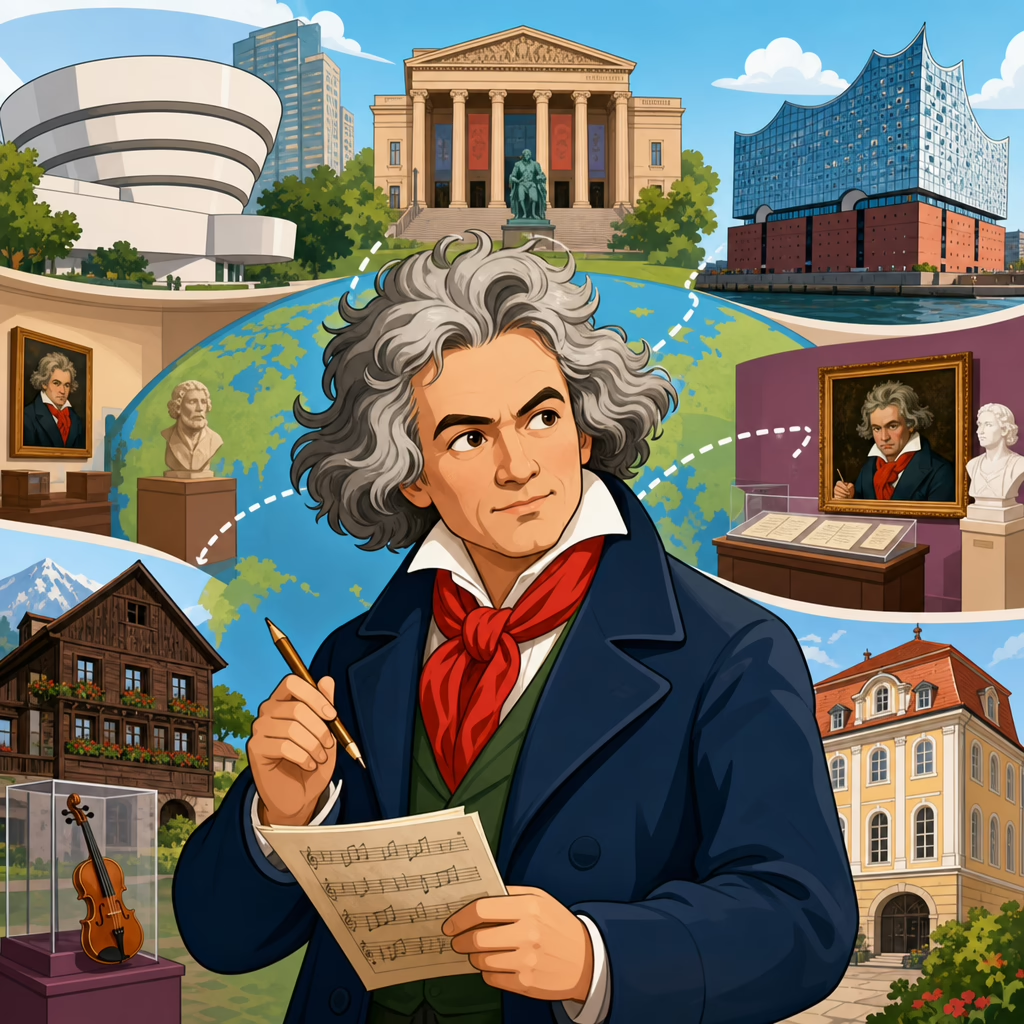
Beethoven in Museums Beyond Bonn and Vienna
Beethoven’s story is usually told through Bonn, where he was born, and Vienna, where he made his career, yet a fuller cultural map appears when you follow him into museums far beyond those two cities. “Beethoven in museums beyond Bonn and Vienna” means tracing how curators, collectors, archivists, and audiences in other places preserve objects, stage interpretation, and connect the composer to political history, instrument making, listening culture, and modern memory. This matters because museums do more than store relics. They decide which manuscripts are displayed, which portraits become iconic, which instruments are used to explain sound, and which episodes of Beethoven’s life are framed as universal rather than local. After years of visiting music museums and special exhibitions, I have found that these institutions often reveal aspects of Beethoven that house museums in Bonn and Vienna cannot fully show on their own: his relationship to French revolutionary culture, the spread of his reception through Britain and America, the role of publishers and collectors in shaping his image, and the afterlife of his music in performance practice. If you want to understand why Beethoven became a durable public symbol rather than simply a great composer, the museum trail outside his two best-known cities is indispensable.
Berlin and Leipzig: archives, instruments, and the documentary Beethoven
Berlin and Leipzig are essential starting points because they present Beethoven through documentation rather than birthplace mythology. In Berlin, the Staatsbibliothek zu Berlin holds major manuscript sources and sketch materials that have underpinned Beethoven scholarship for generations. For a visitor, even when originals are not constantly on display, the institution’s exhibitions and catalogued holdings make one point unmistakable: Beethoven was a working composer who revised obsessively. Seeing sketches, corrections, and layered notation changes public understanding. The heroic image of sudden genius gives way to compositional labor. That shift matters in museum interpretation because manuscripts are evidence, not legend.
Leipzig adds another dimension through the Bach Museum, the Museum of Musical Instruments of Leipzig University, and the city’s broader publishing history. Beethoven never belonged to Leipzig in the way he belonged to Vienna, but Leipzig was a major node in German music printing, criticism, and later canon formation. Instrument museums there help explain how Beethoven’s keyboard writing relates to the fortepianos he knew and the larger, more resonant instruments that emerged after him. When curators place an early nineteenth-century Viennese action beside a later Erard or Broadwood model, visitors can literally see why Beethoven’s sonic imagination pressed against the limits of his instruments. That is a more useful lesson than vague claims that he “expanded the piano.” It shows how material technology affected phrasing, range, articulation, and dynamic scale.
Museums in these cities also excel at contextual labels. A strong label does not merely say “autograph manuscript.” It explains whether a page is a fair copy, draft leaf, or corrected proof; whether Beethoven prepared it for a publisher; and what scholars infer from the alterations. Those distinctions are crucial. They tell us whether an object records the act of invention, the process of revision, or the economics of publication. In my experience, visitors stay longer at displays when that precision is present, because the object becomes readable instead of reverentially opaque.
Paris: revolutionary memory, the Erard connection, and transnational prestige
Paris is one of the best places to grasp Beethoven’s European stature beyond the German-speaking world. At the Musée de la Musique, part of the Philharmonie de Paris complex, curators can situate him within the instrument culture, publishing networks, and political atmosphere that linked Vienna to France. Beethoven’s connections to French ideals are not a museum invention. They are built into his era, his admiration for republican rhetoric, and the famous history of the “Eroica” Symphony’s dedication crisis involving Napoleon. In Paris, that story stops being a textbook anecdote and becomes part of a broader visual field that includes instruments, scores, prints, and evidence of how music circulated through elite and public spaces.
The Erard firm is especially important here. Sébastien Erard and the pianos associated with his workshop represent a technological world that Beethoven followed closely. He also knew Broadwood instruments from London, and museums that compare these makers help visitors understand that Beethoven’s keyboard music belongs to an international market of innovation. French museums often do this well because they can embed Beethoven in a story about craftsmanship and industrial refinement. A display of action mechanisms, pedal systems, and case construction may sound technical, but it clarifies why late Beethoven sonatas demand sonorities that earlier instruments only partially supplied.
Parisian collections also illuminate prestige. By the nineteenth century, to collect Beethoven-related material was to participate in a European culture of genius. Portrait engravings, commemorative editions, and salon arrangements show how his image traveled far beyond concert halls. Museums in Paris are therefore useful not because Beethoven lived there, but because they document how a major capital consumed and reinterpreted him. For readers interested in the larger cultural arc, this complements the perspective in the main guide at https://lvbeethoven.com/why-beethoven-became-a-global-cultural-icon/, but the museum evidence makes that transformation tangible.
London: Broadwood, collecting culture, and Beethoven in the English-speaking world
London offers one of the most concrete museum encounters with Beethoven’s afterlife because Britain played a direct role in his career and in his posthumous reputation. The broad historical anchor is the Broadwood piano sent to Beethoven in 1817, an instrument frequently discussed in scholarship and central to explaining his relationship with English makers. Depending on exhibition schedules and loans, visitors encounter this story through institutional displays, interpretive materials, and collections connected to instrument history. The Victoria and Albert Museum, the Royal College of Music Museum, and other specialist collections help frame how instrument design and collecting culture shaped Beethoven reception in Britain.
The key museum lesson in London is that Beethoven was not simply admired from afar; he was materially supported, marketed, and memorialized. British publishers issued editions, critics debated performances, and collectors prized relics associated with him. Museums often preserve this through concert programs, early editions, portrait medallions, and keyboard instruments. These objects show how the English-speaking world made Beethoven a moral and artistic reference point during the nineteenth century. By the Victorian period, he had become a figure through whom seriousness, self-discipline, and transcendence were publicly advertised.
That may sound abstract, but museum objects make it plain. An early engraved portrait is not just a likeness. It is evidence of circulation. A domestic arrangement of a symphonic movement for piano duet is not a reduction in status. It is proof that Beethoven entered middle-class homes. In gallery practice, these are strong examples because they connect elite composition to everyday use. Visitors understand immediately that canon formation required reproduction, not merely reverence.
Budapest, Prague, and Central Europe: patronage, travel, and the regional Beethoven
Central European museums beyond Vienna often reveal the regional networks that sustained Beethoven’s career. In Budapest, the Hungarian National Museum and music-focused collections can place him alongside aristocratic patronage, Habsburg culture, and the circulation of German-language music across imperial territories. The point is not to claim Budapest as “his” city, but to show how the nobility, salons, and institutional life of the region created audiences and financial structures on which composers depended. Beethoven’s patrons, dedications, and social alliances make more sense when viewed within this wider map.
Prague presents a similar case. Museums and archival exhibitions there can connect Beethoven to Bohemian musical life, virtuoso performers, and the routes by which works traveled through the region. This is valuable because Beethoven’s fame was not built exclusively through static masterpieces enshrined after his death. It emerged through copying, playing, reviewing, teaching, and adapting. Regional museums are often better than major memorial houses at showing this practical chain. They also correct the misleading idea that cultural significance radiated from one center outward in a neat hierarchy. In reality, Beethoven’s influence moved through dense networks of courts, theaters, publishers, churches, teachers, and amateur musicians.
| City | What museums highlight | Why it matters for Beethoven |
|---|---|---|
| Berlin | Manuscripts, sketches, documentary evidence | Shows revision, working methods, and source history |
| Leipzig | Instrument history and publishing context | Explains sound world and canon formation |
| Paris | Political memory and piano technology | Links Beethoven to European prestige and innovation |
| London | Broadwood legacy, editions, collecting culture | Shows reception in the English-speaking world |
| Budapest/Prague | Patronage and regional circulation | Restores the wider Central European network |
| New York/Washington | Collectors, rare books, public exhibitions | Documents modern institutional afterlife |
When curators in these cities do their job well, they answer a simple visitor question directly: what can I learn here that I cannot learn in Bonn or Vienna? The answer is scale. You learn how Beethoven functioned in a multilingual, politically complex, commercially active region where music was carried by people and objects across borders.
New York and Washington: the collector’s Beethoven and the American museum frame
American museums and libraries are crucial to the subject because they preserve how Beethoven became a global museum object. In New York, institutions such as The Morgan Library & Museum and The Juilliard collections, along with occasional exhibitions at major art museums, have presented manuscripts, letters, first editions, and portraits in ways that emphasize rarity, provenance, and intellectual history. In Washington, the Library of Congress has long been a major site for musicological exhibition and public access to rare materials. These institutions do not rely on local biography. Instead, they build significance through collecting history and scholarly framing.
This changes the visitor experience. In a house museum, a desk or room can imply intimacy. In an American rare-book or manuscript exhibition, authority comes from curation: object labels, comparative display, conservation notes, and provenance chains. I have found these shows especially effective for explaining why authenticity matters. A corrected proof differs from a later copy. A first edition with known publication data differs from a commemorative reprint. A letter with secure provenance can settle questions that a famous anecdote cannot. Museums in the United States often make these distinctions visible because they speak to an audience trained by art museums to value original objects and documentation.
There is also a democratic angle. Beethoven’s image in American museums has often been used to argue that serious music belongs in public culture, not only private collecting or European pilgrimage. Exhibitions tied to anniversaries, educational programs, and performance partnerships make the case that manuscripts are not dead paper. They are part of an ongoing civic conversation about creativity, freedom, struggle, and artistic endurance. That framing can become sentimental if overdone, but in the best exhibitions it is anchored by evidence and by the palpable force of the objects themselves.
How museums shape what people think Beethoven means
The deepest reason to seek Beethoven in museums beyond Bonn and Vienna is interpretive diversity. Museums are not neutral containers. They shape meaning through selection, arrangement, label writing, lighting, and proximity. Put Beethoven beside keyboard technology and he appears as an innovator responding to material constraints. Place him among political prints and dedication documents and he becomes a figure of revolutionary disappointment and postrevolutionary complexity. Display him through relics and death masks and he becomes a saint of genius. Frame him via domestic editions and teaching materials and he appears as a household presence.
Each frame is partial, but together they produce a richer historical truth. Beethoven’s cultural power rests partly on this adaptability. He can be shown as composer, craftsman, celebrity, patient, intellectual, nationalist symbol, European icon, or global heritage figure. Good museums do not flatten those roles into one message. They explain the tradeoffs. For example, relic displays can be emotionally compelling, yet they risk replacing music with fetishized objects. Instrument galleries can be technically illuminating, yet they need clear interpretation so non-specialists grasp why action, hammer covering, and string tension matter. Manuscript exhibitions can display scholarship at its best, yet low light and dense notation can alienate visitors unless curators provide visual guidance.
That is why the strongest Beethoven museums beyond Bonn and Vienna succeed through mediation. They use audio stations, digital facsimiles, conservation imaging, and concise explanatory text to turn specialist material into public understanding. When they do, visitors leave with something more durable than admiration: they leave able to explain how Beethoven’s works were made, circulated, heard, and remembered.
Beethoven in museums beyond Bonn and Vienna is not a secondary topic for completists. It is one of the best ways to see how a composer became a durable cultural institution across borders and centuries. Berlin and Leipzig reveal the documentary and technological Beethoven. Paris shows him inside revolutionary memory and international piano culture. London clarifies his bond with the English-speaking world through instruments, editions, and collecting. Budapest and Prague restore the regional networks of patronage and circulation. New York and Washington demonstrate how modern museums and libraries turned Beethoven into a global archival presence.
The common lesson is straightforward. Museums outside his two most famous cities do not merely repeat the standard biography. They widen it. They show the objects that carried Beethoven into public life: manuscripts, proofs, portraits, pianos, concert ephemera, commemorative editions, and curated narratives. They also teach a critical habit that every serious visitor should keep: ask not only what is displayed, but why this object, in this city, under this interpretation. That question turns museum-going into historical reading.
If you are planning a Beethoven-focused itinerary, add at least one museum outside Bonn and Vienna and approach it with a specific theme in mind, such as instruments, manuscripts, patronage, or reception. You will come away with a clearer picture of how Beethoven’s legacy was built, preserved, and continually reimagined.
Frequently Asked Questions
Why look for Beethoven in museums outside Bonn and Vienna?
Because Beethoven’s legacy was never confined to the two cities most closely tied to his biography. Bonn explains his beginnings, and Vienna explains much of his artistic maturity, but museums elsewhere reveal how his image, music, and meaning traveled across Europe and far beyond it. When a museum in another city exhibits a period keyboard, a first edition, a portrait, a hearing device, a concert program, or correspondence linked to Beethoven’s circle, it helps reconstruct the wider networks that shaped his reputation. Those objects show how publishers marketed him, how instrument makers responded to changing musical demands, how political movements appropriated his image, and how later generations turned him into a symbol of genius, freedom, struggle, and cultural prestige.
Looking beyond Bonn and Vienna also changes the kinds of questions visitors can ask. Instead of treating Beethoven as a solitary monument, museums in other places often situate him within broader histories of collecting, performance, education, empire, nationalism, and public memory. A city with a strong instrument museum may illuminate what Beethoven expected from pianos of his time. A library exhibition may focus on manuscripts, copying practices, and circulation. An art museum may show how Romantic portraiture shaped the now-familiar visual mythology around him. In other words, these museums do not merely repeat the standard life story; they expand it into a cultural map of how Beethoven was heard, displayed, interpreted, and continually reinvented.
What kinds of museums and collections outside Bonn and Vienna can help tell Beethoven’s story?
A surprisingly wide range of institutions can contribute meaningfully to Beethoven’s story. Music museums and composer houses are the most obvious places, but they are only the beginning. Instrument museums are especially valuable because they place Beethoven in the material world of sound production. Seeing early nineteenth-century fortepianos, string instruments, and workshop tools helps explain the tonal possibilities available to him and the technical pressures that his compositions exerted on instrument design. Museums devoted to decorative arts or technology can also be relevant when they preserve listening devices, engraving equipment, or objects associated with domestic music-making.
Libraries, archives, and rare book collections are equally important, even when they do not present themselves primarily as “Beethoven museums.” First editions, annotated scores, sketch materials, publishers’ correspondence, subscription lists, and concert ephemera all show how Beethoven’s music moved through public and private life. Art museums may hold portraits of Beethoven, his patrons, his interpreters, or the broader visual culture that framed him for nineteenth-century audiences. History museums can connect him to the Napoleonic era, changing ideas of citizenship, and the politics of commemoration. Even local museums with no obvious Beethoven branding may preserve objects tied to performers, collectors, salons, or institutions that helped establish his afterlife. Taken together, these collections reveal that Beethoven is not preserved in one single museum category; he survives across many kinds of institutions, each highlighting a different dimension of his significance.
How do museums beyond Bonn and Vienna connect Beethoven to political and social history?
Museums outside the two canonical Beethoven cities are often especially effective at showing how his legacy became entangled with political and social meaning. Beethoven lived through revolutionary upheaval, war, censorship, and shifting ideas of authority, and later generations repeatedly used his music to represent their own values. Exhibitions can trace how works such as the “Eroica” Symphony, the Ninth Symphony, or “Fidelio” were interpreted in relation to liberty, heroism, human dignity, state ceremony, and cultural identity. Rather than presenting these connections as timeless truths, strong museums show that they were historically constructed, debated, and sometimes contested.
This wider museum landscape is also useful for understanding how different nations, cities, and institutions adopted Beethoven for their own purposes. In one context, he may appear as a universal genius transcending borders; in another, as part of German-speaking cultural heritage; in another still, as a figure central to concert life, education, or diplomacy. Museums can document how commemorations, statues, anniversaries, broadcasts, exhibitions, and school programs transformed Beethoven into a public symbol. They may also address more difficult histories, including ideological misuse, selective memory, and the ways elite institutions have shaped whose Beethoven gets preserved and celebrated. By placing his legacy alongside political documents, public rituals, and social practices, museums make clear that Beethoven’s history is not only musical. It is also a history of power, identity, and cultural interpretation.
What can museums teach us about Beethoven’s instruments, hearing, and listening culture?
One of the greatest advantages of exploring Beethoven through museums beyond Bonn and Vienna is the opportunity to understand him through objects rather than only through biography or musical analysis. Instrument collections can show the physical characteristics of pianos from different makers, the range and touch they offered, and the ways those instruments evolved during Beethoven’s lifetime. That matters because his music pushed against existing technical limits. When visitors encounter surviving fortepianos, action mechanisms, and workshop records, they gain a more concrete sense of why certain sonorities, textures, and dynamic contrasts in his works were so striking.
Museums can also deepen understanding of Beethoven’s hearing loss without reducing his life to a simple story of tragedy and triumph. Objects such as ear trumpets, conversation books, medical references, and portraits help frame hearing not just as a private medical issue but as part of a larger history of communication, disability, sociability, and adaptation. Equally important is the broader culture of listening. Museums often preserve evidence of where and how people heard Beethoven: in aristocratic salons, public concerts, domestic parlors, conservatories, civic halls, and later through recordings and broadcasts. Programs, tickets, critical reviews, and household instruments reveal that listening was shaped by class, technology, space, and custom. In that sense, museums allow visitors to move from the abstract idea of “Beethoven’s music” to the lived historical realities of making, hearing, collecting, and interpreting it.
How should visitors approach Beethoven-related exhibits in museums that are not exclusively about him?
The best approach is to look for connections rather than expecting a complete cradle-to-grave narrative. In a museum not dedicated solely to Beethoven, the most revealing material may appear in a single case, one gallery, or a handful of objects embedded in a broader display. A fortepiano in an instrument museum, a printed score in a library exhibition, a portrait in an art collection, or a commemorative object in a history museum may each tell only part of the story, but together they can be remarkably illuminating. Visitors should pay attention to labels that mention networks of patrons, publishers, performers, collectors, and institutions, because those networks often explain how Beethoven’s reputation spread and why certain objects were preserved.
It also helps to ask a few guiding questions. What exactly is the museum claiming this object proves about Beethoven or his world? Is the emphasis on original context, later reception, national memory, performance practice, or collecting history? Is Beethoven the central figure, or is he being used to illuminate a broader theme such as Romanticism, political culture, music publishing, or technological change? This kind of active viewing turns even small displays into meaningful encounters. Rather than searching only for relics, visitors begin to see how museums construct knowledge through selection, framing, and interpretation. That is ultimately why museums beyond Bonn and Vienna matter so much: they do not simply add extra stops to Beethoven tourism; they expand the historical imagination through which his life and legacy are understood.