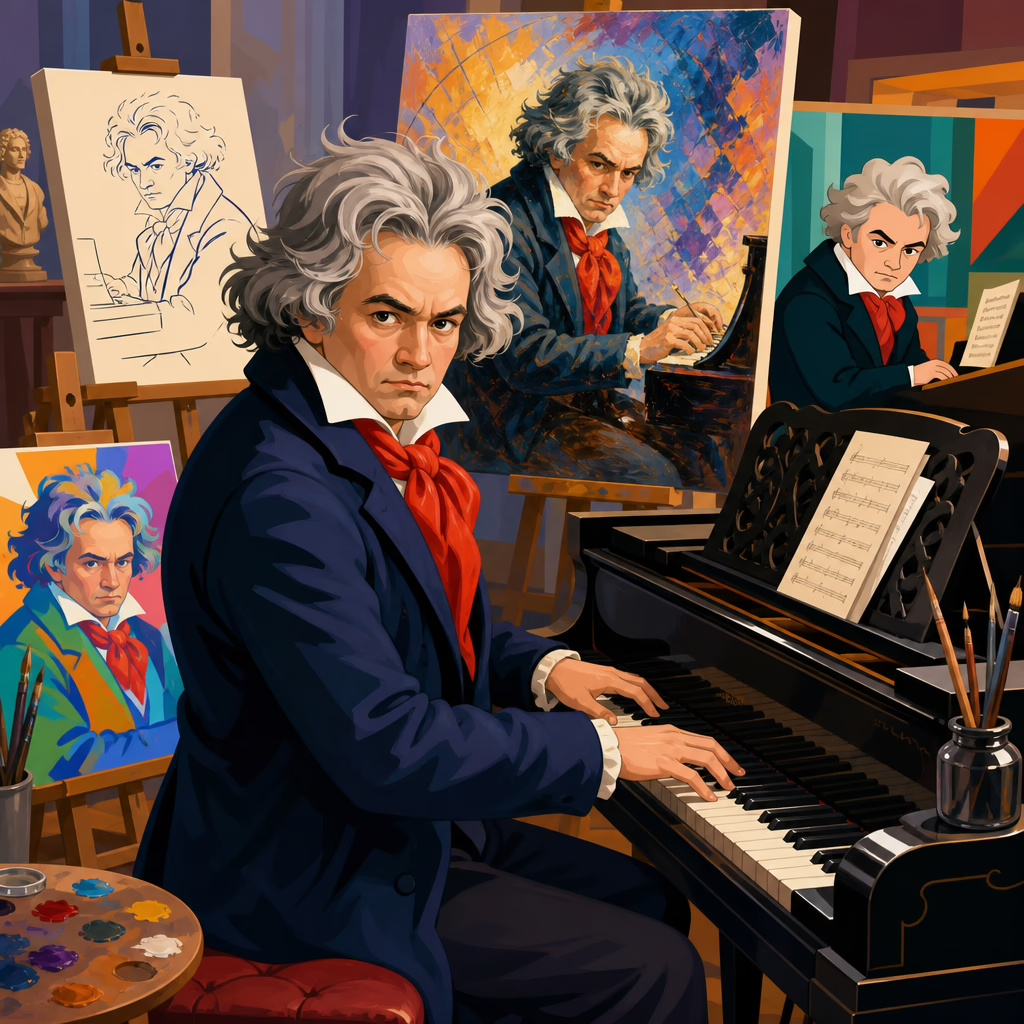
Why Artists Keep Painting Beethoven at the Piano
Beethoven at the piano is one of the most persistent images in Western art because it condenses biography, myth, sound, struggle, and genius into a single instantly legible scene. Painters, illustrators, poster designers, and filmmakers return to it again and again for a practical reason: a piano gives Beethoven’s creativity a visible stage. Unlike composition itself, which happens silently on paper or inwardly in the mind, piano playing can be dramatized through posture, hands, expression, candlelight, spectators, and the charged space between sound and silence. The image answers a basic cultural question directly: what does genius look like? For many artists, the answer is Beethoven leaning over keys, hair untamed, body tense, turning private inspiration into public force.
The scene matters because it joins fact and invention so effectively. Beethoven was a formidable pianist in Bonn and especially in Vienna, known in his early career for improvisation that astonished listeners. Yet the most reproduced visual formula does not simply document performance practice. It transforms the composer into a cultural symbol of artistic will. In paintings of Beethoven at the piano, the instrument is never just furniture. It becomes a battlefield, a pulpit, a laboratory, or a confessional. That symbolic density explains why the motif survives across centuries, from nineteenth-century history painting to twentieth-century book illustration and contemporary digital art. Artists keep painting Beethoven at the piano because the image remains one of the clearest ways to depict music, intellect, emotion, and heroism at once.
To understand why the motif endures, it helps to define three ideas that govern it. First is iconography: the set of recognizable visual signs attached to a figure. Beethoven’s iconography includes the severe face, storm-tossed hair, manuscript pages, cramped Viennese rooms, and piano. Second is mythmaking: the process by which real life is shaped into a story larger than documented fact. Third is mediation: every Beethoven image filters him through later values, whether Romantic individualism, bourgeois domestic culture, nationalist memory, or modern celebrity. I have worked through dozens of Beethoven images in museum databases, concert-program archives, and old editions, and the pattern is consistent. The piano scene survives not because it is neutral, but because it is endlessly adaptable.
The piano gives artists a visible way to paint invisible music
Music is difficult to represent in static visual form. A canvas cannot literally produce duration, harmony, modulation, or rhythmic tension. Painters therefore rely on proxies: gesture, facial intensity, surrounding listeners, fluttering manuscripts, and the physical instrument. Beethoven at the piano solves a core representational problem by giving the viewer a mechanism for imagining sound. The keyboard lines imply movement. Bent shoulders suggest force. Open mouths of listeners imply astonishment. A candle burning low can signal a long night of work. Even silence becomes legible when Beethoven appears inwardly absorbed before striking a note.
This is why artists favor the piano over, say, Beethoven walking with sketchbooks or sitting at a writing desk. Those scenes matter biographically, but they are less immediately musical. The piano image bridges the gap between composition and performance. It allows viewers to believe they are witnessing creation in real time, even when the historical Beethoven may actually have composed much of a passage away from the keyboard. In visual storytelling, that distinction matters less than intelligibility. The piano turns abstract authorship into a dramatic event.
The instrument also offers compositional advantages. Its horizontal shape anchors a room. Its polished surfaces catch light. Its lid, keyboard, bench, and music stand create strong geometric lines around a volatile human figure. For artists trying to balance order and emotional turbulence, Beethoven plus piano is ideal material. The instrument frames him while his body seems to exceed the frame.
Historical reality supports the image, even when later art exaggerates it
The motif persists partly because it is rooted in truth. Beethoven arrived in Vienna not only as a composer but as a pianist of extraordinary reputation. Contemporaries described his improvisations as overwhelming, unpredictable, and structurally daring. Carl Czerny, Ferdinand Ries, and others recalled the power of his keyboard playing, especially in earlier years before severe hearing loss changed his public role. This matters because artists need some factual anchor. Beethoven at the piano is not an arbitrary invention attached to a nonperforming composer. It reflects a real foundation in his career.
At the same time, many famous depictions flatten chronology. They combine young virtuoso Beethoven, middle-period heroic Beethoven, and late deaf Beethoven into one composite figure. A painting may show the wild-haired, fate-defying master at the keyboard as if composing the late sonatas in a single volcanic burst. Historically, Beethoven’s relationship to the piano evolved with changing instruments, worsening deafness, and shifts from public performance toward composition. Yet art often compresses those phases because the combined image is more culturally potent than a scrupulously dated one.
That selective compression is typical of composer portraiture. It is similar to how images of Mozart often emphasize child prodigy elegance or divine ease, regardless of circumstance, while Bach is frequently shown with score in hand as the embodiment of learned order. Beethoven’s piano image instead privileges struggle. The persistence of the scene comes from how accurately it reflects his public legend, even when it simplifies his actual working habits.
Romanticism turned Beethoven at the keyboard into a model of genius
Nineteenth-century Romantic culture changed the meaning of artist images. Genius was increasingly imagined as inward, original, emotionally intense, and in tension with society. Beethoven fit this model almost too perfectly. His difficult personality, physical suffering, and artistic ambition made him the exemplary modern creator. The piano became the stage on which that concept could be visualized. A composer merely writing notes could look scholarly; Beethoven at the keyboard looked elemental.
Artists repeatedly emphasized physical strain because strain signaled authenticity. A smooth, effortless Beethoven would undermine the myth. Furrowed brows, dramatic hand positions, disordered rooms, and rapt listeners all communicate that the music costs something. This visual language parallels biographies and criticism from the nineteenth century, which often framed Beethoven’s work as the audible record of conflict transformed into form. The image of him at the piano therefore does ideological work: it teaches viewers how to understand the music before they hear a note.
That Romantic framework still shapes modern reproductions, from classroom posters to streaming thumbnails. When contemporary designers choose an image of Beethoven at a keyboard, they inherit a long tradition that equates pianistic intensity with uncompromising creativity. For a broader account of how that tradition helped elevate him beyond music into public symbolism, see this guide to why Beethoven became a global cultural icon.
The image works because the piano represents both creation and combat
One reason the motif remains visually persuasive is that the piano can signify opposite things at once. It is an instrument of domestic refinement, associated with salons, teaching, and middle-class culture. But in Beethoven imagery it also becomes a site of combat. The keyboard is where thought meets resistance: fingers versus mechanism, inspiration versus limitation, inner hearing versus physical reality. Artists exploit that duality. A familiar household object becomes the place where unprecedented music enters the world.
That tension is especially powerful in depictions made after Beethoven’s deafness became central to his legend. Here the piano is no longer just a means of sounding music. It becomes a paradoxical tool for a composer increasingly cut off from ordinary hearing. Some artists make this poignant; others make it heroic. In either case, the instrument symbolizes defiance. The viewer understands the stakes immediately, even without specialized knowledge of his late life.
| Visual element | What artists show | What viewers read into it |
|---|---|---|
| Hands over keys | Forceful attack, suspended motion, or delicate touch | Creation happening now |
| Wild hair and tense posture | Physical agitation | Genius as struggle, not ease |
| Dark room or candlelight | Night work, isolation, concentration | Art as sacrifice and devotion |
| Listeners nearby | Students, patrons, friends, or stunned audiences | Immediate proof of extraordinary impact |
| Manuscript pages | Scores on piano or scattered around room | Link between improvisation and lasting composition |
Specific works and recurring visual formulas reinforced the tradition
No single canonical painting explains the entire phenomenon, but several influential image types established the pattern. Josef Danhauser’s 1840s Beethoven on his deathbed fixed one path of sanctification, while other nineteenth-century illustrations favored the living composer at the instrument, often surrounded by admirers or immersed in solitary labor. Later engravings for biographies, sheet music covers, and educational editions circulated these conventions widely. Reproduction mattered as much as originality. Once schoolbooks, album covers, and concert advertisements repeated the keyboard scene, it became the default visual shorthand for Beethoven.
Franz von Stuck, Max Klinger, and other symbolist or monumental interpreters did not always paint literal piano scenes, but they helped consolidate Beethoven as a figure suited to grand psychic drama. Meanwhile, more anecdotal genre painters created intimate interiors in which he appears improvising for a small audience, often women in fashionable dress and men leaning in attentively. These scenes may tell us more about nineteenth-century fantasies of musical sociability than about any specific event in Beethoven’s life, but they were effective. They gave collectors and viewers an emotionally accessible Beethoven, both exalted and domestic.
Twentieth-century mass media intensified the formula. Record sleeves, film posters, textbook illustrations, and postcards favored scenes that read instantly from a distance. Beethoven seated at a piano works better in that context than a nuanced historical portrait. The image scales easily across media because its message is immediate.
Artists use the scene to manage the contradiction between the man and the monument
Beethoven is hard to picture because he is simultaneously intimate and colossal. The historical person lived in rented rooms, argued with publishers, worried about money, and dealt with illness. The cultural monument stands for freedom, seriousness, artistic autonomy, and civilizational prestige. Paintings of Beethoven at the piano reconcile those scales. A room interior keeps him human. The act of making music makes him monumental.
That balance explains why the motif serves so many institutions. Museums can present it as biography. Conservatories can present it as discipline and craft. Broadcasters can present it as inspiration. Even advertisers have used Beethoven-at-the-piano imagery to borrow connotations of intensity and high culture. The scene is flexible without losing identity. Few composer images travel so well across elite and popular contexts.
The tension also helps artists avoid a static marble effect. A bust or frontal portrait can make Beethoven look frozen in reverence. At the piano, he is active. Activity allows interpretation. Is he composing, performing, revising, remembering, fighting the instrument, or hearing inwardly what no one else can hear? Different artists answer differently, which keeps the motif alive.
What the image leaves out is part of why it endures
Every durable cultural image is selective. Beethoven at the piano foregrounds inspiration and struggle, but it often hides routine labor, revision, administrative work, and collaboration with copyists, publishers, instrument makers, and performers. It can also obscure the historical diversity of pianos Beethoven knew, from lighter Viennese actions to later, more robust instruments sent by makers such as Broadwood. Many paintings present a generic grand piano that suits modern expectations better than period accuracy.
The image can also overemphasize solitary genius. Beethoven certainly prized independence, yet his career unfolded within dense networks of patrons, aristocratic salons, students, instrument technology, and print culture. Artists simplify that ecosystem because a lone figure at a keyboard is more compelling than a realistic supply chain of cultural production. In my experience, this is not a flaw to dismiss but a clue to function. The image survives precisely because it edits reality into a memorable emblem.
Recognizing that selectivity makes the motif more interesting, not less. It shows how visual culture builds historical memory. We do not just inherit Beethoven; we inherit recurring ways of seeing Beethoven. The piano scene is one of the most durable of those ways because it crystallizes what audiences most want from him: urgency, depth, and unmistakable presence.
Artists keep painting Beethoven at the piano because the image solves several problems at once. It makes invisible music visible, turns biography into drama, and gives audiences an immediate picture of creative force. Its staying power comes from a rare combination of factual grounding and symbolic range. Beethoven really was a remarkable pianist, especially as an improviser, but the enduring image goes further. It presents the piano as the place where mind, body, and history collide.
That is why the motif remains useful across centuries and media. Romantic painters used it to define genius. Publishers used it to market seriousness and prestige. Modern designers still use it because viewers instantly understand the stakes. Even when the details are historically compressed or idealized, the scene communicates something true about Beethoven’s cultural meaning: he is imagined not simply as a composer who wrote masterpieces, but as a creator wrestling sound into existence before our eyes.
When you encounter another painting, poster, or illustration of Beethoven at the keyboard, look past the familiar hair and dramatic pose. Ask what the artist wants the piano to mean: performance, composition, struggle, solitude, heroism, or sanctity. That question reveals why the image never quite wears out. It keeps offering a vivid answer to one of culture’s oldest desires—to see genius happen. If you want to understand Beethoven’s afterlife in art more clearly, start with the keyboard scene and compare how different eras remake it for their own needs.
Frequently Asked Questions
Why do artists so often depict Beethoven at the piano instead of writing music at a desk?
Artists keep returning to Beethoven at the piano because the piano makes creativity visible in a way that composition on paper usually does not. A composer sitting quietly with a manuscript can be historically accurate, but it is harder to dramatize. By contrast, the piano gives the artist an immediate stage: hands in motion, a body leaning forward, a concentrated face, a room charged with energy, and a recognizable instrument that signals music at a glance. Even viewers with no knowledge of Beethoven’s life can instantly understand the scene. They see action, sound implied through gesture, and a direct connection between the man and the music.
The image also solves a practical storytelling problem. Beethoven’s genius is abstract, but a painting needs concrete forms. The keyboard provides those forms. It lets painters translate invisible creative power into posture, tension, and atmosphere. A bent shoulder can suggest struggle, raised hands can imply force, candlelight can stand in for late-night labor, and a stormy expression can hint at the emotional intensity associated with his music. In that sense, the piano scene works as a visual shorthand for invention itself. It condenses the whole idea of Beethoven—discipline, inspiration, turbulence, greatness—into one legible and memorable image.
What makes Beethoven at the piano such a powerful symbol in Western art?
The image is powerful because it brings together several layers of meaning at once: biography, myth, sound, struggle, and genius. Beethoven is not just any composer in cultural memory; he is often treated as the model of the heroic artist, the figure who turns personal hardship into monumental art. When artists place him at the piano, they are not simply showing a man with an instrument. They are activating a larger cultural story about inspiration under pressure, creativity in conflict with the world, and music emerging from intense inner necessity.
There is also an important visual economy to the scene. Many of the central ideas people associate with Beethoven can be compressed into a single room: the keyboard suggests music, scattered pages suggest composition, candlelight suggests obsessive work, disordered hair suggests passion, and the performer’s body suggests emotional force. Few artistic subjects are so instantly readable while carrying so much symbolic weight. That is why the motif has remained durable across paintings, illustrations, posters, book covers, and films. It is not only recognizable; it is narratively efficient. The image communicates “Beethoven” in a richer way than a plain portrait ever could, because it shows him in the act that culture most wants to imagine: transforming feeling into music.
How does the piano help artists represent music, which cannot actually be seen in a painting?
One of the great challenges in depicting music is that sound disappears the moment it is made and cannot be directly painted. The piano helps artists overcome that problem because it offers a physical framework for suggesting sound through visible clues. The angle of Beethoven’s arms, the pressure implied in his hands, the lift of his torso, the tilt of his head, and the reaction of people around him can all make viewers feel that music is happening, even in silence. In effect, the instrument becomes a bridge between the invisible world of sound and the visible world of image.
Artists also use the piano to build an emotional atmosphere that stands in for musical experience. Light, shadow, crowded or sparse interiors, open windows, candles burning low, and the placement of manuscripts all contribute to a sense of rhythm, intensity, or solitude. The keyboard’s geometry can suggest structure and discipline, while Beethoven’s pose can suggest emotional force breaking through that structure. This contrast mirrors how many listeners experience his music: ordered yet explosive, controlled yet deeply expressive. So although a painting cannot literally reproduce a sonata or concerto, it can evoke what audiences believe that music feels like. The piano is central to that translation because it gives the eye something concrete to follow while the imagination supplies the unheard sound.
Is the image of Beethoven at the piano meant to be historically accurate, or is it more of a mythic artistic invention?
In most cases, it is both, though the balance varies. Beethoven certainly played the piano, composed at the keyboard, improvised brilliantly, and occupied rooms full of instruments, papers, and intense concentration. So the subject has a real basis in history. However, the repeated cultural image of “Beethoven at the piano” is rarely just documentary. It is usually shaped by later generations’ desire to portray him as the embodiment of artistic genius. That means artists often heighten certain features—his dramatic pose, his emotional intensity, the surrounding atmosphere, the sense of heroic isolation—not simply to report facts, but to express what Beethoven has come to mean.
This is why many depictions feel larger than life. They do not only ask, “What did Beethoven’s room look like?” They ask, “What does creative struggle look like?” or “How can genius be made visible?” In that sense, the image belongs partly to biography and partly to cultural mythology. It reflects historical memory, but it also reveals what later audiences want from Beethoven: authenticity, depth, defiance, emotional truth, and creative fire. Rather than weakening the image, this blend of fact and myth is exactly what gives it staying power. Artists return to it because it lets them portray a real figure while also engaging a much bigger symbolic tradition.
Why does the Beethoven-at-the-piano image continue to appear in modern media like posters, films, and book covers?
The image survives because it remains one of the fastest and most effective ways to communicate high culture, musical genius, and emotional intensity. Modern media depend on immediate recognition, and Beethoven at the piano delivers that almost instantly. A silhouette at the keyboard, a stern profile, flying hair, candlelit manuscripts, or a forceful seated posture can identify the subject before a viewer reads a title or caption. For designers and filmmakers, that kind of visual clarity is invaluable. It allows a single image to carry biography, prestige, drama, and mood all at once.
Just as important, the motif is flexible. It can be rendered reverently in a historical painting, romantically in an illustration, starkly in a poster, or psychologically in a film scene. It can suggest intimacy, obsession, loneliness, triumph, or raw creative force depending on how it is staged. That adaptability helps explain why the image keeps being reinvented rather than discarded. It still speaks to contemporary audiences because the underlying idea is timeless: we are fascinated by the moment when art seems to come into being. Beethoven at the piano remains compelling not simply because it refers to a famous composer, but because it offers a vivid, enduring picture of creativity itself under pressure, made visible through the body, the instrument, and the charged space around them.