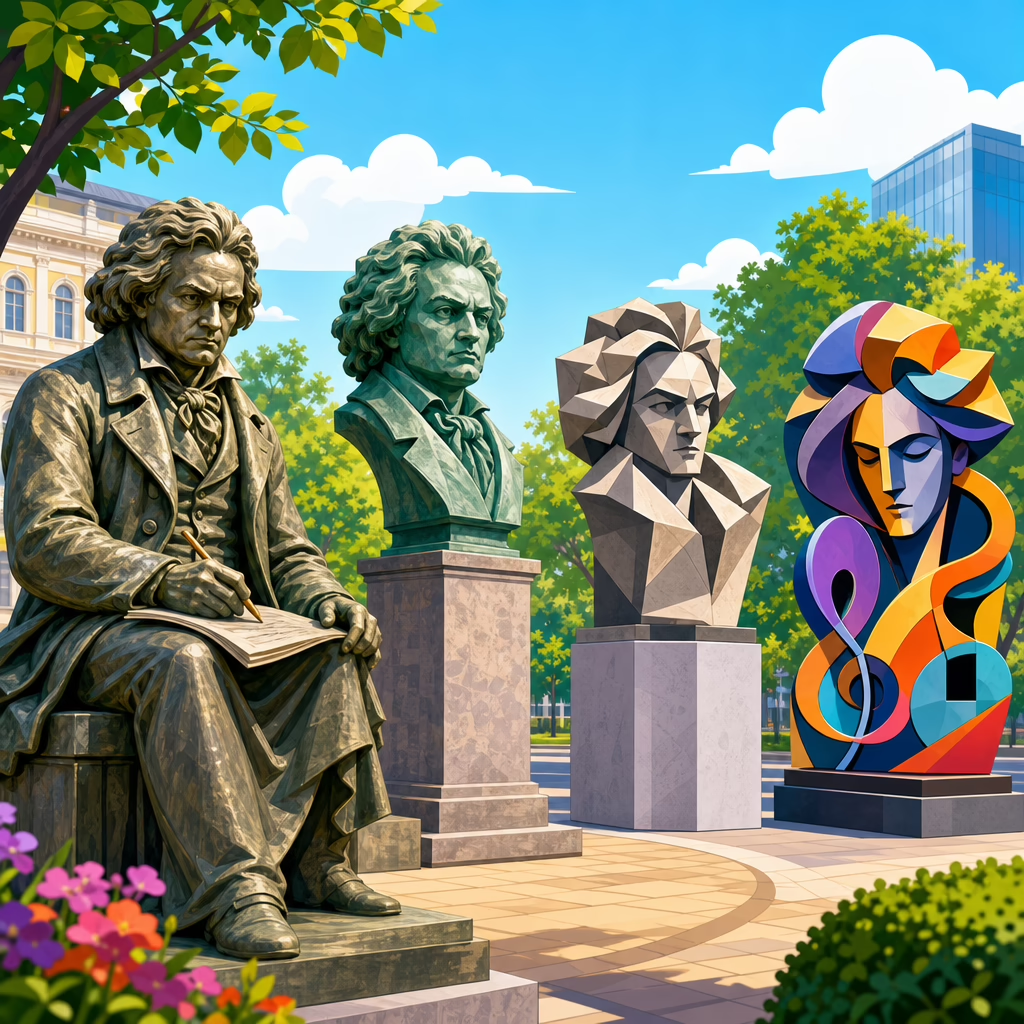
Beethoven in Public Sculpture from Realism to Abstraction
Public sculpture has played a decisive role in shaping how Beethoven is seen, remembered, and argued over, because monuments turn a historical composer into a visible civic presence. In streets, squares, parks, and museum forecourts, Beethoven appears not only as a musician but as a moral symbol, a national emblem, and, increasingly, a flexible artistic subject. “Public sculpture” here means works placed in shared space or made explicitly for public viewing, including freestanding monuments, reliefs, architectural sculpture, and later abstract commemorative forms. “Realism” refers to sculpture that presents Beethoven as a recognizable human figure, usually identifiable through his familiar hair, coat, intense expression, and association with musical manuscripts. “Abstraction” describes works that reduce, distort, or reimagine that figure through simplified form, symbolic geometry, fragmented surfaces, or conceptual references to sound, struggle, and modernity.
This shift from realism to abstraction matters because every sculptural choice carries an argument about what Beethoven represents. A nineteenth-century bronze statue in a central square typically asserts continuity, civic pride, and historical reverence. A twentieth-century or contemporary abstract memorial may instead present Beethoven as energy, rupture, or unresolved cultural memory. I have spent years studying European music monuments on site, and Beethoven examples are unusually revealing because they sit at the intersection of music history, urban identity, politics, and visual style. Few composers have been monumentalized so often, and few have survived so many changes in taste while remaining instantly legible to the public.
Beethoven’s sculptural afterlife also tracks broader developments in monument culture. Early commemorative programs favored heroic likeness, especially in the decades when nation building and civic patronage demanded stable icons. By the late nineteenth century, sculptors were not merely depicting Beethoven’s face; they were staging his genius through allegorical figures, elevated plinths, and carefully controlled urban settings. In the twentieth century, however, war, modernism, and skepticism toward heroic monuments changed the field. Artists began asking whether a composer known for innovation and emotional intensity should still be represented by a stern seated body on stone. That question opened the way for expressionist distortion, fragment, and abstraction.
Understanding Beethoven in public sculpture therefore requires looking closely at material, posture, scale, inscription, and location. Bronze suggests endurance; marble invites idealization; rough stone can imply struggle; polished modern metal can imply universality or distance. A seated Beethoven often reads as contemplative authority, while a standing figure can suggest public address or moral confrontation. These details are not decorative. They determine whether viewers encounter Beethoven as a citizen of Bonn or Vienna, a Romantic genius, a democratic prophet, or a modern cultural code. The history of Beethoven monuments is not a side note to music reception. It is one of the clearest records of how culture repeatedly rebuilds the meaning of artistic greatness in public space.
Why Beethoven became a natural subject for monuments
Beethoven was unusually suited to public sculpture because his biography and reputation already lent themselves to visual myth. By the mid nineteenth century, he was widely understood as the composer who transformed personal struggle into universal art. Deafness, independence from aristocratic service, association with liberty, and the canonization of works such as the Ninth Symphony gave patrons and civic committees a ready-made heroic narrative. Sculpture could condense that narrative into a single image: the unruly hair, the concentrated brow, the manuscript in hand. Unlike a less visually defined composer, Beethoven had become iconographically stable enough to monumentalize repeatedly across different countries.
Another practical reason is that Beethoven belonged simultaneously to local and transnational memory. Bonn could claim his birth. Vienna could claim his mature career and burial. German-speaking lands could present him as a national cultural giant. International audiences could embrace him as a universal figure of artistic freedom. That flexibility encouraged many kinds of commissions, from municipal monuments to exhibition pieces and memorials tied to anniversaries. The result is a broad sculptural record that reveals changing political uses of Beethoven. For readers interested in how that larger image developed across media and nations, the main guide at https://lvbeethoven.com/why-beethoven-became-a-global-cultural-icon/ provides the wider context.
Importantly, Beethoven monuments were rarely neutral tributes. They emerged through fundraising campaigns, committee debates, and design competitions, all of which forced patrons to decide what counted as an appropriate public image. Should Beethoven look approachable or elevated beyond ordinary life? Should the monument celebrate music itself or the moral seriousness associated with it? Should allegory be used to translate sound into visual form? These questions pushed sculptors toward increasingly elaborate answers, and those answers changed over time as public expectations shifted.
The realist foundation: the nineteenth-century Beethoven monument
The foundational model is the nineteenth-century civic monument, and the most famous example is Ernst Julius Hähnel’s Beethoven monument in Bonn, unveiled in 1845 during the first major Beethoven Festival. This bronze statue established many conventions that later works either repeated or resisted. Beethoven stands in cloak and formal dress, one hand holding a score, his head turned with concentrated gravity. The portrait is individualized but idealized. Hähnel did not depict an exhausted, physically diminished man in private life. He presented a public Beethoven: disciplined, dignified, and intellectually commanding. The monument’s placement in Münsterplatz made him part of the urban center, not an isolated cemetery memory.
What makes this monument realist is not photographic literalism but persuasive corporeal presence. Viewers recognize a human body with weight, drapery, gesture, and facial psychology. The realism is selective. Hair is dramatic, but not chaotic. Expression is stern, but not unstable. Clothing grounds him in history while preserving heroic form. In practical monument terms, realism worked because it made cultural authority visible to a broad public, including people who might never hear a symphony but could understand seriousness, thought, and civic honor embodied in bronze.
During this period, realism often blended with allegory rather than excluding it. Beethoven could be rendered naturalistically while surrounded by reliefs, inscriptions, or symbolic figures representing inspiration, harmony, or mourning. This mixed language was common in academic sculpture. It allowed patrons to maintain likeness while enlarging meaning. In effect, nineteenth-century public sculpture insisted that Beethoven’s body remained the anchor of commemoration even when abstract ideas about genius were added around it.
Vienna, memory, and the sculptural staging of genius
In Vienna, Beethoven sculpture developed under different pressures because the city was not only memorializing a famous resident but managing a dense cultural pantheon. Monuments there had to compete with opera houses, concert institutions, and memorials to other composers. As a result, Viennese Beethoven sculpture often became more theatrically staged. The best-known case is Max Klinger’s Beethoven, completed in 1902 for the Vienna Secession exhibition. Although not a traditional outdoor monument and not consistently in public urban placement, it profoundly influenced public visual culture around Beethoven. Klinger combined different materials, including marble, bronze, ivory, and colored surfaces, to create a seated, commanding figure with symbolic ambition far beyond straightforward portrait statuary.
Klinger’s work matters because it marks a threshold. The head remains legible as Beethoven, but naturalistic portraiture is subordinated to an almost cultic environment of symbolism, bodily mass, and spiritual tension. The seated pose evokes enthronement rather than everyday humanity. Surface, scale, and setting make the figure feel less like a citizen in a square and more like a force to be contemplated. When I have discussed this work with museum audiences, the recurring reaction is that it feels halfway between monument and apparition. That response captures its historical importance. Beethoven is still represented physically, yet realism is no longer sufficient to carry his meaning.
Vienna’s memorial culture also exposed a persistent challenge: music is temporal and immaterial, while sculpture is static and spatial. Realist monuments solved that problem by relying on recognizable likeness and social prestige. Around 1900, artists increasingly tried to make sculpture express sound’s intensity indirectly through exaggerated mass, rhythmic folds, symbolic companions, and charged stillness. Beethoven became a testing ground for that visual problem because his music was already interpreted as struggle, destiny, and transcendence.
From likeness to idea: expressionism and early abstraction
The move away from realism did not happen overnight. It unfolded through exaggeration, compression, and fragmentation. Expressionist sculptors retained Beethoven’s head or body but altered proportion and surface to convey inward force rather than outward accuracy. Angular planes, rough modeling, and compacted volume suggested psychic pressure. This approach suited a composer long described in terms of conflict and breakthrough. Instead of showing Beethoven exactly as he appeared, sculptors asked how his music and mythology could be translated into form.
One major factor was the broader crisis of heroic monumentality after World War I. Publics had seen too many official statues tied to political systems that now seemed compromised or broken. Artists therefore distrusted smooth academic realism and sought a language that admitted fracture. Beethoven remained commemorable, but the terms changed. A broken contour or reduced silhouette could imply that cultural memory itself had become unstable. This was not disrespect. In many cases it was a more serious attempt to honor Beethoven as a difficult, disruptive modern ancestor rather than a polished civic saint.
Abstract tendencies also benefited from Beethoven’s established iconography. Because audiences already knew the hair, profile, and name, artists could simplify aggressively without losing recognition. A monument might only hint at a cloak, a bent head, or a stern mask-like face, and viewers would still identify Beethoven. That is a key reason his image survived abstraction more successfully than some other composers’ did. Strong visual memory gave sculptors room to experiment.
How public sculptures of Beethoven differ across styles
| Approach | Typical features | Main message | Public effect |
|---|---|---|---|
| Academic realism | Full figure, detailed dress, recognizable face, score in hand | Authority, civic honor, stable greatness | Immediate recognition and ceremonial dignity |
| Symbolist monumentality | Seated pose, mixed materials, allegorical setting, amplified scale | Genius as spiritual force | Awe, contemplation, distance from ordinary life |
| Expressionist distortion | Rough surfaces, compressed forms, intensified head and hands | Inner struggle, creative tension | Emotional charge, less comfort, more interpretation |
| Modern abstraction | Reduced geometry, fragment, symbolic rhythm, minimal likeness | Beethoven as idea, energy, or memory | Open-ended meaning, stronger dependence on context and labeling |
This comparison clarifies an important point: abstraction does not simply remove information. It redistributes meaning from face and costume to shape, material, and site. In a realist monument, viewers read Beethoven primarily through portrait likeness. In an abstract work, they read him through title, placement, commemorative inscription, and the sculptural suggestion of movement, sound, or force. That requires more from the audience, but it can also produce richer interpretations.
Late twentieth-century and contemporary public Beethoven
By the late twentieth century, sculptors working in public space had inherited both the monumental Beethoven tradition and widespread suspicion toward old-style monuments. Many responses therefore became hybrid. Some commissions preserved enough facial or bodily likeness to remain accessible while stripping away elaborate allegory and academic finish. Others embraced abstraction more directly, using vertical slabs, fractured profiles, or rhythmic metal forms to evoke musical structure rather than bodily presence. In these works, Beethoven is often less a person than a cultural signal activated by title and place.
Anniversary years, especially 1970 and 2020, stimulated renewed commissions and reinterpretations. Cities and institutions wanted tributes that acknowledged Beethoven’s continuing prestige without merely repeating nineteenth-century formulas. That often meant integrating modern materials such as welded steel, cast concrete, or simplified bronze masses. Some sculptures foregrounded the head as the irreducible icon; others translated motifs from manuscript marks, sonata motion, or the ideal of the “Ode to Joy” into spatial design. These decisions show how strongly Beethoven can survive visual transformation. The monument no longer needs to show a full body to announce its subject.
There are limits, however. Public response tends to divide when abstraction becomes too detached from recognizable reference. Visitors generally accept reduction when some link remains to Beethoven’s known image or music. When that link is weak, the sculpture may function better as contemporary art than as public commemoration. This is a practical lesson visible across many cities: successful Beethoven sculpture balances innovation with cultural memory. It gives people a way in, then asks them to think further.
What these monuments reveal about Beethoven’s cultural meaning
Across two centuries, Beethoven sculpture shows that public memory is never fixed. Realist monuments present him as a stable great man whose authority can anchor civic identity. Symbolist and expressionist works turn him into a vessel for metaphysical seriousness and creative struggle. Abstract memorials treat him as a durable cultural language, one capable of surviving even when the human body dissolves into form. Each stage says as much about the period that produced the sculpture as it does about Beethoven himself.
The most revealing pattern is that Beethoven repeatedly absorbs artistic change without losing commemorative force. That is rare. Many historical figures become trapped in one official image and fade when styles shift. Beethoven does not. His sculptural identity is robust enough to move from bronze naturalism to fractured modernism because the culture around him continues to hear in his music a combination of individuality, resistance, and universality. Public sculpture makes that process visible. It shows how a composer becomes urban memory, then artistic problem, then shared symbol again.
For anyone studying Beethoven and culture, the lesson is clear: look at the monuments, not just the music. They reveal who claimed Beethoven, how cities used him, and why visual form kept changing around an apparently unshakable figure. From Bonn’s civic realism to modern abstract reinterpretations, public sculpture charts the long transformation of Beethoven from historical person into mutable public idea. If you encounter one of these monuments in person, pause over the pose, the material, and the site. Those details explain not only how artists saw Beethoven, but how each generation wanted to be seen through him.
Frequently Asked Questions
Why has Beethoven been such an important subject in public sculpture?
Beethoven has been an unusually powerful subject for public sculpture because he represents far more than a famous composer. Once a historical figure enters public space as a monument, bust, or commemorative statue, he becomes part of civic identity. Beethoven has long carried meanings that cities, institutions, and governments want to project: artistic greatness, moral seriousness, intellectual struggle, and cultural prestige. A sculpture of Beethoven in a square, park, museum forecourt, or concert venue does not simply illustrate a musician; it turns him into a visible public presence that can embody values a community wants to celebrate.
That symbolic flexibility is one reason he appears so often. In different eras, Beethoven has been cast as a heroic genius, a defender of human freedom, a national icon, and an image of creative endurance. Public sculpture gives those interpretations physical form. A realistic monument might emphasize his recognizable face, stern expression, and historical authenticity, encouraging viewers to see him as a monumental individual from the past. A more modern or abstract work may shift attention away from likeness and toward ideas associated with his music, such as tension, energy, fracture, rhythm, or transcendence.
There is also a practical cultural reason for his prominence. Beethoven’s reputation became global in a way few composers’ did, so his image could circulate across borders and still be legible. Even people who know little of music history often recognize his name and associate it with genius and seriousness. That broad recognition makes him especially attractive for public art commissions, where immediate symbolic impact matters. In short, Beethoven has mattered in public sculpture because he is both historically specific and endlessly reusable: a real person, a cultural myth, and a public symbol all at once.
What does “from realism to abstraction” mean in relation to Beethoven sculptures?
In this context, “from realism to abstraction” describes a broad shift in how artists have chosen to represent Beethoven in public view. Realist sculpture aims to make him visibly recognizable as an individual. It usually emphasizes facial features, hairstyle, clothing, posture, and other biographical signals that identify the historical Beethoven. These works often draw on portraits, death masks, and established visual traditions, presenting him as a tangible person whose physical presence can be honored. Realist monuments frequently support commemorative goals: they say, in effect, “Here is Beethoven, the great man, fixed in history and memory.”
Abstraction changes that emphasis. Instead of focusing primarily on portrait likeness, abstract or semi-abstract public sculpture may try to express what Beethoven signifies rather than what he literally looked like. An artist may use simplified forms, fragmented volumes, dramatic surfaces, or nonfigurative structures to suggest emotional intensity, musical architecture, struggle, or visionary force. In such works, the question is not only “Does this resemble Beethoven?” but also “Does this capture something essential about Beethoven’s art, reputation, or cultural meaning?”
The movement from realism to abstraction does not imply that one approach replaces the other completely or that abstraction is automatically more modern in a simplistic sense. Public sculpture often contains a spectrum of styles. Some works are firmly representational, others blend portraiture with expressive distortion, and still others nearly abandon likeness altogether. What changes over time is the expectation of what a monument should do. Earlier public monuments often prioritized stable remembrance and civic reverence. Later works may invite interpretation, debate, and even uncertainty. That is especially fitting for Beethoven, whose legacy has never been fixed. His image in sculpture evolves because each period asks different questions about history, genius, public memory, and the role of art in shared space.
How do public Beethoven monuments shape the way people remember him?
Public monuments shape memory by making Beethoven seem continuously present in everyday life. A person may never read a full biography or attend a scholarly lecture, yet still absorb a powerful idea of Beethoven by passing his statue on the way to work, seeing his bust in a concert hall, or encountering his image in a civic plaza. Public sculpture turns remembrance into a spatial experience. It anchors cultural memory in specific places, so Beethoven becomes connected not just to music history but to the local identity of a city, institution, or nation.
The design of the sculpture strongly influences what kind of memory is being produced. A seated Beethoven may suggest thought, gravity, and inward concentration. A standing heroic figure may imply authority, endurance, and public stature. A rough, fragmented surface might present him as a figure of struggle or modern relevance rather than polished classical perfection. Scale matters too: oversized monuments tend to elevate him into a near-mythic presence, while smaller or more intimate works can encourage personal reflection. Placement also matters. In front of a concert hall, Beethoven may appear as a guardian of high culture; in a public square, he may serve as a broader civic emblem.
Importantly, public sculpture does not just preserve memory; it interprets it. Every monument selects certain qualities and leaves others aside. Beethoven the radical artist, Beethoven the moral hero, Beethoven the suffering genius, Beethoven the national symbol, and Beethoven the universal humanist are all different public versions shaped by artistic choices. Because these sculptures remain in shared space over long periods, they can naturalize those interpretations, making them feel self-evident. At the same time, changing audiences can read the same monument differently across generations. That is why public sculpture is so influential: it stabilizes memory while also leaving room for reinterpretation and argument.
Why do Beethoven sculptures often carry political or national meanings beyond music?
Beethoven sculptures often carry political and national meanings because public monuments are rarely neutral. Whenever a city, state, cultural institution, or patron places a historical figure in public space, it is making a claim about collective values. Beethoven has been especially available for that kind of use because his life and work have long been linked to ideals that go beyond composition alone. He has been associated with artistic freedom, moral courage, intellectual seriousness, and the dignity of the individual. Those associations make him useful in public symbolism, especially in moments when communities want to represent cultural authority or historical continuity.
National meaning enters the picture because Beethoven has repeatedly been claimed as part of larger narratives about heritage and identity. In some settings, he has been presented as a great German cultural figure; in others, as a European icon or even a universal voice of humanity. Public sculpture helps formalize those claims. The monument’s style, inscriptions, siting, and ceremonial use can all reinforce a broader story: that a nation, city, or institution sees itself reflected in Beethoven’s stature. Even when the sculpture appears purely artistic, it is often participating in a politics of memory, prestige, and belonging.
That political dimension becomes even more visible over time, because the meaning of monuments changes with historical context. A Beethoven statue erected in one era as a patriotic symbol may later be read more critically, especially if audiences begin asking who is being represented, which values are being celebrated, and whose histories are left out. Modern and contemporary artists sometimes respond to that problem by reimagining Beethoven through abstraction or unconventional forms, making the monument less about unquestioned reverence and more about reflection. In that sense, Beethoven’s public sculptures reveal not only how people admire him, but how societies use cultural figures to negotiate identity, authority, and historical memory.
How have modern and contemporary sculptors reinterpreted Beethoven for public audiences?
Modern and contemporary sculptors have reinterpreted Beethoven by moving away from the idea that public commemoration must depend on a faithful, heroic likeness. Rather than simply reproducing familiar features, many artists have explored how sculpture can translate qualities associated with Beethoven’s music and legacy into form. That may involve exaggerating his head and hands, roughening surfaces, fragmenting the body, simplifying contours, or using abstract structures that evoke force, rhythm, tension, or spiritual ascent. These choices suggest that Beethoven can be represented not only as a person from history but as an ongoing artistic problem: how to make music, emotion, intellect, and myth visible in public space.
This reinterpretation also reflects changing ideas about what public art should do. Traditional monuments often aimed for consensus, dignity, and permanence. Contemporary public sculpture is more likely to encourage multiple readings. A modern Beethoven may appear restless rather than stable, unresolved rather than complete, or symbolic rather than documentary. That can make the work more demanding, but also more alive. Instead of telling viewers exactly what to think, it invites them to consider what Beethoven means now: Is he a civic hero, a cultural inheritance, a burden of tradition, or a source of creative renewal?
Another important development is the widening range of public settings and artistic formats. Beethoven can appear not only in conventional stone or bronze monuments but also in experimental installations, site-specific works, and sculptures designed for museum forecourts or public cultural campuses. In these contexts, artists may engage with architecture, landscape, circulation, and audience movement, making the experience of “seeing Beethoven” less static and more spatial. The result is that modern and contemporary sculpture often treats Beethoven less as a fixed icon and more as a dynamic subject through which larger questions can be asked about memory, cultural authority, and the relationship between historical greatness and present-day public life.