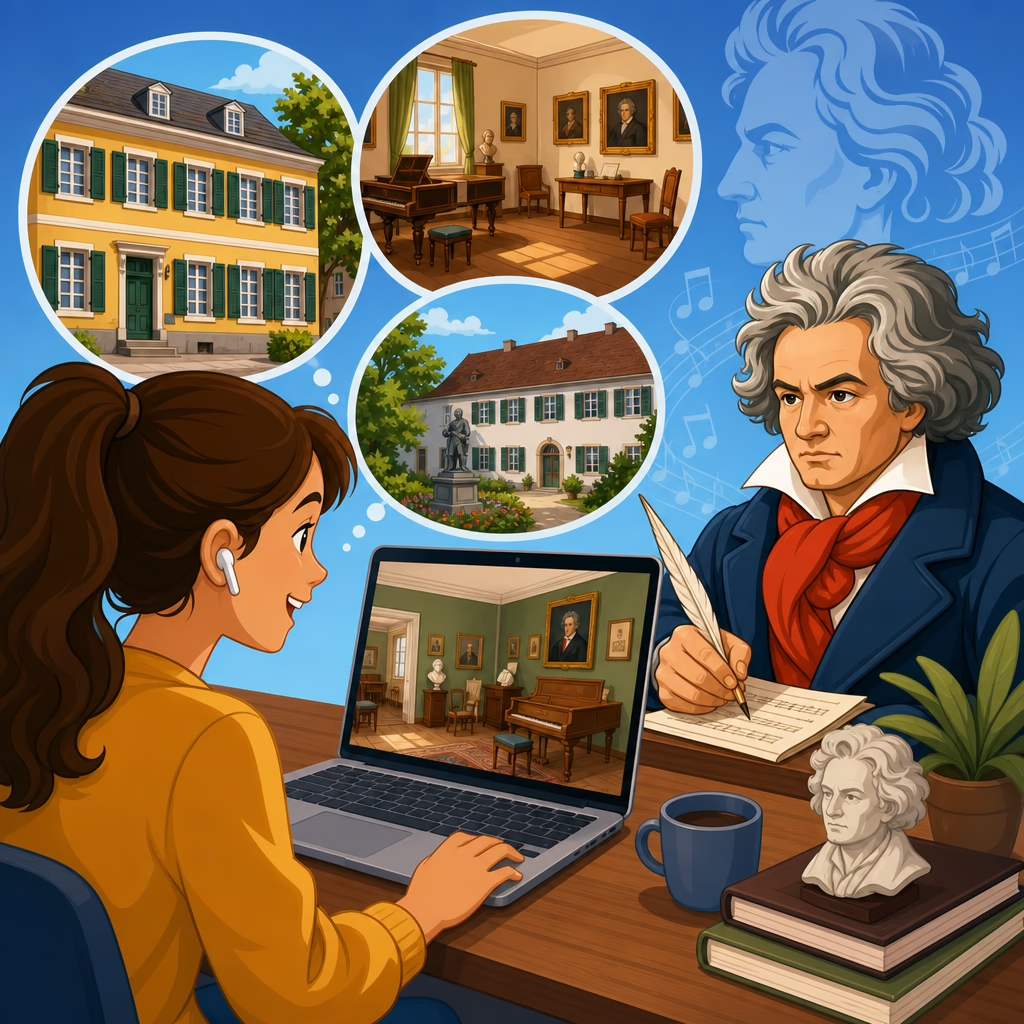
Virtual Tours of Beethoven Museums and Homes
Virtual tours of Beethoven museums and homes open the composer’s world to anyone with a screen, turning archives, period rooms, manuscripts, and instruments into accessible cultural experiences. In practical terms, a virtual tour is a digital visit delivered through panoramic photography, video walkthroughs, interactive maps, narrated exhibits, or high resolution object viewers that let users zoom into details impossible to study behind glass. For Beethoven enthusiasts, music students, teachers, travelers planning a European itinerary, and researchers who cannot easily reach Bonn, Vienna, or smaller regional collections, these tours matter because they reduce distance without flattening context. I have used them both as preparation for on site visits and as stand alone study tools, and the best ones do more than display rooms: they explain chronology, provenance, acoustics, and the relationship between Beethoven’s life and the objects preserved today.
Beethoven’s surviving homes and museums are spread across a geography that mirrors his biography. Bonn, where he was born in 1770, preserves the strongest connection to his early years through Beethoven-Haus. Vienna, where he built his career and spent most of his adult life, holds multiple addresses associated with his residences, patrons, and final years, including the Pasqualatihaus and the Heiligenstadt Testament site. Other museums and memorial rooms across Austria and Germany add context through letters, portraits, hearing devices, pianos, death masks, and first editions. A strong hub page on virtual tours of Beethoven museums and homes should therefore do two jobs at once: guide readers to the most valuable digital experiences and explain what each location contributes to understanding the composer as a working musician, not just a monument.
The phrase Beethoven museums and homes covers several distinct categories. Some are original residences with documented occupancy, such as the Bonn birth house or Vienna apartments where he lived and composed. Others are memorial museums assembled later from related artifacts, correspondence, or reconstructed interiors. A third category includes broader music institutions with significant Beethoven collections, even if he did not live there. That distinction matters online because a digital visitor needs to know whether a tour offers authentic architecture, curated interpretation, or a mixed presentation. The strongest virtual experiences state clearly what is original, what has been reconstructed, and what is inferred from scholarship. That transparency builds trust and also helps teachers, students, and cultural travelers cite the material responsibly in papers, class presentations, and travel planning notes.
What to look for in a high quality virtual Beethoven museum tour
A useful virtual Beethoven tour should answer five basic questions quickly: where is this place, why is it connected to Beethoven, what original materials does it hold, how is the tour structured, and what can a visitor learn that a general biography would miss. In my experience reviewing music museum sites, many institutions succeed on visual appeal but fail on orientation. The best tours begin with a concise location note, dates of Beethoven’s association, and a floor by floor or room by room pathway. They also include multilingual labels, image credits, and object level metadata for manuscripts, portraits, instruments, and furniture. When those elements are present, the experience becomes more than sightseeing; it becomes a reliable reference point.
Image quality and interface design matter more for music history than many readers expect. Beethoven collections often contain manuscripts with revisions, instrument construction details, and small personal objects such as ear trumpets or conversation books. If the viewer cannot zoom, rotate, or isolate these items, educational value drops sharply. Institutions using gigapixel imaging, IIIF compatible viewers, or structured object databases create far better results than static slideshows. Audio also matters. A room connected to the late piano sonatas feels different when paired with a historically informed performance on a fortepiano than when left silent. Good tours make smart use of short curatorial audio, period instrument demonstrations, or captions that connect visual evidence to musical works and life events.
Accessibility is another essential criterion. Strong tours work across desktop and mobile devices, include readable contrast, provide alt text or transcripts for audio and video, and avoid navigation that depends entirely on tiny hotspots. This is not just a technical preference; it shapes who can participate in Beethoven scholarship and appreciation. A well built online exhibition can support a conservatory seminar, a secondary school lesson, a retirement community music program, or an independent traveler planning a visit to Vienna. Because this page functions as a hub within a Multimedia Gallery, readers should treat accessibility, object transparency, and interpretive depth as the standards by which every miscellaneous Beethoven virtual tour is judged.
Beethoven-Haus Bonn: the essential starting point
For most readers, the most important virtual destination is Beethoven-Haus Bonn, widely regarded as the central museum devoted to the composer. The institution preserves the house complex associated with his birth and maintains one of the world’s leading Beethoven archives, with manuscripts, letters, early editions, portraits, and personal objects. Its digital offerings have varied over time, but the key value remains consistent: Bonn provides the strongest foundation for understanding Beethoven’s family background, early education, performance environment, and posthumous reception. If you only explore one online museum before reading deeper material or planning travel, start here because it anchors the chronology and the object record.
In virtual form, Beethoven-Haus is especially valuable when it integrates room views with collection highlights rather than treating architecture and artifacts as separate experiences. Readers should look for displays tied to childhood in Bonn, the electoral court milieu, Beethoven’s early keyboard training, and the transition toward Vienna. The museum’s holdings of manuscripts and portraiture help visitors trace how Beethoven’s public image changed from gifted young musician to uncompromising master. The archive is equally important for serious users because object records and digitized sources often support classroom use and scholarly citation. For a hub article, Beethoven-Haus also serves as the best internal reference point against which smaller memorial sites can be compared for depth, authenticity, and research utility.
Vienna residences and memorial sites: where biography becomes place
Virtual tours of Beethoven’s Vienna locations are compelling because they map directly onto major creative periods. Unlike the single symbolic power of the Bonn birth house, Vienna presents a network of addresses, each tied to changing patronage, health, finances, and compositional output. Pasqualatihaus, for example, is closely associated with the years in which Beethoven worked on pieces including parts of Fidelio and the Fifth and Sixth Symphonies. Heiligenstadt is inseparable from the 1802 document known as the Heiligenstadt Testament, in which he confronted worsening hearing loss. Apartments linked to his late years illuminate the conditions under which the late quartets, Missa solemnis, and Ninth Symphony emerged.
Because many historic urban residences have been altered, adapted, or partially reconstructed, virtual visitors should read curatorial notes carefully. An excellent tour explains what survives from Beethoven’s occupancy, what was restored later, and how scholars identified the address. That nuance is not a drawback; it is part of responsible interpretation. In practice, the most useful Vienna tours pair period rooms with timelines, maps, and object stories. A digital map showing Beethoven’s moves across the city can reveal how often he changed lodgings and why. That matters because mobility in Vienna was linked to patronage networks, noisy neighbors, changing health needs, and the practical realities of a freelance composer navigating an expanding musical marketplace.
| Site | Primary significance | Best use in a virtual visit | What to verify |
|---|---|---|---|
| Beethoven-Haus Bonn | Birthplace, archive, core collection | Start with chronology and major objects | Whether room views connect to collection records |
| Pasqualatihaus Vienna | Middle period residence association | Study links between place and major works | How much of the interior is original or reconstructed |
| Heiligenstadt site | Hearing crisis and 1802 testament context | Understand health history and emotional turning point | Quality of historical explanation beyond memorial symbolism |
| Late Vienna memorial rooms | Final years, late works, death legacy | Explore domestic context and reception history | Documentation for occupancy dates and displayed artifacts |
How virtual exhibits reveal Beethoven’s working life
The greatest advantage of digital museum interpretation is that it can show Beethoven as a working professional rather than a frozen icon. Manuscript viewers reveal his compositional process through deletions, inserted ideas, and layered revisions. Conversation books, used after deafness made spoken communication difficult, show how daily logistics, artistic concerns, and social exchanges intersected. Ear trumpets and medical references complicate simplistic narratives about heroic suffering by grounding hearing loss in physical objects and documented responses. When an institution links these materials clearly, the visitor sees Beethoven not only as the composer of canonical works but also as a man managing drafts, publishers, landlords, copyists, family conflict, and chronic health problems.
Instrument displays are especially informative in virtual form. Beethoven wrote for pianos that evolved significantly during his lifetime, including instruments from makers such as Broadwood, Streicher, and Erard. A digital exhibit that identifies action type, range, pedal mechanisms, and tonal character can immediately clarify why his keyboard writing pushed boundaries. The same applies to performance spaces. Even a simple panoramic room view, if paired with dimensions and acoustic notes, helps users imagine domestic music making versus public concert performance. I have found that students grasp the relationship between instrument technology and musical style faster when they can compare an object photograph, a sound sample, and a manuscript page in one digital sequence.
Using Beethoven virtual tours for teaching, travel planning, and research
Teachers can use virtual tours of Beethoven museums and homes to move beyond textbook summaries. A focused lesson might ask students to compare how Bonn and Vienna institutions present the same issue, such as deafness, patronage, or Beethoven’s public image. University instructors can assign a virtual room analysis in which students evaluate authenticity, curatorial framing, and object selection. Music history classes can connect a museum artifact to a score study assignment, for example pairing a Heiligenstadt exhibit with the Eroica period or a late Vienna memorial room with Op. 131. Because many museum sites provide multilingual labels, they also support language learning and comparative cultural history courses.
For travelers, virtual tours work best as reconnaissance. Before visiting Bonn or Vienna, review floor plans, object highlights, opening information, and neighborhood context. This helps prioritize limited time and avoids the common mistake of treating every memorial room as interchangeable. A traveler interested in manuscripts should build around institutions with strong archive displays, while someone focused on lived environment may prioritize preserved domestic interiors. Researchers benefit differently. Even when a virtual tour cannot replace archival consultation, it can identify holdings, confirm provenance details, and expose relationships among objects spread across collections. As a hub for miscellaneous resources, this article points readers toward using digital tours as gateways to catalogs, institutional databases, concert programs, and related gallery content.
Common limitations and how to evaluate them honestly
Virtual access has real limits, and readers should approach every Beethoven museum tour with informed expectations. A panorama cannot convey material texture the way standing near plaster walls, floorboards, or period instruments can. Color calibration varies across screens. Spatial compression can make cramped apartments look generous or large galleries feel intimate. Audio samples are shaped by recording technique rather than live acoustics. Institutions also differ widely in budget, which affects everything from translation quality to metadata completeness. A smaller museum may hold important Beethoven material yet offer a basic digital interface, while a better funded institution may have polished visuals but thinner historical explanation.
The right response is not cynicism but method. Check whether the site identifies curators, collection sources, photographers, and update dates. Prefer tours that distinguish originals from replicas and cite the historical basis for reconstructions. Look for object numbers, maker names, dates, and dimensions, especially with instruments and documents. If no provenance appears, treat claims cautiously. Compare a museum’s narrative with established references such as critical biographies, thematic catalogs, or institutional publications. In my own workflow, I keep notes on what a virtual tour demonstrates directly, what it suggests indirectly, and what remains uncertain. That habit prevents overclaiming and makes digital exploration genuinely useful for cultural learning.
Virtual tours of Beethoven museums and homes are most valuable when used as informed entry points into the composer’s life, work, and historical environment. They make geographically dispersed collections accessible, help readers compare Bonn and Vienna contexts, and reveal how manuscripts, instruments, portraits, and domestic spaces illuminate different stages of Beethoven’s career. The best tours are transparent about authenticity, rich in object level detail, accessible across devices, and designed to answer practical visitor questions without sacrificing scholarly precision. For a Multimedia Gallery hub covering miscellaneous resources, that combination matters because readers need a framework for judging many different digital experiences, not just a list of links.
The core takeaway is simple: start with Beethoven-Haus Bonn for chronology and collection depth, then use Vienna’s virtual sites to connect places with major turning points such as the hearing crisis, middle period creativity, and late style. As you explore, evaluate each tour for orientation, metadata, image quality, interpretive clarity, and evidence for reconstruction. Used this way, virtual museum visits become more than substitutes for travel. They become tools for teaching, trip planning, comparative analysis, and deeper listening. Explore the major sites, save notes on standout objects, and continue through the rest of this Multimedia Gallery to build a fuller picture of Beethoven’s world.
Frequently Asked Questions
What can you actually see on a virtual tour of Beethoven museums and homes?
A strong virtual tour of Beethoven museums and homes usually goes far beyond a simple slideshow. Depending on the institution, visitors may be able to explore panoramic rooms, move through reconstructed interiors, follow guided video walkthroughs, and examine digitized collections in very high resolution. That can include period furniture, handwritten music manuscripts, letters, early printed scores, portraits, listening stations, personal objects, and keyboard instruments linked to Beethoven’s life and era. In some cases, the digital experience also includes curatorial commentary, timelines, floor plans, and interactive hotspots that explain why a room, object, or document matters.
One of the biggest advantages of a virtual visit is the ability to study details that are often difficult to examine during an in-person trip. Manuscript pages can sometimes be enlarged enough to see revisions, corrections, and Beethoven’s famously energetic notation. Instruments may be presented from multiple angles, allowing users to inspect craftsmanship and historical design. Even domestic spaces such as birth homes, apartments, or memorial rooms can become more meaningful when accompanied by interpretive text that places them within Beethoven’s personal, artistic, and historical context. For students, teachers, and dedicated listeners, these features can turn a virtual tour into a serious educational resource rather than just a quick visual preview.
Are virtual Beethoven museum tours useful for music students and teachers?
Yes, they can be extremely useful, especially when the digital material is well organized and supported by expert interpretation. For music students, virtual tours offer direct access to primary and contextual sources that deepen understanding of Beethoven’s creative world. Seeing manuscripts, annotated editions, historical instruments, and period rooms helps connect abstract musical analysis to the realities of composition, performance, and daily life in Beethoven’s time. A student studying a sonata or symphony may gain valuable insight from viewing sketches, comparing drafts, or examining the kinds of pianos available during Beethoven’s career.
For teachers, virtual tours can serve as flexible classroom tools across music history, music appreciation, humanities, German studies, and cultural history courses. A teacher might assign students to compare objects from different Beethoven sites, analyze the presentation of biography in museum interpretation, or discuss how space and material culture shape public memory of composers. Because virtual access is not limited by geography, these tours also make it easier to incorporate museum-based learning into online classes, hybrid instruction, and independent study. In many cases, virtual exhibits can support lesson planning by providing stable visual resources, explanatory labels, and curated narratives that are easier to revisit than a one-time field trip.
How do virtual tours make Beethoven’s world more accessible?
Virtual tours expand access in several important ways. First, they remove travel barriers. Not every admirer of Beethoven can visit Bonn, Vienna, or other sites associated with his life, and digital tours allow anyone with an internet connection to engage with these collections from home, school, or a library. This is especially valuable for international visitors, researchers with limited funding, older adults, and people whose schedules make travel difficult. Virtual access also helps users preview a museum before visiting in person, which can make future trip planning easier and more rewarding.
Second, virtual formats can improve accessibility for people with mobility limitations or those who may find historic buildings physically challenging to navigate. Some digital tours also include captions, transcripts, multilingual text, zoom functions, audio narration, or screen-friendly exhibit structures that support a wider range of users. While accessibility quality varies by institution, the best virtual experiences are designed with inclusion in mind, making Beethoven-related collections available to broader audiences than traditional museum attendance alone. In that sense, digital tours do more than reproduce a building online; they open cultural heritage to people who might otherwise be excluded from it.
Can a virtual tour replace visiting a Beethoven museum or historic home in person?
A virtual tour is best understood as a powerful complement to an in-person visit rather than a complete replacement. Physical museums and preserved homes offer atmosphere, scale, and spatial presence that are difficult to replicate on a screen. Standing in a room associated with Beethoven, seeing original materials at their true size, and experiencing the arrangement of objects in a historic environment can produce a stronger emotional and sensory impression than digital viewing alone. In-person exhibitions also often include temporary displays, acoustical elements, and a sense of place that is tied to the building, neighborhood, and city around it.
That said, virtual tours have clear strengths of their own. They allow repeat viewing, slower study, and close inspection that is often impossible in a gallery setting. A visitor online can revisit a manuscript several times, pause on a caption, zoom into a keyboard mechanism, or compare multiple rooms without worrying about opening hours, crowds, or travel time. For many people, the ideal approach is to use both formats together: virtual tours for preparation, research, and review, and in-person visits for physical immersion and emotional connection. Even when a museum visit is not possible, a thoughtfully produced virtual experience can still provide genuine insight into Beethoven’s life, works, and legacy.
What should you look for in a high-quality virtual tour of a Beethoven museum or home?
The best virtual tours combine strong visuals, reliable scholarship, and intuitive navigation. Start with image quality. If a tour includes panoramic views, high-resolution object photography, or deep zoom functionality, users can engage much more meaningfully with manuscripts, instruments, portraits, and household objects. Navigation also matters. A clear floor plan, labeled rooms, clickable hotspots, and logical exhibit pathways make it easier to understand how spaces relate to Beethoven’s biography and historical context. If the platform feels confusing or limited, even excellent collections can become difficult to appreciate.
Scholarly value is equally important. Look for tours that provide curator-written labels, historical timelines, contextual essays, and, when possible, audio or video interpretation by experts. A good virtual tour should explain not just what an object is, but why it matters: how a manuscript connects to a specific work, how an instrument reflects performance practice, or how a room relates to Beethoven’s family, health, patrons, or professional life. Extra features such as multilingual support, classroom materials, archival links, and embedded musical examples can make the experience even richer. In short, a high-quality Beethoven virtual tour should do more than display artifacts. It should tell a coherent story about the composer’s environment, creativity, and lasting cultural importance.