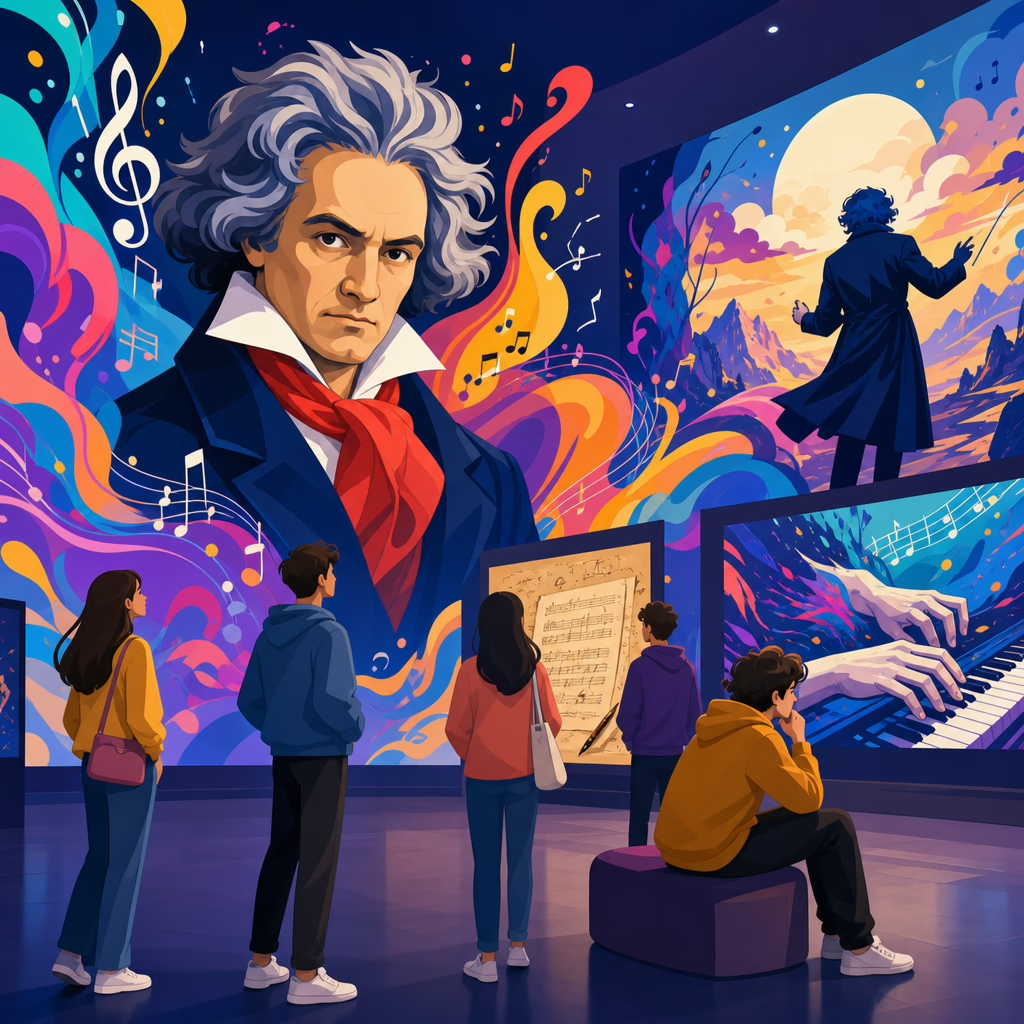
Digital Art Exhibits Inspired by Beethoven
Digital art exhibits inspired by Beethoven translate the force, structure, and emotional range of his music into immersive visual experiences that audiences can see, hear, and often physically navigate. In the Multimedia Gallery context, this miscellaneous hub article gathers the many ways curators, artists, developers, and educators interpret Beethoven through projection mapping, generative animation, interactive installations, virtual reality, archival media, and hybrid performance design. The key idea is simple: instead of treating a concert, painting, and museum visit as separate experiences, digital exhibition design fuses them into one environment. Beethoven is especially suited to this approach because his work combines recognizable motifs, dramatic contrasts, formal innovation, and a life story marked by struggle, experimentation, and deafness. Those elements give artists clear material to translate into image, movement, light, text, and spatial interaction. For galleries, this matters because digital exhibits can attract listeners who might never attend a classical concert, while also giving seasoned music audiences new ways to interpret familiar compositions. I have worked on multimedia exhibition planning where music rights, projection timing, visitor flow, and accessibility had to align, and Beethoven-based shows consistently require both technical precision and curatorial restraint. Done well, they deepen understanding rather than merely decorate the music. This hub covers the formats, themes, production methods, and visitor benefits that define digital art exhibits inspired by Beethoven.
What defines a digital art exhibit inspired by Beethoven
A digital art exhibit inspired by Beethoven is a curated visual or interactive environment built around his compositions, manuscripts, biography, or cultural legacy. The exhibit may use high-resolution screens, synchronized audio, LED walls, responsive sensors, motion tracking, immersive sound, or virtual spaces, but the defining feature is interpretation rather than simple playback. In practice, that means the visual system responds to the rhythm, harmony, orchestration, or narrative context of works such as the Fifth Symphony, Ninth Symphony, Moonlight Sonata, Fidelio, the late string quartets, or the Diabelli Variations. Some exhibitions focus on direct audiovisual translation, where frequency, tempo, and dynamics drive moving forms or particle systems. Others use Beethoven as a thematic anchor, exploring Romanticism, Enlightenment ideals, revolution, disability, or the history of listening. A strong exhibit states its interpretive logic clearly. If a room uses fractured monochrome geometry for the Grosse Fuge, the visual language should reflect the score’s density, dissonance, and abrupt changes. If another room pairs the Pastoral Symphony with environmental imaging, the curator should distinguish between Beethoven’s evocation of nature and modern ecological commentary. The best exhibitions make those connections legible to general visitors without flattening the music into cliché.
Major exhibit formats and how they work
Most Beethoven-themed digital exhibits fall into a handful of production formats, each with different technical demands and audience outcomes. Immersive projection shows surround visitors with floor-to-ceiling animated imagery timed to recorded performances. These are common in repurposed industrial spaces and large galleries because they scale well for tourism and group attendance. Interactive installations go further by letting visitors trigger visual or sonic changes through touchscreens, gesture recognition, pressure floors, or biometric inputs. In one model I have seen work effectively, a touchscreen score viewer lets visitors isolate strings, winds, brass, and percussion while adjacent graphics show how motifs travel through the orchestra. Virtual reality exhibits place users inside reconstructed concert halls, imagined landscapes, or abstract visualizations of musical form, which is powerful for education but slower in visitor throughput. Augmented reality layers Beethoven manuscripts, annotations, or 3D objects onto physical gallery surfaces using mobile devices or headsets. Hybrid performance exhibits combine live musicians with synchronized visuals, creating a timed event rather than a free-flow installation. Finally, archival media exhibits digitize letters, sketches, portraits, and first editions, using interactive kiosks and spectral imaging to reveal revisions and working methods. Each format changes how the public encounters Beethoven: as spectacle, as system, as biography, or as process.
Themes artists use to interpret Beethoven visually
Artists return to several recurring themes when building digital art exhibits inspired by Beethoven. The first is struggle and transcendence, often linked to the famous opening of Symphony No. 5 and to Beethoven’s progressive hearing loss. Visual interpretations may start with constrained, dark, repetitive forms and gradually open into luminous, expansive compositions. The second theme is nature, especially through Symphony No. 6, where artists use flowing landscapes, botanical growth simulations, weather systems, and field-recording textures. The third is universality and human solidarity, usually anchored in the Ninth Symphony and the “Ode to Joy,” which lends itself to multilingual text projections, crowd-sourced portrait mosaics, and networked installations involving remote participants. A fourth theme is formal architecture. Beethoven’s sonata forms, variation techniques, and contrapuntal structures can become spatial diagrams, algorithmic animations, or layered generative grids. A fifth theme is experimentation late in life. The late quartets inspire many of the most compelling exhibits because they permit ambiguity, fragmentation, silence, and discontinuity. Rather than assigning every note a color, serious artists ask what it means to visualize tension, delay, recursion, and unresolved expectation. That shift from decorative accompaniment to rigorous interpretation is what separates durable exhibition work from novelty media.
Tools, production methods, and curatorial decisions
Building a credible Beethoven digital exhibit requires more than visual talent. It requires a production workflow that respects musicology, rights management, acoustics, visitor circulation, and hardware reliability. Creative teams often use TouchDesigner, Unreal Engine, Notch, Resolume, Max/MSP, QLab, and Ableton Live for synchronization, real-time rendering, and show control. High-resolution playback demands calibrated projectors, media servers, multi-channel audio routing, and precise timecode. If the exhibit reacts live to performances or visitor movement, teams add sensors such as LiDAR units, infrared cameras, depth cameras, or MIDI-linked interfaces. On the curatorial side, the first decision is scope. A biography-driven exhibit needs manuscripts, historical framing, and contextual interpretation from reputable archives. A composition-centered exhibit needs score analysis and a coherent reason for selecting specific recordings. Established performance references matter. Conductors such as Carlos Kleiber, John Eliot Gardiner, Herbert von Karajan, and Nikolaus Harnoncourt present radically different Beethoven, and the visual treatment should align with the chosen interpretive style. Accessibility is equally important. Captions, transcripts, seating zones, controlled sound levels, and clear navigation are not optional. For visitors with hearing impairments, haptic feedback, visualized vibration, and score-based animation can make the exhibit more inclusive rather than paradoxically excluding audiences from a composer whose life was shaped by deafness.
Examples of exhibit approaches across the miscellaneous hub
This miscellaneous hub connects many article angles because Beethoven inspires a wide spread of digital exhibition concepts. Some subtopics focus on symphony visualization, where each movement becomes a distinct environment. Others cover manuscript-driven displays that animate corrections, erased passages, and sketchbook development to show how ideas evolved. Educational installations form another branch, using interactive orchestration maps, harmonic reduction screens, and tempo comparison stations for students. Community-centered exhibits may invite local artists to respond to Beethoven through motion graphics, dance film, or spoken-word overlays. There are also disability-centered interpretations that examine hearing, vibration, embodiment, and communication without reducing Beethoven to a simplistic triumph narrative. Commercial immersive productions deserve separate coverage too, because they raise practical questions about ticketing, throughput, merchandising, and whether spectacle overwhelms substance. Finally, crossover exhibits link Beethoven with contemporary media forms including AI-generated visuals, game-engine environments, data sonification, and large-format LED domes. As a hub page, this article serves as the starting point for all of those directions while keeping the central question in view: what does it mean to translate Beethoven into digital space responsibly and effectively?
Best practices for designing a successful Beethoven digital exhibit
The most successful exhibits follow a repeatable set of principles that balance artistry with clarity. They begin with one curatorial thesis, choose media that fit the thesis, test pacing with real visitors, and build interpretation into the environment instead of relying on wall text to rescue weak concepts. They also avoid overloading every second with movement. Beethoven’s music depends on contrast, phrasing, and structural release, so visual design should preserve moments of stillness and negative space. In gallery testing, I have repeatedly seen visitors stay longer when the room gives them time to listen before prompting interaction.
| Design element | What works best | Common mistake |
|---|---|---|
| Music selection | Use complete movements or clearly explained excerpts | Random highlights with no narrative link |
| Visual language | Match style to musical character and historical context | Generic swirling effects for every piece |
| Interaction | Give visitors meaningful control with obvious feedback | Novel sensors that add confusion, not insight |
| Interpretation | Provide concise labels, captions, and guided prompts | Assuming visuals alone explain complex music |
| Accessibility | Include seating, captions, transcripts, and sensory options | Designing only for standing, hearing audiences |
| Operations | Plan for resets, maintenance, and staff training | Launching unstable systems that drift out of sync |
Those fundamentals apply whether the venue is a museum, university gallery, concert hall lobby, public library, or touring pop-up installation. They also help curators connect this hub to related Multimedia Gallery content on immersive sound, projection art, interactive archives, and cross-disciplinary performance design.
Common pitfalls, audience expectations, and future directions
Digital art exhibits inspired by Beethoven can fail in predictable ways. The most common problem is superficial equivalence, where loud passages trigger bright explosions and quiet passages produce dark stillness without deeper reasoning. Another is biographical reduction, especially when exhibitions turn Beethoven’s deafness into sentimental branding instead of examining communication, adaptation, technology, and historical reality. Rights and attribution can also be mishandled. Curators must verify recording licenses, image permissions, text translations, and archive usage, particularly when using manuscripts from institutions such as the Beethoven-Haus Bonn, the Library of Congress, or major European collections. Audience expectations are split. Some visitors want a contemplative museum experience; others expect a high-impact immersive attraction. Good programming addresses both through timed sequences, optional interpretation layers, and varied dwell zones. Looking ahead, the field is moving toward responsive environments that analyze live performance data, volumetric scans of instruments and spaces, and multilingual AI-assisted interpretation tools supervised by human curators. Yet the standard for quality will not change. A valuable Beethoven exhibit must illuminate the music, not bury it under screens. It should help visitors understand why a motif matters, why a form unfolds as it does, or why a late quartet can feel unsettling and intimate at the same time. That educational and emotional clarity is the real measure of success.
Digital art exhibits inspired by Beethoven succeed when they treat music as a source of structure, meaning, and public connection rather than as background for decorative effects. Across immersive rooms, archival interactives, VR experiences, hybrid performances, and educational installations, the strongest projects start with a clear curatorial idea and then choose technology that serves it. They respect musical form, acknowledge biography without oversimplifying it, and make space for both emotional impact and factual context. As the miscellaneous hub under Multimedia Gallery, this page maps the full landscape: formats, themes, tools, best practices, limitations, and future directions. The practical takeaway is straightforward. If you are planning, studying, or commissioning a Beethoven digital exhibit, begin with the work itself, define what visitors should understand by the end, and build every visual and interactive choice around that goal. Explore the related articles in this subtopic to go deeper into symphony visualization, manuscript exhibits, accessibility design, immersive production, and interdisciplinary gallery programming.
Frequently Asked Questions
What are digital art exhibits inspired by Beethoven?
Digital art exhibits inspired by Beethoven are immersive multimedia experiences that reinterpret his music through visual, spatial, and interactive technologies. Instead of presenting Beethoven solely as sheet music, concert performance, or historical biography, these exhibits translate the architecture, tension, movement, and emotional intensity of his compositions into environments that visitors can see, hear, and often physically move through. In practice, that can include projection-mapped rooms synchronized to symphonic passages, generative animations that respond to the rhythm or harmonic structure of a sonata, interactive installations that let visitors influence visual compositions, and virtual reality spaces built around the dramatic contours of works such as the Fifth Symphony, the “Moonlight” Sonata, or the Ninth Symphony.
What makes these exhibits especially compelling is that they bridge classical music and contemporary media without reducing either one. Curators and artists often treat Beethoven’s work as both source material and conceptual framework. His use of motif development, contrast, surprise, and emotional escalation lends itself naturally to digital interpretation. A short rhythmic phrase can become a recurring visual pattern. A shift from darkness to triumph can become a transition in light, color, and scale. The result is not simply decoration layered on top of music, but a cross-disciplinary translation of musical ideas into moving image, sound design, responsive space, and embodied audience experience.
How do artists and curators transform Beethoven’s music into visual and interactive experiences?
Artists and curators usually begin by studying the underlying musical structure of a specific composition or body of work. They may analyze tempo, dynamics, orchestration, motif repetition, harmonic tension, and emotional trajectory to identify visual equivalents. For example, a forceful opening motif might be represented through bold geometric forms, kinetic bursts of light, or sharply timed edits in projected imagery. Slower, lyrical passages may inspire fluid motion, layered atmospheric textures, or softer visual gradients. In many exhibits, developers use audio-reactive systems so that the visuals are not merely pre-edited but generated or modulated in real time according to the music’s frequency, volume, rhythm, or timbral changes.
Curators then shape those artistic elements into a coherent visitor journey. In a multimedia gallery setting, that might mean organizing a sequence of rooms around different interpretive themes, such as Beethoven’s struggle and resilience, his innovation in form, his influence on Romanticism, or the relationship between silence, hearing loss, and inner sound. Interactive installations can deepen engagement by allowing visitors to trigger visual changes through gesture, touch, movement, or proximity. Projection mapping can transform walls, floors, and sculptural surfaces into dynamic score-like environments, while archival materials such as manuscripts, portraits, letters, and historical recordings may be integrated to ground the digital spectacle in Beethoven’s documented life and legacy. The strongest exhibits balance technological sophistication with artistic clarity, ensuring that the visitor feels a meaningful connection to the music rather than just sensory overload.
What technologies are commonly used in Beethoven-themed digital exhibits?
These exhibits often combine several technologies to create layered, multisensory experiences. Projection mapping is one of the most common tools, allowing artists to animate architectural surfaces or gallery interiors in sync with musical developments. Large-scale digital screens, LED environments, and surround sound systems are also frequently used to envelop visitors in synchronized image and audio. Generative animation software can translate live or recorded musical data into evolving visual forms, making the exhibit feel responsive and alive rather than fixed. Motion sensors, touch interfaces, computer vision, and spatial audio systems add interactivity, enabling visitors to influence pacing, composition, or viewpoint as they move through the installation.
Virtual reality and augmented reality are increasingly important as well. VR can place audiences inside abstract visual worlds shaped by Beethoven’s compositions, while AR can layer historical context, notation, or interpretive graphics onto physical gallery spaces. Some exhibits incorporate AI-assisted tools for pattern generation, though these are typically most effective when guided by strong curatorial intent and musical understanding. Archival media technology also plays a role: digitized manuscripts, remastered recordings, and animated historical documents can connect the immersive experience to Beethoven’s era. In educational or hybrid performance settings, live musicians may perform alongside responsive visuals, creating a dialogue between traditional concert practice and contemporary digital design. The most successful exhibitions use technology in service of interpretation, not novelty, so that every tool supports a deeper understanding of Beethoven’s artistic power.
Why does Beethoven work so well as inspiration for immersive multimedia and gallery installations?
Beethoven’s music is particularly suited to immersive reinterpretation because it is structurally strong, emotionally expansive, and culturally recognizable. His compositions often unfold with a sense of dramatic inevitability: small motifs develop into large-scale musical arguments, contrasts intensify, and emotional states transform in ways that feel almost cinematic even though they were written long before cinema existed. That quality gives digital artists rich material to work with. They can build visual environments around recurring motifs, mirror the tension and release of harmonic movement, or create spatial narratives that reflect the momentum of a symphony or sonata. His music also spans an enormous emotional range, from intimacy and tenderness to defiance, turbulence, transcendence, and joy, which makes it highly adaptable to immersive storytelling.
There is also a broader cultural reason. Beethoven occupies a unique place in public imagination as both a historical figure and a symbol of artistic intensity, innovation, and perseverance. His life story, especially his struggle with hearing loss, adds another interpretive dimension for artists exploring embodiment, sensory perception, and the relationship between inner experience and outward expression. For educators and curators, Beethoven provides a familiar entry point that can attract audiences who may not normally visit a digital art exhibit or engage deeply with classical music. For contemporary creators, his work offers a foundation sturdy enough to support experimentation across media without losing intellectual or emotional substance. That combination of formal depth, narrative richness, and public recognition helps explain why Beethoven continues to inspire projection-based installations, VR worlds, interactive galleries, and hybrid performances around the world.
What can visitors expect from a digital art exhibit inspired by Beethoven in a multimedia gallery setting?
Visitors can usually expect something more experiential than a traditional museum display and more exploratory than a standard concert. Rather than standing in front of static objects or listening from a fixed seat, audiences are often invited to move through an environment where sound, image, light, and spatial design interact continuously. One area of the gallery may focus on immersive projection and orchestral scale, surrounding visitors with animated forms that pulse with the music. Another may feature interactive stations where users remix motifs, examine digitized scores, or trigger visual responses tied to Beethoven’s compositional language. In some exhibitions, archival content and historical interpretation are woven into the experience so that visitors learn about Beethoven’s life, creative process, and influence while engaging with cutting-edge media.
The overall experience can vary widely depending on the curatorial approach. Some exhibits emphasize emotional immersion, creating powerful audiovisual spaces that let visitors feel Beethoven’s intensity in a new way. Others are more educational, breaking down musical form and showing how visual systems can represent rhythm, harmony, or thematic development. Still others blend live performance, digital scenography, and participatory design to create a hybrid event that feels part concert, part installation, and part museum encounter. For most visitors, the value lies in seeing Beethoven from a fresh perspective. A digital exhibit can make the logic of his music more visible, the emotional arc more tangible, and the historical legacy more accessible to contemporary audiences. Whether someone is a lifelong classical listener or completely new to Beethoven, a thoughtfully designed multimedia gallery experience can make his work feel immediate, physical, and newly alive.