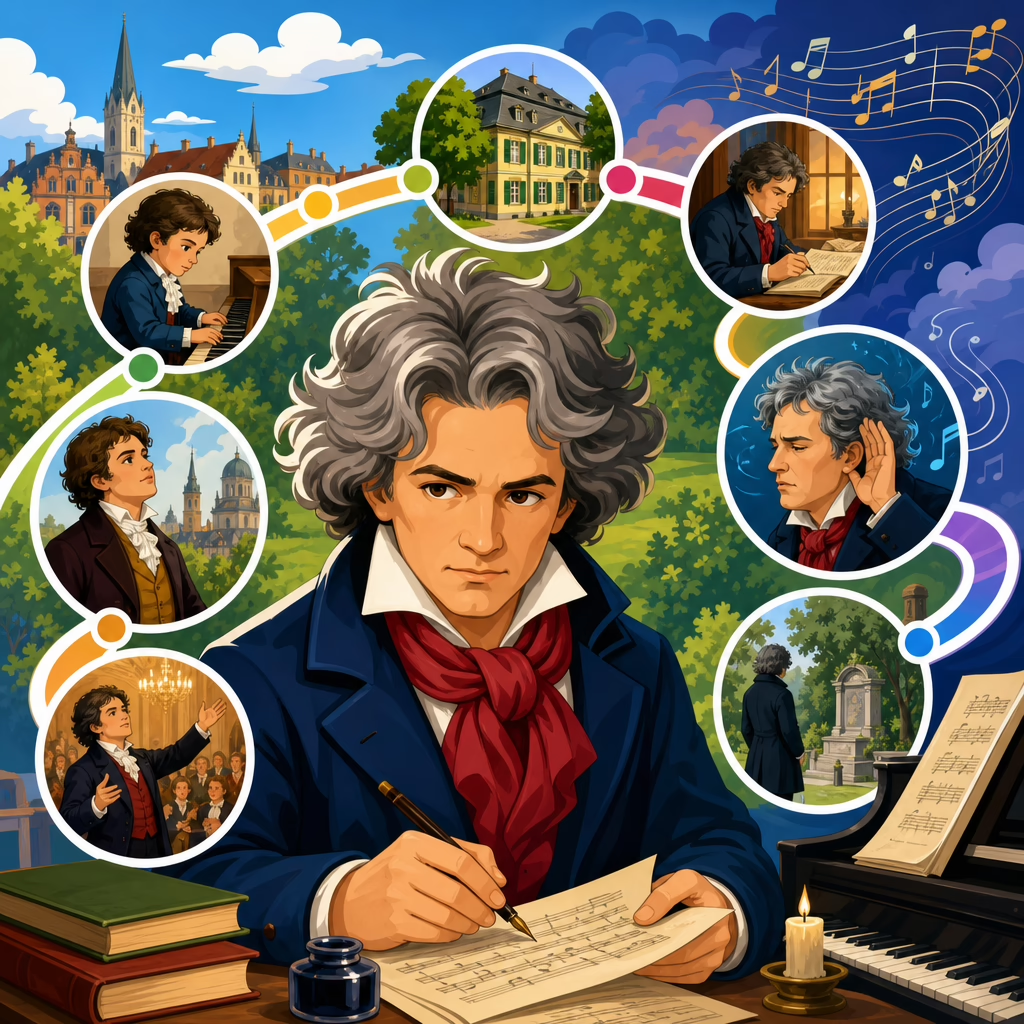
Interactive Timelines of Beethoven’s Life
Interactive timelines of Beethoven’s life turn a familiar biography into a navigable historical map, helping readers trace how family origins, political upheaval, illness, patronage, and creative breakthroughs intersected across one extraordinary career. In this context, an interactive timeline is a digital, user-controlled sequence of dated events that can combine text, images, scores, letters, recordings, and geographic references. Rather than forcing visitors through a single linear narrative, it lets them jump from Bonn childhood years to Vienna premieres, from the Heiligenstadt Testament to the late quartets, and from personal crises to public triumphs. I have built educational music timelines for archive projects, and Beethoven consistently proves why this format matters: his life is documented in rich but scattered sources, and chronology is the key that makes them understandable. For a multimedia gallery, this hub page gathers the miscellaneous angles that do not fit one narrow category but are essential to the whole picture: family background, residences, health, notebooks, legal disputes, friendships, instruments, and reception history. A strong Beethoven timeline does more than list dates. It explains why 1792 matters for his move to Vienna, why 1802 marks a psychological turning point, why 1808 was both artistically explosive and financially unstable, and why 1824 did not end the story with the Ninth Symphony. Readers, students, curators, and teachers use these timelines to answer practical questions quickly while still seeing patterns across decades.
What an Interactive Beethoven Timeline Should Include
The best interactive timelines of Beethoven’s life combine chronology with context. At a minimum, they should cover birth in Bonn in 1770, early training under his father Johann van Beethoven, service within the Electoral court environment, the move to Vienna in 1792, studies linked to Joseph Haydn, the rise of his reputation as a pianist and improviser, the onset and progression of hearing loss, the so-called heroic middle period, the guardianship battle over his nephew Karl, the late piano sonatas, the Missa solemnis, the Ninth Symphony, and his death in 1827. A timeline that omits these anchors may still look polished, but it will fail as a reference tool.
To make the page genuinely useful, every event should answer three questions directly: what happened, why it mattered, and what sources support it. For example, an entry for 1802 should not simply say that Beethoven stayed in Heiligenstadt. It should explain that he wrote the Heiligenstadt Testament there, a private document addressed to his brothers that reveals despair over worsening deafness and his determination to continue composing. That single entry helps users connect biography, psychology, and artistic persistence.
Media choices also matter. Portraits by Joseph Karl Stieler, manuscript images from the late quartets, excerpts from autograph scores, and mapped addresses such as the Pasqualati House in Vienna provide visual anchors. Audio should be used selectively and tied to the date. If a user clicks 1804, hearing the opening of the “Eroica” Symphony is far more effective than presenting a generic playlist. In a multimedia gallery, those direct associations improve retention because visitors remember events through sound, place, and image together.
Core Milestones from Bonn to Vienna
Beethoven was baptized on December 17, 1770, in Bonn, and because infant baptism usually followed birth quickly in Catholic practice, scholars accept December 16 as the likely birth date. His family background shaped the earliest timeline entries. His grandfather, also named Ludwig van Beethoven, had been Kapellmeister in Bonn and provided a model of musical prestige, while his father Johann worked as a tenor and instrumentalist but was unreliable and struggled with alcohol. Those domestic conditions matter because they explain both Beethoven’s early training and the pressure placed on him as a child performer.
By 1784, Beethoven had secured employment as assistant court organist in Bonn, a meaningful professional foothold for a teenager. Bonn was not Vienna, but it was intellectually active. The court of Elector Maximilian Franz encouraged exposure to literature, opera, and Enlightenment thinking. Through this environment, Beethoven encountered broader cultural currents that later helped shape works with unusually strong moral and political dimensions. Around 1787 he likely visited Vienna and may have briefly met Mozart, though the evidence is uncertain and should be labeled carefully in any responsible timeline.
The French Revolutionary wars disrupted the Rhineland and changed the world around him. In 1792 Beethoven left Bonn permanently for Vienna, where Count Waldstein famously expressed hope that he would receive Mozart’s spirit from Haydn’s hands. That phrase is often quoted because it captures contemporary expectation. In Vienna, Beethoven built a career not first as a symphonist but as a pianist, improviser, and composer of ambitious chamber and keyboard works. Timeline users need this corrective because popular summaries often jump too quickly to the symphonies.
How to Organize the Major Periods of Beethoven’s Life
For readers, students, and curators, periodization makes a long timeline readable. The following structure works well because it matches both biographical developments and changes in musical style.
| Period | Approximate Years | Main Life Context | Representative Works or Events |
|---|---|---|---|
| Bonn formation | 1770–1792 | Family training, court employment, early patronage | Assistant organist post, viola playing, early publications |
| Vienna emergence | 1792–1802 | Piano career, aristocratic networks, rising fame, first signs of deafness | Op. 2 sonatas, Op. 18 quartets, First Symphony |
| Heroic middle period | 1803–1814 | Expanded scale, public ambition, political instability, worsening hearing | “Eroica,” Fifth Symphony, “Appassionata,” Fidelio |
| Transition and crisis | 1815–1819 | Nephew custody battle, reduced public activity, health strain | Karl guardianship case, fewer major premieres |
| Late period | 1819–1827 | Near-total deafness, inward style, monumental sacred and chamber works | Missa solemnis, Ninth Symphony, late quartets, Diabelli Variations |
This period model is not arbitrary. It reflects changes visible in the works, documented shifts in Beethoven’s social world, and turning points preserved in letters and conversation books. A good hub page should also link out to focused gallery items on each phase, because visitors often enter through one famous work and then want the larger life sequence around it.
Health, Deafness, and the Documents That Explain Them
No interactive Beethoven timeline is complete without a careful treatment of health. The standard question readers ask is simple: when did Beethoven go deaf? The accurate answer is that hearing loss emerged gradually, probably becoming noticeable in the late 1790s, was deeply troubling by 1801, and left him functionally isolated from ordinary conversation in later years. This matters because timelines often oversimplify the issue into a single date, which misrepresents the lived reality of progressive impairment.
The Heiligenstadt Testament of 1802 is a crucial anchor because it is Beethoven’s own testimony. In it, he describes withdrawal from society caused by hearing difficulty and the humiliation of not hearing what others heard. Later, conversation books became essential tools. Since Beethoven could not follow speech well, visitors wrote comments or questions in notebooks, and he replied aloud or occasionally in writing. These books are not complete transcripts, but they remain among the most valuable sources for reconstructing his final decade.
Medical interpretation is still debated. Scholars have proposed otosclerosis, Paget disease, lead exposure, autoimmune conditions, and other explanations, but no single diagnosis commands universal agreement. Recent scientific analysis of authenticated hair samples has added data without closing every question. A trustworthy timeline should present the evidence hierarchy clearly: primary documents establish symptoms and chronology; modern science may refine possibilities; certainty has limits. That balance helps readers distinguish documented fact from retrospective speculation.
Places, Patrons, and Personal Relationships
Beethoven’s life cannot be understood without place and patronage. Vienna gave him access to aristocratic supporters such as Prince Karl Lichnowsky, Archduke Rudolph, and Prince Lobkowitz, whose commissions, stipends, or performance opportunities sustained him when the commercial music market alone could not. One famous 1809 annuity agreement involving Archduke Rudolph, Prince Kinsky, and Prince Lobkowitz was designed to keep Beethoven in Vienna after an offer from Kassel. Though financial complications later reduced its stability, the agreement shows his rare status as a composer patrons considered worth retaining strategically.
Residences are equally important timeline markers. Beethoven moved frequently within Vienna, and those addresses are useful not as trivia but as evidence of changing finances, working conditions, and social circles. The Pasqualati House is commonly highlighted because portions of Fidelio and other major works are associated with it. A mapped timeline can also connect concert venues, publishers, and coffeehouses, giving users a more physical sense of musical life in the city.
Personal relationships require nuance. Beethoven never married, but he formed intense attachments, and the unsent letter to the “Immortal Beloved,” written in 1812, remains one of the most discussed documents in music history. Candidates proposed by scholars include Antonie Brentano and Josephine Brunsvik, yet no identification is universally accepted. The responsible approach for a hub article is to present the letter as authentic, emotionally significant, and unresolved in recipient. That is more useful than pretending certainty where scholarship does not supply it.
Works, Premieres, and Why Chronology Changes Interpretation
Chronology is not just biographical decoration; it changes how Beethoven’s works are heard. The Third Symphony, composed during the early middle period and first linked to Napoleon before the dedication was withdrawn, makes more sense when placed against revolutionary politics and Beethoven’s evolving public ambitions. The Fifth and Sixth Symphonies, premiered together in the long and under-rehearsed concert of December 22, 1808, gain meaning when users see the event beside the Fourth Piano Concerto, parts of the Mass in C, and the Choral Fantasy on the same program. The timeline reveals not only genius but practical strain.
Opera is another example. Fidelio did not arrive fully formed. It underwent revisions across years, and its reception was shaped by occupation-era Vienna and changing theatrical circumstances. A timeline entry that tracks the versions and overtures gives visitors a clearer picture than a static work list. The same principle applies to the late quartets. Heard alone, they can seem abstractly “advanced.” Placed after years of illness, isolation, legal stress, and inward concentration, they emerge as products of a specific final creative phase.
For a miscellaneous hub under a multimedia gallery, these work-centered entries should also connect to manuscripts, first editions, premiere history, and modern recordings using historically informed performance and modern orchestra traditions. That cross-linking turns a timeline into a practical navigation tool rather than a dead-end article.
Using This Hub as a Gateway to the Multimedia Gallery
This hub page should function as the central access point for every miscellaneous Beethoven resource in the gallery. In practice, that means organizing links around user intent. Some visitors want a quick life summary. Others want manuscript images, portraits, house museums, instrument history, family trees, legal documents, or audio excerpts tied to exact years. The timeline should therefore serve as both an overview and a route into specialized pages. A 1796 entry, for instance, can point users to early touring routes and piano works; an 1815 entry can lead to content on the Karl guardianship case and its emotional toll.
Accessibility deserves explicit attention. Interactive timelines often fail because they depend too heavily on hover states, tiny dates, or autoplay media. Good implementation includes keyboard navigation, readable date labels, alt text for images, transcripts for audio and video, and mobile layouts that collapse dense chronology into expandable cards. From experience, this is where many otherwise attractive culture pages underperform. They look impressive in desktop mockups but become unusable in classrooms and on phones.
The practical benefit of a well-built Beethoven timeline is clarity. It helps readers see the man, the music, and the historical environment together, without flattening complexity into myth. Use this hub to explore the related gallery pages, compare sources, and follow each stage of Beethoven’s life through documents, places, portraits, and sound. When the chronology is visible, the achievements become more human and more remarkable. Start with one year that interests you, then move outward through the linked materials until the full arc of Beethoven’s life comes into focus.
Frequently Asked Questions
What is an interactive timeline of Beethoven’s life, and how is it different from a standard biography page?
An interactive timeline of Beethoven’s life is a digital, user-directed way to explore the major events, relationships, places, and compositions that shaped his career. Instead of presenting his story as one continuous block of text, the timeline organizes dated moments in sequence so readers can move backward and forward through his life at their own pace. A well-designed version may include short historical summaries, manuscript images, excerpts from letters, references to premieres, portraits, maps, and even audio clips connected to specific years or periods.
The key difference from a standard biography page is control and context. Traditional biographies often guide readers through a fixed narrative, usually emphasizing the broad arc from Bonn to Vienna, from youthful promise to late masterworks. An interactive timeline, by contrast, lets visitors focus on what matters most to them. One reader may want to trace Beethoven’s family background and early training in Bonn, while another may be more interested in the years surrounding the “Eroica,” his increasing hearing loss, or the late string quartets. The structure makes it easier to see how personal struggles, political events, patronage networks, and creative milestones overlapped rather than occurring in isolation.
For a subject like Beethoven, that format is especially valuable because his life cannot be understood fully through a single straight line. His work developed alongside the Napoleonic era, changing social structures in Vienna, shifting support from aristocratic patrons, and profound health challenges. An interactive timeline transforms these intersecting elements into a navigable historical map, helping readers understand not only what happened, but when, where, and under what pressures or opportunities each turning point emerged.
Why does an interactive timeline help readers understand Beethoven more clearly?
Beethoven’s life is familiar in outline, but much more complex in detail than many summaries suggest. Readers may know that he was born in Bonn, moved to Vienna, lost his hearing, and wrote symphonies that changed music history. What an interactive timeline does well is reveal the connections between those facts. It shows, for example, how early family circumstances influenced his training, how political instability affected the cultural world around him, how patrons supported him at key moments, and how periods of illness or isolation coincided with dramatic shifts in style.
This format improves clarity because it breaks large historical and artistic developments into dated, manageable segments. Rather than asking readers to remember a long sequence of names and events from one article-length narrative, the timeline presents milestones in context. A visitor can examine the early Bonn years, then jump to his first Viennese successes, then compare those with the so-called heroic period, and later with the intensely experimental late works. That progression helps people recognize patterns, such as recurring financial concerns, changing friendships, or the long-term impact of deafness on both his public career and private life.
Interactive design also encourages comparison. When a timeline links a composition to a letter, a patron, a city, or a political event, the reader gains a layered understanding of Beethoven as a working composer rather than a distant legend. The result is often a more accurate and humane portrait. Instead of reducing him to either a genius hero or a suffering artist, the timeline shows him as a person navigating family tensions, professional ambitions, health problems, and a rapidly changing Europe while continuing to produce extraordinary music.
What kinds of events and materials should be included in an interactive timeline of Beethoven’s life?
The strongest interactive timelines combine biographical milestones with artistic, historical, and documentary evidence. At a basic level, the timeline should include major life events such as Beethoven’s birth in Bonn in 1770, his family background, early musical training, his move to Vienna, notable patron relationships, the onset and progression of his hearing difficulties, important premieres, legal and family disputes, and his death in 1827. Those core dates provide the framework readers expect.
Beyond that foundation, a truly useful timeline should also highlight the development of his compositions. That means identifying when key works were drafted, revised, premiered, or published, and showing how they relate to specific periods in his life. Symphonies, piano sonatas, string quartets, chamber works, sacred music, and major vocal compositions all deserve careful placement, especially when they correspond to important personal or historical moments. A timeline becomes much richer when it clarifies not just that Beethoven wrote a work, but what else was happening around him when he wrote it.
Supporting materials make the experience far more authoritative and engaging. Letters can illuminate his personality, health, frustrations, and artistic ambitions. Manuscript pages and first editions help readers connect the abstract idea of “great works” to real historical documents. Portraits, city maps, and references to important venues in Bonn and Vienna add geographic depth. Audio excerpts can bring specific compositions to life, while concise explanations can help non-specialists understand why a certain piece marked a turning point. If available, links between dated events and broader European political developments can also show how Beethoven’s career unfolded within the age of revolution, empire, and restoration. Together, these materials turn a timeline into a serious interpretive tool rather than a simple list of dates.
How can an interactive timeline show the relationship between Beethoven’s hearing loss, personal life, and musical innovation?
One of the greatest strengths of an interactive timeline is its ability to place Beethoven’s hearing loss within a broader sequence of lived experience rather than treating it as an isolated tragedy. A static biography might mention that his hearing deteriorated and then move quickly to the idea that he somehow “overcame” it. A timeline can do much better by showing when the symptoms became noticeable, how they affected his professional identity as a performer, how they appeared in letters and private reflections, and how they intersected with specific creative periods.
For example, readers can trace the years leading up to the Heiligenstadt Testament and see that his growing distress did not stop his artistic expansion. Instead, the timeline can place that crisis beside works that signal ambition, experimentation, and a widening emotional range. Later entries can show how increasing deafness changed his social interactions, public appearances, and methods of communication, while also coinciding with some of the most innovative music he ever composed. This side-by-side presentation helps readers avoid simplistic conclusions. Hearing loss was profoundly painful and limiting, but it was also part of a larger life marked by determination, adaptation, and radical artistic vision.
The same approach works for his personal life. Family conflict, especially the long and emotionally draining custody struggle over his nephew Karl, can be placed alongside compositional output to reveal how private turmoil overlapped with creative achievement. Readers begin to see that Beethoven’s music did not emerge from a vacuum. It developed amid practical stress, emotional instability, shifting friendships, and moments of intense concentration. An interactive timeline makes these overlaps visible, helping users understand that his innovation was not detached from life’s difficulties, but deeply entangled with them.
Who benefits most from using an interactive timeline of Beethoven’s life?
Interactive timelines are useful for a surprisingly wide range of readers because they serve both quick reference needs and deeper historical inquiry. Students often benefit first because the format makes chronology easier to grasp. Beethoven’s life includes many overlapping strands—family background, compositional periods, patrons, health struggles, and political context—and those can be hard to keep straight in a conventional essay. A timeline helps learners sort events into sequence while still seeing how the strands connect.
General readers also gain a great deal from the format. Many people are curious about Beethoven but do not want to read a long scholarly biography from start to finish. A timeline allows them to enter through whatever topic interests them most, whether that is the Fifth Symphony, his Vienna years, his deafness, or his late style. Because the user controls the path, the experience feels exploratory rather than overwhelming. That makes the material more accessible without oversimplifying it.
Musicians, teachers, and researchers benefit in more specialized ways. Performers can use the timeline to place a work in relation to Beethoven’s artistic development and personal circumstances. Teachers can use it to demonstrate how biography, music history, and European history intersect. Researchers and serious enthusiasts may appreciate links between dated events and documentary evidence such as letters, sketches, manuscripts, and premiere information. In short, the best interactive timeline works on several levels at once: it introduces newcomers to Beethoven’s world, helps students build historical understanding, and offers experienced readers a structured, richly contextualized way to revisit one of the most influential lives in Western music.