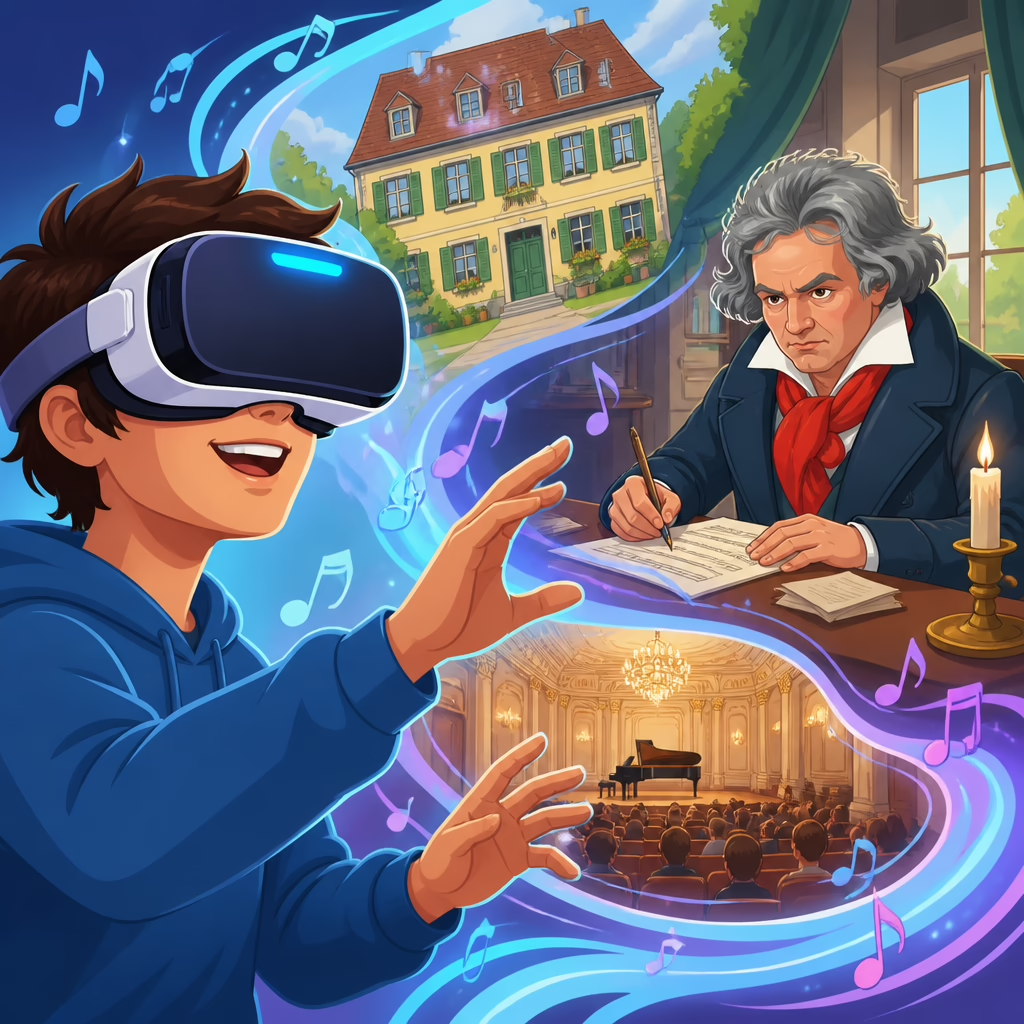
Virtual Reality Tours for Beethoven Fans
Virtual reality tours for Beethoven fans have moved from novelty to serious cultural tools, giving listeners a way to stand inside the composer’s world instead of only reading about it. In practical terms, a virtual reality tour is an immersive digital environment viewed through a headset such as the Meta Quest 3, PlayStation VR2, or HTC Vive, often enhanced with spatial audio, hand tracking, and interactive objects. For Beethoven enthusiasts, that can mean walking through Bonn’s Bonngasse, exploring period rooms linked to the Heiligenstadt Testament, or sitting in a reconstructed Viennese salon while a late string quartet unfolds around them. I have tested museum-grade heritage experiences and music-focused VR applications, and the strongest projects share a simple goal: they turn historical context into something felt in the body, not just understood in the mind.
This matters because Beethoven appreciation depends heavily on setting, acoustics, and biography. Many fans know the broad outline: born in Bonn in 1770, career in Vienna, progressive hearing loss, radical expansion of symphonic and chamber form. What often gets lost is scale. A score note about an early apartment, a damaged manuscript, or a theater commission can feel abstract on a page. In VR, those details gain proportion and emotional weight. You can judge the size of a room, the distance between keyboard and audience, or the intimacy of a domestic performance space. That spatial understanding helps explain why certain works landed as they did and why Beethoven’s creative decisions were shaped by material realities, including instruments, patronage, urban geography, and his changing hearing.
For fans deciding whether virtual reality tours are worth the time and cost, the answer is yes when the experience is built on credible scholarship and strong audio design. A weak tour is little more than a floating slideshow. A strong one uses documented architecture, museum collections, performance-practice insight, and responsive sound to answer concrete questions. Where did Beethoven live and work? What did audiences hear in his era? How did the rooms, streets, and instruments around him shape the music? The best experiences address those questions directly while remaining enjoyable for newcomers and rewarding for experienced listeners. That balance makes VR especially valuable for a niche audience like Beethoven fans, who often want both emotional immersion and factual precision.
Another reason these tours matter is access. Most Beethoven devotees will never spend weeks in Bonn and Vienna moving between archives, memorial houses, concert halls, and libraries. Even for those who can travel, preservation rules limit touching objects, approaching manuscripts, or hearing period instruments in original locations. VR cannot replace the aura of the real site, but it can broaden access dramatically. A student in Toronto, a retiree in São Paulo, and a chamber musician in Seoul can all enter the same guided experience and compare impressions in real time. For educators, that opens new possibilities for music history teaching. For independent fans, it makes specialized cultural interpretation available without airfare, timed-entry tickets, or language barriers.
What Beethoven fans should look for in a virtual reality tour
The first criterion is historical fidelity. Not every attractive digital reconstruction deserves trust. The best Beethoven-centered VR tours state their sources, distinguish documented facts from inferred details, and collaborate with recognized institutions such as the Beethoven-Haus Bonn, the Wien Museum, or performance-practice specialists. If a room reconstruction includes furnishings, wall colors, or instrument models, the tour should explain whether those elements come from inventories, surviving objects, iconography, or comparative research. In my experience, fans notice weak scholarship quickly. An anachronistic piano, incorrect street layout, or generic nineteenth-century décor can undermine the entire experience.
The second criterion is sound. Beethoven is not a painting-only subject; audio determines whether the environment feels persuasive. High-quality tours use binaural or ambisonic recording, dynamic range that respects classical repertoire, and location-aware playback so music changes as the visitor moves. Imagine hearing the opening of the “Eroica” in a reconstructed hall and noticing how brass resonance accumulates differently from what you hear on headphones. That is not a gimmick. It teaches acoustic context. Strong projects may also include comparisons between modern concert grands and fortepianos, or spoken commentary explaining why articulation, sustain, and balance differ.
Usability matters just as much. A Beethoven fan may be sixty-five, highly knowledgeable, and completely new to VR controls. Good tour design uses clear locomotion options, seated and standing modes, subtitles, comfort settings to reduce motion sickness, and straightforward navigation. Museums increasingly understand this. The benchmark is not gaming complexity; it is interpretive clarity. If users spend ten minutes figuring out how to pick up a facsimile manuscript, the educational value collapses. The best interfaces keep attention on the content: place, music, objects, and ideas.
The most compelling Beethoven locations to explore in VR
For Beethoven fans, location choice determines whether a tour feels essential or merely decorative. Bonn is the natural starting point. A virtual tour of Beethoven’s birthplace area can map his early environment: the modest scale of domestic rooms, the civic texture of the Electoral city, and the institutional world that shaped his youth. When users can move from street to interior and hear excerpts from early works or contemporaneous repertoire, they understand Bonn not as a footnote but as a formative soundscape. The strongest reconstructions also show how much of the city was altered by later history, making VR uniquely useful for recovering vanished context.
Vienna is even richer. Here, an effective VR tour should avoid presenting “Beethoven’s Vienna” as one generic old city. His career intersected with apartments, patrons’ homes, theaters, churches, taverns, publishing networks, and medical spaces. A focused experience might reconstruct a salon setting for chamber music, then contrast it with a larger hall associated with a public premiere. That shift clarifies social function. Chamber works lived in intimate rooms where listeners were near the performers; symphonic works addressed broader publics and more complex acoustics. A fan who experiences both spaces in sequence will hear familiar recordings differently afterward.
The Heiligenstadt setting deserves special treatment because biography and place converge there. Many listeners know the 1802 document now called the Heiligenstadt Testament, in which Beethoven confronted despair over worsening hearing loss. In VR, this location can become more than a memorial stop. A path through the village outskirts, combined with carefully staged readings and environmental sound, can help users grasp the contrast between pastoral surroundings and inner crisis. This works best when handled soberly. The goal is not melodrama; it is interpretive depth grounded in text, geography, and chronology.
| Location | Why it matters for fans | Best VR features |
|---|---|---|
| Bonn birthplace district | Shows Beethoven’s early domestic and civic environment | Street reconstruction, object close-ups, youth repertoire excerpts |
| Viennese salon | Explains chamber music culture and patronage | Interactive seating, period instrument audio, host commentary |
| Concert hall or theater | Places major premieres in acoustic and social context | Spatial orchestra sound, audience scale, conductor viewpoint |
| Heiligenstadt | Connects hearing loss, landscape, and personal documents | Guided narration, ambient soundscape, manuscript overlays |
How immersion changes the way fans hear Beethoven
The deepest value of virtual reality tours is that they reframe listening. Most Beethoven fans first encounter the music through recordings, then add books, liner notes, and live performance. VR introduces a third layer: embodied context. When you stand beside a fortepiano model and hear its quicker decay, lighter action, and more transparent middle register, orchestration choices that once seemed purely abstract become practical. Thick left-hand writing, wind doubling, or sudden dynamic contrasts start to look like responses to specific instruments and rooms. This does not solve every interpretive question, but it sharpens them in useful ways.
Spatial audio is the decisive feature. In a standard stereo recording, instrumental placement is interpreted for you by engineers. In VR, especially with head-tracked audio, you orient yourself. Turn toward a string section, step back from a keyboard, or face a wall, and the sound image changes. That simple shift trains attention. Fans begin noticing directional cues, resonance buildup, and the relationship between performer position and musical clarity. I have seen knowledgeable listeners come out of a well-made reconstruction of an early nineteenth-century room saying they finally understood why certain textures speak so strongly at close range but blur in larger modern halls.
Immersion also improves memory. Cognitive research on place-based learning consistently shows that spatialized information can be easier to retain than isolated facts. For Beethoven fans, that means a timeline attached to rooms, objects, and audible examples is more likely to stick. Instead of memorizing that a work belongs to a period of personal upheaval, the visitor recalls hearing its motif while standing in a reconstructed environment linked to letters, patrons, or illness. That association is powerful for students and lifelong amateurs alike. If you already enjoy analytical tools, the next step is pairing immersive context with score study, and this guide on how AI tools can help analyze Beethoven scores complements that process well.
Choosing platforms, formats, and tour styles
Not every Beethoven-themed virtual experience requires the same hardware. Standalone headsets such as Meta Quest devices offer the easiest entry point because they need no external sensors or gaming computer. For museum visitors and casual fans, that convenience usually outweighs the slight graphical limits. PC-tethered systems like Valve Index or HTC Vive Pro can deliver sharper textures, wider tracking volume, and better performance for complex reconstructions, which matters if a tour includes detailed manuscript scans or multiroom environments. Mobile phone viewers remain the least convincing option. They can present 360-degree video, but they rarely support the interactive depth that makes cultural VR worthwhile.
Format is just as important as platform. There are three main styles Beethoven fans will encounter. First, guided linear tours resemble expert-led museum visits, with narration controlling pace and focus. These work well for first exposure. Second, explorable reconstructions let users move freely, open information layers, and compare objects or recordings. That style suits experienced fans who want autonomy. Third, performance-centered experiences place the user inside a rehearsal, salon, or concert. Those can be transformative when audio is excellent, though they sometimes sacrifice historical explanation for dramatic effect. Ideally, a strong project blends all three.
Before purchasing or booking, check for practical details: session length, subtitle support, seated mode, controller complexity, language options, and whether the experience uses original scholarship or generic art assets. Also look for partnerships. When a conservatory, archive, or recognized museum is involved, quality tends to improve because factual review is built into development. Price alone is not a reliable indicator. I have seen expensive productions with stunning visuals but shallow content, and modest educational tours that deliver far more insight because every room, citation, and sound cue serves a clear interpretive purpose.
Limits, tradeoffs, and what VR cannot replace
Virtual reality tours for Beethoven fans are powerful, but they are not substitutes for everything. They cannot reproduce the exact aura of standing before an original manuscript, feeling the social energy of a live quartet performance, or hearing a period instrument in a resonant physical room. Haptic feedback remains limited, headset comfort varies, and some users experience eye fatigue or motion sensitivity after twenty to thirty minutes. Developers can reduce these problems with teleport locomotion, high frame rates, and ergonomic interface design, but they cannot eliminate them completely.
There is also a scholarly tradeoff between certainty and completeness. Beethoven’s world cannot always be reconstructed down to every wallpaper pattern or street sound with documentary confidence. Responsible tours acknowledge gaps. They may mark some visuals as hypothetical, provide alternate scholarly interpretations, or explain where evidence is fragmentary. That transparency is a strength, not a weakness. Fans should prefer a project that says “based on comparative sources” over one that pretends total certainty. Historical honesty preserves trust and encourages deeper engagement with the underlying evidence.
The best way to use VR, then, is as part of a broader Beethoven practice. Pair it with recordings on both modern and period instruments, reliable biographies, score reading, and if possible visits to actual archives, museums, or performances. Used that way, immersive tours become unusually effective bridges between scholarship and emotion. They let fans move through spaces, hear context, and test assumptions in ways books alone cannot. If you care about Beethoven not just as a name in music history but as a working artist shaped by places, people, and sound, a well-made virtual reality tour is worth seeking out next.
Frequently Asked Questions
What is a virtual reality tour for Beethoven fans, and how is it different from a standard museum website or video?
A virtual reality tour for Beethoven fans is an immersive digital experience that places you inside historically inspired spaces connected to Ludwig van Beethoven’s life, music, and cultural world. Instead of looking at flat images on a website or watching a documentary from a distance, you explore environments as if you were physically present. With a headset such as the Meta Quest 3, PlayStation VR2, or HTC Vive, you can look around naturally, move through rooms, examine objects up close, and often interact with exhibits using hand tracking or motion controllers.
What makes VR especially compelling for Beethoven enthusiasts is the sense of scale, presence, and atmosphere. You are not simply reading that Beethoven lived in Bonn or worked in Vienna; you may be able to stand in a recreated Bonngasse street scene, step into a period interior, inspect manuscripts on a virtual desk, or hear excerpts of symphonies and sonatas positioned spatially around you. That combination of visual context and spatial audio can make Beethoven’s world feel more immediate and emotionally accessible.
Unlike a conventional museum website, which usually organizes information into pages, captions, and images, a VR tour can present history in a more embodied way. You might open a drawer to reveal letters, select an instrument to trigger commentary, or compare performance spaces to understand how sound and architecture influenced listening in Beethoven’s era. In that sense, VR is not just a delivery format for facts; it is a cultural interpretation tool that can deepen engagement, memory, and curiosity.
What kinds of places and experiences can Beethoven fans expect to explore in a VR tour?
The exact content depends on the platform or producer, but many virtual reality tours for Beethoven fans focus on locations and themes that shaped the composer’s life and legacy. Common examples include Beethoven’s birthplace in Bonn, reconstructions of streets such as Bonngasse, Viennese residences, salons, concert settings, and museum galleries displaying instruments, documents, portraits, and personal artifacts. Some experiences also include historically styled rehearsal rooms or immersive visualizations inspired by major works such as the “Eroica,” the Fifth Symphony, the “Pastoral,” or the Ninth.
Beyond architecture and artifacts, the strongest VR experiences usually layer in interpretation. That may include narrated historical commentary, close-up views of manuscript pages, interactive timelines, 3D instrument models, and contextual explanations about patronage, deafness, performance practice, and Beethoven’s evolving compositional style. In more advanced tours, users can trigger specific audio moments, compare arrangements, or hear how a room’s acoustics might affect a string quartet versus a piano sonata.
Some experiences are designed for faithful historical reconstruction, while others are more interpretive or artistic. A historically grounded tour may focus on museum accuracy and education, helping visitors understand where Beethoven lived, worked, and premiered music. A more imaginative version may translate musical ideas into visual environments, allowing fans to move through a scene shaped by rhythm, harmony, and orchestral color. Both approaches can be valuable: one enriches historical understanding, and the other opens a more emotional, sensory pathway into Beethoven’s music.
Do virtual reality tours actually help people understand Beethoven better, or are they mainly entertainment?
When they are thoughtfully designed, virtual reality tours can absolutely improve understanding of Beethoven, and not just serve as entertainment. The educational value comes from immersion, context, and interaction. Many people know Beethoven through isolated pieces or broad biographical summaries, but VR can connect the music to physical environments, social history, and lived experience. Seeing the scale of a room, the layout of a street, or the details of period objects helps transform abstract information into something concrete and memorable.
For example, learning about Beethoven’s hearing loss in a textbook is one thing; encountering a curated VR segment that combines narration, visual context, and altered sound design to convey changing auditory perception can create a deeper emotional and intellectual impression. Similarly, standing in a reconstructed salon or concert venue while hearing spatial audio can clarify how audiences of the time may have experienced chamber music or symphonic performance. These are interpretive advantages that standard articles and static exhibits often struggle to provide on their own.
That said, educational quality depends on the source. The best VR tours are developed with input from musicologists, historians, curators, archivists, and audio specialists. They distinguish clearly between documented history and creative reconstruction, cite locations and artifacts responsibly, and avoid reducing Beethoven to a handful of myths. For users, the most useful approach is to treat VR as a powerful complement to books, recordings, museum collections, and scholarly resources. It can make Beethoven more vivid and approachable while still encouraging deeper study beyond the headset.
What equipment do I need to take a virtual reality tour focused on Beethoven, and is it difficult to get started?
Most VR tours require a compatible headset, and the specific hardware depends on how the experience was developed. Standalone headsets such as the Meta Quest 3 are often the easiest starting point because they do not require a gaming PC and tend to have relatively simple setup. Other experiences may run on systems such as PlayStation VR2, which needs a PlayStation 5, or on PC-based hardware like the HTC Vive, which may offer strong visual performance but involves more technical configuration.
In addition to the headset, you will typically need enough physical space to move safely, stable software installation, and headphones or integrated audio capable of presenting spatial sound clearly. Internet access may be necessary for downloading the experience or accessing online features, though many tours can be enjoyed once installed. Some museum or cultural institution experiences also appear in curated venues, meaning you can try them on-site without owning personal VR hardware.
Getting started is usually easier than many first-time users expect. Most well-designed VR applications guide you through calibration, controls, and comfort settings with short tutorials. If you are new to VR, it helps to begin with seated or low-movement experiences and to take breaks if you feel eye strain or motion discomfort. Beethoven fans who care most about historical interpretation should also review the tour description before downloading, since some apps emphasize education and museum-style exploration while others lean more toward dramatic storytelling or music visualization.
How can I choose the best virtual reality tour for Beethoven fans?
The best virtual reality tour for you depends on what kind of Beethoven experience you want most: historical accuracy, musical immersion, interactivity, or accessibility. Start by looking at the creator behind the project. Experiences produced by museums, archives, cultural foundations, universities, or respected heritage organizations are more likely to provide reliable context and stronger curatorial standards. If the listing mentions historians, musicologists, or partnerships with institutions in Bonn or Vienna, that is usually a positive sign.
Next, evaluate the features. If you want to feel grounded in Beethoven’s real environment, look for tours that include reconstructed locations, artifact-based storytelling, period detail, and clear historical narration. If you are more interested in the emotional force of the music, seek out experiences emphasizing spatial audio, orchestral immersion, interactive listening, or visual interpretation of major works. Reviews can also reveal whether the experience feels polished, informative, and comfortable to use, or whether it is too limited, too short, or overly game-like for serious cultural exploration.
It is also wise to check practical considerations such as headset compatibility, language options, session length, accessibility settings, and whether the program supports seated play. A strong Beethoven VR tour should do more than impress visually; it should give you reasons to linger, listen closely, and connect what you see with what you hear. The most rewarding experiences are those that combine technology with scholarship, allowing fans to move beyond novelty and into a richer encounter with Beethoven’s life, places, and music.