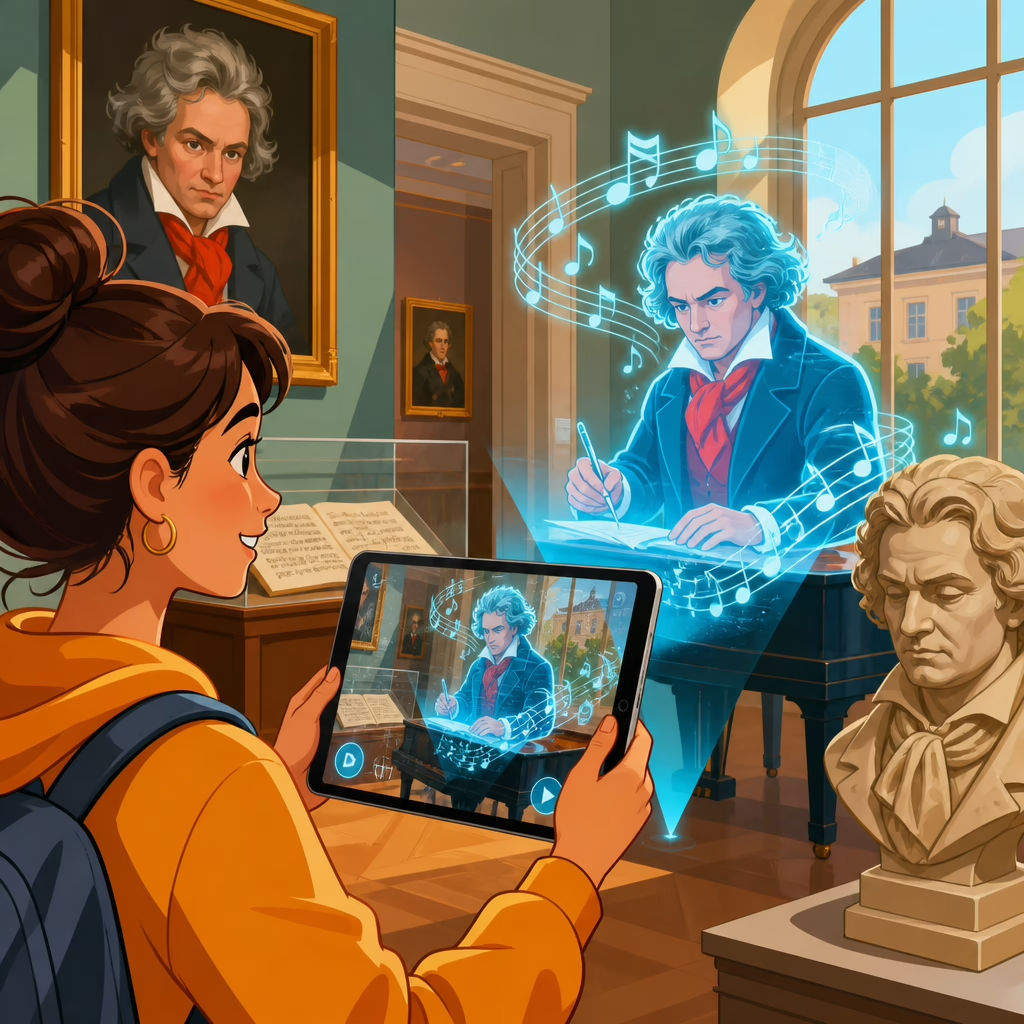
Augmented Reality and Beethoven Museum Experiences
Augmented reality is reshaping Beethoven museum experiences by layering digital interpretation onto physical galleries, manuscripts, instruments, and historic rooms without replacing the authenticity that visitors travel to see. In this context, augmented reality, or AR, means software that places text, animation, sound, three-dimensional models, or interactive prompts onto a live view of the museum through a phone, tablet, headset, or projection system. For Beethoven-focused institutions, that matters because the composer’s legacy is unusually dependent on artifacts that need explanation: corrected score pages, ear trumpets, conversation books, pianos built to different standards, and urban locations tied to Vienna, Bonn, and Heiligenstadt. I have worked on digital interpretation planning for music collections, and the recurring problem is clear. Visitors are moved by Beethoven’s reputation, yet many struggle to read autograph notation, understand instrument mechanics, or connect a silent display case to a vivid creative process. AR solves part of that gap by turning observation into guided discovery. It can show how a fortepiano action works, reveal revisions in a manuscript layer by layer, or place a visitor inside the changing acoustic world Beethoven knew. Done well, AR improves learning, accessibility, dwell time, and emotional engagement. Done poorly, it creates distraction, congestion, maintenance costs, and a gimmicky layer that dates quickly. The most successful Beethoven museum experiences use AR to answer a practical question: what can digital interpretation reveal here that labels, audio guides, and glass cases cannot explain as effectively?
Why AR fits Beethoven museums better than many other historical subjects
Beethoven museums are especially suited to AR because so much of the story involves transformation over time rather than static viewing. A manuscript page is not just a relic; it is evidence of compositional decision-making. A lock of hair, hearing device, or metronome is not meaningful on sight alone. Even a room associated with the composer becomes more powerful when visitors can see period furnishing reconstructions, route maps, performance practices, and social context aligned to the exact space before them. AR excels when objects need interpretation in place. That is precisely the condition of most Beethoven collections.
Consider the challenge of explaining Beethoven’s hearing loss. Traditional labels can summarize medical theories and biographical consequences, but AR can do more responsibly and concretely. A visitor can point a device at a conversation book and see translated excerpts, handwriting identification, and a timeline explaining why companions wrote replies while Beethoven answered verbally. A hearing simulation can demonstrate why simplistic “muffled sound” effects are misleading, replacing them with a more nuanced model that reflects frequency loss, tinnitus references, and the uncertainty historians must acknowledge. That balance between immersion and caution is vital. Museums should not claim certainty where scholarship remains debated.
AR also fits music museums because sound is central, yet many galleries must remain quiet, controlled, and object-safe. Personal devices or directional audio can let visitors hear excerpts associated with a displayed score or instrument without flooding the room with competing playback. In one planning exercise I worked through for a composer collection, the strongest digital moments were not the loudest or most cinematic. They were the moments when a visitor could compare a passage played on a modern concert grand and on an early nineteenth-century fortepiano while standing inches from the actual instrument type under discussion. That kind of situated comparison turns abstract knowledge into durable understanding. Readers interested in the wider intersection of Beethoven scholarship and digital analysis can also explore the main guide at https://lvbeethoven.com/how-ai-tools-can-help-analyze-beethoven-scores/.
What visitors actually gain from augmented reality in a Beethoven exhibition
The best AR experiences deliver four concrete benefits: orientation, interpretation, interaction, and memory. Orientation means helping visitors understand where they are in Beethoven’s life or output. A room can instantly display a timeline anchored to that site, whether the focus is Bonn childhood, Viennese career building, the Eroica period, the late quartets, or the Ninth Symphony. Interpretation means answering object-level questions immediately. Why are there so many corrections on this score page? Why did this piano design matter? Why does this letter mention patrons, publishers, and deadlines so urgently? AR can label details directly on the viewed object, avoiding the constant back-and-forth between case and wall text.
Interaction is where engagement becomes measurable. Visitors can rotate a scanned instrument, trigger comparison clips, zoom into manuscript layers, or follow the route of a premiere through the city. These are not novelty features when they support a learning goal. Museums routinely track dwell time, completion rates, and repeat interactions, and interactive interpretation tends to increase all three when the interface is simple. Memory is the final gain. People remember what they discovered, not just what they glanced at. A visitor who overlays an orchestral seating plan onto a Beethoven premiere scene or peels back revisions in the opening of the Fifth Symphony leaves with a specific mental image linked to a specific concept.
AR can also improve accessibility when planned from the beginning. Multilingual captioning, adjustable text size, sign-language overlays, descriptive audio, and transcript-linked listening are more flexible in AR than on fixed labels. For school groups, AR creates entry points for students who may not read music but can still grasp pattern, revision, contrast, and historical context through animation and guided prompts. For expert visitors, deeper layers can be optional rather than overwhelming casual audiences. The principle is simple: one object, multiple interpretive depths, delivered on demand.
Design principles that make AR credible inside a Beethoven museum
Credible AR starts with curatorial purpose, not technology procurement. The first question should be which Beethoven-related problems need visual or spatial explanation. If the answer is weak, AR should not be used. In practice, the strongest use cases are manuscript decoding, instrument mechanics, room reconstruction, performance context, and city mapping. The weakest are generic selfie filters, floating mascots, or dramatic effects that have no interpretive value. Beethoven institutions trade on seriousness, and visitors notice quickly when digital content feels ornamental rather than informative.
Accuracy depends on source control. Every 3D reconstruction, translation, and animation should be tied to catalog records, edition references, conservation imaging, or established scholarship. If a room is partially hypothetical, the interface should distinguish documented elements from informed reconstruction. If a sound example uses a modern edition or instrument substitute, that should be disclosed. Trust grows when museums show the difference between evidence and interpretation. This is particularly important with Beethoven because myths have accumulated around his personality, deafness, and heroic image for two centuries.
Usability matters just as much as scholarship. In gallery testing, visitors rarely tolerate more than a few seconds of setup friction. Marker recognition must be quick, screens readable in mixed light, and pathways obvious for first-time users. Device sanitation, charging, Wi-Fi resilience, and fallback modes are not glamorous topics, but they determine whether the experience works on a busy Saturday afternoon. Museums that deploy AR successfully usually limit each interaction to one clear task: reveal revisions, compare sounds, reconstruct a room, or explain an object. Stacking too many features into one screen confuses users and slows traffic around cases.
| AR use case | Best Beethoven application | Main visitor benefit | Primary risk |
|---|---|---|---|
| Manuscript overlay | Showing revisions, erased passages, and final readings on autograph pages | Makes compositional process visible | Overloading users with editorial detail |
| Instrument visualization | Animating fortepiano action, pedal systems, or string layout | Explains sound-world differences clearly | Inaccurate reconstruction of historical mechanics |
| Room reconstruction | Rebuilding lost interiors tied to Beethoven residences or premieres | Strengthens historical immersion | Presenting speculation as fact |
| Geo-located city layer | Mapping Beethoven’s movements through Vienna or Bonn | Connects biography to urban space | Weak indoor positioning or user distraction |
| Listening comparison | Contrasting period and modern performances at an object display | Links seeing to hearing | Audio leakage or rights limitations |
Practical examples: manuscripts, instruments, hearing history, and performance spaces
Manuscripts are often the strongest starting point because Beethoven’s working pages are visually dramatic yet difficult for non-specialists to decode. AR can highlight insertions, cross-outs, rewritten rhythms, and altered dynamics in sequence, effectively narrating the emergence of a phrase. Imagine a visitor viewing a sketch leaf and seeing colored overlays identify motive fragments that later become part of a finished movement. This approach teaches not only biographical reverence but composition itself: ideas are tested, compressed, reordered, and refined. That insight is powerful for students, performers, and general audiences alike.
Instruments provide another ideal application. Many visitors cannot tell why an 1800s fortepiano differs fundamentally from a modern piano beyond appearance. AR can animate the lighter action, shallower key dip, leather-covered hammers, smaller frame, and distinct sustaining behavior. Pair that with short, synchronized recordings of the same passage on both instruments, and a long paragraph of wall text becomes instantly intelligible. The point is not to declare one superior, but to explain why articulation, pedaling, balance, and dynamic expectation differ across instrument types.
Beethoven’s hearing history requires special care. Museums should avoid simplistic simulations that reduce a complex and still debated condition to a single muffled soundtrack. Better practice is comparative interpretation: excerpts from letters, documented symptoms, period medical context, and clear limits on what cannot be reconstructed. AR can visualize frequencies, tinnitus descriptions, and communication strategies while reinforcing that inner hearing and compositional imagination persisted even as social and practical challenges intensified. This approach respects both disability history and historical uncertainty.
Performance spaces are equally compelling. If a museum has links to halls, salons, or churches associated with Beethoven, AR can rebuild seating, ensemble layout, candlelight levels, or audience proximity. Visitors quickly understand that hearing a symphony in an early nineteenth-century venue was not the same experience as hearing it in a modern hall. Spatial interpretation clarifies orchestral size, room resonance, and social atmosphere in ways that labels alone rarely achieve.
Challenges museums must solve before launching an AR experience
The largest obstacle is not software; it is operational reality. AR content requires rights clearance for images, recordings, and translations, plus conservation approval for scanning workflows around fragile objects. Hardware choices create long-term commitments. Bring-your-own-device models reduce equipment cost but widen compatibility problems and exclude some visitors. Museum-owned tablets improve consistency but demand staffing, cleaning, charging, replacement planning, and robust mobile-device management. Headsets can be compelling, yet they often slow throughput and raise accessibility concerns.
Content maintenance is another underestimated issue. Scholarship changes, operating systems update, links break, and user expectations rise. A Beethoven exhibition cannot freeze a digital layer for five years and expect it to remain persuasive. The most resilient projects use modular content management so curators can revise translations, swap media, and update references without rebuilding the entire application. Analytics should guide those revisions. If visitors abandon a manuscript interaction after twenty seconds, the museum needs to know whether the problem is interface complexity, reading level, or physical congestion around the case.
There is also a philosophical constraint. Museums exist to preserve and interpret material culture, not to replace it with screens. Every AR feature should direct attention back to the authentic object, room, or site. When I evaluate these projects, the best test is simple: does the technology send the visitor looking more carefully at the original artifact afterward? If not, the balance is wrong. Beethoven museums gain the most when AR acts like a magnifying lens for historical evidence, not a competing attraction.
The future of augmented reality and Beethoven museum experiences
The future of augmented reality and Beethoven museum experiences will belong to institutions that treat digital interpretation as scholarship in public, not entertainment pasted onto heritage. AR works best when it clarifies difficult objects, reveals hidden process, and gives visitors just enough structure to notice what experts see. In Beethoven settings, that means visualizing revision, instrument design, hearing history, performance context, and urban geography with honesty about uncertainty. It also means building for accessibility, maintenance, and real gallery behavior, not just launch-day excitement.
The central benefit is precision. A label can tell visitors that Beethoven revised obsessively or composed under changing auditory conditions. AR can show exactly how, where, and why those realities appear in a page, an object, or a room. That is the difference between information and understanding. For museum leaders, the takeaway is practical: start with interpretive goals, select narrow use cases, verify every claim, and test with actual visitors before scaling. For visitors, the result is a more vivid encounter with Beethoven that deepens attention rather than diverting it. If you are planning or evaluating a Beethoven exhibition, use AR only where it reveals something the naked eye and standard label cannot. That discipline is what turns technology into lasting museum value.
Frequently Asked Questions
How does augmented reality improve the Beethoven museum experience without taking attention away from the original artifacts?
Augmented reality improves a Beethoven museum visit by adding interpretation directly around the real objects visitors came to see rather than replacing those objects with a fully digital experience. In practice, AR can place readable captions, visual reconstructions, musical excerpts, animated timelines, or three-dimensional overlays onto manuscripts, period instruments, furniture, portraiture, and historic interiors. That means a visitor can stand in front of an authentic score or piano and immediately understand what they are looking at, why it matters, and how it connects to Beethoven’s life and work.
This matters especially in Beethoven-focused institutions because many objects are visually significant but not always instantly legible to the general public. A handwritten manuscript may appear beautiful but difficult to decode. With AR, the museum can highlight revisions, show translated notes, explain compositional changes, or even let visitors hear a passage while seeing where Beethoven altered it. The original artifact remains the centerpiece, but the digital layer gives it context that would otherwise require long labels, separate audio guides, or specialist knowledge.
When used well, AR supports authenticity instead of competing with it. Visitors still encounter the real room, the real instrument, the real historical atmosphere, and the real material evidence of Beethoven’s world. The technology simply reduces interpretive distance. It helps people understand what is in front of them at the exact moment they are looking at it, making the experience more immediate, memorable, and meaningful.
What kinds of augmented reality features are most effective in museums dedicated to Beethoven?
The most effective AR features in a Beethoven museum are the ones that clarify music, biography, and historical setting in ways that conventional display methods cannot do as vividly. One of the strongest uses is manuscript interpretation. AR can overlay clean notation onto handwritten pages, spotlight revisions, explain erased passages, and connect a score fragment to the finished composition visitors may already know. This is especially valuable because Beethoven’s working process was complex, layered, and full of revision, and AR can make that process visible in an intuitive way.
Another highly effective feature is instrument visualization. A visitor looking at a fortepiano, string instrument, or hearing device can use AR to see how it was played, how it was built, how it sounded compared with a modern counterpart, and how it fit into Beethoven’s evolving musical world. Similarly, room-based AR can reconstruct how a historic studio, salon, or domestic space may have looked or functioned during Beethoven’s lifetime, helping visitors imagine social and artistic life beyond what survives physically.
Audio-linked AR also works particularly well in this context. Because Beethoven’s legacy is inseparable from sound, museums can trigger short excerpts, thematic demonstrations, or layered listening guides as visitors view related objects. For example, a visitor might look at a score and hear the corresponding phrase, then hear it isolated by instrument, then hear it in full orchestral context. Combined with biographies, maps, timelines, and accessible multilingual interpretation, these features turn static displays into richer educational encounters without overwhelming the physical museum environment.
Can augmented reality help visitors understand Beethoven’s music and personal history more clearly?
Yes, and that is one of its greatest strengths. Beethoven’s importance rests not only on artifacts connected to his life but also on music, creative process, historical context, and personal struggle. Those subjects can be difficult to communicate through wall text alone. AR helps museums connect objects to stories in a direct and engaging way. A letter, sketchbook, or instrument becomes easier to understand when visitors can see an overlay identifying key details, hear a narrated explanation, or watch a visual sequence showing how that object relates to a composition, friendship, performance, or turning point in Beethoven’s life.
It is especially helpful in explaining complex topics such as Beethoven’s deafness, his compositional revision process, and the political and cultural climate of his time. AR can map timelines onto galleries, compare different stages of a composition, or show how a musical idea developed from notebook fragment to concert work. Instead of asking visitors to imagine abstract connections, the museum can make those relationships visible on the spot. This leads to stronger comprehension for both casual visitors and serious enthusiasts.
AR can also make Beethoven’s world feel more human. It can reveal where he lived, who influenced him, how Vienna’s musical culture shaped him, and how his later life differed from his earlier years. In doing so, it helps visitors move beyond the image of Beethoven as a distant genius and see him as an artist working through material realities, social networks, creative ambition, and physical limitations. That combination of emotional access and historical clarity is a major reason AR has become so valuable in museum interpretation.
Is augmented reality in Beethoven museums useful for families, students, and first-time visitors?
Absolutely. One of the biggest advantages of AR is that it can serve multiple audiences at once without forcing every visitor into the same interpretive path. Families often benefit from interactive prompts, scavenger-style discovery, short visual animations, and age-appropriate explanations that help children stay engaged in galleries that might otherwise feel formal or text-heavy. Students can use AR to explore music history, listening skills, notation, instrument development, and European cultural history in a more active way than traditional labels allow.
For first-time visitors, AR lowers barriers to understanding. Many people arrive with limited background in classical music, manuscript studies, or eighteenth- and nineteenth-century history. AR can translate specialist material into accessible language, define unfamiliar terms, and allow visitors to choose the depth of interpretation they want. Someone who wants a quick overview can receive concise guidance, while a more advanced visitor can open deeper layers about composition, reception history, or conservation details.
This flexibility makes the museum more inclusive and welcoming. It supports different learning styles, reading levels, languages, and attention spans. It can also improve accessibility by offering visual enlargement, synchronized audio, captioning, and alternative formats that help a broader public connect with the collection. In a Beethoven museum, where the subject combines music, biography, and historical material culture, that ability to personalize interpretation is especially valuable.
What should museums consider when implementing augmented reality in a Beethoven exhibition?
Museums should begin with interpretation, not technology. The most successful AR experiences are designed around clear educational goals: helping visitors understand a manuscript, hear a musical structure, visualize a lost historical setting, or connect an object to Beethoven’s life and legacy. If the digital layer does not serve a meaningful purpose, it can feel distracting or unnecessary. For a Beethoven exhibition, every AR element should deepen appreciation for the authentic material on display and reinforce the museum’s curatorial narrative.
Usability is equally important. The interface should be intuitive, fast, and reliable, whether it is delivered through a phone, tablet, headset, or projection system. Visitors should not have to struggle with downloads, calibration, or complicated instructions in the middle of a gallery. Museums also need to think carefully about sound management, screen glare, crowd flow, battery life, multilingual support, and accessibility features. Because Beethoven museums often attract international audiences, translation and universal design are especially important.
Finally, institutions should preserve a strong balance between immersion and restraint. The goal is not to turn every room into a spectacle. It is to provide moments of insight that feel natural within the historic environment. Thoughtful AR should respect conservation needs, visual atmosphere, and the emotional weight of authentic spaces. When implemented with curatorial discipline, historical accuracy, and visitor-centered design, augmented reality can become a powerful interpretive tool that strengthens, rather than dilutes, the Beethoven museum experience.