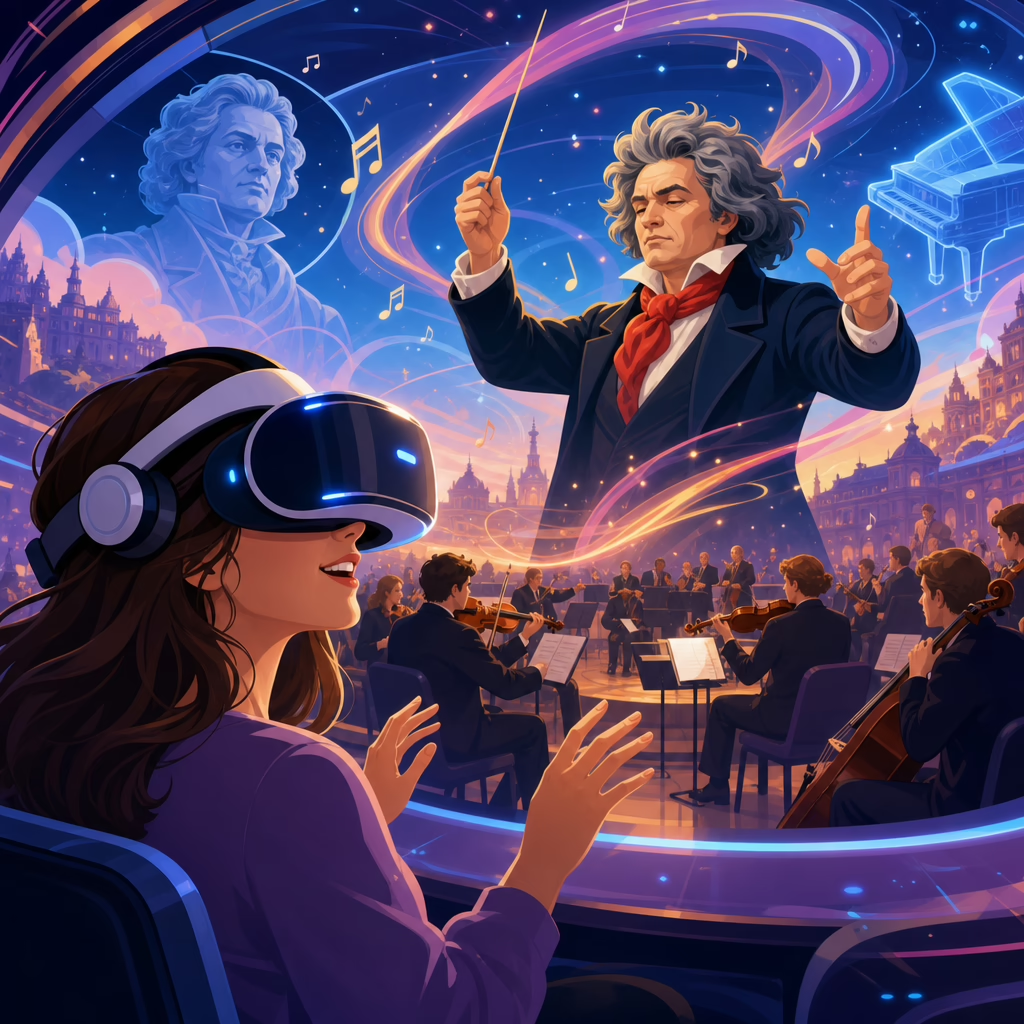
Virtual Reality and Beethoven: Immersive Concerts of the Future
Virtual reality and Beethoven belong together more naturally than many people expect. Beethoven expanded the physical and emotional scale of concert music, and virtual reality expands the space in which audiences can encounter it. When these two forces meet, immersive concerts of the future become more than a novelty. They become a practical way to experience a symphony from the conductor’s podium, a string quartet from inside the ensemble, or a historically informed reconstruction of an 1808 Vienna premiere. In my work evaluating digital music experiences, I have seen the difference between passive streaming and true presence: when the listener can look around, perceive depth, and respond to the environment, attention, memory, and emotional engagement all increase.
Virtual reality, or VR, refers to computer-generated or camera-captured environments viewed through a head-mounted display such as Meta Quest, Apple Vision Pro, HTC Vive, or PlayStation VR2. Immersive concerts use these systems to place a listener inside a performance rather than in front of a flat screen. That immersion may be built from volumetric video, 360-degree capture, game-engine environments, spatial audio, haptic feedback, or real-time avatars. For Beethoven, whose music depends heavily on dynamic contrast, architectural pacing, and the placement of instrumental forces, these tools matter. They can clarify musical structure for new listeners while giving expert audiences access to details impossible to perceive from a conventional seat.
This matters because classical music institutions face a real access problem. Major Beethoven performances are concentrated in urban venues, ticket prices can be high, and many listeners first encounter the repertoire through compressed audio on phones. At the same time, orchestras, archives, conservatories, and museums are investing in digital outreach. A strong hub on virtual reality and Beethoven helps connect those efforts: performance technology, music education, accessibility, acoustics, historical reconstruction, and audience development. The central question is simple. Can immersive concert design respect Beethoven’s musical integrity while using technology to deepen understanding? The answer is yes, but only when production choices serve the score rather than distract from it.
Why Beethoven works especially well in virtual reality
Beethoven’s music adapts unusually well to immersive concert formats because it is built around motion, tension, release, and spatial drama. Even listeners with no formal training can feel the propulsion of the Fifth Symphony, the choral expansion of the Ninth, or the intimate conversational texture of the late string quartets. In VR, those qualities become physically legible. A viewer can turn toward the horns as a motif passes, watch timpani cues align with harmonic stress, or stand near the first violins during a rising sequence and hear how articulation shapes momentum.
Unlike repertoire that depends mainly on surface color, Beethoven often reveals his logic through relationships across sections. Immersive design can expose those relationships. A well-produced VR concert might offer selectable viewpoints: audience center, principal oboe, conductor, or chorus. That flexibility helps beginners grasp orchestration and form without requiring prior expertise. It also supports scholars and serious amateurs who want to study bowing coordination, baton technique, seating layouts, and ensemble communication in a way standard broadcasts rarely permit.
There is also a historical reason Beethoven fits this medium. His career sits at the intersection of performance culture, instrument development, and changing public expectations. He wrote for salons, theaters, churches, and expanding civic concert life. VR can recreate those environments and demonstrate how venue size, reverberation time, and instrument design affect interpretation. A historically informed performance of the Eroica in a modeled early nineteenth-century hall tells a different story than a modern symphony orchestra in a large shoebox acoustic. Immersive media can present both and make the comparison immediate.
The technologies that power immersive Beethoven concerts
An effective virtual Beethoven concert depends on three technical pillars: visual capture or rendering, spatial audio, and interaction design. Visual systems generally use either 360-degree video, volumetric capture, or fully modeled real-time environments in engines such as Unreal Engine or Unity. A 360-degree video recording is the fastest route to production and can document a real orchestra with minimal visual abstraction. Its weakness is limited freedom of movement. Volumetric capture records performers as three-dimensional forms, allowing viewers to move around them, but it requires multiple synchronized cameras, complex processing, and substantial computing resources.
Spatial audio is even more important than visuals. Beethoven’s orchestral writing collapses if the sound field is reduced to flat stereo without care. Immersive productions therefore rely on ambisonics, binaural rendering, object-based mixing, or Dolby Atmos workflows adapted for head-tracked playback. In practice, the best results come from combining spot microphones with room capture so the listener hears both instrumental detail and hall response. When I assess these experiences, weak spatial audio is usually the first reason they fail. Listeners may forgive stylized visuals, but they immediately notice unnatural localization, dry strings, or a chorus that seems detached from the orchestra.
Interaction design determines whether the experience feels musical or gimmicky. Useful interactions include changing seats, highlighting instrument families, following the score, or accessing commentary before and after movements rather than during crucial passages. Poor interactions pull attention away from phrasing and structure. Beethoven’s music benefits from restraint. Designers should remember that immersion is not constant stimulation; often it is the ability to stay still inside a believable acoustic and visual space.
| Technology | Primary Use in Beethoven VR | Strength | Main Limitation |
|---|---|---|---|
| 360-degree video | Documenting live orchestra performances | Authentic view of real players and venue | Limited viewer movement |
| Volumetric capture | Walking around soloists, quartets, or conductors | True sense of depth and presence | High production cost |
| Game-engine environment | Historical reconstructions and interactive learning | Flexible, scalable, highly customizable | Can look artificial if underfunded |
| Spatial audio rendering | Reproducing orchestral placement and hall acoustics | Most critical factor for realism | Requires expert mixing and device optimization |
Recreating the concert hall, the premiere, and the archive
One of the most compelling uses of virtual reality and Beethoven is historical reconstruction. Instead of presenting only a modern concert, producers can rebuild lost or altered spaces and let audiences hear how context changes perception. Beethoven’s famous 1808 Akademie in Vienna, which included the Fifth and Sixth Symphonies, the Fourth Piano Concerto, and the Choral Fantasy, is a prime candidate. Contemporary reports describe a long program, cold conditions, uneven rehearsal standards, and practical chaos. A VR reconstruction could place the audience in the Theater an der Wien, restore period lighting, and simulate the sonic profile of the venue with period instruments. That would teach more in fifteen minutes than many textbook summaries.
Archive activation is another major opportunity. Libraries and museums hold sketches, letters, first editions, hearing devices, and instrument collections related to Beethoven, but these materials are often fragmented across institutions. In immersive form, those objects can be contextualized around the music itself. A user listening to the slow movement of the Seventh Symphony might enter a linked archival layer showing manuscript revisions, conductor annotations, and instrument diagrams. This turns the hub from a passive repository into an exploratory knowledge environment.
The strongest projects do not claim perfect certainty where evidence is incomplete. Historical acoustics modeling depends on assumptions about materials, occupancy, stage configuration, and tuning. Costume and lighting reconstructions involve interpretation. Trustworthy productions state these boundaries clearly. That transparency increases value. Users learn not only what historians believe, but also how musicologists, acousticians, and developers reach conclusions from partial evidence.
How immersive Beethoven can improve education and audience development
Virtual reality is not only for spectacle. It is one of the most promising educational tools in classical music because it can reduce intimidation while preserving complexity. Beethoven often enters public consciousness through a few famous motifs, yet full works can seem inaccessible to first-time listeners. In immersive environments, educators can guide attention without diluting the music. A student can hear the opening of the Fifth Symphony and visually track how the rhythm migrates across sections. In the Pastoral Symphony, they can compare instrumental color between woodwinds and strings while observing how thematic material paints scenes without literal sound effects.
For conservatories and schools, VR offers repeatable exposure to high-level performance practice. Not every student can sit near a top orchestra during rehearsal, observe a conductor’s left-hand shaping, or study ensemble breathing from the inside. A carefully produced Beethoven VR library can provide those perspectives at scale. It can also support accessibility. Users with mobility constraints, geographic limitations, or sensory processing preferences may find a headset-based concert more manageable than a crowded hall. Captions, adjustable camera positions, and guided modes make a meaningful difference.
Audience development benefits when institutions use immersive concerts as a bridge rather than a replacement. The best strategy I have seen pairs a headset experience with program notes, pre-concert talks, backstage content, and ticket offers for in-person events. A museum might host a VR introduction to the Ninth Symphony, then direct visitors to a live performance. An orchestra might release a short movement in VR to build familiarity before presenting the full work on stage. Used this way, immersive Beethoven expands the funnel without devaluing the hall.
The creative and practical limits of Beethoven in VR
Not every Beethoven work, venue, or audience goal suits virtual reality equally well. Late piano sonatas often demand inward concentration that can be weakened by excessive interactivity. Chamber music generally works better than massive symphonic repertoire when budgets are small, because fewer performers allow more precise capture and cleaner sound staging. Headset comfort still matters, especially for long forms. A complete Ninth Symphony in VR is technically possible, but many users will prefer movement-based chapters, intermissions, or companion mobile access.
There are also rights, workflow, and preservation issues. Beethoven’s compositions are public domain, but specific editions, recordings, performances, and visual assets may not be. Union rules, performer consent, and venue agreements must be handled carefully. File formats and platform dependencies create long-term risk. A project built only for one headset ecosystem can become obsolete quickly. For that reason, producers should retain high-resolution masters, documented metadata, and interoperable assets wherever possible.
Most importantly, immersive design should not mistake proximity for understanding. Standing virtually beside a principal cellist is exciting, but musical meaning still depends on phrasing, tempo relationships, harmonic direction, and cultural context. The future of virtual reality and Beethoven will be shaped by teams that combine developers with conductors, recording engineers, musicologists, educators, and accessibility specialists. When those disciplines work together, the result can be rigorous, moving, and commercially sustainable rather than a short-lived tech demo.
Virtual reality and Beethoven point toward a future in which concert culture becomes more accessible, more informative, and in some cases more emotionally direct. The central benefit is not novelty. It is perspective. Immersive concerts let audiences hear form through space, understand interpretation through proximity, and connect archival history with live performance. For a composer whose work continues to anchor orchestral seasons, music education, and public imagination, that is a meaningful expansion rather than a gimmick.
The strongest Beethoven VR projects share clear traits. They use spatial audio as the foundation, choose interactivity carefully, respect historical and musical context, and explain their methods honestly. They serve multiple audiences at once: newcomers seeking an inviting first encounter, students needing deeper access, scholars testing historical questions, and institutions looking to widen reach. This miscellaneous hub within Beethoven Technology and Science should connect all of those strands, because immersive concert design touches acoustics, pedagogy, preservation, interface design, and performance practice at the same time.
If you are building content around Beethoven technology, start here: map the repertoire, the venues, the production methods, and the user questions that matter most. Then explore the linked articles in this subtopic with a practical standard in mind. Ask whether each technology helps listeners hear Beethoven more clearly, learn more deeply, or attend more confidently. When the answer is yes, immersive concerts are not the future in theory. They are already taking shape now.
Frequently Asked Questions
How does virtual reality change the way people experience Beethoven’s music?
Virtual reality changes Beethoven from something audiences watch at a distance into something they inhabit. In a traditional concert hall, listeners experience the orchestra from a fixed seat, hearing the blended result of many performers working together. In VR, that perspective can shift dramatically. A listener can stand beside the conductor, sit among the first violins, move near the timpani, or even explore the acoustic space of the hall while the performance unfolds. That flexibility matters especially with Beethoven because his music is built on contrast, structure, tension, and release. Hearing how a motif passes from strings to winds, or how brass and percussion reshape the emotional weight of a climax, becomes much more immediate when the listener can perceive those relationships spatially.
VR also deepens the emotional side of Beethoven’s work. His symphonies, piano concertos, and chamber music often feel architectural in scale, but they are also intensely human. Immersive environments can reinforce both dimensions at once. A user might experience the opening of a Beethoven symphony in a visually restrained historical setting, then feel the environment subtly expand as the music grows in force. When done well, this does not replace the composition. It supports listening by helping audiences sense form, energy, and musical dialogue in a more embodied way. That makes VR especially promising not only for entertainment, but also for education, accessibility, and audience development.
Why is Beethoven such a strong match for immersive concert technology?
Beethoven is a particularly strong fit for immersive concert technology because his music already pushes beyond the idea of passive listening. He enlarged the expressive and physical scope of the concert experience long before digital media existed. His works often create a feeling of motion, confrontation, intimacy, and triumph that seems to demand space around the listener. Virtual reality answers that demand by giving modern audiences a way to encounter the music as an environment rather than as a distant event. In that sense, VR and Beethoven are aligned at a conceptual level: both expand the scale of how experience is organized.
There is also a practical reason. Beethoven’s catalog contains music that works at multiple levels of immersion. A string quartet can place the audience inside the ensemble, revealing the close conversational logic of chamber music. A piano sonata can let listeners experience the physicality of performance up close, including gesture, touch, and resonance. A symphony can position the user in front of the orchestra or within a reconstructed historic venue, showing how Beethoven’s larger forms unfold across musical forces. Because his music ranges from private introspection to public monumentality, it offers creators many different ways to design immersive experiences that feel meaningful rather than gimmicky.
Can virtual reality recreate a historical Beethoven concert in an authentic way?
Virtual reality can recreate a historical Beethoven concert in a highly compelling and educational way, but authenticity depends on how carefully the project is designed. A historically informed VR experience might reconstruct an early 19th-century venue, period instruments, candlelit staging, audience behavior, and performance practices based on surviving documents, scholarly research, and acoustic modeling. For example, a recreation of the famous 1808 Vienna concert associated with Beethoven could help modern audiences understand not just the music, but the social and physical conditions in which it was first heard. Users could witness the scale of the event, the arrangement of players, the architecture of the room, and even the practical limitations of the era, all of which shape perception.
That said, authenticity in VR is never just about visuals. It also involves tempo choices, ensemble size, articulation, tuning standards, reverberation, and the realism of listener perspective. A truly authoritative experience requires collaboration among musicologists, historians, performers, audio engineers, and VR designers. The goal should not be to create a fantasy version of the past, but to build a well-researched interpretive model of it. When handled responsibly, VR becomes an extraordinary bridge between scholarship and public engagement. It allows audiences to understand Beethoven’s world not as static museum history, but as a living performance context that can be explored from the inside.
What are the educational benefits of experiencing Beethoven in virtual reality?
The educational benefits are substantial because VR can make complex musical ideas easier to grasp without oversimplifying them. Beethoven’s music is often taught in terms of form, motif development, orchestration, and historical importance, but many listeners struggle to connect those concepts to what they actually hear in real time. Immersive concert technology can close that gap. A VR experience can show where themes originate, how they move through an ensemble, how instrumental colors interact, and how musical architecture unfolds across a movement. Instead of treating analysis as something separate from listening, VR can integrate the two in a way that feels intuitive and memorable.
It is also a powerful tool for broadening access. Students who may never visit a major concert hall can still experience a convincing orchestral environment. New listeners who feel intimidated by classical music can explore Beethoven from perspectives that make the music more immediate and less abstract. Teachers can use immersive performances to discuss history, acoustics, conducting, instrument families, and interpretation. For more advanced learners, VR can reveal performance decisions with unusual clarity, including bowing coordination, ensemble communication, and conductor-player interaction. In short, virtual reality can turn Beethoven from a subject people study at arm’s length into something they experience actively, which is often the key to deeper understanding.
Will immersive Beethoven concerts replace traditional live performances?
No, immersive Beethoven concerts are far more likely to complement traditional live performances than replace them. The irreplaceable value of a live concert lies in its shared presence: real musicians, real acoustics, and the unrepeatable energy of a performance unfolding in a room full of people. Virtual reality does not duplicate that exactly, nor should it try to. What it offers is a different mode of access. It can bring audiences closer to the mechanics and emotional texture of performance, allow repeatable exploration from multiple vantage points, and make Beethoven available to people who cannot easily attend in person due to geography, cost, mobility, or scheduling.
In fact, the best future for immersive concerts is likely hybrid. A major orchestra might present a live Beethoven performance while also capturing it for VR distribution. Educational institutions might pair classroom study with immersive historical reconstructions. Concert halls might use VR to prepare first-time attendees, giving them confidence and context before they hear the music live. Rather than weakening the concert tradition, this can strengthen it by expanding its audience and creating new pathways into Beethoven’s work. When used thoughtfully, VR does not compete with the concert hall. It extends Beethoven’s reach into new spaces while preserving the value of live performance at the center.