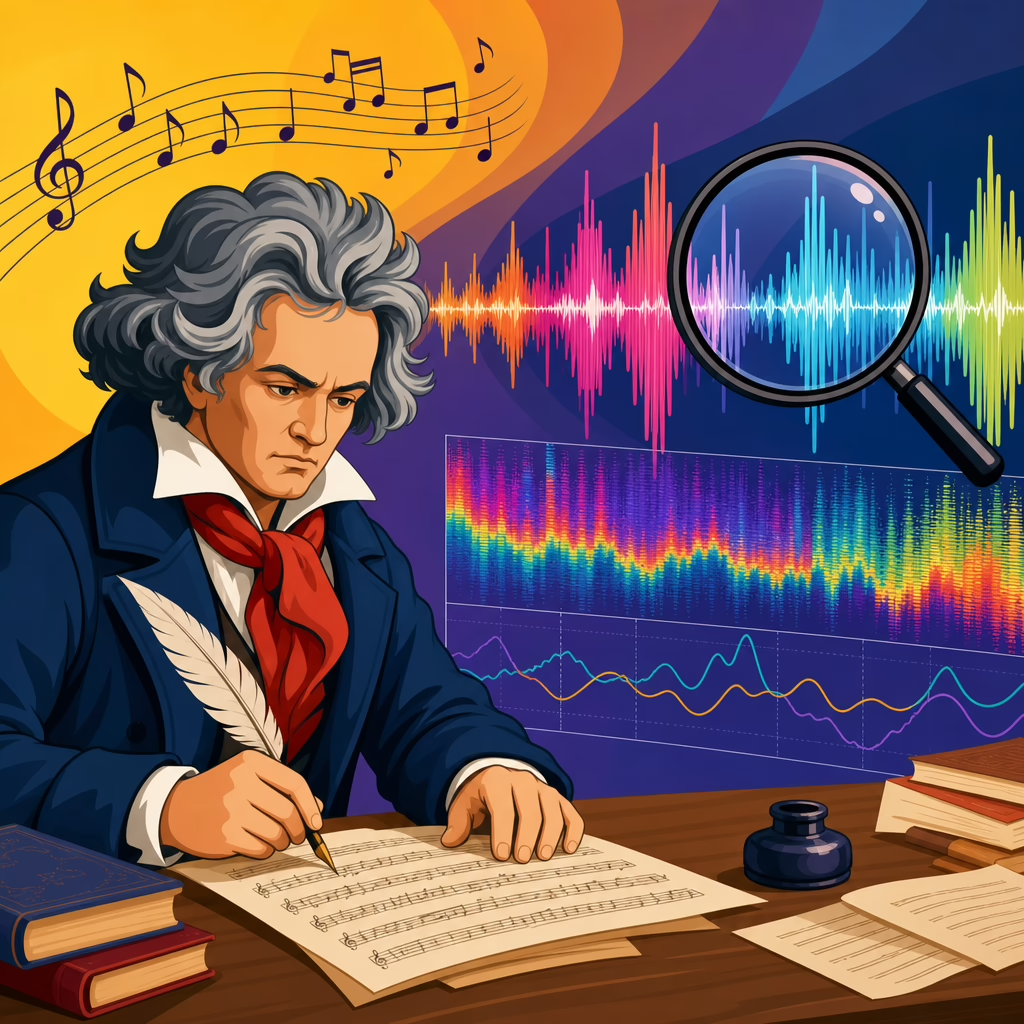
How Soundwave Analysis Reveals Patterns in Beethoven’s Works
Soundwave analysis reveals patterns in Beethoven’s works by turning performance and score into measurable data, showing how rhythm, dynamics, articulation, form, and even hearing-era changes emerge in visual and statistical detail. In practical terms, soundwave analysis means examining audio waveforms, spectrograms, onset patterns, tempo curves, frequency balance, and loudness envelopes with digital tools such as Sonic Visualiser, Praat, Librosa, Audacity, and Music Information Retrieval methods. For Beethoven studies, that matters because his music sits at the meeting point of composition, performance, acoustics, instrument history, and cognition. I have used waveform and spectrogram analysis on historical and modern recordings, and the same result appears repeatedly: data does not replace musicianship, but it exposes recurring structures that the ear senses without always naming. A hub article on this subject must therefore connect several related questions. How do analysts detect motivic repetition in a symphony movement? What can attack transients tell us about piano touch in the sonatas? Can spectral analysis distinguish period instruments from modern ones? How do dynamic envelopes illuminate Beethoven’s dramatic architecture? And where are the limits, especially when recordings are separated from the original nineteenth-century sound world? Answering those questions creates a foundation for every related article in the broader Beethoven Technology & Science cluster.
What Soundwave Analysis Actually Measures in Beethoven
At its simplest, a waveform plots amplitude over time. In Beethoven, that lets an analyst trace phrase shape, silence, accent, and large-scale contrast. A spectrogram adds frequency information, mapping low to high energy across time and making orchestration and register shifts immediately visible. Onset detection marks the exact timing of note attacks, which is essential for studying rhythmic precision, rubato, and ensemble coordination in recordings of the symphonies, quartets, and piano sonatas. Loudness curves estimate perceived intensity rather than raw amplitude, helping explain why a passage feels explosive even when peak level alone is misleading. Tempo extraction converts beat timing into a graph, exposing acceleration, ritardando, and structural pacing. Feature analysis can also measure spectral centroid, brightness, roughness, and attack slope, all useful for comparing instruments and interpretations.
These measures become powerful because Beethoven wrote music with unusually strong motivic concentration and large dynamic spans. The four-note opening motive of the Fifth Symphony is the obvious example, but the principle extends across his output. Short cells recur in altered rhythm, register, orchestration, and harmonic context. Soundwave analysis can highlight those recurrences by matching attack profiles and interval timing patterns, even when the motive is transformed. In the Piano Sonata No. 8, “Pathétique,” sharply differentiated attacks and rests create a waveform signature that mirrors the rhetorical contrast in the score. In the Seventh Symphony, repeated rhythmic cells generate measurable periodicity that appears in onset histograms. This kind of evidence is especially useful for readers navigating miscellaneous Beethoven topics, because it links composition, acoustics, performance practice, and computation within one method rather than treating them as separate disciplines.
Finding Motivic and Formal Patterns Across Major Works
One of the clearest benefits of soundwave analysis is that it makes motivic economy visible. Beethoven often builds entire movements from compressed ideas that expand through sequence, inversion, fragmentation, and rhythmic displacement. Analysts can compare repeated segments using self-similarity matrices, which plot where passages resemble earlier material. In the first movement of the Fifth Symphony, those matrices tend to show dense blocks of resemblance because the opening motive saturates the texture. In the “Eroica” Symphony, longer spans reveal a more expansive formal process, yet recurring rhythmic and contour relationships still emerge. In string quartet movements, especially the late quartets, similarity plots can uncover hidden continuity in passages that sound superficially discontinuous because timbre and harmony change rapidly.
Formal analysis also benefits from data. Beethoven’s sonata forms frequently intensify transition sections through rising energy, thickened texture, and compressed harmonic rhythm. A waveform or loudness plot often displays this as a gradual or stepped increase before a clear boundary at the secondary theme. In the first movement of the “Waldstein” Sonata, for example, registral spread and repeated figurations create a distinctive spectral brightening as the music drives forward. In the Ninth Symphony’s first movement, broad formal zones can be aligned with changes in dynamic envelope and orchestral density. When I compare multiple recordings, the exact shape differs by conductor, but the underlying structural pressure points remain surprisingly stable. That stability is important: it suggests that some patterns belong to the composition itself, not merely to interpretive fashion.
Because this page serves as a hub, it is useful to think of motif tracking and form tracking as two connected pathways. Motif tracking asks, “Where does this idea return, and in what transformed state?” Form tracking asks, “How does local repetition support long-range architecture?” Beethoven invites both questions. His works are not only expressive narratives; they are engineered systems of recurrence. Soundwave analysis gives those systems a measurable profile that can guide deeper study of individual symphonies, sonatas, quartets, and concertos.
Rhythm, Tempo, and Performance Signatures in Recordings
Beethoven scholarship increasingly uses recorded performance as evidence, and soundwave analysis is central to that shift. Tempo curves can be extracted from recordings to show how performers shape transitions, climaxes, cadences, and lyrical episodes. In the slow movement of the Seventh Symphony, conductors vary local tempo around phrase endings in ways that are easy to hear but easier to compare when graphed. In Beethoven piano sonatas, onset analysis can reveal whether a performer places left-hand accompaniment exactly with the melody or allows micro-asynchrony for expressive emphasis. These tiny timing differences affect perceived character, especially in Adagio and variation movements.
Historical recordings add another layer. Early twentieth-century pianists and string players often use more flexible tempo, more portamento, and less metrical uniformity than many late twentieth-century studio recordings. Waveform and timing analysis can quantify those differences without reducing them to mere numbers. A researcher might measure inter-onset interval variability in recordings of the “Moonlight” Sonata’s first movement and find that some older interpretations breathe more at cadence points, while modern performances maintain steadier pulse. Neither approach is inherently superior, but the patterns are real and reproducible. Similar comparisons in the Fifth or Ninth Symphonies show how orchestral traditions changed as conductors moved between Romantic elasticity and modernist precision.
| Analytical focus | What the data shows | Beethoven example | Useful tools |
|---|---|---|---|
| Onset timing | Attack placement, rhythmic tightness, expressive delay | String quartet scherzo entries | Sonic Visualiser, Librosa |
| Tempo curve | Acceleration, ritardando, phrase pacing | Symphony No. 7, second movement | Beat tracking plugins, Praat |
| Loudness envelope | Crescendo design, climactic shape, release | “Eroica” development section | Audacity, MIR Toolbox |
| Spectral profile | Timbre, register emphasis, instrument color | Period vs modern orchestra in Symphony No. 5 | Spectrogram analysis, Essentia |
| Self-similarity mapping | Motivic return and formal recurrence | Fifth Symphony opening motive | Music21, Librosa |
For readers exploring miscellaneous Beethoven technology topics, this area opens several article paths: comparing conductors, measuring rubato, identifying ensemble coordination, and linking performance choices to notation. The practical lesson is straightforward. Recordings are not transparent windows into Beethoven’s intentions, but they are rich datasets that preserve interpreters’ decisions. Soundwave analysis turns those decisions into evidence.
Dynamics, Timbre, and the Material Reality of Instruments
Beethoven’s sound world cannot be understood fully without instrument technology. He wrote for pianos with lighter action, shorter sustain, and different tonal decay than a modern Steinway, and for orchestras using gut strings, natural horns, narrower bore winds, and classical timpani. Spectral analysis helps clarify what those material differences mean. Period pianos usually show faster transient decay and less sustained upper partial energy than modern concert grands. In practical listening terms, that can make Beethoven’s fast figurations sound clearer and less blended. The difference is not merely aesthetic preference; it affects how textures register in the ear and how phrase endings breathe.
Orchestral timbre shows similar contrasts. Natural horns have a more uneven overtone profile across hand-stopped and open notes, and classical timpani produce a different attack-to-resonance balance than modern instruments. On a spectrogram, those qualities create distinguishable signatures. When analysts compare historically informed performances of the Fifth Symphony with modern symphonic recordings, they often find less low-mid saturation, sharper textural edges, and more pronounced articulation in the period-instrument versions. That helps explain why inner voices can project more clearly even at lower overall mass. The same method can be used in Beethoven’s overtures, the Missa solemnis, and chamber music, where instrumental setup strongly shapes blend and contrast.
Dynamics deserve equal attention. Beethoven’s scores are famous for extreme markings, from sudden sforzandi to extended crescendos. A digital loudness envelope can reveal whether performers realize those instructions as abrupt events, gradual arcs, or hybrid gestures. In the opening of the “Appassionata” Sonata, small changes in attack and sustain profoundly alter the sense of menace. In the finale of the Fifth Symphony, the long-range dynamic build can be measured across sections, making it possible to compare whether a conductor saves maximum intensity for the coda or peaks earlier. This is where soundwave analysis serves musicians directly: it shows not just what is written, but how sound energy unfolds in real time.
Limits, Misreadings, and Best Practices for Beethoven Research
Soundwave analysis is powerful, but it can mislead when treated as self-sufficient. The first limitation is source distance. Beethoven left scores, sketches, instruments, and contemporary accounts, but no recordings. Any audio analysis therefore studies later realizations, not the original sounding event. The second limitation is recording mediation. Microphone placement, room acoustics, editing, mastering compression, and transfer quality can distort tempo perception, dynamic range, and timbral balance. A close-miked piano recording may exaggerate attacks, while a reverberant orchestral recording may blur onsets and inflate sustain. Analysts who ignore those variables risk attributing engineering choices to Beethoven or to the performer.
Another common mistake is overvaluing what is easy to measure. Timing, amplitude, and spectral features are accessible; phrasing intention, harmonic tension, and expressive meaning are harder. The measurable features matter, but they only become musically significant when tied back to score study, historical context, and listening. In my own workflow, the best results come from triangulation: inspect the score, generate timing and loudness data, compare at least two recordings, and then test claims against what informed listeners can actually hear. For notation-rich questions, Music21 and symbolic score encoding may be more reliable than audio alone. For timbre questions, spectrograms are useful, but they should be paired with knowledge of instrument construction and venue acoustics.
Best practice in Beethoven research is therefore cumulative rather than reductive. Use digital tools to sharpen questions, not to bypass musicianship. If a self-similarity plot suggests a hidden recurrence in a late quartet, confirm it in the score. If tempo extraction shows unusual flexibility in a conductor’s “Eroica,” ask where that flexibility aligns with harmony, orchestration, and historical style. Good analysis does not force certainty where evidence is mixed. It makes strong claims only when multiple forms of evidence converge.
Soundwave analysis reveals patterns in Beethoven’s works because his music combines concentrated motives, bold contrasts, and structurally meaningful timing in ways that lend themselves to careful measurement. Waveforms show phrase shape and silence. Spectrograms expose register, orchestration, and timbral identity. Onset and tempo analysis uncover rhythmic design and interpretive freedom. Loudness curves clarify the architecture of crescendo, shock, and release. Together, these methods help explain why Beethoven’s music feels inevitable even when it sounds volatile: beneath the drama lies a dense network of recurring relationships that data can make visible.
For a sub-pillar hub within Beethoven Technology & Science, the main value is scope. This topic connects digital musicology, historical performance, instrument acoustics, recording studies, and computational analysis. It supports deeper articles on motivic mapping in the Fifth Symphony, tempo rubato in the piano sonatas, period-instrument spectra in the symphonies, quartet timing studies, and AI-assisted pattern recognition in Beethoven corpora. It also gives general readers a clear answer to a basic question: yes, technology can reveal new things about Beethoven, but only when used in partnership with the score, the ear, and historical understanding.
If you are building out this Beethoven Technology & Science section, use this hub as the starting point. Explore each branch in detail, compare recordings critically, and let the data sharpen your listening rather than replace it. That is where soundwave analysis becomes most valuable: not as a novelty, but as a precise tool for hearing Beethoven more clearly.
Frequently Asked Questions
What is soundwave analysis, and how does it help scholars study Beethoven’s music?
Soundwave analysis is the process of turning musical sound into measurable visual and statistical information so researchers can examine details that are difficult to track by ear alone. In Beethoven studies, this often includes looking at raw audio waveforms, spectrograms, onset timing, tempo curves, loudness envelopes, articulation patterns, and frequency distribution. Instead of relying only on traditional score reading or subjective listening, analysts can compare what is written in the score with what actually happens in a performance and quantify recurring traits across works, movements, and recordings.
This approach is especially useful with Beethoven because his music is rich in rhythmic tension, dramatic contrasts, motivic development, and formal transformation. Soundwave analysis can reveal how short rhythmic cells recur over time, how dynamic surges shape climactic passages, how phrase boundaries are reinforced or blurred by performers, and how Beethoven’s large-scale structures unfold acoustically. For example, a spectrogram can show how harmonic density and register expand during a buildup, while a tempo curve can expose where performers broaden or press forward in ways that align with formal transitions. These tools do not replace musical interpretation; they strengthen it by adding evidence. As a result, scholars, performers, and listeners gain a more precise understanding of the patterns that make Beethoven’s music feel both rigorously constructed and emotionally powerful.
What kinds of patterns in Beethoven’s works can soundwave analysis reveal?
Soundwave analysis can uncover a wide range of patterns, from small-scale rhythmic details to large-scale structural design. At the micro level, it can identify onset regularity, accent placement, articulation length, attack sharpness, and the spacing between repeated motives. This is valuable in Beethoven because many of his signature ideas are built from concise rhythmic cells that generate momentum through repetition, variation, and displacement. By measuring note attacks and durations, analysts can see how these figures are tightened, fragmented, or expanded across a movement.
At the macro level, soundwave analysis can expose broader formal and expressive patterns. Loudness envelopes show where energy accumulates and releases, helping researchers trace climaxes and sectional boundaries. Spectrograms reveal shifts in register, texture, and frequency balance that often correspond to transitions, developments, and recapitulations. Tempo analysis can map how performances handle Beethoven’s often challenging pacing, showing whether interpreters emphasize drive, weight, flexibility, or architectural breadth. In orchestral works, frequency and amplitude data can also highlight how instrumental layering changes over time, making it easier to study orchestration and balance.
Another major benefit is comparative analysis. When multiple recordings of the same sonata or symphony are examined, recurring features become visible alongside interpretive differences. Scholars can compare articulation in the opening of the Fifth Symphony, tempo flexibility in late piano sonatas, or dynamic contour in the slow movements of the string quartets. This allows them to separate patterns likely rooted in the score from those introduced by performance practice. In short, soundwave analysis reveals not just what Beethoven wrote, but how his musical ideas behave in time and sound.
How do digital tools like Sonic Visualiser, Praat, Librosa, and Audacity contribute to Beethoven analysis?
Each of these tools supports a different part of the analytical process, and together they make Beethoven’s music accessible as data without stripping away its artistic complexity. Sonic Visualiser is widely used for detailed annotation and visual inspection. It allows researchers to line up an audio recording with waveforms, spectrograms, beat markers, and tempo layers, making it easier to study phrasing, pulse, and structural timing. This is particularly helpful in Beethoven, where subtle fluctuations in pacing and accent can have major interpretive consequences.
Praat, though often associated with speech analysis, can also be useful for highly precise measurements of timing, intensity, and frequency-related features. For music researchers interested in attack shape, sustain behavior, or dynamic contour, it offers a way to inspect events closely and extract data that can be compared across passages or performances. Audacity is often used at a more practical level for waveform viewing, cleaning audio, isolating excerpts, and conducting straightforward visual comparisons. It is accessible and effective for initial exploration, especially when researchers want to identify obvious contrast points or prepare audio for deeper analysis.
Librosa and broader Music Information Retrieval methods add computational power. With Python-based analysis, scholars can extract tempo estimates, onset events, spectral centroid, RMS energy, chroma features, and other descriptors across large corpora of Beethoven recordings. That means it becomes possible to test larger questions: Do performances of the “Eroica” tend to accelerate in similar places? Are late sonata recordings shaped by comparable loudness profiles? Does articulation in historically informed performances differ measurably from modern concert tradition? These tools are valuable because they bridge close listening and large-scale evidence. They allow Beethoven analysis to move from impressionistic observation toward repeatable, data-supported insight.
Can soundwave analysis show how Beethoven’s hearing loss may have influenced his music?
Soundwave analysis cannot directly prove what Beethoven heard internally, but it can help scholars investigate how his musical style changed across different periods of his life, including the years associated with significant hearing decline. By comparing works chronologically, researchers can examine whether there are measurable shifts in register use, dynamic contrast, textural density, rhythmic emphasis, and formal pacing. These findings do not provide a simple cause-and-effect answer, but they can reveal patterns that contribute to the larger historical and musicological discussion.
For instance, analysts might study whether later works show stronger reliance on registral contrast, more abrupt dynamic architecture, denser motivic compression, or unusually distinctive rhythmic organization. Spectrograms can make registral extremes and textural layering visible. Loudness envelopes can show how dramatic contour is shaped over long spans. Onset analysis can capture the persistence of sharply defined rhythmic identities. When these observations are compared with earlier compositions, scholars can better describe Beethoven’s evolving compositional language in empirical terms rather than relying only on broad stylistic labels such as “heroic” or “late style.”
At the same time, responsible scholarship is careful not to reduce Beethoven’s artistic development to medical biography. His late works reflect intellectual ambition, experimentation, spirituality, formal innovation, and engagement with compositional problems far beyond hearing loss alone. Soundwave analysis is helpful precisely because it adds nuance. It can show what changed in the music and how those changes manifest acoustically, while leaving room for interpretation about why they happened. In this way, it supports a more disciplined conversation about Beethoven’s hearing-era works without falling into oversimplification.
Why does soundwave analysis matter for performers, students, and everyday listeners of Beethoven?
Soundwave analysis matters because it translates complex musical behavior into visible patterns that deepen understanding for many different audiences. For performers, it offers concrete feedback on timing, articulation, balance, and dynamic shape. A pianist studying a Beethoven sonata can compare their phrasing with landmark recordings, inspect where tempo fluctuates, and evaluate whether accents and crescendos are producing the intended structural effect. Conductors and chamber musicians can use similar tools to examine ensemble precision, pacing across transitions, and the acoustic impact of interpretive choices. This does not turn performance into a mechanical exercise; rather, it helps artists refine expressive decisions with greater awareness.
For students and researchers, soundwave analysis creates a bridge between theory and sound. Concepts like sonata form, motivic development, rhythmic propulsion, and dynamic architecture become easier to grasp when they are visible as recurring events and trajectories in the audio. Instead of reading that Beethoven builds tension through repetition and expansion, students can actually see a motive’s onset pattern, track the growth of loudness, or observe how a texture thickens in the spectrogram before a climax. That kind of evidence-based learning is especially effective in teaching environments where listening skills, score study, and digital literacy are all important.
Everyday listeners also benefit, even if they never use the software themselves. Articles, documentaries, lecture concerts, and educational media can use waveform and spectrogram visuals to explain why Beethoven’s music feels so compelling. Viewers can see the explosive contrast in a symphonic opening, the long arc of a slow movement, or the rhythmic insistence of a familiar motive. These visuals make the listening experience more engaging and reveal that Beethoven’s expressive power is not abstract; it is built from patterns that can be heard, seen, and measured. That combination of accessibility and rigor is exactly why soundwave analysis has become such a valuable way to explore his works.