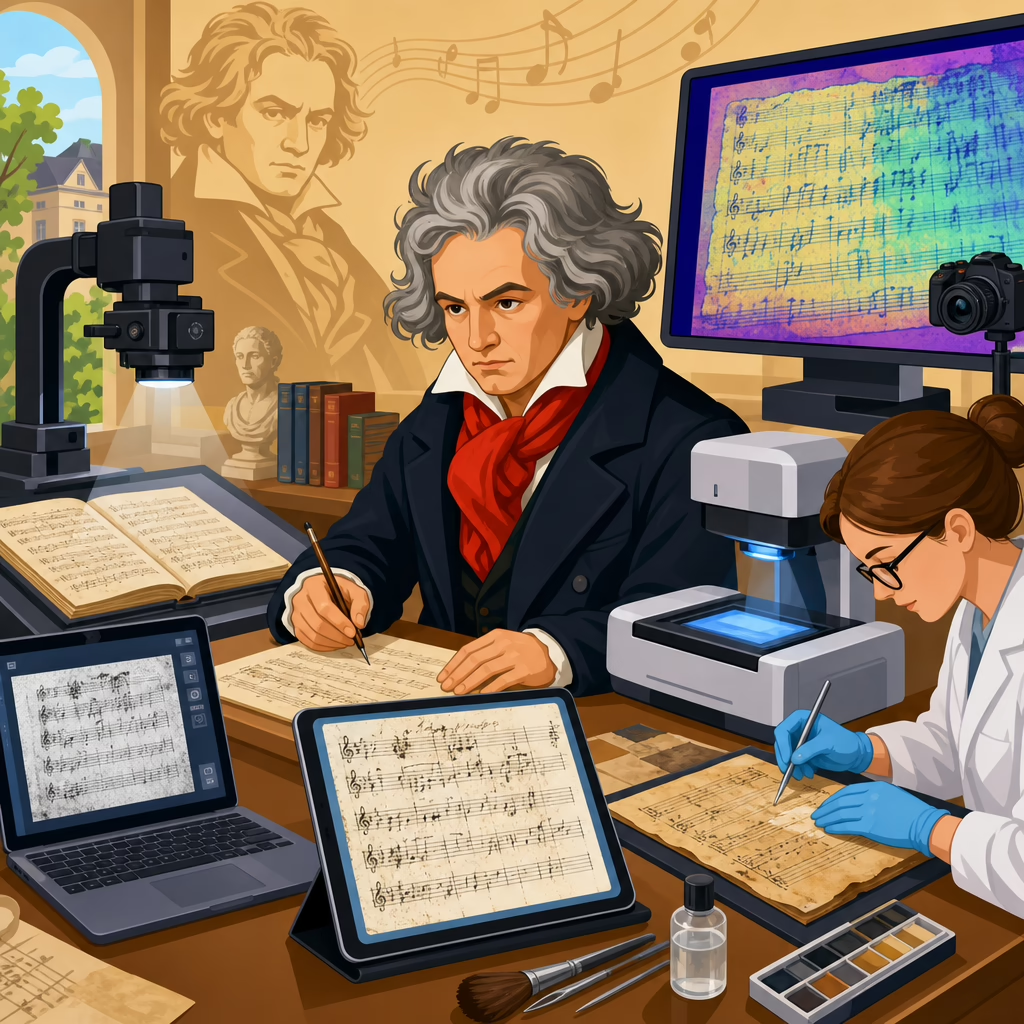
Technologies That Helped Preserve Beethoven’s Manuscripts
Technologies that helped preserve Beethoven’s manuscripts span chemistry, optics, climate control, digitization, and data management, and together they explain why fragile sheets covered with corrections, ink blots, and hastily penciled revisions remain accessible today. In practical terms, “preservation” means slowing physical decay, stabilizing damaged paper, capturing readable surrogates, and documenting provenance so scholars can trust what they see. Beethoven’s surviving manuscript legacy includes autograph scores, sketchbooks, conversation books, copyists’ materials, and loose leaves dispersed across libraries and private collections, with major holdings in institutions such as the Staatsbibliothek zu Berlin, the Beethoven-Haus Bonn, and the Austrian National Library. I have worked with archival imaging and manuscript metadata projects, and Beethoven material is a textbook example of why preservation is not one technology but a chain of decisions. Paper from the late eighteenth and early nineteenth centuries can be durable when made from linen and cotton rag, yet it is still vulnerable to tears, abrasion, mold, light exposure, poor repairs, and environmental fluctuation. Iron gall ink, common in the period, can also corrode paper fibers if acidity and humidity are not controlled. For Beethoven studies, preservation matters because the manuscripts are not merely carriers of finished compositions. They contain working evidence: overwritten bars, canceled themes, pasted slips, pagination anomalies, and handwriting patterns that reveal chronology, authorship, and compositional process. When a conservator humidifies a crumpled bifolio, when an imaging specialist captures erased notation under raking light, or when a cataloger records watermark data, each action protects both object and meaning. This hub article explains the miscellaneous technologies that made that protection possible and shows how they connect across conservation labs, reading rooms, and digital scholarship.
Early conservation science and paper stabilization
The first major line of defense for Beethoven manuscripts was conservation science applied to the physical object. Before advanced imaging or online access could help, conservators had to stabilize sheets so they could be handled, stored, and studied safely. For manuscript paper, the core tasks were surface cleaning, flattening distorted leaves, mending tears, and reducing harmful residues from earlier repairs. Older pressure-sensitive tapes, acidic backing papers, animal glues, and brittle mounts often did more damage than the original wear. Modern conservation replaced many of those interventions with reversible wheat starch paste, toned Japanese tissue, and carefully controlled humidification. Those materials matter because they support weak paper fibers without introducing excessive bulk or irreversible chemistry.
Deacidification became important where paper or previous storage materials introduced acids that accelerated embrittlement. While many Beethoven-era rag papers are inherently stronger than later wood-pulp sheets, mixed collections often contain later enclosures, labels, and repair papers that create local acid migration. Conservators also monitor iron gall ink corrosion, a known hazard in music manuscripts. If ink begins to eat through a staff line or notehead, the treatment strategy can include stabilization methods that limit further oxidation and provide support where losses have already formed. Institutions preserving Beethoven sources typically follow conservation principles set by organizations such as the International Council on Archives and the American Institute for Conservation: minimal intervention, reversibility where possible, and full treatment documentation.
Protective housing is another technology, even if it appears simple. Acid-free folders, lignin-free boxes, polyester sleeves used with caution, buffered or unbuffered interleaving selected for the media present, and custom drop-spine cases dramatically extend the life of manuscripts. In my experience, rehousing projects often produce preservation gains faster than ambitious restoration because they reduce repeated abrasion and handling immediately. For Beethoven sketches on irregular scraps or bifolios with weak folds, custom supports can prevent new breaks every time an item is requested.
Environmental monitoring and storage systems
Stable storage conditions have preserved Beethoven’s manuscripts as effectively as any treatment bench intervention. Paper expands and contracts with changes in relative humidity, and repeated cycling weakens fibers, distort sheets, and increase the risk of planar damage. Archives therefore maintain temperature and humidity ranges designed to slow chemical decay and inhibit mold growth, typically through HVAC systems, filtration, insulation, and sealed storage furniture. Data loggers now provide continuous readings, allowing staff to detect microclimates inside cases and boxes rather than relying on occasional manual checks.
Light management is equally important. Visible light fades media over time, while ultraviolet radiation accelerates damage. Reading rooms and exhibition galleries use filtered lighting, low lux levels, timed exposure, and facsimile rotation to minimize cumulative harm. This is especially relevant for Beethoven manuscripts displayed because of their cultural prestige. A famous autograph score can draw visitors, but exhibition schedules must be balanced against preservation limits. In several major collections, institutions display originals only for short periods and rely on high-quality facsimiles the rest of the time.
Disaster preparedness also belongs in this technological history. Fire detection, water sensors, compartmentalized storage, freeze-drying arrangements for wet paper, and emergency response protocols have protected music archives from irreversible loss. Flooding can cause ink bleeding, cockling, adhesion between sheets, and mold within forty-eight hours. Modern preparedness plans, supported by environmental sensors and coordinated salvage workflows, mean that a burst pipe is no longer automatically a catastrophe for manuscript collections.
| Technology | What it protects against | Why it matters for Beethoven manuscripts |
|---|---|---|
| HVAC with humidity control | Warping, mold, chemical decay | Stabilizes rag paper and slows ink corrosion |
| UV-filtered exhibition lighting | Fading and embrittlement | Reduces damage during public display of autograph scores |
| Acid-free boxes and folders | Abrasion, dust, acid migration | Protects fragile leaves, folds, and pasted inserts |
| Data loggers | Undetected environmental fluctuations | Provides evidence for long-term preservation decisions |
| Water sensors and disaster plans | Flood and leak damage | Enables rapid salvage before mold and adhesion occur |
Photography, microfilm, and high-resolution digitization
Long before online archives, photography created preservation surrogates that reduced wear on originals. Nineteenth- and twentieth-century photographic reproduction allowed scholars to consult manuscript images without transporting or repeatedly handling the source. Microfilm later became a major preservation medium because it was standardized, relatively compact, and durable when produced and stored correctly. Many Beethoven manuscript sources entered scholarly circulation through microfilm sets used in research libraries worldwide. Even when image quality was modest, microfilm preserved content that might otherwise have remained inaccessible or vulnerable to loss.
Today, high-resolution digitization has transformed access and preservation. Overhead planetary scanners and conservation-safe camera systems capture manuscripts at resolutions sufficient to study ink flow, pen pressure, paper texture, and marginal annotations. Color targets, calibrated lighting, and ICC color management ensure that digital images are not merely attractive but reliable for scholarly comparison. File formats such as TIFF are favored for archival masters, while JPEG or JPEG2000 derivatives support web delivery. A proper workflow includes checksum verification, redundant storage, and persistent identifiers so files remain authentic and findable over time.
For Beethoven research, digitization changed the scale of comparison. A scholar can now review sketch leaves held in Bonn, Berlin, Vienna, and elsewhere within a single session, identifying related paper stocks, notation habits, or thematic rework without intercontinental travel. That does not replace the original, because thickness, chain lines, and some erased traces still require direct examination. But digital surrogates greatly reduce handling and widen access. Institutions such as Beethoven-Haus Bonn have demonstrated how manuscript portals can serve both preservation and scholarship by pairing zoomable images with catalog metadata, source descriptions, and links to related works.
Multispectral imaging and advanced readability tools
Some of the most important technologies for preserving Beethoven’s manuscripts do not physically alter the paper at all; they recover legibility from difficult surfaces. Multispectral imaging captures a sequence of images at different wavelengths, often from ultraviolet through visible to infrared, then compares reflectance patterns to reveal faded writing, erased passages, or distinctions between inks. In music manuscripts, this can clarify overwritten notes, obliterated dynamics, and compositional revisions hidden beneath later marks. The result is preservation by interpretation: scholars gain information without invasive treatment.
Raking light photography is another deceptively powerful method. By directing light at a shallow angle, technicians emphasize surface topography such as blind impressions, drypoint traces, pressure marks from heavy writing, and areas where text was scraped or abraded. Transmitted light helps identify watermarks, chain lines, and paper structure, all of which can assist dating and source attribution. For Beethoven documents, watermark analysis has been especially useful in sorting sketch materials chronologically and connecting scattered leaves from once-unified gatherings.
Image enhancement software further supports readability. Contrast stretching, false-color rendering, and channel separation can distinguish graphite from ink or identify later annotations added by editors and owners. These tools require restraint. Poorly documented enhancement can mislead viewers into treating an interpretive composite as a neutral photograph. Best practice is to preserve the raw capture, document every processing step, and present enhanced images alongside standard views. When done correctly, advanced imaging protects the manuscript by reducing pressure for repeated physical inspection while producing better evidence than the naked eye alone.
Cataloging, metadata, and provenance tracking
A manuscript is not preserved if no one can identify it, date it, or distinguish it from copies. Cataloging technology therefore plays a central role. Modern collection databases record shelfmarks, physical descriptions, dimensions, foliation, watermark notes, ownership history, related works, bibliography, and links to digital images. Standards such as MARC, Dublin Core, EAD, and linked-data frameworks make records portable across catalogs and discovery systems. For music materials, authority control is especially valuable because a single Beethoven work may appear under opus number, thematic catalog number, nickname, key, or generic title.
Provenance tracking has protected Beethoven manuscripts from dispersal and confusion. Auction records, library stamps, collector annotations, accession files, and digitized correspondence can reconstruct the path of a manuscript from composer to copyist, publisher, collector, and institution. This matters for authenticity. Beethoven’s market value has long attracted attribution errors and, in rare cases, forgery. A robust metadata trail helps scholars test whether a source is truly autograph, partly in another hand, or a later copy with editorial interventions. In my own project work, the biggest breakthroughs often came not from imaging but from harmonizing inconsistent legacy records so dispersed fragments could be recognized as belonging together.
Persistent identifiers and interoperable metadata now allow manuscript ecosystems rather than isolated catalogs. A digitized sketch can link to a thematic catalog record, a published edition, performance history, and conservation report. That networked context preserves knowledge that earlier card catalogs could not efficiently connect.
Facsimile production, digital editions, and public access systems
Preservation succeeds when access is redirected intelligently. Facsimile technology, from fine art photolithography to today’s color-managed digital printing, has reduced the need to expose Beethoven’s original manuscripts to heavy consultation. High-quality facsimiles preserve scale, color, and even paper tone closely enough for many teaching, exhibition, and editorial uses. They also democratize access; a conservatory class in another country can study a near-life-size reproduction without travel or insurance costs.
Digital scholarly editions extend that benefit. By encoding variants, revisions, and source relationships, editors can present Beethoven’s manuscript evidence in structured form rather than as static photographs alone. Music encoding standards such as MEI allow manuscripts, transcriptions, and commentary to interact. A user can compare a sketch to a fair copy, inspect editorial decisions, and trace how a theme evolved. This reduces pressure on originals while increasing interpretive richness. Public access platforms add zoom interfaces, IIIF compatibility, and annotation layers that support both specialists and general readers.
There are limits. No digital interface fully conveys verso bleed-through, page stiffness, or subtle ink gloss, and not every institution can afford top-tier imaging or sustained digital preservation. But the combination of facsimiles, editions, and online access has unquestionably preserved Beethoven manuscripts by making the original object a rarer point of contact rather than the default research copy.
The preservation of Beethoven’s manuscripts did not depend on a single breakthrough; it depended on a coordinated stack of technologies that protect paper, recover legibility, document identity, and widen access without increasing risk. Conservation science stabilized torn and chemically vulnerable sheets. Environmental monitoring and archival housing slowed everyday deterioration. Photography, microfilm, and high-resolution digitization created dependable surrogates. Multispectral imaging and raking light revealed information hidden in damaged or revised passages. Cataloging systems and provenance research ensured that the right manuscript could be found, trusted, and connected to related sources. Facsimiles and digital editions then shifted routine use away from the original, which is one of the most effective preservation strategies any archive can adopt.
For a sub-pillar hub on Beethoven technology and science, the main lesson is clear: miscellaneous preservation tools are not peripheral at all. They are the infrastructure that makes every other line of Beethoven research possible, from source criticism to performance practice. If you want to understand how technology shapes our picture of Beethoven, start with the manuscript itself and the systems that kept it alive long enough to be studied. Explore the linked articles in this subtopic to see how each method, from imaging to archival science, contributes to a fuller and more reliable view of Beethoven’s creative world today.
Frequently Asked Questions
What kinds of technologies have been most important in preserving Beethoven’s manuscripts?
The preservation of Beethoven’s manuscripts has never depended on a single invention. It has been the result of several technologies working together across chemistry, optics, environmental control, digitization, and archival documentation. On the chemical side, conservators use carefully tested treatments to stabilize paper, reduce harmful acidity where appropriate, and consolidate areas weakened by age, handling, or old repairs. Optical technologies, including high-resolution photography and specialized imaging methods, make it possible to record fine details such as erased notes, overwritten passages, ink density, and paper texture without repeatedly handling the original sheets.
Climate control has also been crucial. Stable temperature and relative humidity help slow the natural deterioration of paper, ink, and binding materials. Light management, including filtered display lighting and dark storage, protects manuscripts from fading and embrittlement. In more recent decades, digitization has transformed access by creating detailed surrogates that scholars, performers, and the public can study without exposing the originals to constant physical use. Finally, data management systems tie everything together by recording provenance, conservation history, ownership changes, physical condition, and image metadata. That combination is what allows Beethoven’s fragile working manuscripts—often crowded with corrections, blots, and revisions—to survive not just as objects, but as trustworthy research sources.
How does chemistry help conserve fragile paper and ink in Beethoven’s original scores and sketches?
Chemistry plays a practical and often quiet role in manuscript preservation. Paper from Beethoven’s era can become brittle over time because of aging, environmental exposure, and the chemical composition of the fibers themselves. Conservators study the condition of the sheet, the stability of the inks, and the effects of previous repairs before choosing any treatment. In some cases, they may use conservation-grade materials and adhesives to mend tears, support weak folds, or secure fragments that are in danger of being lost. The goal is not to make the manuscript look new, but to stabilize it so it can survive future handling, storage, and study.
Ink presents its own challenges. Historical manuscripts may include iron gall ink or other formulations that can fade, burn through paper, or react to moisture and pollutants. Because Beethoven’s pages often contain dense layers of notation, annotations, crossings-out, and hurried revisions, conservators must be especially cautious. Even small chemical changes can alter legibility or damage evidence that scholars rely on. Modern conservation chemistry therefore emphasizes minimal, reversible, and well-documented interventions. Testing, microscopy, and material analysis help professionals understand what the paper and ink can safely tolerate. In that sense, chemistry is less about dramatic restoration and more about informed restraint—using science to slow decay while preserving the manuscript’s authenticity.
Why are imaging and digitization technologies so valuable for Beethoven manuscript preservation?
Imaging and digitization are invaluable because they reduce wear on the originals while dramatically expanding what can be seen and studied. A high-resolution digital image can capture minute details that are easy to miss in person: pressure marks from a pen stroke, faint pencil additions, erasures, irregular ink flow, page damage, watermarks, stitching evidence, and differences in paper tone. For Beethoven’s manuscripts, those details matter. His creative process often survives in layers of alteration—crossed-out measures, inserted ideas, compressed rewrites, and marginal notes—so a detailed image can reveal how a composition developed over time.
Advanced imaging can go even further. Depending on the manuscript and institution, specialists may use raking light, transmitted light, ultraviolet, infrared, or multispectral techniques to bring out faded writing, distinguish different inks, or identify repairs and structural features of the paper. These methods can help scholars separate original notation from later annotations or detect text hidden beneath damage and discoloration. Digitization also supports preservation by creating access copies that can be shared online, used in catalog systems, and compared across collections. When researchers can consult digital surrogates, the original manuscript spends less time under lights, outside storage, or in reading rooms. That lowers the cumulative risk of tears, abrasion, light exposure, and accidental mishandling.
What role do climate control and storage systems play in keeping Beethoven’s manuscripts intact?
Climate control is one of the most effective long-term preservation tools because paper and ink are highly sensitive to environmental fluctuations. When temperature and humidity swing too widely, paper can expand and contract, become brittle, distort, or encourage mold growth. Ink can fade, migrate, or interact more aggressively with the paper support. For manuscripts as historically important and physically vulnerable as Beethoven’s, preservation depends on maintaining stable storage conditions rather than simply reacting after damage appears. Carefully controlled storage rooms, archival boxes, acid-free folders, and protective housings all help buffer the manuscripts against environmental stress.
Light control is equally important. Prolonged exposure to visible light and ultraviolet radiation can accelerate fading and weaken paper fibers. That is why original manuscripts are usually kept in low-light conditions and displayed only for limited periods under tightly managed exhibition standards. Storage technology also includes secure enclosures designed to reduce dust, pollutants, and unnecessary movement. Some institutions use custom supports so folded, torn, or oversized leaves are not strained during storage or consultation. In practical terms, these systems buy time. They do not stop aging altogether, but they slow it enough that future generations can continue to examine Beethoven’s manuscripts in both physical and digital form.
How do cataloging, provenance tracking, and data management technologies improve trust in preserved Beethoven manuscripts?
Preservation is not only about the physical sheet; it is also about confidence in the record surrounding it. Cataloging and data management technologies help institutions document what a manuscript is, where it came from, how it relates to other sources, what condition it is in, and what has happened to it over time. For Beethoven materials, that information is essential because surviving manuscripts may be scattered across libraries, archives, museums, and private collections, and many works exist in multiple forms such as sketch leaves, drafts, fair copies, corrected copies, and early editions. A reliable digital catalog can connect these pieces and help scholars distinguish original authorial material from later additions, copies, or editorial interventions.
Provenance tracking is especially important for authenticity and interpretation. Knowing a manuscript’s chain of ownership, sale history, collection marks, and prior descriptions can help establish whether it is genuinely linked to Beethoven and whether it has been altered, trimmed, rebound, or reorganized. Modern collection management systems can integrate conservation reports, imaging records, watermark studies, physical measurements, and bibliographic references into a unified record. That means a scholar looking at a digital image is not seeing an isolated photograph but a documented object with context. In preservation terms, this kind of structured data protects intellectual integrity. It ensures that access to Beethoven’s manuscripts is not just convenient, but credible.