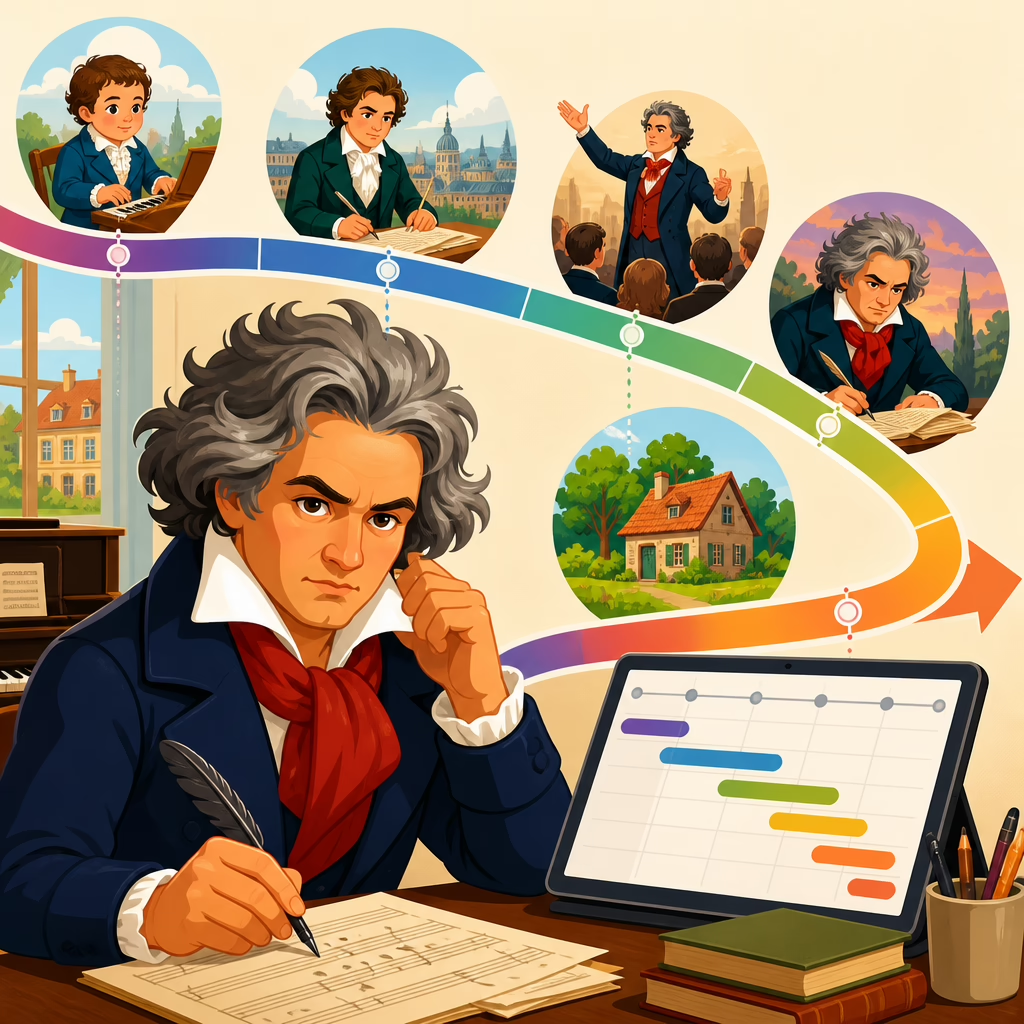
Using Timeline Tools to Visualize Beethoven’s Life
Using timeline tools to visualize Beethoven’s life turns a familiar biography into a structured, searchable map of cause and effect. Instead of seeing Ludwig van Beethoven as a string of isolated milestones, readers can place his moves, patrons, illnesses, premieres, letters, and compositional breakthroughs on a single axis and understand how events overlapped. A timeline tool is any digital platform that arranges dated information visually, often with layers, filters, media, and links. In practice, that can mean a simple spreadsheet-driven chronology, an interactive exhibit built in TimelineJS, a research database displayed in Aeon Timeline, or a classroom project made in Tiki-Toki. For Beethoven, this matters because his life is unusually rich in documented dates yet often misunderstood when retold only as legend. The popular narrative jumps from child prodigy to deaf genius to heroic master, but the real story includes legal disputes, publication strategies, changing political conditions in Vienna, and long periods of revision. When I have built music history timelines for teaching, the visual arrangement immediately exposes patterns that prose biographies can hide: dense clusters of works around patronage stability, periods of crisis followed by stylistic change, and the long tail between sketching and publication. A well-designed timeline does more than decorate facts. It becomes an analytical instrument for examining Beethoven’s development with precision.
Any useful Beethoven timeline begins with clear definitions of what will be plotted. Life events are personal occurrences such as births, deaths, moves, illnesses, and family conflicts. Career events include commissions, premieres, dedications, publication dates, and payments from patrons. Historical context covers the French Revolutionary and Napoleonic eras, censorship, aristocratic networks, and concert culture in Bonn and Vienna. Source data should also distinguish between exact dates, approximate dates, and date ranges. That distinction is essential because Beethoven scholarship relies on varied evidence: autograph manuscripts, conversation books, legal records, letters, and publishers’ notices do not all offer the same certainty. If a timeline presents every event with identical confidence, it quietly distorts the record. The value of visualizing Beethoven’s life, then, is not just convenience. It is the ability to compare parallel strands of evidence, see uncertainty honestly, and ask better questions. Why did the Heiligenstadt crisis coincide with stylistic expansion rather than retreat? How did worsening hearing affect public performance versus private composition? Which relationships were brief but decisive? Timeline tools help answer those questions by making chronology visible, inspectable, and revisable.
What a Beethoven timeline should include
The strongest Beethoven timelines use multiple categories rather than one uninterrupted list of dates. At minimum, I recommend five lanes: personal life, residences and travel, compositions, performances and publications, and historical context. Personal life would include his birth in Bonn in December 1770, the death of his mother in 1787, the onset and progression of hearing loss, the guardianship struggle over Karl, and his death in Vienna in March 1827. Residences and travel would mark the move from Bonn to Vienna in 1792, visits to spas such as Heiligenstadt, and time spent in lodgings associated with particular works. Compositions should track not just completion dates but sketches, revisions, and opus publication when known. Performances and publications deserve their own lane because Beethoven often revised works after premieres and publication schedules followed commercial logic, not purely artistic chronology. Historical context should include events such as the French occupation of Bonn, the Congress of Vienna, and the Napoleonic Wars, all of which shaped patronage, mobility, and public life.
Separating those categories yields practical insight. For example, if you place Beethoven’s hearing difficulties only as a biographical note, they can appear dramatic but disconnected. Put them beside public performance dates, however, and the timeline shows a shift away from the virtuoso pianist career that had helped establish him in Vienna. Add compositional activity and the same period reveals not silence but redirection. The years around 1802 become a pivot rather than a collapse. Likewise, plotting publication dates alongside composition dates clarifies that opus numbers are not reliable guides to when Beethoven wrote a piece. This is a common misunderstanding among students and casual listeners. A timeline makes the point instantly. Some works were drafted years before publication; others circulated in manuscript or performance before entering print. By organizing events in layers, the tool teaches chronology and corrects myths at the same time.
Choosing the right timeline tool for the job
The best timeline tool depends on whether your goal is teaching, research, exhibition, or personal study. TimelineJS is excellent for public-facing storytelling because it turns a spreadsheet into a clean, media-rich interactive display. It is free, easy to embed, and strong for images, maps, and short explanatory text. Tiki-Toki offers an attractive interface and supports 3D-style navigation, which can be useful for student engagement, though its long-term project management is less research-oriented. Aeon Timeline is far stronger for scholarly work because it handles dependencies, date uncertainty, and relationships between people, places, and events. That makes it ideal for Beethoven, whose life intersects with patrons such as Archduke Rudolf, Prince Lichnowsky, and Prince Lobkowitz; publishers across Europe; and overlapping composition phases. Microsoft Excel or Google Sheets should not be dismissed either. Many reliable timelines begin there because spreadsheets force data discipline before design decisions obscure errors.
| Tool | Best use | Strength for Beethoven projects | Main limitation |
|---|---|---|---|
| TimelineJS | Public storytelling | Easy media integration for manuscripts, portraits, and audio excerpts | Less precise for complex uncertainty and parallel scholarly annotations |
| Aeon Timeline | Research and analysis | Handles date ranges, linked entities, and causal relationships well | Requires more setup and a steeper learning curve |
| Tiki-Toki | Classroom and exhibit use | Visually engaging for broad audiences exploring Beethoven’s life stages | Less robust for source-critical documentation |
| Google Sheets or Excel | Data preparation | Excellent for cleaning dates, categories, and citations before publishing | Limited native narrative presentation |
In projects I have managed, the most efficient workflow is to build the master chronology in a spreadsheet, verify each event against a source, then export or recreate it in a presentation layer. This prevents a frequent problem: users begin with a flashy interface, then discover later that their date fields are inconsistent, their sources are missing, or their event labels are too vague to search. Beethoven’s life especially benefits from structured fields. I recommend columns for start date, end date, event title, event type, location, associated people, source citation, confidence level, and notes. With that schema, you can filter for all events involving Vienna between 1808 and 1812, isolate every documented interaction with a patron, or compare draft and premiere intervals for major works. If you are also exploring score-based analysis, the broader methodological context is well introduced in the main guide at https://lvbeethoven.com/how-ai-tools-can-help-analyze-beethoven-scores/, which complements timeline work by connecting chronology to close musical study.
Building a reliable chronology from Beethoven sources
A Beethoven timeline is only as good as its source handling. The central challenge is that different event types come from different documentary traditions. Birth, baptism, death, and legal disputes often have formal records. Compositions may survive in autograph manuscripts, copyists’ parts, sketchbooks, or first editions. Personal states such as hearing deterioration depend on letters, recollections, and medical interpretations, all of which require caution. Established scholarly resources include the New Beethoven Complete Edition, thematic catalogues, critical biographies, and reputable archives such as the Beethoven-Haus Bonn. When extracting dates, always record whether the date marks inception, substantial completion, revision, first private reading, public premiere, or publication. Those are not interchangeable. The Eroica Symphony, for instance, belongs to a development arc, not a single date stamp. Presenting it as one isolated year erases the process that made it historically significant.
A practical method is to assign each event a confidence tag. Exact dates can be labeled confirmed. Approximate datings such as “summer 1803” should be marked estimated. Events inferred from correspondence patterns or secondary synthesis should be labeled probable or contextual. This is not pedantry. It protects users from overstating certainty and improves future revision. If a new edition or archive finding adjusts a chronology, you can update the timeline systematically. I have found this especially useful when teaching students to compare narrative claims. A textbook may state that Beethoven wrote a work in a certain year, while a manuscript study narrows that claim to a span of months. A timeline that visibly encodes both the date and the confidence level trains historical judgment. It also discourages one of the worst habits in digital humanities work: converting complex evidence into falsely clean data simply because software prefers neatness.
Using visualization to reveal patterns in Beethoven’s life
The real analytical payoff comes after the data is entered. A timeline lets you test relationships between biographical stress, institutional support, and creative output. Consider the period from roughly 1798 to 1802. If you plot letters mentioning hearing trouble, medical consultations, public appearances, and the retreat to Heiligenstadt, the visual pattern shows increasing personal anxiety alongside continued compositional ambition. Add works from the same years, and the timeline reveals not an artistic shutdown but an intensification of experimentation. Move forward to the so-called middle period and align major orchestral works with aristocratic patronage, benefit concerts, and Vienna’s unstable political climate. The result is a more grounded picture of Beethoven’s heroism: not romantic isolation, but persistent negotiation within a specific social economy. Timelines are powerful because they force chronology to do explanatory work rather than serving as background decoration.
They also clarify long-term developments that biographies often compress. Beethoven’s deafness did not arrive in one dramatic moment, and a timeline can resist that oversimplification by plotting references over years instead of assigning one symbolic turning point. The same is true of the late style. Rather than treating the late quartets, Missa solemnis, and Ninth Symphony as sudden products of old age, a chronology can trace preparatory habits, interruptions, commissions, and delayed completions. Even domestic instability becomes legible when mapped against work patterns. The guardianship battle over Karl consumed time, attention, and emotional energy, and timelines help show how legal conflict intersected with compositional pacing. For museum educators, this visual structure helps visitors grasp complexity quickly. For researchers, it suggests new hypotheses, such as whether certain publication delays align more with market conditions than with Beethoven’s perfectionism alone.
Design practices that make the timeline understandable
Good design determines whether a Beethoven timeline informs or confuses. Use concise event titles, then reserve interpretation for the description field. “Moves to Vienna” is better than “Begins the transformative relocation that defines his mature voice.” Color-code categories consistently and keep the palette restrained. Personal crises, compositions, performances, and historical context should be distinguishable at a glance. If the tool allows filtering, enable users to turn layers on and off; this is essential when the chronology becomes dense. Media should support the date, not distract from it. A manuscript image, a portrait by Joseph Karl Stieler, a theater program, or a map of Vienna can sharpen understanding, but endless decorative images slow interaction and dilute the analytical purpose. Accessibility matters too: include alt text, readable contrast, and direct language. A timeline that cannot be navigated clearly on mobile devices or by screen readers loses educational value.
One design principle I strongly recommend is separating event summary from evidence note. For example, the visible card might say “Heiligenstadt Testament drafted, 1802,” while an expandable note explains that the document was written as a private statement to his brothers and not published in his lifetime. This preserves readability without hiding important nuance. Another useful practice is adding cross-links between recurring entities: click Archduke Rudolf and see every lesson, dedication, payment, and correspondence reference associated with him. Likewise, geographic links can show how Bonn, Vienna, and summer retreats function differently within Beethoven’s life. Done well, this transforms a timeline from a line of dates into a networked research interface. The user still perceives chronological order, but can also explore relationships that narrative prose usually handles one at a time. That dual view is exactly why timeline tools are so effective for Beethoven.
Best uses in teaching, research, and public history
In teaching, a Beethoven timeline works best when students build part of it themselves. Assign one group to compositions, another to patrons, another to health and family, and another to historical events in Vienna and Europe. When those layers are merged, students immediately see that musical history is not autonomous. In research, timelines help organize revision-heavy projects, especially when comparing multiple biographies or critical editions. They are also useful for identifying gaps: if a major work appears with a completion estimate but no premiere record in your dataset, that absence may prompt archival checking. In public history, timeline tools can anchor digital exhibits by giving visitors a clear path through complexity. Instead of overwhelming audiences with names and opus numbers, the interface leads them from one verified moment to the next while preserving context.
The main benefit is disciplined understanding. Beethoven’s life becomes less mythical and more intelligible when dates, documents, relationships, and works are placed in a coherent visual structure. Choose a tool that fits your purpose, build the data carefully, distinguish certainty from approximation, and design for clarity rather than novelty. A strong timeline will help students learn faster, help researchers ask sharper questions, and help general readers connect biography to music with fewer misconceptions. If you are creating one, start small: plot ten confirmed events across two categories, verify every source, and expand only after the structure works. That simple first step usually reveals how much more there is to see.
Frequently Asked Questions
Why use a timeline tool to study Beethoven’s life instead of a standard biography?
A timeline tool makes Beethoven’s life easier to understand because it turns a long, complex biography into a visual sequence of connected events. In a traditional narrative, readers may learn about his childhood in Bonn, his move to Vienna, his hearing loss, his relationships with patrons, and the premieres of major works, but those details can feel separated by chapters or themes. A timeline places them on one shared axis, allowing readers to see what happened first, what overlapped, and what may have influenced later decisions. This is especially useful for Beethoven because his artistic development, health struggles, financial arrangements, and personal correspondence often unfolded at the same time rather than in neat stages.
Using a timeline also helps reveal cause and effect. For example, readers can compare periods of illness with changes in productivity, connect new patronage arrangements with greater creative independence, or place landmark compositions alongside major life disruptions. Instead of treating works like the “Eroica,” the Fifth Symphony, or the late string quartets as isolated achievements, a timeline shows the surrounding circumstances that shaped them. The result is a more structured and searchable view of Beethoven’s life, one that supports both quick reference and deeper historical interpretation.
What kinds of events should be included in a Beethoven timeline?
A strong Beethoven timeline should include more than birth, death, and a list of famous compositions. To make the visualization genuinely useful, it should combine personal, artistic, and historical material. Core entries would include major life events such as his birth in Bonn, early musical training, his move to Vienna, periods of illness, evidence of worsening hearing loss, legal battles over guardianship, and his final years. Just as important are professional milestones: first performances, publication dates, commissions, dedications, revisions, major premieres, and the completion of significant works across symphonies, sonatas, quartets, and sacred music.
It is also valuable to include relationships and context. Beethoven’s patrons, publishers, teachers, students, collaborators, and correspondents all played a role in his career. Letters, diary references, and documented reactions from contemporaries can help explain why certain periods were especially productive or difficult. Historical background should not be ignored either. Political changes in Vienna, the Napoleonic era, and cultural shifts in European music all affected the environment in which he worked. When these categories are layered together, the timeline becomes much more than a chronology; it becomes an interpretive map of how Beethoven’s personal life and creative output intersected over time.
How can timeline tools show connections between Beethoven’s hearing loss and his music?
Timeline tools are especially effective for this topic because they allow readers to compare medical, personal, and compositional events side by side. Rather than mentioning Beethoven’s hearing loss as a single tragic fact, a well-built timeline can trace its progression across many years. Entries might include early reports of auditory problems, letters describing frustration and isolation, the Heiligenstadt Testament, changes in social behavior, and later evidence of near-total deafness. When those entries are positioned alongside the dates of key works, readers can immediately see that some of his most innovative music emerged during periods of profound physical and emotional challenge.
This format helps avoid simplistic conclusions while still revealing meaningful patterns. A timeline does not claim that hearing loss mechanically caused a specific symphony or quartet, but it does show the environment in which those works were created. It can highlight how Beethoven continued to compose, revise, and premiere major works despite increasing isolation. It can also mark transitions in style, showing how the middle and late periods align with significant personal struggles. For students, teachers, and general readers, this side-by-side structure makes a difficult subject more concrete and historically grounded, while preserving the complexity of Beethoven’s experience.
What features make a timeline tool most useful for visualizing Beethoven’s life?
The best timeline tools do more than place dates in order. For a subject as rich as Beethoven, useful features include layers, filters, media support, and searchable entries. Layers allow users to separate categories such as personal events, compositions, performances, correspondence, health, and historical background. Filters make the timeline easier to navigate, especially for readers who want to focus on one theme, such as piano sonatas, patronage, or illness. Search functions are equally important because they let users quickly locate specific people, cities, works, or years without scanning the full chronology manually.
Media support adds another level of value. Images of manuscripts, portraits, maps of Bonn and Vienna, audio excerpts, and links to letters or scholarly sources can turn a static timeline into an interactive learning environment. Clear date handling also matters, since some Beethoven events are known precisely while others are approximate or span a range of time. A strong tool should make those distinctions visible rather than forcing uncertain history into overly rigid dates. In practice, the most effective timeline platform is one that helps readers compare multiple strands of evidence, move easily between overview and detail, and understand Beethoven’s life as an interconnected sequence rather than a flat list of milestones.
How can a Beethoven timeline be organized for students, researchers, or general readers?
The most effective organization depends on the audience, but a good Beethoven timeline usually starts with a broad chronological structure and then adds interpretive layers. For general readers, the timeline should be simple and intuitive, beginning with major phases such as Bonn, early Vienna, the heroic middle period, and the late years. Within those sections, key entries can highlight major works, turning points in health, patron relationships, and significant public events. This approach gives non-specialists a clear path through Beethoven’s life without overwhelming them with too much technical detail at once.
For students and researchers, a more advanced structure is often helpful. Entries can be tagged by genre, source type, people involved, location, and degree of historical certainty. Researchers may also benefit from links to letters, manuscript catalogs, premiere records, and secondary scholarship. Students, meanwhile, often learn best when the timeline includes concise explanations of why an event matters, not just when it happened. The ideal setup balances accessibility with depth: it allows quick scanning for essential milestones while also supporting close analysis of patterns, overlaps, and historical relationships. In that sense, a well-organized Beethoven timeline serves multiple audiences at once, functioning as both an educational guide and a serious analytical tool.