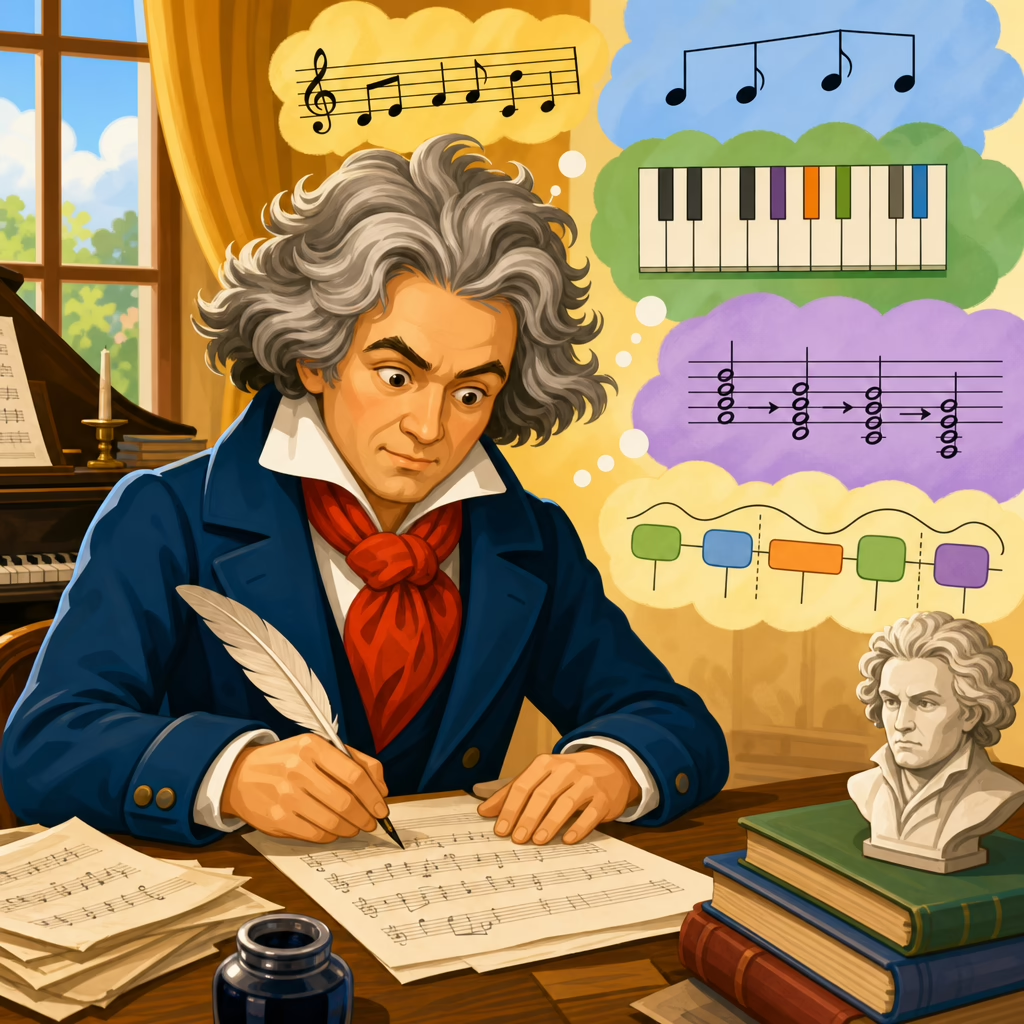
Using Beethoven’s Compositional Practices to Teach Music Theory
Using Beethoven’s compositional practices to teach music theory gives students a concrete way to connect abstract rules with musical decisions they can hear, analyze, and imitate. Beethoven is especially useful in the classroom because his works sit at the meeting point of Classical clarity and Romantic expansion, so one passage can demonstrate phrase structure, harmony, voice leading, rhythm, motivic development, form, and expressive marking at the same time. When teachers use his scores as models rather than monuments, music theory stops feeling like a list of isolated terms and starts functioning as a toolkit for composition, listening, and performance.
In practical teaching, “compositional practices” means the repeatable habits Beethoven used to build music: shaping motives, intensifying sequences, delaying cadences, varying accompaniment patterns, controlling texture, and balancing expectation with surprise. “Music theory” here includes common-practice harmony, counterpoint, formal analysis, meter, phrase rhythm, chromaticism, and score reading. I have found that students who struggle to identify a secondary dominant on a worksheet often recognize its dramatic purpose immediately when it appears in a Beethoven sonata or symphony. That shift matters because durable learning usually happens when analysis answers a real musical question.
This topic matters for a sub-pillar hub on Beethoven’s compositional tools because miscellaneous techniques often drive the strongest teaching moments. A lesson may begin with sonata form but quickly require discussion of registral contrast, pedal point, hemiola, textural thinning, or motivic compression. Beethoven’s music rewards that integrated approach. His pieces are not theory exercises; they are finished artistic statements where technical choices have audible consequences. For students, that makes him ideal. For teachers, it provides a rich center that can link outward to focused lessons on harmony, form, rhythm, piano texture, orchestration, sketch study, and revision strategies across the broader Beethoven’s Compositional Tools cluster.
Why Beethoven works so well as a theory teaching model
Beethoven works well in theory instruction because his materials are memorable, his procedures are traceable, and his results are unmistakable. A beginner can sing the four-note motive of Symphony No. 5, while an advanced student can trace how that motive governs rhythm, accompaniment, large-scale form, and dramatic pacing. That range is rare. Haydn is often subtler, Mozart often smoother, but Beethoven frequently exposes process in a way students can observe. He lets teachers ask direct questions: What changed? Why here? What expectation was created? How was tension extended?
Another advantage is the abundance of reliable editions, recordings, and scholarship. Teachers can use scores from Bärenreiter or Henle, compare interpretations by Schnabel, Brendel, Arrau, Gardiner, or Bernstein, and support observations with established analytical vocabulary. Beethoven also wrote across genres: piano sonatas, string quartets, symphonies, concertos, overtures, songs, and variation sets. That breadth means one teaching principle can be reinforced in multiple settings. For example, motivic economy appears in keyboard writing, chamber texture, and orchestral rhetoric, allowing students to transfer a concept instead of memorizing a single example.
Teaching motive, development, and unity through small cells
If a teacher wants students to understand how a tiny idea can organize a large composition, Beethoven is the clearest possible guide. He often begins with a compact cell and then transforms it through repetition, sequence, inversion, rhythmic displacement, fragmentation, and registral transfer. In lessons, I start by asking students to mark every recurrence of a motive before naming the formal section. This reverses a common mistake in theory pedagogy, where students learn form labels first and musical evidence second. With Beethoven, motive usually provides the evidence.
Symphony No. 5 in C minor remains the classic example because the opening rhythm is not just thematic decoration. It becomes accompaniment, transitional energy, connective tissue, and a large-scale signpost. Students hear unity because the motive keeps returning, but they also hear change because its context changes. That distinction is essential. Development is not mere repetition. It is repetition under pressure. In piano sonatas such as Op. 2, Op. 13, and Op. 57, Beethoven shows the same principle through keyboard figuration, where a motive may migrate into the left hand, expand into sequence, or reappear hidden inside passagework.
For classroom use, motive teaching should move from identification to invention. After analyzing a Beethoven excerpt, ask students to compose eight measures using only one intervallic cell and two rhythmic values. Then require at least three transformation types. This mirrors Beethoven’s discipline. Students quickly learn that motivic coherence does not limit expression; it creates it. They also begin to understand why development sections feel inevitable when the composer has planted strong motivic DNA from the start.
Phrase structure, cadence, and the management of expectation
Beethoven is invaluable for teaching phrase structure because he honors Classical conventions while constantly stretching them. Students can first learn normative patterns such as the period, sentence, antecedent-consequent design, half cadence, authentic cadence, and tonic expansion. Then Beethoven shows how these patterns become expressive when delayed, compressed, expanded, or disrupted. In the Piano Sonata in C minor, Op. 13, the “Pathétique,” cadential arrival is often postponed by intensified harmony and figuration, making closure feel earned rather than routine.
One practical strategy is to compare a balanced eight-measure theme from an easier sonata with a more restless opening from a middle-period work. Ask students to count measures, locate cadence types, and mark moments where Beethoven blurs phrase boundaries through elision or sequential continuation. This teaches phrase rhythm, not just phrase length. In my experience, students often know what a perfect authentic cadence is but cannot explain why one cadence sounds conclusive and another provisional. Beethoven provides that answer through context: register, dynamics, texture, bass motion, and preceding instability all shape cadential force.
His slow movements are equally useful. Many contain deceptively simple melodies whose syntax becomes rich through embellishment, appoggiaturas, and inner-voice motion. Teaching these passages helps students hear that cadence is not simply a Roman numeral event. It is a multidimensional arrival involving melody, harmony, meter, and breath. That understanding improves both analysis and performance.
Harmony, chromatic color, and controlled surprise
Students often encounter harmony as a static progression chart, but Beethoven teaches harmony as directed energy. He uses diatonic stability strategically, then introduces chromaticism to intensify motion, darken color, or redirect form. Secondary dominants, diminished seventh chords, modal mixture, Neapolitan sonorities, augmented sixths, and deceptive resolutions appear throughout his works, yet rarely as isolated textbook examples. They matter because they alter expectation.
Take the first movement of the “Moonlight” Sonata, Op. 27 No. 2. Its harmonic rhythm, sustained pedal texture, and unresolved atmosphere allow teachers to discuss prolongation, inversion, nonchord tones, and tonal ambiguity without forcing the music into simplistic labels. By contrast, the “Waldstein” Sonata, Op. 53, is excellent for showing long-range harmonic planning, especially the role of dominant preparation and remote key relationships within a clearly articulated form. In string quartets, Beethoven often sharpens harmonic argument through conversational voice leading, making each chromatic inflection audible as a structural event rather than surface ornament.
| Teaching concept | Useful Beethoven example | What students should listen for |
|---|---|---|
| Motivic unity | Symphony No. 5, first movement | How one rhythm controls theme, accompaniment, and transition |
| Phrase expansion | Piano Sonata Op. 13, first movement | Cadential delay, sequential continuation, heightened closure |
| Chromatic predominants | Piano Sonata Op. 57, first movement | Neapolitan and intensified pre-dominant tension before arrival |
| Variation technique | 32 Variations in C minor, WoO 80 | Bass pattern continuity under changing texture and character |
| Texture and register | “Moonlight” Sonata, first movement | Pedal resonance, spacing, and harmonic blur shaping expression |
When teaching chromatic harmony through Beethoven, accuracy matters. Students should learn standard function, but they also need to hear exceptions and ambiguities. A chord can prolong, color, or destabilize without fitting a neat one-word category. Beethoven’s writing encourages that mature view. He proves that analysis is strongest when it explains sound, not when it merely names symbols.
Rhythm, meter, and the drama of propulsion
Beethoven’s rhythmic language is one of the fastest ways to make theory feel alive. He uses syncopation, sforzando accents, offbeat repetition, hemiola-like reinterpretation, rests, and metric disruption to create forward drive. In many student analyses, rhythm receives less attention than harmony because it seems harder to quantify. Beethoven corrects that imbalance. His rhythmic choices often determine how harmonic and formal events are perceived.
The scherzos are prime teaching material. They show how humor, menace, and momentum can arise from accent pattern alone. In the Seventh Symphony, for instance, repeated rhythmic cells generate irresistible motion, allowing instructors to discuss ostinato, hypermeter, and phrase-level momentum. In piano works, sudden silences are equally important. A rest placed before a cadential arrival can feel more dramatic than another chord. Students learn that omission is also a compositional tool.
A useful classroom exercise is to strip a Beethoven passage to rhythm only by tapping or speaking counts. Once the pitch content disappears, students notice where momentum increases, where meter feels destabilized, and how repeated accents shape expectation. Reintroducing pitch afterward shows that rhythm and harmony cooperate rather than compete. This also helps performers, who often solve “difficult” Beethoven by clarifying underlying pulse and accent hierarchy instead of simply playing louder.
Texture, register, and variation as practical teaching bridges
Miscellaneous teaching topics often become most productive when handled through texture, register, and variation. Beethoven constantly alters density, spacing, accompaniment pattern, and registral placement to restate material without weakening identity. That makes him ideal for assignments that connect analysis to composition. A student who cannot yet write a full sonata can still learn to vary a theme by changing register, thinning texture, converting block chords to arpeggiation, or moving melody into an inner voice.
The Diabelli Variations, Op. 120, and the 32 Variations in C minor, WoO 80, are especially effective because they let teachers isolate one parameter at a time. One variation may preserve bass design while transforming rhythm; another may keep phrase outline while altering texture and mode. This teaches a core lesson: variation is not decoration added after the fact. It is structural thinking. Beethoven understood that listeners need continuity and contrast in carefully measured proportion.
This hub page also points naturally to deeper articles within the Beethoven’s Compositional Tools topic. A lesson on texture can lead to focused study of accompaniment patterns in the piano sonatas, orchestral doubling in the symphonies, contrapuntal compression in late quartets, sketchbook evidence of revision, or the role of dynamic markings in shaping formal perception. That internal structure benefits readers and teachers alike because Beethoven’s miscellaneous techniques rarely remain miscellaneous for long; they connect directly to every major area of music theory pedagogy.
Teaching music theory through Beethoven’s compositional practices works because it joins technical precision with audible purpose. Students do not just label motives, cadences, and chromatic chords; they hear how those devices create tension, continuity, surprise, and release. Beethoven is uniquely effective as a hub for miscellaneous theory topics because his works expose process clearly enough for beginners while remaining rich enough for advanced analysis. Whether the lesson concerns phrase rhythm, harmonic direction, texture, variation, or metric energy, his music provides examples that are specific, memorable, and transferable to composition and performance.
The main benefit is integration. Instead of treating harmony, form, rhythm, and expression as separate classroom units, Beethoven shows how they operate together inside real pieces. That approach improves analytical writing, aural skills, and creative work because students learn to ask not only what a device is, but what it does. If you are building a curriculum or a content cluster around Beethoven’s compositional tools, use this miscellaneous hub as the starting map, then branch into focused studies with scores, recordings, and short writing assignments that turn observation into musicianship.
Frequently Asked Questions
Why is Beethoven especially effective for teaching music theory?
Beethoven is especially effective in music theory instruction because his music makes theoretical concepts audible, visible, and memorable all at once. Students are not just learning rules in isolation; they are hearing how those rules become expressive choices inside real pieces. His works are ideal for this because they stand at a productive intersection between Classical balance and Romantic intensity. That means a single excerpt can demonstrate clear phrase structure, functional harmony, motivic economy, rhythmic drive, voice leading, formal design, and expressive nuance without feeling artificially constructed for the classroom. In practical teaching terms, this helps students connect the abstract language of theory to concrete musical events they can recognize and discuss.
Another reason Beethoven works so well pedagogically is that his compositional process is often highly traceable. He regularly builds large passages from small motives, reshapes familiar patterns, delays expected cadences, intensifies harmonic motion, and manipulates texture to create momentum. These are exactly the kinds of strategies theory teachers want students to notice. Instead of presenting harmony, counterpoint, rhythm, and form as separate units, Beethoven allows teachers to show how they interact. For example, a cadence is not just a harmonic label; it may be weakened by inversion, interrupted by rhythmic displacement, expanded by sequence, or intensified by dynamics and register. This integrated quality makes his music exceptionally rich for analysis and discussion.
Just as importantly, Beethoven’s music rewards students at different levels. Beginners can identify periods, tonic-dominant relationships, and basic motivic repetition, while more advanced students can examine chromaticism, formal ambiguity, enharmonic reinterpretation, and long-range structural planning. Because the repertory is so widely taught and recorded, students can also compare performances and hear how analytical understanding affects interpretation. In short, Beethoven is effective not simply because he is historically important, but because his music vividly demonstrates how theory operates as a living musical language.
Which music theory topics can be taught most successfully through Beethoven’s works?
Beethoven’s works can support instruction across nearly the full range of core music theory topics, making them unusually versatile for classroom use. Phrase structure is one of the strongest areas. His themes often present clear examples of antecedent-consequent design, sentence structure, phrase expansion, and cadential articulation, allowing students to study how formal expectations are established and then modified. Harmony is another major strength. Teachers can use Beethoven to illustrate tonic and dominant functions, predominant harmonies, applied chords, modulation, chromatic intensification, and the dramatic effect of harmonic delay. Because these harmonic events are embedded in compelling musical contexts, students are more likely to understand why they matter.
His music is also especially effective for teaching motivic development. Beethoven is famous for generating large-scale coherence from small rhythmic or melodic cells, and this helps students understand that motives are not decorative fragments but structural tools. A short idea can be sequenced, fragmented, inverted, rhythmically altered, or transferred into different voices and textures. This creates ideal examples for teaching thematic unity, developmental technique, and the relationship between local detail and large-scale form. Rhythm and meter are equally important. Beethoven often energizes a passage through syncopation, metric ambiguity, offbeat accents, repeated-note figures, and persistent rhythmic motives, all of which can sharpen students’ awareness of musical motion.
Form is another topic that benefits greatly from Beethoven-based instruction. Sonata form, variation form, rondo procedures, scherzo design, and developmental expansion can all be explored through his repertoire. His works also open the door to discussions of voice leading, texture, orchestration or pianistic writing, expressive markings, and style history. Because he frequently stretches conventions rather than simply following them, students learn not only what a form or progression is supposed to do, but how composers manipulate expectations for expressive and structural effect. This makes Beethoven especially valuable for moving students beyond rule memorization toward interpretive, context-sensitive musicianship.
How can teachers use Beethoven’s compositional practices to make abstract theory concepts easier for students to understand?
Teachers can make abstract theory concepts easier to understand by treating Beethoven’s music as a set of musical decisions rather than as untouchable masterpieces. Instead of beginning with a definition and stopping there, instructors can present a short passage and ask what problem Beethoven appears to be solving: how to extend a phrase, intensify a cadence, unify a movement, or move from one key area to another. Once students hear and see the decision in context, theoretical terminology becomes much more meaningful. A sequence is no longer just a pattern on the page; it is a way to build momentum. A predominant is no longer just a category; it is part of a directed harmonic motion toward cadence. This approach turns theory into an explanation of musical action.
One especially effective method is guided score study. A teacher might isolate a small excerpt and ask students to identify the motive, mark phrase boundaries, label cadences, trace bass motion, or map harmonic rhythm. From there, students can compare surface simplicity with deeper structural sophistication. For example, a passage may sound straightforward while containing subtle voice-leading control, register shifts, and phrase expansion. By working from listening to notation to analysis, students learn that theory is not detached from sound. They learn to connect what they hear with what they see and then with the vocabulary used to describe it.
Imitation and recomposition are also powerful strategies. After analyzing a Beethoven theme, students can be asked to write a parallel period, continue a motive through sequence, reharmonize a phrase, or compose a brief developmental passage using fragmentation and modulation. This is often where true understanding becomes visible. If students can imitate the compositional logic, they are much more likely to have absorbed the theory behind it. Beethoven is particularly suitable for this because his music often reveals a strong, graspable relationship between a basic idea and its transformation. That clarity helps students move from passive recognition to active application, which is where durable learning happens.
What are the best Beethoven pieces or excerpts to use in a music theory classroom?
The best Beethoven excerpts for teaching depend on the level of the class and the concept being emphasized, but several works are consistently effective because they combine accessibility with analytical richness. Piano sonatas are often the most practical starting point. They are widely available, manageable in length, and full of clearly teachable examples. Themes from sonatas such as the “Pathétique,” “Moonlight,” “Waldstein,” and “Appassionata” can be used to teach phrase design, harmonic tension, texture, motivic work, and formal contrast. Even very short openings can provide enough material for substantial discussion. Teachers do not always need to assign an entire movement; a carefully chosen excerpt can carry multiple lessons at once.
Symphonic works are also extremely valuable, especially for form, orchestral texture, and large-scale motivic thinking. The opening movement of Symphony No. 5 is perhaps the most famous example of concentrated motivic development in Western music and can help students understand how a tiny rhythmic idea can shape an entire movement. Symphony No. 3, the “Eroica,” offers excellent material for expanded form, tonal drama, and formal innovation, while Symphony No. 7 can be especially useful for rhythm, ostinato-like propulsion, and phrase tension. String quartets and chamber works can also be very effective because their textures often make contrapuntal relationships and inner-voice activity easier to follow.
For developing students, simpler and more concise materials may be best, including themes, slow movements, variation movements, and sets of dances or bagatelles. Shorter keyboard works can provide approachable examples of cadence, sequence, accompaniment patterns, and formal balance without overwhelming students. For advanced learners, late Beethoven opens opportunities to discuss ambiguity, compression, expansion, remote key relations, and the boundaries of Classical syntax. The key is to select excerpts with a clear pedagogical purpose. A passage should not be used merely because it is famous, but because it demonstrates a concept with exceptional clarity while still allowing students to hear theory functioning as expressive musical thought.
How does studying Beethoven help students move from analysis to composition and performance?
Studying Beethoven helps students move from analysis to composition and performance because his music shows theory as a practical creative resource rather than a descriptive afterthought. In composition, students can observe how a small motive becomes the seed of an entire section, how a phrase can be expanded without losing coherence, or how harmonic pacing shapes dramatic trajectory. These observations can then become compositional models. A student who has analyzed Beethoven’s use of repetition, sequence, liquidation, cadential delay, or registral intensification can try the same techniques in original work. This creates a direct bridge from analytical insight to creative action. Theory becomes something students use, not just something they identify.
The same is true in performance. Analytical understanding helps performers make more informed decisions about phrasing, articulation, dynamics, pacing, balance, and character. If a pianist understands that a passage is a continuation rather than a presentation, or that a cadence has been intentionally weakened, that knowledge can influence timing and emphasis. If a chamber ensemble recognizes a motive being passed between voices or hears a harmonic arrival as structurally decisive, their interpretation can become more coherent and communicative. Beethoven’s music is especially rewarding in this respect because expressive impact is so often tied to structural detail. Performers who understand the underlying design are better equipped to shape the musical surface convincingly.
Perhaps most