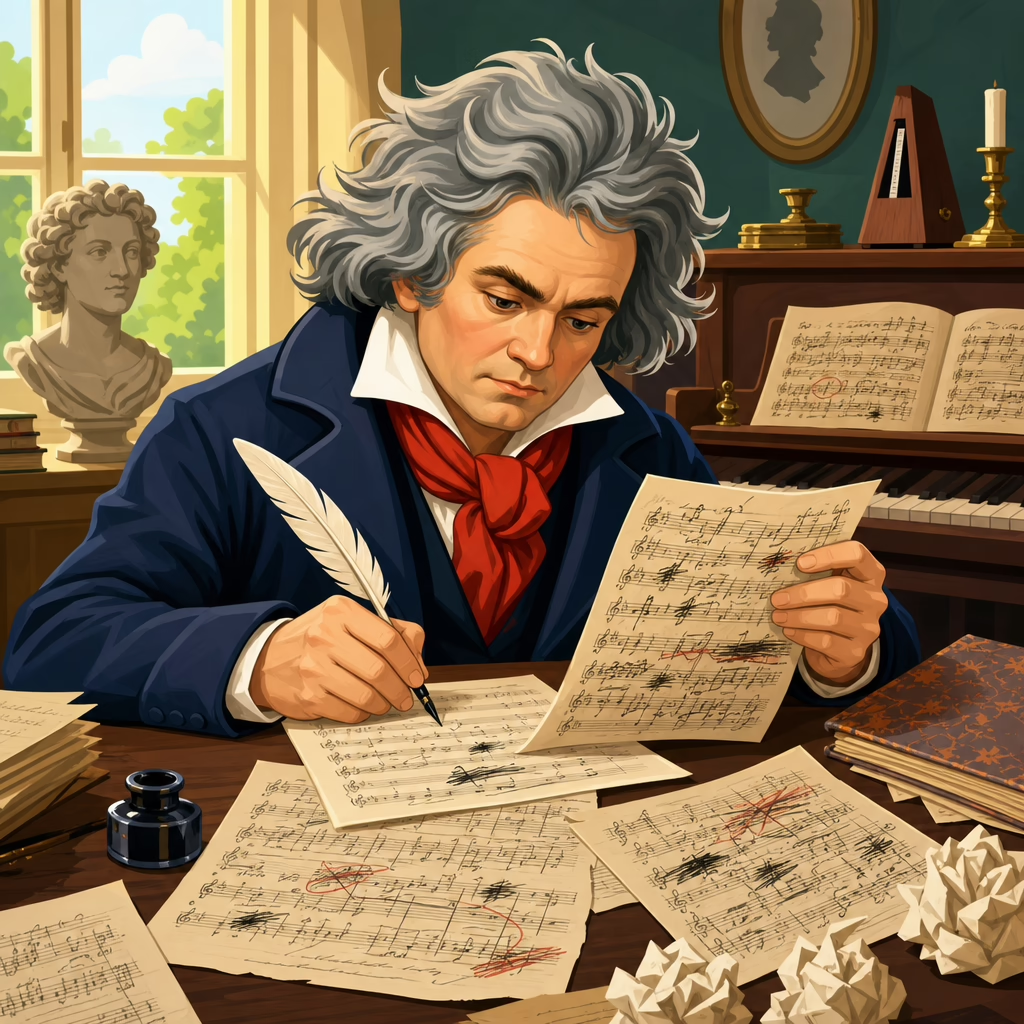
What Manuscripts Reveal About Beethoven’s Editing Process
What manuscripts reveal about Beethoven’s editing process is not simply how a composer corrected notes, but how he thought, tested, doubted, and rebuilt musical ideas until they carried the exact force he wanted. In practical terms, a manuscript can mean an autograph score in Beethoven’s hand, a sketchleaf filled with fragments, a desk sketchbook, a conversation book, or a copy marked for engravers and performers. Together, these documents show composition as revision. They matter because Beethoven’s reputation for inevitability—the sense that a theme had to unfold exactly as it does—was created through visible struggle, not effortless inspiration. Anyone studying Beethoven’s compositional tools eventually arrives at the manuscripts, since they connect every other object in his working world: pianos, quills, paper types, publishers, copyists, and the physical habits of drafting music under pressure.
I have worked through digital facsimiles and critical editions of Beethoven sources, and the recurring lesson is clear: the crossings-out are as informative as the surviving notes. Beethoven often drafted multiple rhythmic shapes before stabilizing a motive, shifted phrase lengths to sharpen momentum, and revoiced textures so inner parts carried structural weight. His manuscripts also preserve decisions made late, sometimes after a copy had already been prepared for print. For readers exploring the broader Miscellaneous branch of Beethoven’s compositional tools, this article serves as a hub: it explains what kinds of manuscripts survive, what they reveal about revision, how editors and scholars read them, and where they link to related subjects such as sketchbooks, paper studies, notation practice, copyists, and first editions. The central point is simple. Beethoven edited by composing and composed by editing.
What counts as a Beethoven manuscript, and why do source types matter?
Not all manuscripts answer the same question. A small sketchleaf may show the birth of a motive, while a near-complete autograph score can reveal orchestration, articulation, and formal balancing at a later stage. Desk sketchbooks, used heavily from the middle period onward, preserve sequential thinking: short ideas, harmonic tests, contrapuntal trials, and reminders to expand passages elsewhere. Autograph scores usually show a more continuous layer of work, though they still contain deletions, inserted leaves, and overwritten bars. Then there are Stichvorlagen, or engraver’s copies, which may contain Beethoven’s last-minute corrections added after copyists prepared a cleaner text. If you want to know whether a sforzando was a first impulse or a late emphasis, the source type matters.
These distinctions matter because Beethoven’s editing process was cumulative. Unlike composers who left relatively clean autographs, he often moved material across stages. A motive could appear first as a skeletal rhythm, then as a harmonic cell in a sketchbook, then as a developed passage in a draft score, and finally as a refined version with altered dynamics in a copy for publication. Scholars use source criticism to map this chain. They compare handwriting layers, ink color, paper rastra ruling, watermarks, and pagination. The standard modern resource is the critical edition, especially the Beethoven Gesamtausgabe and associated critical reports, which collate variants and explain where one source corrects or complicates another. Reading these reports alongside facsimiles prevents the common mistake of treating a printed score as Beethoven’s singular, fixed intention.
How Beethoven revised motives, rhythm, and form on the page
The clearest window into Beethoven’s editing process is motivic revision. He rarely treated a theme as a finished melody that simply arrived complete. More often, he tested short cells for interval profile, rhythmic grip, and developmental usefulness. In sketch materials for works across the heroic period, one sees him stripping an idea down to a few notes and then changing accent placement, shortening note values, or shifting the point of harmonic arrival. These are not cosmetic changes. They determine whether a motive can drive a movement. Beethoven wanted themes that could be fragmented, sequenced, inverted, displaced, and recontextualized without losing identity.
Rhythm was especially subject to revision. I repeatedly notice in Beethoven manuscripts that apparently small rhythmic edits alter the energy of an entire span. Dotted figures become more urgent when he compresses rests; syncopations become clearer when surrounding textures are simplified; repeated notes gain rhetorical force when dynamics and articulation are adjusted together. In movements where we hear overwhelming inevitability, the manuscript often shows alternatives that were more square or less volatile. He edited away predictability. This is one reason the final versions feel so concentrated: weak transitions, overlong sequential passages, and merely decorative figuration were often reduced or repurposed.
Form also emerged through revision rather than preset design. Beethoven did not always begin with a complete architectural plan that he simply filled in. Sketches can show uncertainty about transition length, recapitulation strategy, or coda scale. In some works the coda expands dramatically late in the process, becoming a second development rather than a routine ending. In others he rebalances the exposition by clarifying harmonic goals and thematic contrast. This is crucial for understanding his mature style. Beethoven’s forms feel monumental because he edited local details in service of long-range tension. The manuscript is where that tension becomes visible.
What physical marks reveal: deletions, insertions, paper, and layout
Beethoven’s manuscripts are materially eloquent. A thick cancellation line can show decisive rejection, but lighter overwriting may indicate hesitation or practical reuse of expensive paper. Inserted slips and pasted patches often mark expansion: he ran out of room because an idea grew. Crowded systems can indicate that he drafted faster than the page comfortably allowed, while a sudden cleaner stretch may reflect copying after prior work elsewhere. The layout itself matters. When staves are widely spaced, he may have left room for inner voices or later corrections. When systems become compressed near a page turn, pragmatic constraints can affect notation density and the legibility of revision.
Paper study has become one of the most reliable ways to track chronology. Watermarks, chain lines, and rastral patterns can link leaves to known batches of paper Beethoven used in Vienna at particular times. This helps scholars determine whether passages were conceived together or assembled from different moments. Alan Tyson’s work on paper and chronology fundamentally changed Beethoven studies by showing that source dating cannot rely on style alone. A manuscript page is therefore not just a carrier of music; it is evidence with forensic value. For readers moving deeper into this Miscellaneous hub, paper types, quill usage, and workspace conditions deserve their own attention because they directly shaped how revision happened.
| Manuscript feature | What it often indicates | Why it matters for editing |
|---|---|---|
| Heavy crossings-out | Decisive rejection of a passage or voicing | Shows options Beethoven abandoned, not just errors |
| Inserted leaves or pasted slips | Expansion or replacement after initial drafting | Reveals late structural growth, especially transitions and codas |
| Different ink or handwriting layers | Work completed at different times or by copyists | Helps separate first thoughts from later corrections |
| Watermark and paper-stock matches | Chronological relationship between leaves | Supports dating and reconstruction of compositional sequence |
| Added dynamics and articulation | Refinement of rhetoric and performance intent | Shows Beethoven editing expression, not only pitch |
Case studies: what specific works show about Beethoven’s revision habits
The sketch tradition behind the “Eroica” Symphony demonstrates Beethoven’s willingness to remake large-scale argument from small cells. Surviving materials show persistent work on thematic contour, bass motion, and formal pacing. The first movement’s drive depends on motivic compression and harmonic thrust, yet those qualities were earned through reworking. In the finale, Beethoven revisits material tied to earlier uses of the Prometheus theme, and the manuscripts reflect transformation rather than simple reuse. He was not recycling; he was testing how known material could carry new structural weight inside a symphonic context.
The Fifth Symphony offers another textbook example. Its famous opening seems elemental, but the documentary record surrounding Beethoven’s working methods makes clear that elemental does not mean unedited. The economy of the motive, the balance between insistence and flexibility, and the cumulative handling of transitions all point to a composer refining every bar for developmental potential. In practical editorial terms, Beethoven’s process often involved reducing material to what could survive relentless repetition and modulation. What remains in the final score is not the first idea, but the hardest-working idea.
The piano sonatas are equally revealing because the medium allowed rapid experimentation. In autograph and sketch sources for sonatas from the middle and late periods, one can watch Beethoven alter pedaling implications, register placement, accompaniment patterning, and the spacing of chords. He frequently rewrote passagework so it felt more idiomatic at the keyboard while still intensifying expression. The “Hammerklavier” tradition especially reminds us that difficulty itself could be revised into a structural tool: texture, range, and rhythmic concentration become part of argument, not display. Manuscripts show that virtuosity in Beethoven is usually engineered, not ornamental.
The late quartets and late piano sonatas reveal perhaps the most sophisticated layer of manuscript evidence. Here Beethoven’s revisions often concern continuity between radically contrasting sections, contrapuntal density, and the exact notation of articulation and phrasing. Because these works challenge performers with ambiguity, the sources are invaluable. A slur extended by one note, an accent added to a weak beat, or a rewritten inner voice can change the logic of a passage. Manuscripts show Beethoven editing for intelligibility inside complexity. Even when the music sounds visionary, the page records practical problem-solving.
How copyists, publishers, and performers shaped late-stage editing
Beethoven’s editing process did not end when he completed an autograph. Copyists were essential intermediaries, and their errors or normalizations often prompted another round of correction. Beethoven could be impatient with copyists, but he depended on them, especially for large projects and publication deadlines. A copyist’s fair copy might trigger new changes in dynamics, phrasing, or even notes because seeing the work in cleaner form exposed weaknesses. This is a pattern I have seen repeatedly in source comparisons: a legible copy becomes a diagnostic tool. It allows the composer to edit more critically than a cluttered draft might permit.
Publishers also affected revision. Engraving introduced constraints of space, readability, and market timing. Beethoven corrected proofs intensely, and first editions sometimes preserve late intentions absent from earlier manuscripts. At the same time, printed texts can introduce fresh errors, so no single source should be treated as infallible. This is why critical editors weigh autograph, copy, proof, and edition against one another. For performers, the implication is important. Markings in modern scores may represent editorial choices among conflicting sources. Understanding the documentary chain encourages informed interpretation rather than blind obedience to one printed page.
Performance itself could feed back into editing. Beethoven’s own playing, the capacities of Viennese pianos, and the abilities of specific musicians all influenced revision. If a passage projected weakly, he might thicken the texture or sharpen articulation. If balance failed in ensemble, he could redistribute material. This practical side is easy to miss when Beethoven is treated only as a heroic genius. The manuscripts show a working musician responding to acoustics, instruments, players, and deadlines. Revision was not merely abstract perfectionism; it was a way to make the music function in real conditions.
How scholars reconstruct Beethoven’s process, and what readers should explore next
Reconstructing Beethoven’s editing process requires combining several methods. Source criticism compares all surviving documents. Paleography studies handwriting and notational habits. Paper analysis dates leaves and groups them by stock. Digital facsimiles from institutions such as the Beethoven-Haus Bonn make side-by-side comparison easier than ever, while modern critical reports explain variant readings in technical detail. No method works alone. A dynamic added in darker ink might be late, but without paper evidence and source order, conclusions remain tentative. Good Beethoven scholarship is cumulative and careful, not speculative.
For readers using this article as a hub within Beethoven’s Compositional Tools, the best next steps are clear. Explore sketchbooks to see early invention in motion. Study paper and watermark analysis to understand chronology. Read about copyists and engravers to follow transmission from draft to print. Compare autograph scores with first editions to see where late revisions entered the record. Look at notation practices—slurs, accents, pedal marks, and beaming—because Beethoven edited expression through signs as much as through pitches. Finally, connect manuscripts to instruments. The action, range, and sustaining behavior of Beethoven’s pianos often explain why a rewritten passage became more playable, more resonant, or more radical.
Beethoven’s manuscripts reveal an editing process grounded in relentless testing. He revised motives until they could generate whole movements, altered rhythms until they carried undeniable momentum, reshaped forms to intensify long-range drama, and refined notation so performers could project structure and character. Physical details on the page—crossings-out, inserted leaves, ink changes, paper stocks, and copyists’ interventions—turn abstract admiration into concrete evidence. They show that Beethoven’s greatness was not the absence of struggle, but mastery through revision.
That is the main benefit of studying these sources. Manuscripts let us hear the finished works more accurately because they teach us what Beethoven cared enough to change. They also unify the wider Miscellaneous field within Beethoven’s compositional tools by linking documents, materials, collaborators, and performance realities into one working process. If you want a deeper understanding of Beethoven beyond the polished score, follow the paper trail: start with the sketchbooks, move to autograph scores and engraver’s copies, and read critical editions alongside facsimiles. The edits are where Beethoven becomes most human and most formidable.
Frequently Asked Questions
What kinds of manuscripts help scholars understand Beethoven’s editing process?
Several different types of manuscripts shed light on how Beethoven revised and refined his music, and each one captures a different stage of his working method. Autograph scores, written in Beethoven’s own hand, are among the most valuable because they often preserve direct corrections, overwritten passages, erased ideas, altered dynamics, and changes to articulation or structure. These documents can show where a piece was still fluid even late in the compositional process. Sketchleaves are equally important, though they often look less orderly. A single page may contain tiny motifs, harmonic experiments, rhythmic cells, abandoned themes, and quick tests of transitions, all crowded together. That apparent disorder is precisely what makes them so revealing: they document musical thinking before it was stabilized.
Desk sketchbooks and larger bound books provide an even broader record. They allow scholars to trace how Beethoven returned to ideas over time, carrying a fragment from one context into another, expanding a short motive into a substantial section, or testing multiple versions of a single passage. Marked copies prepared for engravers or performers also matter because they show that revision did not stop once a draft existed. Beethoven continued adjusting tempo indications, expression marks, phrasing, and even notes as works moved toward publication or performance. Conversation books, while not music manuscripts in the strictest sense, can also add context by documenting practical concerns, communication with assistants or visitors, and aspects of his daily working environment. Taken together, these sources show that Beethoven’s editing process was not a final cleanup phase. It was woven into composition itself from beginning to end.
How do Beethoven’s manuscripts show that composition was really a process of revision?
Beethoven’s manuscripts make it clear that he did not simply hear a finished piece in his mind and write it down unchanged. Instead, they reveal a composer who repeatedly tested, challenged, and reworked his material. In many surviving pages, one can see a musical idea appear in a brief or rough form, then be crossed out, expanded, compressed, transposed, or rhythmically altered. A theme may begin as a small gesture and then gradually acquire the contour, harmonic weight, and formal role it needed. Passages are often rewritten not because they were incorrect, but because Beethoven was searching for greater clarity, energy, balance, or expressive intensity.
This is one of the most important lessons the manuscripts teach. Revision for Beethoven was not merely corrective. It was creative. He used rewriting as a way to think. By comparing sketch stages with later versions, scholars can observe how he sharpened motivic relationships, strengthened transitions, adjusted textures, and intensified contrasts. Sometimes the edits are microscopic, such as changing a rhythm, accent, or dynamic marking. At other times they are structural, involving reordered sections, newly developed codas, or major reimagining of the musical argument. The evidence across these documents strongly supports the idea that Beethoven built his works through sustained experimentation. The finished score, however inevitable it may sound today, was often the result of many layers of deliberate revision.
What do crossings-out, insertions, and rewritten passages reveal about Beethoven’s musical thinking?
These visible marks are among the clearest signs of Beethoven’s inner decision-making. A crossing-out does not simply mean that he rejected a bad idea. Often it means he found a stronger one, or realized that a passage was not yet carrying the dramatic or structural force he wanted. Insertions can show where he felt something was missing, perhaps a stronger transition, a more convincing harmonic preparation, a sharper accent, or an extra measure needed to control momentum. Rewritten passages may reveal that he was recalibrating how a listener would experience tension, release, continuity, and surprise.
What makes these details especially valuable is that they allow us to see Beethoven’s priorities at work. He was intensely concerned with the power of motives, the architecture of form, and the expressive precision of details such as articulation and dynamics. When a phrase is rewritten several times, scholars can often see him moving toward greater concentration and inevitability. When textures are thinned or thickened, it may indicate a search for clearer voicing or stronger dramatic contrast. Even messy notation can be informative, because it captures a mind in motion rather than a polished presentation copy. In this sense, the physical traces on the page are not peripheral evidence. They are direct records of Beethoven evaluating his own ideas and pushing them toward maximum expressive effect.
Why are Beethoven’s manuscripts so important for performers, editors, and music historians?
For performers, Beethoven’s manuscripts offer a richer understanding of how his music breathes, resists, and unfolds. A printed edition presents one stabilized version of a work, but manuscripts can reveal uncertainty, emphasis, and alternatives that deepen interpretive choices. A performer studying these sources may better understand why a sforzando matters in one location, why a phrase needs propulsion rather than smoothness, or why a seemingly small rhythmic figure has structural importance. The manuscripts can also expose places where later editorial traditions simplified or regularized details that may originally have been more pointed or unusual.
For editors, the value is equally significant. Beethoven’s music often survives in multiple source layers, including sketches, autograph scores, copyists’ manuscripts, corrected proofs, and first editions. Establishing a reliable text requires comparing these materials carefully, weighing inconsistencies, and deciding which reading best reflects Beethoven’s intentions at a given moment. Since he sometimes revised even during engraving or rehearsal, the editorial task is not always straightforward. Music historians, meanwhile, use the manuscripts to understand broader questions about style, working habits, chronology, and artistic development. These sources help explain how Beethoven transformed inherited Classical procedures into something more volatile, concentrated, and expansive. In short, the manuscripts are not only relics of authorship. They are working documents that illuminate performance, scholarship, and the evolution of musical thought.
What broader picture of Beethoven emerges when we study his manuscripts closely?
A close study of Beethoven’s manuscripts reveals a composer defined not by effortless inspiration, but by relentless refinement. The documents show someone willing to doubt his first impulses, dismantle passages that were merely adequate, and rebuild musical material until it achieved exact expressive and structural impact. That picture is deeply human as well as artistically impressive. It replaces the simplistic myth of genius as instant perfection with a more compelling reality: genius as persistence, self-critique, and imaginative discipline.
These manuscripts also show how interconnected Beethoven’s creative life was. His sketches, autograph pages, marked copies, and related documents collectively suggest that composing, editing, and rethinking were inseparable activities. He did not move cleanly from idea to draft to finished work in a linear way. Instead, he circulated among possibilities, revisiting and reshaping material as the piece’s identity became clearer. That broader picture matters because it changes how we hear the music. We begin to recognize not just brilliance in the final result, but the pressure of choices behind it. The manuscripts reveal Beethoven as a composer who forged musical inevitability through labor, experiment, and revision. That is precisely why they remain so important: they let us witness creation not as a mystery hidden behind the score, but as an active, visible process on the page.