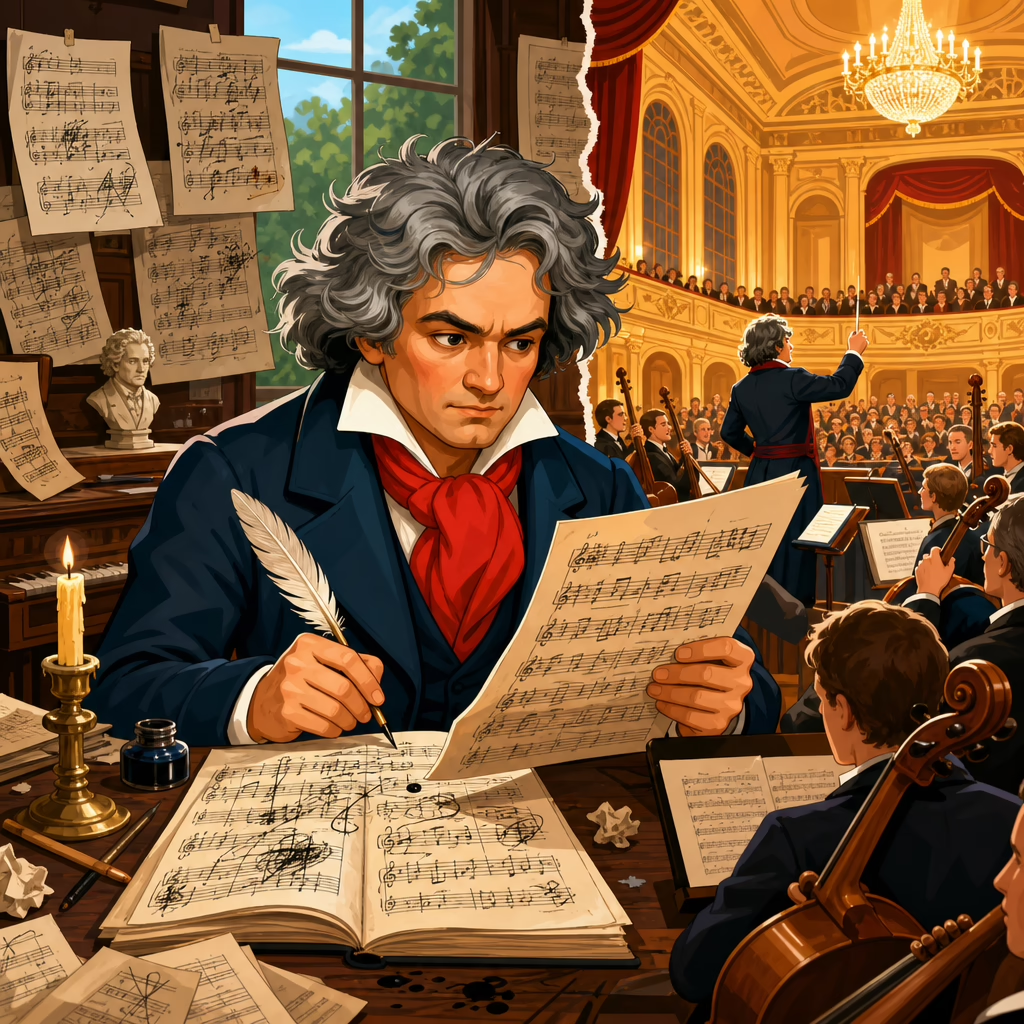
Beethoven’s Orchestration Notes: What Changed Between Draft and Premiere
Beethoven’s orchestration notes reveal a practical side of genius: the score heard at a premiere was often the result of revision, not a fixed idea preserved unchanged from first draft. In this subtopic hub for Beethoven’s Compositional Tools, “miscellaneous” means the working materials that do not fit neatly into harmony, form, or motive alone—margin instructions, added wind doublings, altered brass cues, rewritten tuttis, rehearsal annotations, copyist interventions, and last-minute performance adjustments. These details matter because orchestration is not decoration in Beethoven; it is structure, rhetoric, pacing, and dramatic force. When instrumentation changes, balance changes, and when balance changes, listeners perceive theme, harmony, and tension differently. I have spent years comparing autograph leaves, early copies, and first-edition readings, and the recurring lesson is simple: Beethoven treated orchestration as a living problem to be solved under real conditions.
Drafts, sketchbooks, Stichvorlagen, and parts tell different stages of that problem. A sketch may show the harmonic design and thematic profile while leaving instrumental allocation fluid. A fair copy can stabilize broad scoring but still contain blank spaces, cue notes, or overwritten dynamics. Premiere materials may add the most revealing evidence of all: practical corrections for available players, halls, instruments, or ensemble limits. For readers exploring Beethoven’s Compositional Tools, this hub explains what typically changed between draft and premiere, why those changes happened, and how to read the evidence without forcing a false idea of a single “final” intention. It also points toward related articles on sketch studies, wind writing, timpani usage, string articulation, copyist practice, and performance materials, because miscellaneous evidence often connects every other compositional tool Beethoven used.
What orchestration notes are and where the evidence survives
Orchestration notes are any written traces that show Beethoven refining instrumental deployment. They include explicit verbal reminders such as “clarini” or “fagotti,” added staves in autograph score, crossed-out doublings, rehearsal instructions in parts, dynamic adjustments made after hearing rehearsals, and corrections entered by copyists under the composer’s supervision. The surviving sources are uneven. Some works preserve dense sketchbook evidence, while others depend more on partial autographs, manuscript copies, and printed first editions. Scholars regularly triangulate among the autograph score, contemporaneous parts, early editions, and documented premiere circumstances. That method matters because no single source reliably captures every late change.
For Beethoven, orchestration problems were inseparable from production realities. Vienna’s theater orchestras differed from court ensembles in size, training, and available instruments. Natural horns and trumpets had limited chromatic resources; timpani technique varied by player; clarinet parts depended on the instruments and specialists available; string strength could overwhelm or disappear depending on room size. Beethoven knew this from direct experience as pianist, conductor, and collaborator with copyists and performers. His notes therefore often respond to concrete constraints: redistribute a line to bassoons because viola projection is weak, reinforce a cadence with trumpets and timpani because a hall blurs rhythmic attack, or simplify inner figuration when rehearsal time is short. These are not trivial edits. They show compositional judgment under pressure.
What usually changed between draft and premiere
The biggest category of change is reinforcement. A melody first assigned to one choir may later gain doubling at the octave or unison to secure clarity. Beethoven frequently thickened climaxes by adding wind support to strings, especially in tuttis where thematic identity had to cut through texture. Another common category is subtraction. He often removed busy inner lines that looked effective on paper but clouded harmony in performance. Rebalancing, not mere expansion, defines many premiere-stage revisions.
Rhythmic articulation also changed. Drafts can show broad gestures that later acquire sforzandi, rests, slurs, or tremolo patterns to sharpen attack. In Beethoven, these markings alter orchestration because articulation determines which instruments project and which recede. A horn note with an accent behaves differently in the texture than the same pitch without one. Likewise, a string tremolo can transform background harmony into active suspense. Finally, transitions often received the latest attention. Beethoven revised modulating passages, codas, and reentries because those moments are acoustically risky: balance slips, thematic return must register instantly, and formal proportion can sag if scoring is too thin or too dense.
| Type of change | Typical reason | Plain-language effect at the premiere |
|---|---|---|
| Added wind doubling | Clarify theme over thick strings | The melody becomes easier to hear |
| Reduced inner motion | Avoid harmonic blur | The texture sounds cleaner and stronger |
| Extra brass/timpani at cadence | Strengthen formal arrival | Important endings land with certainty |
| Rewritten articulation | Improve attack and ensemble precision | Rhythm feels tighter and more dramatic |
| Redistributed lines | Match available players and instruments | Balance improves without changing the idea |
Why Beethoven revised orchestration late
Late revision did not mean uncertainty in the weak sense; it reflected Beethoven’s habit of testing ideas against sound. He composed through iteration. Sketch studies show him generating alternatives for motive, register, and accompaniment pattern before locking down instrumentation. Once the music reached copying and rehearsal, another layer began: evaluation in actual acoustic space. A passage that reads powerfully in score can fail in a theater if the bass line lacks definition or if horns cover a syncopated string figure. Beethoven listened for that failure and corrected it.
Another reason was the technology of his orchestra. Natural horns and trumpets functioned through harmonic series rather than valves, so key area directly affected available notes and tone color. Woodwinds were less mechanically standardized than modern instruments, making some passages more practical than others. String setup, bowing norms, and seating also influenced projection. Beethoven’s orchestration notes often show awareness of these limits. He did not write abstractly for “horn” or “clarinet” in a modern generic sense; he wrote for specific capabilities. When circumstances differed from expectation, the score adapted.
Institutional conditions mattered too. Premiere deadlines were tight, copying errors were common, and rehearsal time could be inadequate. In such contexts, a composer might simplify exposed counterpoint, add cues to prevent missed entries, or strengthen unisons to keep ensemble intact. Beethoven’s reputation for demanding execution is well known, but the surviving materials also show pragmatism. He could insist on difficulty when the effect justified it, yet he also modified scoring when the medium resisted. That balance between ideal conception and practical realization is one of the most useful lessons in Beethoven studies.
Examples from major works and what they teach
The best-known examples come from large public works where source layers survive in unusual richness. In the Fifth Symphony, scholars have long noted the precision with which Beethoven handles winds and brass at moments of structural arrival. Comparison across sources suggests a pattern familiar throughout his output: transitions and codas became more explicitly profiled in scoring as performance approached. Reinforcements in climactic zones are not random loudness increases; they articulate form. The listener knows a threshold has been crossed because orchestration says so before analysis ever catches up.
In the Eroica Symphony, the very scale of the work made balance a compositional issue. Beethoven’s handling of horns is emblematic. What appears daring on the page is often even more strategic in context, because horn color can announce distance, disrupt expectation, or weld together large spans. Revisions involving horn placement or support from lower winds show that orchestration here is tied to narrative timing. A changed cue can alter the perceived inevitability of a return or the breadth of a climax.
Fidelio offers another revealing case because opera generates constant pressure from stage action, singers, and pit conditions. Beethoven revised the opera extensively across versions, and orchestration adjustments were part of making drama legible. In theater, covering a texted line is a functional error, not merely a coloristic choice. Added doublings, thinned accompaniments, and revoiced tuttis therefore reflect dramatic priorities. The Missa solemnis and Ninth Symphony present a different problem: massive forces and ambitious counterpoint. In these scores, orchestration notes often clarify hierarchy inside complexity. When Beethoven adjusts who carries a line, he is deciding what the audience must hear first.
How copyists, parts, and rehearsal materials reshape the story
A common mistake is to imagine Beethoven writing a score in isolation and then handing down a flawless text. In practice, copyists were central to transmission. They prepared manuscript scores and individual parts, and those materials became working documents where corrections accumulated. Some changes originated with Beethoven, others with trusted assistants, and some were practical fixes adopted by performers. Sorting those layers requires source criticism: handwriting identification, ink comparison, paper type, and chronology. This is why serious discussions of Beethoven’s orchestration notes rely on critical reports, not isolated anecdotes.
Premiere parts are especially valuable because they preserve decisions too late or too local to enter the autograph cleanly. A bassoon cue penciled into one part may indicate an emergency reinforcement after rehearsal. An altered dynamic in the first violins may answer a balance problem with oboes. A tacet marking can reveal that a supposedly intended layer was judged ineffective in performance. None of this means the autograph is unimportant; it means orchestration history is distributed across materials. For anyone using this hub as a starting point, the practical route is to read autograph, copy, parts, and first edition as a network rather than a ladder of authority.
This broader view also explains why related subtopics belong together. Sketch studies illuminate the earliest conception; articles on Beethoven’s wind writing explain the mechanics of color; copyist practice shows how instructions moved into circulation; performance-material studies reveal the last mile between concept and sound. Miscellaneous evidence is the connective tissue. It catches the moments where theory becomes rehearsal, and where compositional intention becomes audible fact.
How to interpret revisions without oversimplifying them
Not every change between draft and premiere signals artistic improvement, and not every discrepancy deserves equal weight. Some revisions are clearly substantive: a newly added brass layer at a major cadence changes formal emphasis. Others are neutral housekeeping, such as corrected transpositions or clarified rests. Still others are ambiguous. A copyist may regularize an articulation pattern without direct authorization, or a conductor may adjust a dynamic for a particular room. Good interpretation begins by asking three questions: what source preserves the change, when was it made, and what audible effect does it produce?
It also helps to separate local from systemic revision. If a work repeatedly shows strengthened downbeats in late layers, that pattern probably reflects Beethoven’s evolving hearing of the whole piece. If one isolated note changes in a copied part, the explanation may be practical rather than aesthetic. Context is decisive. Analysts should also avoid the romantic habit of treating every draft reading as a hidden treasure. Beethoven rejected ideas for reasons. Sometimes the earlier version is fascinating because it exposes a road not taken; often the later version is simply better judged for projection, proportion, and force.
For performers and listeners, the payoff is immediate. Understanding these revisions changes how one hears orchestral rhetoric. A reinforced woodwind line is not just “more color”; it may be the device that makes a recapitulation register. A removed accompaniment figure may be what frees a fugato subject to speak. When studying Beethoven’s Compositional Tools, keep orchestration notes beside motivic and formal analysis at all times. They frequently answer the practical question every listener asks, even if silently: why does this moment hit so hard?
Beethoven’s orchestration notes show a composer refining sound in response to form, performers, instruments, and room. Between draft and premiere, the music often changed through reinforcement, subtraction, redistribution, and sharper articulation. Those changes were not cosmetic. They shaped clarity, momentum, dramatic timing, and formal perception. The surviving evidence—sketches, autographs, copies, parts, and first editions—must be read together, because the most revealing orchestration decisions often appear late and across multiple documents.
As the hub for the miscellaneous branch of Beethoven’s Compositional Tools, this page frames the essential questions for every related article: what changed, why did it change, and what did the audience hear because of it? Follow those questions into the connected studies on sketchbooks, wind and brass writing, string articulation, timpani, copyists, and premiere materials. The benefit is practical as well as scholarly: you will hear Beethoven less as a monument in print and more as a working composer solving real orchestral problems with extraordinary precision. Continue through the subtopic cluster and compare sources for a single movement yourself; once you do, Beethoven’s revisions stop looking incidental and start sounding indispensable.
Frequently Asked Questions
What do Beethoven’s orchestration notes actually show about the difference between a draft and a premiere version?
Beethoven’s orchestration notes show that the version heard at a premiere was often the outcome of active problem-solving rather than the simple realization of a perfectly fixed first conception. These notes can include added wind doublings, altered brass entries, reinforced tuttis, revised dynamic markings, practical cues for missing or weak passages, and instructions meant to clarify ensemble coordination. In other words, they document orchestration as a living process. A draft might present the essential musical idea, but the premiere materials frequently reveal a second stage in which Beethoven adjusted balance, projection, texture, and dramatic timing for actual players and actual performance conditions.
This matters because it changes how we understand musical authorship and revision. Instead of imagining Beethoven as writing a complete orchestral vision in one stroke, the evidence suggests that he often refined sonority in response to rehearsal realities, copying stages, and the needs of specific venues or players. The premiere version, then, is not necessarily more “authentic” than the draft, nor is the draft automatically more “pure.” Each layer tells us something different: the draft may preserve the first structural conception, while the premiere materials show how Beethoven translated that conception into a workable and effective orchestral event.
Why would Beethoven add wind doublings, change brass cues, or rewrite tuttis after the initial draft?
These kinds of changes usually reflect practical orchestral thinking. Wind doublings might be added to strengthen a line that did not carry well enough in performance, to improve blend, or to sharpen harmonic definition in a dense texture. Brass cues might be altered to avoid awkward entrances, to better support climactic moments, or to adapt to the ability and reliability of available players. Rewritten tuttis often point to concerns about massed sonority: perhaps the original scoring was too thin, too muddy, too abrupt, or simply less effective than Beethoven wanted once heard in real space. Such revisions show a composer listening critically to the gap between notation and sound.
They also reveal that orchestration is inseparable from performance circumstances. Early nineteenth-century orchestras varied considerably in size, skill, and instrumental resources, and Beethoven was composing in an environment where practical limitations could not be ignored. A line that looked convincing on paper might need reinforcement in the hall. A brass figure that seemed exciting in concept might need to be simplified, delayed, or redistributed. By making these adjustments, Beethoven was not compromising his art; he was completing it. The revisions demonstrate control, responsiveness, and a deep awareness that orchestral writing must succeed acoustically and theatrically, not just compositionally.
How important are rehearsal annotations, copyist changes, and other “miscellaneous” materials for understanding Beethoven’s compositional process?
They are extremely important because they preserve the stages of decision-making that polished scores often conceal. Rehearsal annotations can indicate where ensemble problems emerged, where tempo relationships needed clarification, or where balance and articulation required adjustment. Copyist interventions may reveal how the music was transmitted into usable performing parts, and they can also expose moments where Beethoven corrected, amplified, or rethought details during the preparation process. Margin notes, inserted leaves, overwritten cues, and altered instrumental assignments all belong to this same documentary world. Together, they allow us to reconstruct composition not as a single act, but as an extended chain of revisions, negotiations, and practical refinements.
For scholars, conductors, and historically informed performers, these materials are often indispensable. They can explain why a printed score differs from an earlier manuscript, why one passage appears in multiple forms, or why certain instrumental details seem inconsistent unless one recognizes the pressure of rehearsal and performance deadlines. Just as importantly, these sources humanize Beethoven. They show him dealing with copyists, players, schedules, and acoustic realities. Far from being peripheral scraps, so-called miscellaneous materials are often the very evidence that makes the compositional process visible.
Do these revisions mean Beethoven was uncertain about his music, or do they show something else?
They show something else: not uncertainty in the weak sense, but artistic rigor combined with practical flexibility. Revising orchestration between draft and premiere does not mean Beethoven lacked conviction. It means he distinguished between the core musical idea and the best available means of realizing that idea in sound. Great composers frequently revise because they are exacting, not because they are indecisive. Beethoven’s notes suggest that he was willing to alter details of scoring, emphasis, and execution in order to make the musical argument more forceful, clearer, and more effective under real conditions.
In fact, these revisions can be read as evidence of confidence. Beethoven trusted the strength of his material enough to reshape its presentation without losing its identity. He understood that a passage could remain fundamentally the same music while being orchestrated differently for greater impact. That distinction is crucial. Revision in this context is not a sign of failure at the drafting stage; it is part of the craft of bringing an ambitious score into performable reality. The notes reveal a composer who was both idealistic and unsentimental: committed to the music’s expressive purpose, but fully prepared to modify the means by which that purpose was achieved.
What can modern readers and listeners learn from studying the changes between Beethoven’s first draft and the premiere score?
Modern readers can learn to hear orchestration as an evolving layer of thought rather than a static decorative surface. Comparing drafts with premiere materials helps illuminate how Beethoven built intensity, clarified texture, redistributed weight among instrumental families, and adjusted details for projection and drama. It also encourages a more nuanced view of what a musical “work” is. Instead of treating the piece as a single fixed object, we begin to see it as a process with multiple authoritative stages. That perspective is especially useful in Beethoven studies, where surviving sketches, parts, annotations, and revisions often complicate the idea of one definitive version.
Listeners benefit as well, even if they never examine the manuscripts themselves. Understanding that Beethoven revised orchestrally right up to performance can sharpen the ear for instrumental color, balance, and structural emphasis. It can also deepen appreciation for the collaborative and material realities behind the music: players, copyists, rehearsals, halls, and deadlines all influenced what audiences ultimately heard. Most of all, these changes remind us that Beethoven’s genius included not only bold invention but also relentless refinement. The path from draft to premiere was part of the art, and the traces left in orchestration notes let us hear that path more clearly.