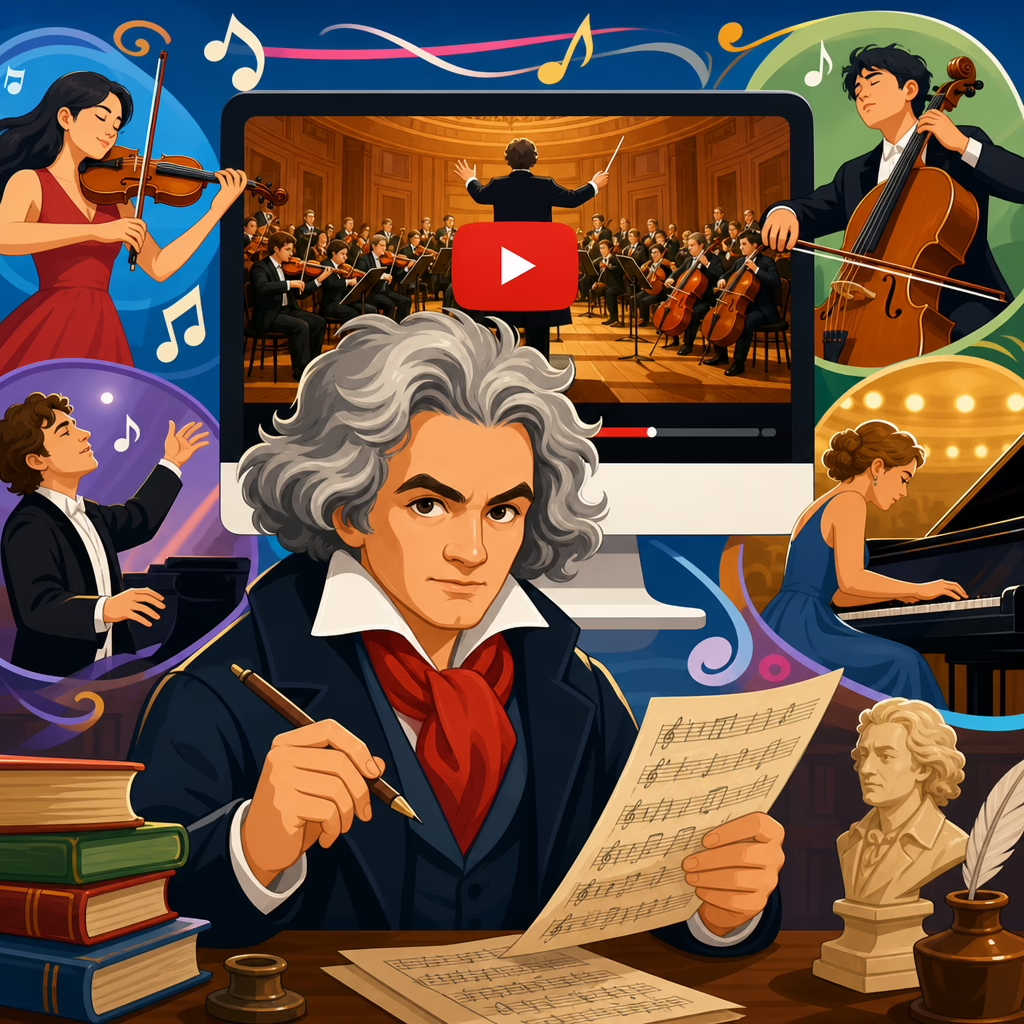
Top Beethoven Performances on YouTube
Beethoven thrives on performance, and YouTube has become one of the richest public archives for hearing how different artists bring his music to life. When listeners search for the top Beethoven performances on YouTube, they usually want more than a random list of videos. They want reliable guidance: which interpretations are musically serious, which recordings are historically important, which live performances capture real intensity, and where to start across symphonies, piano sonatas, concertos, string quartets, and choral works. This hub answers those questions by surveying the strongest Beethoven performances available on YouTube and explaining why they matter.
In practical terms, a performance is the real-time artistic realization of Beethoven’s written score, while a recording is the fixed document of that event, whether captured live in concert or produced in a studio. On YouTube, those categories blur. You will find official uploads from labels such as Deutsche Grammophon, Warner Classics, Decca, and Naxos alongside concert broadcasts from major halls, archives from public broadcasters, conservatory performances, and informed amateur uploads. Quality varies, but the platform is unmatched for comparative listening. I use it constantly when checking tempo choices in the Eroica, comparing pedaling in the “Hammerklavier,” or revisiting how different quartets shape the Cavatina from Op. 130.
This matters because Beethoven sits at the center of the performance tradition. His works test rhythm, structure, tone, endurance, and philosophical range. A convincing account of the Fifth Symphony cannot rely on drama alone; it needs architectural control. A great “Emperor” Concerto performance must balance grandeur with chamber-like dialogue. Late Beethoven requires even more: patience, inwardness, and the courage to sustain ambiguity. YouTube lets listeners hear those differences immediately. It also helps students, collectors, and casual fans discover benchmark interpretations before buying subscriptions, scores, or physical box sets. As a hub page for miscellaneous performance and recordings coverage, this article maps the field broadly, points to representative performances worth seeking, and shows how to evaluate what you hear with confidence.
What Makes a Beethoven Performance Essential on YouTube
The best Beethoven performances on YouTube combine artistic authority with practical accessibility. In my experience comparing uploads, four factors matter most. First is musical insight: the performer must clarify Beethoven’s structure, not merely emote. Second is execution: intonation, ensemble, articulation, pacing, and dynamic control must hold up under repeated listening. Third is recording value: even if the sound or video is older, the document should preserve something distinctive, such as an historic conductor, an exceptional soloist, or a rare live atmosphere. Fourth is availability: a performance is more useful as a recommendation if it is easy to find in stable, official, or widely mirrored uploads with decent audio.
Listeners often ask whether video quality should matter. It does, but less than interpretation. Many indispensable Beethoven documents survive in mono or standard-definition television transfers. Carlos Kleiber’s Beethoven Fifth and Seventh remain electrifying despite older visuals because the rhythmic spring and orchestral attack are almost unmatched. Wilhelm Kempff in the piano sonatas may not offer modern high-fidelity sound, yet his phrasing and natural flow still teach more about Beethoven style than many glossy recent releases. By contrast, some modern videos look immaculate but offer generalized, over-smoothed readings that fade from memory.
Another key criterion is repertoire fit. Certain artists are ideal in specific Beethoven works rather than across everything. Arturo Benedetti Michelangeli in the Fourth Piano Concerto is different from Leonard Bernstein in the Ninth Symphony or the Takács Quartet in the late quartets. YouTube rewards specificity, so listeners should search for pairings, not just famous names. It is better to look for “Claudio Arrau Beethoven Op. 111” or “Furtwängler Beethoven Ninth Lucerne” than to assume one artist defines the entire canon.
| Repertoire | Recommended YouTube Starting Point | Why It Stands Out |
|---|---|---|
| Symphonies | Carlos Kleiber: Symphonies No. 5 and No. 7 | Exceptional rhythmic tension, transparency, and propulsion |
| Piano Sonatas | Wilhelm Kempff: “Moonlight,” “Appassionata,” Op. 111 | Classical line, singing tone, and structural clarity |
| Piano Concertos | Maurizio Pollini with Claudio Abbado; Michelangeli in No. 4 | Precision, orchestral partnership, and refined control |
| String Quartets | Takács Quartet or Alban Berg Quartet in late quartets | Balance of intellect, lyricism, and ensemble discipline |
| Choral Works | Bernstein or John Eliot Gardiner in the Ninth and Missa Solemnis | High dramatic stakes with sharply defined choral textures |
Top Beethoven Symphony Performances on YouTube
If you are starting with orchestral Beethoven on YouTube, begin with Carlos Kleiber. His Fifth Symphony, especially with the Vienna Philharmonic, is one of the clearest examples of how tension can be generated through pulse rather than sheer weight. The famous opening is not merely aggressive; it is controlled, spring-loaded, and connected to the long line. His Seventh has the same qualities, with an Allegretto that avoids sentimentality and a finale that feels dangerous without turning chaotic. These performances are often the first recommendations because they show Beethoven’s energy as disciplined momentum.
For a broader symphonic cycle, Herbert von Karajan’s 1960s Beethoven with the Berlin Philharmonic remains foundational on YouTube. The sound is polished, the brass disciplined, and the string articulation highly unified. Some listeners find Karajan too sleek, but his cycle demonstrates how centralized orchestral sonority can serve Beethoven’s architecture. Claudio Abbado offers a more transparent alternative, especially valuable in the Pastoral and the Third, where inner lines emerge more naturally. If you want a historically informed perspective, John Eliot Gardiner and the Orchestre Révolutionnaire et Romantique reveal how sharper timpani, lighter articulation, and brisker tempos can make familiar works sound newly dangerous.
The Ninth Symphony deserves selective listening because YouTube is full of compromised versions. Leonard Bernstein’s major performances remain compelling for their emotional commitment and rhetorical force, though they can be interventionist. Furtwängler’s wartime and postwar Ninths are historically charged and interpretively extreme, often stretching tempo relationships in ways that modern conductors rarely attempt. They are not neutral references, but they are essential documents. For listeners who want cleaner balance and textural focus, Gardiner or Philippe Herreweghe often provide a more analytically illuminating route. The best approach is comparative: hear one grand Romantic account, one modern mainstream account, and one period-instrument interpretation, then note how Beethoven’s climaxes, transitions, and fugues change character.
Great Beethoven Piano Sonatas and Concertos to Watch
YouTube is especially strong for Beethoven’s keyboard music because it offers both complete recitals and isolated masterpieces. For the sonatas, Wilhelm Kempff is still one of the safest starting points. His playing in the late sonatas, especially Op. 109, Op. 110, and Op. 111, combines cantabile tone with unforced structure. He rarely sounds as though he is imposing an external concept. Instead, the music seems to unfold from within. That matters in Beethoven, where exaggeration can destroy proportion. Emil Gilels offers greater granitic weight and immense concentration, making him superb in the “Appassionata,” “Waldstein,” and the final sonatas. Daniel Barenboim brings a more overtly rhetorical style, often illuminating Beethoven’s dramatic pauses and harmonic arrivals.
For viewers who want modern video quality with top-level musicianship, András Schiff, Igor Levit, and Paul Lewis are excellent names to search. Schiff is especially valuable when he performs on historical instruments or discusses the sonatas in lecture-recital formats, because he connects touch, resonance, and phrasing directly to Beethoven’s notation. Levit’s Beethoven can be searching and physically committed, particularly in the late sonatas and the Diabelli Variations. Even when listeners disagree with a tempo or accent pattern, the interpretive thinking is audible.
In the concertos, the Fourth and Fifth usually produce the strongest YouTube comparisons. Arturo Benedetti Michelangeli in the Fourth is a lesson in control, voicing, and stillness. The opening dialogue with the orchestra can sound almost suspended in air. Maurizio Pollini with Claudio Abbado, especially in the “Emperor,” demonstrates how precision and grandeur can coexist without heaviness. For a more muscular style, Rudolf Serkin’s Beethoven remains gripping. What separates the best concerto performances from merely competent ones is partnership. The pianist must not dominate continuously. Beethoven writes real conversations, and the finest YouTube recordings preserve that interplay, particularly in the slow movements where orchestra and soloist exchange moral weight, not just melody.
String Quartets, Chamber Music, and the Late Style
Beethoven’s chamber music is where YouTube becomes indispensable for serious listeners. Record collectors may own several quartet cycles, but YouTube allows instant comparison of a single movement across ensembles. In the middle quartets, the Alban Berg Quartet offers elegance, precision, and expressive moderation, making them an excellent reference point. The Takács Quartet often brings greater edge and rhetorical contrast, which serves the late quartets especially well. Their performances of Op. 131 and Op. 132 show how to sustain continuity across unusual formal spans while still giving each episode distinct character.
The late quartets demand special care because they are often praised vaguely as spiritual or transcendent. Strong YouTube performances reveal something more concrete: control of pacing, unanimity of articulation, and the ability to shape abrupt changes in register, texture, and tempo without sounding disjointed. In Op. 132, the “Heiliger Dankgesang” must not stall. In Op. 130, the Cavatina must sing without collapsing into sentimentality. In the Grosse Fuge, the ensemble must keep contrapuntal lines audible under extreme pressure. Search for groups such as the Takács, Végh Quartet, Belcea Quartet, and Quatuor Ébène to hear different balances between classical discipline and modern intensity.
Beyond the quartets, the violin sonatas and cello sonatas reward focused listening. The “Kreutzer” Sonata works best when both players project scale and danger without losing rhythmic exactness. Performances by Gidon Kremer, Martha Argerich, Anne-Sophie Mutter, Midori, Mischa Maisky, and Steven Isserlis appear regularly in strong uploads. The “Archduke” Trio is another cornerstone, and versions featuring first-rank collaborators show how Beethoven transforms salon genres into symphonic chamber discourse. These works belong in any complete guide to top Beethoven performances on YouTube because they reveal the composer’s voice in concentrated, conversational form.
Opera, Choral Works, and Historic Documents Worth Finding
Many listeners stop at the symphonies and sonatas, but a serious Beethoven YouTube guide must include the vocal and documentary side. Fidelio can be uneven in the theater, yet the best performances make clear why it matters. Search for recordings conducted by Karl Böhm, Leonard Bernstein, or Nikolaus Harnoncourt. The great challenge is balancing spoken drama, rescue-opera momentum, and idealistic breadth. Leonore’s music needs both steel and humanity, and Florestan’s entrance tests whether the performance can turn suffering into revelation rather than mere volume.
The Missa Solemnis is often harder for newcomers than the Ninth, but it contains some of Beethoven’s most visionary writing. John Eliot Gardiner, Nikolaus Harnoncourt, and Carlo Maria Giulini offer sharply different paths into the score. Gardiner clarifies rhythm and choral diction. Giulini emphasizes solemn breadth. Harnoncourt highlights the work’s unsettling contrasts. On YouTube, these differences are educational because the camera often shows how chorus, soloists, and orchestra coordinate under difficult conditions. The result is not just listening but study.
Historic documents also deserve attention. Furtwängler, Toscanini, Klemperer, Menuhin, Oistrakh, Richter, and Arrau remain central not because older equals better, but because they preserve lineages of style that shaped modern Beethoven playing. Some uploads are unofficial and vary in legality or source quality, so official channels should be preferred when available. Even so, older footage can change a listener’s standards. Seeing Richter’s concentration in Beethoven or hearing Klemperer’s granite pacing in the Eroica explains why these names persist. The larger lesson is that YouTube is not only a convenience platform. It is an informal performance archive, and Beethoven is one of the composers through whom that archive is most rewarding.
The top Beethoven performances on YouTube are not defined by a single artist, school, or recording era. They emerge from a mix of interpretive strength, historical importance, and practical availability. For symphonies, start with Kleiber, then compare Karajan, Abbado, and Gardiner. For piano sonatas, begin with Kempff, then test your ears against Gilels, Schiff, Barenboim, or Levit. For concertos, listen for partnership as much as virtuosity. For quartets and chamber music, use YouTube’s search flexibility to compare ensembles movement by movement. For vocal Beethoven, do not skip Fidelio, the Ninth, and the Missa Solemnis, because they complete the picture of his ambition.
The central benefit of using YouTube well is perspective. Instead of treating Beethoven as fixed repertory, you hear him as a living performance tradition shaped by tempo, instrument type, acoustics, phrasing, and risk. That kind of listening builds judgment quickly. It helps students understand style, helps collectors identify benchmark recordings, and helps casual listeners find versions that truly connect. Use this page as your hub for miscellaneous performance and recordings exploration, then branch into focused guides on symphonies, sonatas, quartets, concertos, and historic interpretations. Open two or three performances of the same work, listen comparatively, and let Beethoven’s greatness reveal itself through contrast.
Frequently Asked Questions
What makes a Beethoven performance on YouTube truly worth watching?
The best Beethoven performances on YouTube stand out for more than clean sound or high view counts. Serious listeners usually look for a combination of musical insight, technical command, historical relevance, and emotional conviction. In Beethoven, interpretation matters enormously: tempo choices, phrasing, articulation, dynamic range, and structural clarity can completely change how a work feels. A strong performance should make the architecture of the music audible, whether that means the long dramatic build of a symphonic movement, the tension and release of a piano sonata, or the conversational interplay of a concerto.
Another key factor is the artist’s authority in the repertoire. Conductors such as Carlos Kleiber, Herbert von Karajan, Leonard Bernstein, Claudio Abbado, and Nikolaus Harnoncourt are often discussed because each represents a distinct Beethoven tradition. The same is true for pianists like Arthur Schnabel, Wilhelm Kempff, Alfred Brendel, Maurizio Pollini, Daniel Barenboim, and Igor Levit. On YouTube, a performance becomes especially valuable when it combines a compelling interpretation with a trustworthy source, such as an official orchestra channel, broadcaster archive, major label upload, or a documented live concert of recognized importance.
Video can also add something unique. Seeing a conductor shape the rhythmic force of the Fifth Symphony, or watching a pianist navigate the intensity of the “Hammerklavier” Sonata, gives viewers insight that audio alone cannot. In short, a Beethoven performance on YouTube is worth your time when it reveals the music’s character clearly, comes from artists with a genuine point of view, and leaves you feeling that the piece has been freshly illuminated rather than merely played through.
Which Beethoven works are the best starting points for listeners exploring YouTube performances?
If you are just starting out, the most accessible place to begin is usually with the major symphonies and a few iconic piano works. Beethoven’s Fifth Symphony is the obvious entry point, but for good reason: it is compact, dramatic, and easy to compare across performances. Different conductors can make it sound urgent, monumental, sharply classical, or almost revolutionary. The Seventh Symphony is another excellent starting place because its rhythmic energy comes across immediately, and strong live performances on YouTube often show just how physically exciting Beethoven can be in concert.
For listeners interested in the piano repertoire, the “Moonlight,” “Pathétique,” “Waldstein,” and “Appassionata” sonatas are natural starting points. These works offer very different faces of Beethoven, from introspective lyricism to explosive power. They are also widely represented on YouTube by both historical and modern pianists, making them ideal for comparison. If you want to hear Beethoven at his most expansive and profound, the late sonatas such as Op. 109, Op. 110, and Op. 111 are essential, though they tend to reward a little more focused listening.
The piano concertos are another smart entry point, especially the Fourth and Fifth. The Fourth Piano Concerto is lyrical, refined, and unusually intimate in places, while the “Emperor” Concerto gives you Beethoven at his most grand and public-facing. For choral-orchestral scale, the Ninth Symphony is indispensable, but it is often best appreciated after hearing a few earlier symphonies first. Overall, the best approach on YouTube is to start with works that are famous for a reason, then use the platform’s breadth to compare how different artists uncover entirely different dimensions within the same score.
Should I prioritize historical recordings or modern high-definition performances of Beethoven on YouTube?
Ideally, you should hear both, because they answer different questions. Historical recordings often carry interpretive authority that modern performances cannot replace. Older Beethoven performances by artists closer to earlier traditions can reveal phrasing styles, expressive freedoms, and tonal ideals that have become less common. A pianist like Arthur Schnabel, for example, may not offer modern studio perfection, but he often brings a sense of structural understanding and urgency that many listeners still find definitive. Likewise, older conductors can present Beethoven in ways that reflect major performance lineages of the twentieth century.
Modern high-definition performances, on the other hand, usually offer clearer sound, sharper ensemble detail, and the visual advantage of seeing the musicians at work. This can be especially important in Beethoven, where orchestral texture and instrumental balance matter so much. A contemporary video from a top orchestra or pianist can help you hear inner lines, observe articulation, and better understand how the interpretation is being shaped in real time. For many newer listeners, this makes Beethoven feel more immediate and approachable.
The smartest strategy is not to treat historical and modern videos as rivals, but as complementary perspectives. Watch a respected older interpretation of a symphony or sonata, then compare it with a recent live performance from a leading orchestra or soloist. You may find that the older reading emphasizes breadth and weight, while the newer one favors agility and rhythmic precision. That contrast is one of YouTube’s greatest strengths. It allows listeners to move beyond the question of which recording is “best” and toward the more interesting question of how Beethoven can be convincingly performed in very different ways.
How can I tell whether a Beethoven performance on YouTube is musically serious and reliable?
A good first step is to look at the source of the upload. Official channels from major orchestras, opera houses, broadcasters, conservatories, festivals, and record labels are generally the safest places to begin. These sources usually provide accurate information about performers, dates, venues, and repertoire. That matters because Beethoven attracts countless uploads with incomplete metadata, misleading titles, or poor transfers. If a video does not clearly identify the conductor, soloist, ensemble, and work, it is harder to judge its reliability.
Next, consider the artists involved. A musically serious Beethoven performance does not have to come from a superstar name, but it should reflect preparation, stylistic awareness, and technical integrity. You can often tell within a few minutes whether the phrasing sounds purposeful, whether tempos feel coherent, and whether the musicians are shaping the long line rather than simply getting through the notes. In orchestral performances, listen for rhythmic discipline, transparency of texture, and control of climaxes. In piano sonatas and concertos, pay attention to tone, voicing, dynamic contrast, and whether the performer makes Beethoven’s structure feel inevitable rather than episodic.
Comments and popularity can be useful, but they should not be your main filter. A highly viewed video may be famous because of the piece, not because the interpretation is exceptional. More trustworthy clues include whether knowledgeable listeners mention the performance’s reputation, whether the video comes from a well-regarded concert series, and whether the artists are known for Beethoven in particular. If you want dependable guidance, compare multiple performances of the same work and notice what keeps recurring among respected interpretations. Over time, your ear becomes the best judge of seriousness.
What are the best ways to compare different Beethoven performances on YouTube without getting overwhelmed?
The most effective method is to compare one piece at a time rather than trying to build a huge playlist immediately. Choose a single work, such as the Fifth Symphony, the “Appassionata” Sonata, or the Fourth Piano Concerto, and listen to two or three contrasting performances. This makes the differences in tempo, expression, balance, and overall conception much easier to hear. If you jump too quickly between many works, it becomes harder to recognize what each artist is actually doing with Beethoven’s language.
It also helps to focus on specific passages. In a symphony, compare the opening movement and the finale; in a piano sonata, compare the first movement and the slow movement; in a concerto, listen closely to the opening orchestral statement, the soloist’s entrance, and the cadenza or central dramatic exchange. These are the places where interpretive choices become especially revealing. One conductor may emphasize tension and propulsion, while another finds nobility and breadth. One pianist may play with granite-like power, while another highlights inner voices and lyric detail.
Finally, let your comparisons include different interpretive schools. Try a historically informed conductor against a more traditional symphonic approach, or a modern virtuoso pianist against an older master. YouTube is especially useful here because it places famous archival performances and recent live concerts side by side. Keep brief notes if you want to sharpen your listening: Was the performance driven or spacious? Transparent or weighty? Dramatic or introspective? By listening this way, you move from passive browsing to active musical discovery, which is exactly how Beethoven becomes most rewarding on YouTube.