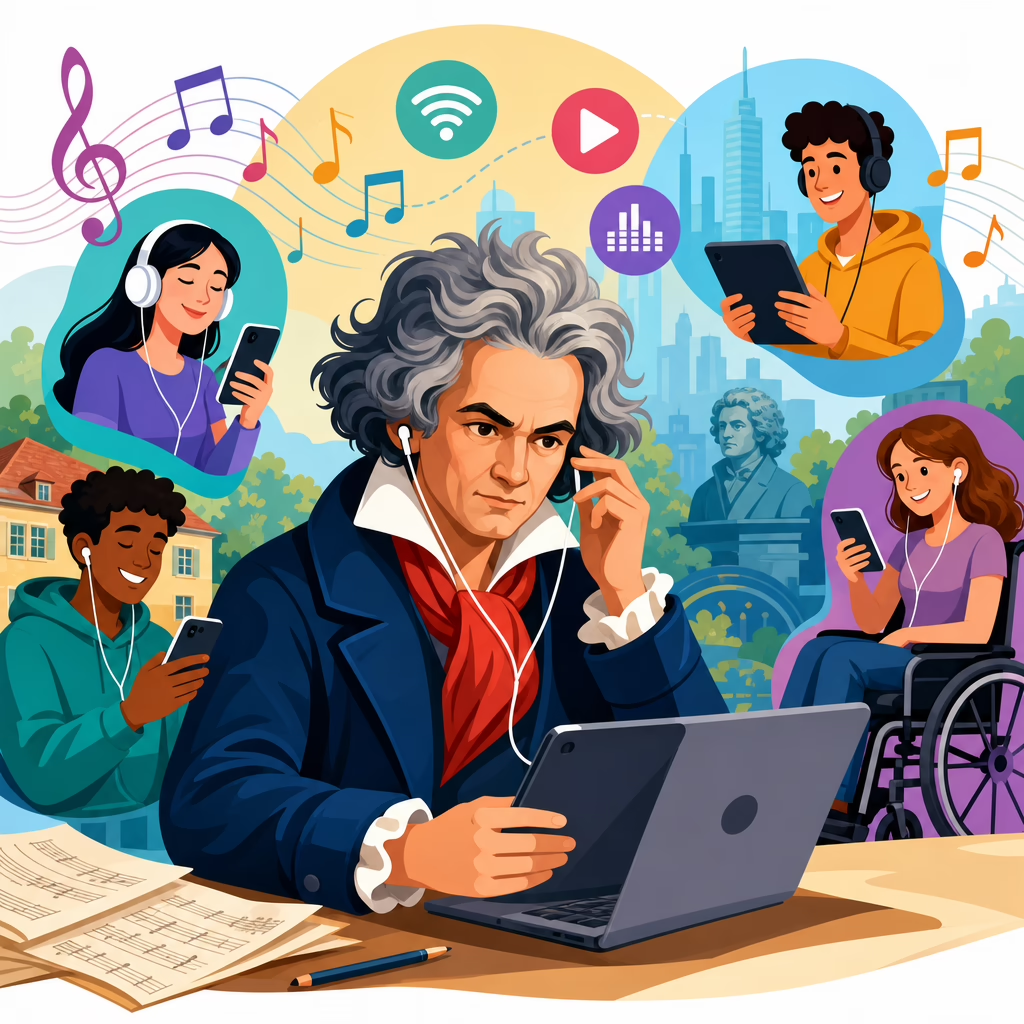
Beethoven in the Digital Era: Streaming and Accessibility
Beethoven in the digital era is no longer defined only by concert halls, compact discs, or specialist scholarship; it is shaped by streaming platforms, online archives, recommendation systems, educational apps, and accessibility tools that bring his music to far wider audiences than any previous generation could reach. In practical terms, streaming means on-demand delivery of audio or video over the internet, while accessibility refers to the design choices, technologies, and distribution methods that make works usable for people with different abilities, devices, languages, budgets, and levels of musical knowledge. For a composer whose works sit at the center of Western classical performance, these changes matter because they influence which recordings are heard, how interpretations spread, who participates in listening culture, and what barriers still remain.
I have worked with digital music catalogs, streaming metadata, and performer archives long enough to see the same pattern repeat: great Beethoven recordings can disappear behind weak labeling, while average ones can dominate simply because they are easier to find. A listener searching for the “Moonlight Sonata” may receive dozens of inconsistent track titles, mixed movements, algorithmic playlists, and video clips with uneven sound. Another listener may need captions, screen-reader-friendly program notes, lower subscription costs, or region-free access to public-domain recordings. The digital shift has therefore created two parallel tasks. First, preserve musical quality and historical context. Second, remove friction so more people can actually encounter Beethoven’s work in meaningful ways.
This hub article surveys that landscape across streaming, metadata, discovery, licensing, educational use, disability access, and archival preservation. It is designed as a broad entry point within Performance and Recordings, especially for readers exploring miscellaneous issues that do not fit neatly into composer biography, score study, or single-album reviews. If you want to understand how Beethoven recordings circulate today, why some performances are easier to find than others, how digital platforms shape interpretation, and what “access” really means beyond simple availability, this overview maps the essential terrain.
How streaming changed Beethoven listening
Streaming changed Beethoven listening by replacing ownership with access and by turning catalog depth into a daily habit. A few decades ago, hearing multiple versions of the Fifth Symphony required a well-stocked library, record shop, or substantial private collection. Today, a listener can compare Carlos Kleiber, Herbert von Karajan, Nikolaus Harnoncourt, John Eliot Gardiner, and Andris Nelsons within minutes. That shift has educational value. It trains the ear to notice tempo, articulation, vibrato, orchestral size, recorded balance, and historically informed practice versus modern symphonic tradition. It also democratizes comparison, something once reserved for critics, conservatory students, and devoted collectors.
Yet streaming also flattens context. Platforms often emphasize single tracks and mood playlists over complete cycles, liner notes, and editorial framing. Beethoven suffers from this more than many pop artists because his music often depends on large formal structure. A symphony movement pulled into an “Epic Classical” playlist may attract a new listener, but it can also detach the music from the architecture that gives it meaning. The late string quartets, piano sonatas, and Missa solemnis especially resist fragmentary listening. In my experience, the most effective Beethoven services pair convenience with structure: complete work pages, movement grouping, recording dates, performer biographies, and links to related repertoire.
Video streaming adds another layer. Performances on YouTube, medici.tv, Digital Concert Hall, and broadcaster archives let audiences see bowing, baton technique, ensemble seating, and audience interaction. For Beethoven, visual information is not trivial. It clarifies differences between period-instrument and modern-instrument performance, shows how chamber ensembles communicate rhythmic tension, and can make deaf or hard-of-hearing viewers engage through gesture and visual rhythm even when audio perception differs. The best digital environment is therefore not merely a jukebox. It is an interpretive space that helps listeners connect work, performance, and context.
Metadata, search, and why discovery often fails
The single biggest practical issue in digital Beethoven access is metadata. Metadata is the descriptive information attached to a recording: composer, work title, opus number, key, movement, performers, ensemble, conductor, recording date, label, and more. When metadata is inconsistent, discovery breaks down. Beethoven’s catalog is particularly vulnerable because works circulate under multiple naming systems. A user may search “Piano Sonata No. 14,” “Sonata quasi una fantasia,” “Moonlight Sonata,” “Op. 27 No. 2,” or “C-sharp minor sonata.” If platforms do not normalize those labels, search results become fragmented and unreliable.
I have seen excellent recordings buried because movements are listed only by tempo marking, such as “Adagio sostenuto,” with no work title attached in visible display. Box sets create further problems. One release may credit “Ludwig van Beethoven,” another “Beethoven,” another “L. van Beethoven.” Featured artists may be missing, and historically informed performances may not be tagged by instrument type. For users, that means more than annoyance. It means educational inequality: informed listeners can navigate the clutter, while newcomers often cannot. Good metadata is therefore an access issue, not just a library issue.
Established standards help. Libraries use authority control and uniform titles to group variant naming. Commercial services increasingly adopt similar principles, though unevenly. Platforms that treat “Symphony No. 6 in F major, Op. 68 ‘Pastoral’” as one canonical work with linked recordings create a far better listening experience than those that leave every label to improvise. Search also improves when movement relationships are preserved and when recordings are grouped by complete work, not only by track. For Beethoven, accurate metadata is the bridge between abundance and understanding.
Accessibility means more than low-price access
Accessibility in digital Beethoven listening includes affordability, but it reaches much further. A blind user may need screen-reader-compatible navigation, properly labeled buttons, alt text for key images, and logical heading structures on platform pages. A deaf or hard-of-hearing user may benefit from synchronized captions in interviews, sign-language interpretation in educational videos, transcripts, waveform visualization, and program notes that explain formal landmarks. A neurodivergent user may prefer uncluttered interfaces, predictable navigation, and reduced autoplay. A rural user with limited bandwidth may need adaptive streaming that still preserves acceptable musical fidelity.
For classical music providers, these needs are often neglected because the sector still imagines an ideal listener sitting attentively before high-end speakers with full prior knowledge. Real audiences are broader. Students listen on phones. Older users may need larger fonts and simple navigation. Public libraries license services that can help low-income households, but only if log-in systems are manageable and region restrictions do not block content. During remote learning periods, I saw how small design choices decided whether Beethoven became available or effectively invisible. A scanned PDF program note that cannot be read by assistive technology excludes users as surely as a locked door excludes wheelchair access.
Accessibility also includes explanation. Beethoven’s music can intimidate new listeners because naming conventions, movement structures, and genre distinctions are unfamiliar. Plain-language guides, listening maps, glossary links, and side-by-side work identifiers reduce that barrier without diluting sophistication. The strongest digital platforms respect experts while helping beginners orient themselves quickly.
Key digital access models for Beethoven recordings
Different access models shape what listeners can hear, what artists earn, and what institutions preserve. No single model is best in every case.
| Model | Main strength | Main limitation | Beethoven example |
|---|---|---|---|
| Subscription streaming | Large catalog, easy comparison across performers | Variable metadata, compressed audio on some tiers, recurring cost | Comparing multiple Ninth Symphony recordings on Apple Music or Spotify |
| Specialist classical platforms | Better work grouping, credits, editorial context | Smaller user base, extra subscription | Browsing complete sonata cycles on Idagio |
| Video concert services | Visual performance context, documentaries, interviews | Catalog narrower than audio platforms | Watching a Beethoven symphony cycle on Digital Concert Hall |
| Public-domain archives | Low-cost or free historical access, preservation value | Inconsistent sound quality, uneven interface | Exploring early twentieth-century Beethoven interpretations on archive collections |
| Library licensing | Broad public access through institutions | Authentication friction, regional availability issues | Using Naxos Music Library through a university or municipal library |
The practical lesson is simple. Subscription convenience gets listeners in the door, specialist platforms improve serious study, archives preserve history, and libraries remain essential for equity. A strong Beethoven hub should point readers across all four paths rather than assuming one commercial platform solves everything.
Algorithms, playlists, and the shaping of taste
Recommendation algorithms now influence Beethoven listening almost as much as critics once did. Platforms analyze skips, saves, repeats, playlist additions, location, and listening time to predict what users want next. That system can help hesitant listeners move from Für Elise to the Pathétique Sonata, from the Seventh Symphony to overtures, or from famous works to less familiar bagatelles and variations. Done well, recommendation creates stepping stones into deeper repertoire.
Done poorly, it narrows Beethoven to a handful of over-circulated excerpts. The same pieces return constantly because they produce reliable engagement signals. As a result, public perception of Beethoven can become skewed toward “greatest hits” listening. That affects performers and labels too. They may prioritize short, playlist-friendly tracks over complete cycles because digital visibility rewards constant surface-level exposure. The risk is not just repetition. It is a distorted canon inside the canon, where globally significant works like the Diabelli Variations or the late quartets receive far less algorithmic support than familiar miniatures.
Curated editorial playlists can partly correct this. The best ones organize by genre, period, instrument, or interpretive school rather than mood alone. A playlist titled “Beethoven: Early, Middle, Late” teaches far more than one titled “Calm Classics.” Similarly, links from a popular work page to complete sonata sets, historically informed recordings, and essays on form encourage progression from casual listening to informed listening. Algorithms are not neutral librarians. They are commercial filters. Beethoven remains accessible only when those filters are balanced by thoughtful curation.
Historical recordings, remastering, and preservation
Digital access is often discussed as if it began with contemporary recordings, but Beethoven’s digital life also depends on historical preservation. Early and mid-twentieth-century recordings document interpretive traditions that no current performer can reproduce exactly because style, instruments, ensemble practice, and recording methods have changed. Listening to Artur Schnabel in the sonatas, Wilhelm Furtwängler in the symphonies, or the Busch Quartet in chamber repertoire reveals tempo flexibility, phrasing habits, and expressive assumptions different from many modern studio releases. These recordings are not museum pieces. They are evidence.
Remastering makes that evidence usable, but it must be handled carefully. Noise reduction can remove shellac hiss or tape hum, yet aggressive processing can also strip upper harmonics, smear transients, and deaden orchestral presence. Responsible restoration aims to improve intelligibility without falsifying source character. Reputable archival labels and audio engineers document transfer chains, source discs or tapes, equalization choices, and pitch correction decisions. That transparency matters because digital listeners often encounter remastered Beethoven without knowing how much intervention shaped the result.
Preservation also depends on rights, file formats, and institutional commitment. Public-domain status may permit wider circulation of older performances in some jurisdictions, but neighboring rights and regional laws complicate distribution. Meanwhile, archives must migrate files, maintain backups, and preserve metadata if recordings are to remain discoverable. In practice, Beethoven’s accessibility is inseparable from digital preservation policy. If the files survive but the descriptive layer collapses, meaningful access still fails.
Education, community, and the future of inclusive listening
The most promising development in Beethoven’s digital era is the merging of performance access with education and community. Streaming alone delivers sound; better platforms deliver understanding. Masterclasses, annotated listening guides, synchronized scores, short expert videos, and forum-based discussion can transform a passive stream into active musical engagement. Students comparing the Eroica across conductors learn more when they can follow a score excerpt, read concise commentary on exposition repeats, and hear why one interpretation emphasizes propulsion while another favors monumentality.
Community matters because Beethoven listening has always grown through shared interpretation. Digital tools now extend that conversation across geography. A conservatory student in Berlin, a public library patron in Ohio, and an amateur pianist in Manila can discuss the same Op. 111 performance the same day. Social platforms are imperfect, but they have widened entry points into repertoire once guarded by institutions. The challenge is to preserve rigor within openness. Reliable hubs should connect recordings to scholarship, performance history, and clear terminology, not just circulate opinion.
For readers using this page as a hub within Performance and Recordings, the central point is straightforward. Beethoven in the digital era is not simply more available; he is mediated by search design, platform economics, accessibility standards, archival practice, and recommendation logic. Better listening starts with better access, and better access requires more than a bigger catalog. It requires accurate metadata, inclusive design, contextual editorial work, strong preservation, and pathways from famous excerpts to complete works. Use that framework as you explore related articles on recordings, performance styles, historic interpretations, and listening guides, and you will hear not only more Beethoven, but Beethoven more clearly.
Frequently Asked Questions
How has streaming changed the way people discover and listen to Beethoven?
Streaming has transformed Beethoven from a composer people often encountered through formal music education, physical recordings, or live performances into one who is available instantly to anyone with an internet connection. Instead of needing to buy a boxed set of symphonies or attend a concert, listeners can now explore everything from the Fifth Symphony to late string quartets on demand through music and video platforms. This ease of access lowers the barrier to entry for new audiences, including people who may never have considered classical music part of their daily listening habits. A person can move from a film soundtrack or a piano study playlist directly into Beethoven’s sonatas, concertos, and chamber works in a matter of seconds.
Recommendation systems have also played a major role in discovery. Streaming platforms use listening data, genre tagging, mood labels, and algorithmic suggestions to introduce Beethoven alongside composers such as Mozart, Brahms, or Chopin, but also in broader categories like focus music, relaxation playlists, or historical masterworks. That means Beethoven is no longer confined to a specialist classical section; he appears in many listening environments that bring his music into modern routines. At the same time, streaming gives experienced listeners a deeper pool of interpretation, making it easy to compare conductors, orchestras, soloists, recording eras, and performance styles in ways that once required substantial money and effort. In short, streaming has made Beethoven more searchable, more comparable, and more integrated into everyday digital culture.
What does accessibility mean when discussing Beethoven in the digital era?
In this context, accessibility goes far beyond simply making Beethoven’s music available online. It refers to the full range of design choices, technologies, and distribution methods that help more people actually engage with the music, regardless of physical ability, learning style, language, technical knowledge, or economic background. For example, accessibility can include captioned performance videos, screen-reader-friendly archive websites, adjustable text size in program notes, transcripts for educational content, simplified navigation in music apps, and affordable or free access to recordings and scores. These features matter because digital availability alone does not guarantee meaningful access.
Accessibility also includes educational and interpretive support. Beethoven’s works can seem intimidating to newcomers because of their historical context, formal complexity, and the sheer number of famous recordings. Digital platforms help bridge that gap through guided listening tools, annotated scores, timeline visualizations, short explainer videos, and interactive lessons that introduce motifs, structure, and historical background. For blind or low-vision users, well-designed metadata and screen-reader-compatible interfaces make exploration easier. For deaf and hard-of-hearing audiences, subtitles, sign-supported educational content, and visual analyses can create alternative ways of engaging with Beethoven’s legacy. In the digital era, accessibility means not just hearing the music, but having practical, inclusive pathways into understanding and appreciating it.
Are streaming platforms a good way to experience Beethoven, or do they oversimplify classical music?
Streaming platforms are both powerful and imperfect tools for experiencing Beethoven. On the positive side, they offer unparalleled convenience, breadth, and flexibility. A listener can compare multiple recordings of the same symphony, explore historically informed performances, follow curated guides for beginners, and access interviews, lectures, and concert films from around the world. This kind of access was once limited to collectors, conservatory students, or people living near major cultural institutions. For many listeners, streaming is the most practical and democratic entry point into Beethoven’s work, especially when paired with playlists, editorial notes, and contextual content.
However, streaming can also oversimplify classical music if the platform emphasizes mood categories, short snippets, or generic labels over deeper musical context. Beethoven’s works are often long, structurally intricate, and highly dependent on interpretation, so reducing them to “study music” or “calm piano” can flatten their artistic complexity. Metadata inconsistencies can also make it difficult to distinguish between movements, editions, performers, and recording dates. That said, these limitations do not make streaming a poor medium; they simply mean listeners benefit from using it critically. The best approach is to treat streaming as a gateway rather than a substitute for deeper engagement. When platforms provide reliable credits, composer pages, educational notes, and full-work organization, they can support a serious and rewarding experience of Beethoven without sacrificing accessibility.
How do online archives and educational apps make Beethoven more accessible to students and general audiences?
Online archives and educational apps have made Beethoven’s world far more open than it was in the era of print-only scholarship and physical media. Digital archives can provide access to manuscripts, letters, early editions, scholarly commentary, and historical timelines that were once available mainly in specialized libraries or academic institutions. This is valuable not only for researchers but also for curious listeners who want to go beyond a recording and understand the composer’s life, creative process, and historical setting. When archives are well organized, searchable, and designed for non-specialists as well as experts, they turn Beethoven from a distant cultural monument into a more approachable and human figure.
Educational apps add another layer by turning passive listening into interactive learning. Many tools now offer guided listening exercises, score-following features, instrument identification, historical background modules, and quizzes that help users absorb key ideas at their own pace. Students can learn how a sonata is structured, why a motif matters, or how Beethoven’s style changed between his early and late periods. General audiences can use these same features to build confidence without needing formal training in music theory. For teachers, these platforms are especially useful because they can combine audio, notation, text, and visual explanation in one place. The result is a more flexible and inclusive learning environment in which Beethoven becomes easier to teach, easier to explore, and easier to appreciate across age groups and levels of experience.
What are the biggest challenges and opportunities for Beethoven’s music in a digital, highly connected world?
The biggest opportunity is reach. Digital distribution allows Beethoven’s music to circulate globally at a scale that would have been unimaginable in earlier eras. A listener in a small town can hear world-class performances, a student can access scholarly materials online, and a newcomer can discover Beethoven through a recommendation engine, a social media clip, or a free educational resource. Accessibility technologies also create more inclusive ways to engage with his music, helping platforms serve people with different sensory, cognitive, linguistic, and financial needs. This broad reach strengthens Beethoven’s cultural presence and keeps his work active in public life rather than confined to elite institutions.
The main challenges involve context, quality, and visibility. In a crowded digital environment, Beethoven competes with an endless stream of content, and that can encourage superficial listening or fragmented engagement. Poor metadata, uneven rights management, algorithmic bias, and limited educational framing can all make it harder for users to find the most relevant recordings or understand what they are hearing. There is also a risk that popularity metrics will favor only the most famous pieces, leaving lesser-known works underrepresented. Still, the digital era offers more solutions than obstacles when platforms, educators, archives, and cultural institutions work together. By improving tagging, expanding accessibility features, offering expert curation, and supporting thoughtful educational content, the digital ecosystem can ensure that Beethoven remains not only widely available, but meaningfully understood by diverse audiences around the world.