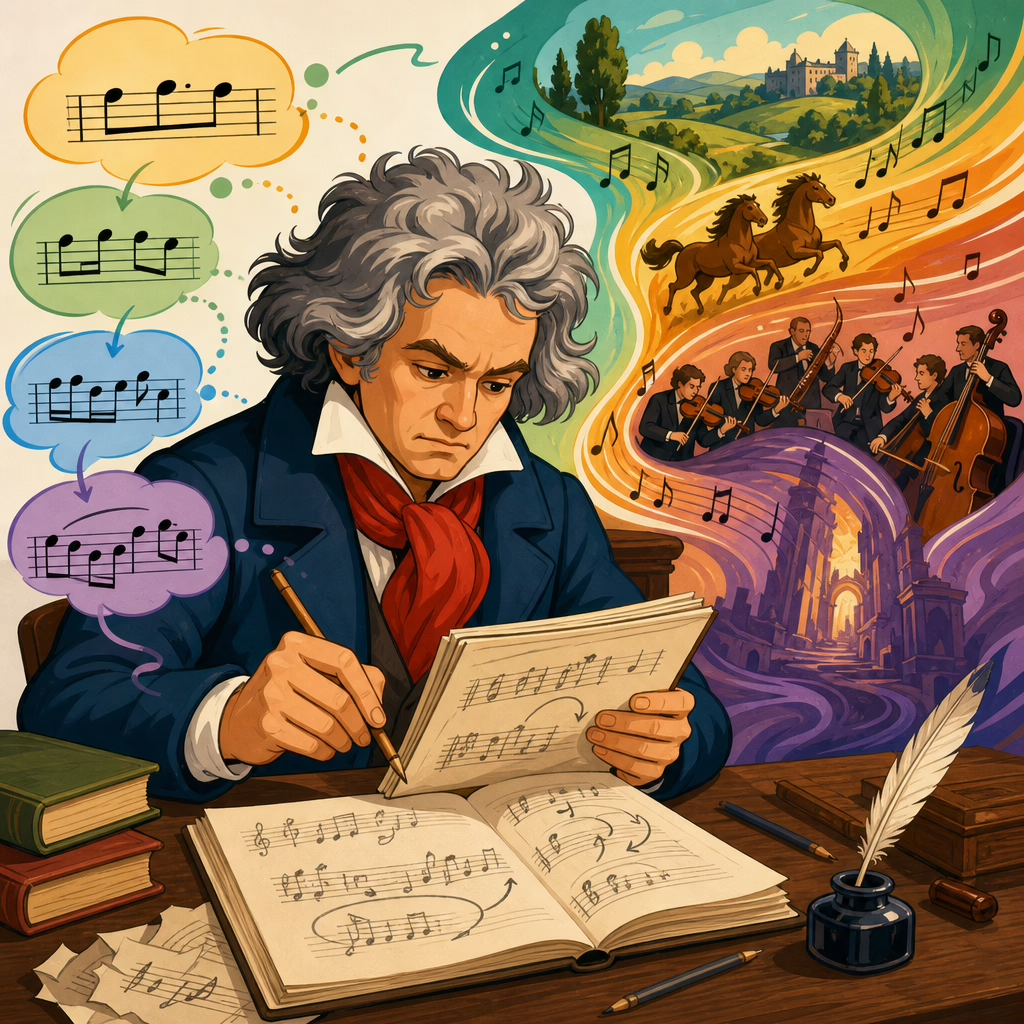
Thematic Development in Beethoven’s Middle Period Sketches
Beethoven’s middle period sketches reveal thematic development in its most exposed, practical form: not as an abstract theory from later textbooks, but as a working method captured on paper while ideas were still unstable. In this context, thematic development means the process by which a small musical cell, motive, rhythmic turn, interval pattern, or harmonic implication is altered, expanded, fragmented, combined, and redirected until it can sustain an entire movement. The middle period usually refers to the years from roughly 1802 to 1812, spanning works such as the “Eroica” Symphony, the “Appassionata” Sonata, the Razumovsky Quartets, the Fourth through Seventh Symphonies, the Violin Concerto, and the Fifth Piano Concerto. These years matter because Beethoven’s sketches from them show a composer no longer merely refining Classical proportion, but actively building long spans from highly compressed material.
For anyone studying Beethoven’s compositional tools, these documents are indispensable. I have worked through facsimiles, sketch transcriptions, and critical commentaries often enough to know that the striking fact is not simply how much Beethoven revised, but what he revised toward. He was not filling in notes around a fixed melody. He was testing whether a motive could generate continuity, contrast, climax, and formal return. Sketches preserve rejected openings, altered bass plans, rhythmic recastings, and experiments in registral placement that explain why the finished works feel inevitable. They also correct a common misconception that Beethoven composed by sudden inspiration and then merely polished details. The evidence points instead to a disciplined search for generative material. As a hub for the miscellaneous side of Beethoven’s compositional tools, this article maps the main patterns scholars and performers repeatedly find in the middle period sketchbooks, leaves, bifolios, and desk books.
Why the Middle Period Sketches Matter as Evidence
Middle period sketches matter because they show process rather than product. A finished score can suggest design, but a sketch can prove sequence: what came first, what was added later, and which problem Beethoven was trying to solve at a given moment. In practical terms, this lets us see whether a theme began as a rhythm before acquiring pitches, whether a transition grew from the same motive as the first subject, or whether a coda was planned early as part of a movement’s argument. The sketchbooks associated with this period, including the Wielhorsky, Razumovsky, Lobkowitz, and Landsberg materials, are especially rich in partially worked ideas. They reveal Beethoven moving between continuity draft, isolated motive study, contrapuntal test, and harmonic outline.
Scholars such as Alan Tyson, Lewis Lockwood, and William Kinderman have shown that these sources are not random notebooks. They are records of compositional decision-making. One page may contain an early version of a symphonic opening beside arithmetic, household notes, or an unrelated canonic idea. That apparent disorder is itself useful, because it shows Beethoven returning to a problem repeatedly from different angles. In the “Eroica,” for example, sketch evidence shows extensive work on transition, developmental sequencing, and large-scale tonal balance, not merely on heroic surface gesture. In the Fifth Symphony, the famous four-note kernel gains significance because the sketches indicate Beethoven exploring how a compact rhythmic identity can animate accompaniment, counterpoint, bridge material, and codas alike. The documents therefore anchor any serious discussion of thematic development in observable craft.
From Motive to Structure: Beethoven’s Core Developmental Method
The central lesson of the middle period sketches is simple: Beethoven begins small and thinks large. A motive in these sources is rarely just a tune fragment. It often combines rhythm, interval, articulation, and implied harmony so tightly that even a tiny remnant can remain recognizable after transformation. This is why Beethoven could build coherence from minimal material. He did not need to repeat a theme literally if he could preserve its dynamic profile or accent pattern. In sketch form, one frequently sees a short idea copied, then recast sequentially, inverted rhythmically, redistributed between voices, or transferred to bass and inner parts. The point is not variation for ornament’s sake; the point is structural productivity.
Take the opening idea of the Fifth Symphony as the best-known example. In analytical shorthand, its significance lies not only in short-short-short-long rhythm but in the way that rhythm projects insistence, compression, and forward drive. The sketches show Beethoven testing continuation patterns and harmonic supports that let the cell function beyond the opening bars. Similarly, in the “Appassionata” Sonata, the germinal material is shaped by registral tension, tremolando energy, and harmonic ambiguity. Beethoven’s sketches repeatedly ask a compositional question modern writers should ask too: can this idea survive displacement? If the answer is yes, the material is fit for development. If not, it remains merely thematic surface.
What the Sketches Show About Revision, Compression, and Expansion
Revision in Beethoven’s middle period is not random correction; it is targeted adjustment toward greater concentration and stronger consequence. Over and over, sketches show him stripping away decorative connective tissue so that motives speak more sharply. A passage may begin in sketch form as a comparatively regular phrase and then become compressed through elision, syncopation, or tighter repetition. Elsewhere, an idea is expanded by sequence or fragmentation until it can pivot into a developmental episode. Beethoven’s practical skill lies in balancing these opposite motions. Compression increases identity. Expansion generates form. The middle period works gain power because both happen at once.
In the Razumovsky Quartets, sketches often suggest that thematic paragraphs were reorganized to strengthen interdependence among voices. In the Violin Concerto, broad lyricism does not mean loose construction; the source material still shows Beethoven calibrating how repeated rhythmic signals, especially the timpani-like pulse, can unify large spans. In the Fourth Symphony, apparent lightness masks rigorous developmental planning. What I find most revealing when comparing sketch states is how often Beethoven improves a passage by clarifying its underlying action: a bass becomes more goal-directed, a sequence becomes more economical, or a cadence is delayed so the thematic argument can keep unfolding. The result is music that sounds spontaneous but is architecturally exact.
Common Developmental Operations Found Across the Sources
Across the middle period sketches, Beethoven relies on a stable set of operations that turn thematic fragments into formal substance. These operations recur in piano sonatas, chamber works, and orchestral scores, which is why they form a useful hub for the miscellaneous branch of Beethoven’s compositional tools. They are not mechanical formulas. Beethoven adapts them according to genre, scale, and expressive aim. Still, the pattern is clear enough that students can trace it from source to source and hear it in finished works.
| Operation | What Beethoven does in sketches | Typical effect in the finished work |
|---|---|---|
| Fragmentation | Breaks a theme into smaller rhythmic or intervallic units | Raises tension and increases momentum in development sections |
| Sequence | Repeats a unit at new pitch levels, often with harmonic intensification | Extends phrases and drives modulation |
| Rhythmic recasting | Preserves contour or interval while changing accent or note values | Keeps identity recognizable without literal repetition |
| Registral transfer | Moves material between bass, inner voice, and upper line | Creates contrast and deepens motivic unity across textures |
| Contrapuntal combination | Tests whether separate ideas can sound simultaneously | Thickens texture and proves thematic compatibility |
| Cadential deferral | Interrupts expected closure with continuation material | Expands form and heightens drama |
These operations explain why Beethoven’s development is often audible even before the formal development section begins. In many middle period movements, the exposition already behaves developmentally. Transitions derive from openings, codettas recycle kernels, and accompaniment figures acquire thematic status. This is especially important for readers navigating related articles in the broader Beethoven’s Compositional Tools cluster: if you are studying rhythm, form, counterpoint, orchestration, or sketch process separately, thematic development is the point where those topics intersect. Beethoven’s sketches make that intersection visible.
Case Studies: Eroica, Appassionata, Razumovsky, and the Fifth
The “Eroica” Symphony is the clearest large-scale demonstration of middle period thematic development. Sketch evidence shows Beethoven not only inventing themes but testing how they can produce expansive continuity. The first movement’s opening triadic material, displaced accents, and energetic bass motions become resources for transition, conflict, and return. The development section does not introduce alien matter so much as expose latent instability already embedded in the opening idea. The Funeral March offers a different model: thematic development through processional rhythm, contrapuntal accumulation, and coloristic intensification. Here the sketches suggest Beethoven measuring breadth with exceptional care.
In the “Appassionata,” thematic development is tied to harmonic darkness and registral volatility. Early notations indicate Beethoven probing how a terse opening can imply a whole field of tension. The eventual movement gains force because the theme is not self-contained; it is a trigger for harmonic motion, texture, and dynamic surge. The Razumovsky Quartets demonstrate that Beethoven could apply the same developmental rigor to conversational chamber textures. A motive may begin in one instrument and then migrate, invert, or collide with countersubject-like material, all while preserving intelligibility. In the Fifth Symphony, the lesson is concentration. The famous rhythmic kernel remains compelling because Beethoven’s sketches show him discovering not just where to repeat it, but how to redesign surrounding matter so that everything feels marked by its presence.
How Performers, Analysts, and Students Can Use These Sketches
Middle period sketches are not only for archival specialists. Performers can use them to identify which notes are structurally loaded and which are surface realizations. That changes phrasing, articulation, pacing, and balance. A conductor studying the Fifth Symphony from sketch commentary will shape repeated rhythmic figures less as background and more as thematic argument. A pianist approaching the “Appassionata” can recognize when Beethoven’s revisions intensify compression, suggesting a leaner, more urgent delivery. String quartets working on Op. 59 benefit from seeing how lines were made interdependent; this often argues against overprojecting a single melody at the expense of inner-voice motive exchange.
For analysts and students, the practical method is straightforward. First, identify the smallest recurring unit in a passage. Second, ask which parameters make it recognizable: rhythm, interval, contour, articulation, register, or harmony. Third, trace how Beethoven alters one parameter at a time. Fourth, relate each alteration to formal function. Does a sequence modulate? Does fragmentation destabilize? Does registral transfer prepare reprise? This approach keeps analysis close to evidence and prevents vague claims about “organic unity.” The value of the sketches is that they show organic unity being made through labor. If you are building out reading paths within this miscellaneous hub, the next useful step is to connect sketch study with specific articles on motivic economy, continuity draft technique, revision habits, and genre-specific development. Together, they show Beethoven’s middle period not as a style label, but as a workshop of compositional intelligence.
Thematic development in Beethoven’s middle period sketches ultimately teaches one major lesson: great musical architecture can grow from very small material if that material is chosen and worked with enough rigor. The sketches document Beethoven testing ideas under pressure, rejecting weak continuations, tightening rhythmic identity, and expanding fragments into whole formal spans. They show that development is not a section inserted after exposition, but a mode of thinking that can govern openings, transitions, climaxes, and codas. This is why the middle period remains central to any account of Beethoven’s compositional tools and why the miscellaneous sketch materials are far from peripheral. They preserve the workshop in which motive became structure.
For readers, performers, and researchers, the practical benefit is clarity. When you study these sketches, finished scores stop looking like monuments and start sounding like solutions to compositional problems. You hear why a rhythm returns, why a cadence is postponed, why an accompaniment figure matters, and why large forms hold together so firmly. Use this hub as a starting point for deeper work across related articles on sketch sources, revision practice, motivic process, and formal design. The more closely you follow Beethoven’s middle period papers, the more clearly you can see thematic development not as a mystery, but as craft made audible.
Frequently Asked Questions
What do Beethoven’s middle period sketches show us about thematic development in practical terms?
Beethoven’s middle period sketches show thematic development as a hands-on compositional process rather than a polished concept explained after the fact. On the page, we can see him taking a tiny musical idea—a short motive, a rhythmic snap, a particular interval, or even a harmonic tendency—and testing how far it can be pushed. Instead of beginning with a fully formed melody and simply decorating it, he often starts with something compact and structurally useful. The sketches reveal repetition with alteration, fragmentation into smaller units, changes of register, rhythmic compression and expansion, harmonic reinterpretation, and the recombination of related materials. In other words, thematic development appears as work: trial, revision, elimination, and strategic reuse.
This is especially valuable because the sketches preserve stages that finished scores conceal. In a completed movement, it can seem as though every development was inevitable. The sketches show that it was not inevitable at all; Beethoven actively searched for the version of an idea that could generate momentum, contrast, and continuity over large spans. They also make clear that thematic development for him was not confined to a formal “development section.” It often began at the level of conception itself. A motive had to prove that it could survive transformation and still retain identity. That practical test—whether a small cell could support a broader musical argument—is one of the clearest lessons the middle period sketchbooks offer.
Why are the middle period sketches so important for understanding Beethoven’s style?
The middle period sketches are crucial because they document Beethoven at a moment when his musical language became especially concentrated, expansive, and architecturally driven. This is the period often associated with the “heroic” style, but the sketches help us move beyond broad labels. They show how large-scale power emerges from disciplined work on small materials. Rather than treating grandeur as something added from outside, Beethoven builds it from motives that are repeatedly reshaped and redistributed. The result is a style in which local detail and large form are tightly connected.
These documents are also important because they reveal the relationship between imagination and control in Beethoven’s method. He does not simply write down inspiration in finished form. He interrogates ideas. He compares alternatives, strips away excess, and strengthens internal connections. A passage that sounds spontaneous in performance may have been subjected to intense rethinking in the sketch stage. That evidence changes how we hear the music. We begin to notice that dramatic contrasts, transitions, climaxes, and even accompanimental figures are often derived from the same core material. The sketches therefore help explain why middle period works can sound both forceful and unified: their energy comes from transformation, not mere variety.
For scholars, performers, and listeners alike, the middle period sketches offer direct access to Beethoven’s compositional priorities. They show what he preserved, what he discarded, and what kinds of ideas he considered compositionally fertile. That makes them one of the best sources for understanding not only what his style sounds like, but how it was made.
How does Beethoven transform a small motive into enough material for an entire movement?
Beethoven’s sketches show that he rarely relies on a motive in only one form. Instead, he subjects it to multiple kinds of transformation until it becomes a network of possibilities. A motive might first appear as a clear rhythmic or intervallic figure, then be shortened into a more urgent fragment, expanded into a sequential passage, shifted to a different harmonic context, or embedded inside an accompaniment pattern. He might invert the contour, alter the accent pattern, redistribute the notes among voices, or fuse it with another idea that shares a compatible rhythmic profile. Each change preserves enough identity for the listener to sense continuity while introducing enough difference to keep the music moving.
This process matters because a movement needs more than repetition; it needs directed change. Beethoven often uses motive-based development to solve several problems at once. A transformed motive can create transition, intensify conflict, articulate cadence, launch a sequence, or underpin contrapuntal writing. The same basic cell can appear as foreground theme in one place and as structural support in another. That flexibility is one reason his music feels so organically unified. The movement does not sound like a string of unrelated sections; it feels as though one idea is discovering new forms under pressure.
The sketches make this process visible in unusually concrete ways. We may find the same figure rewritten with new rhythms, cast into different phrase lengths, or tested in different tonal settings. That evidence demonstrates that thematic development is not merely about “developing” something after it has been presented. It is about choosing an idea that contains latent possibilities from the outset, then drawing out those possibilities through systematic variation and recombination. In Beethoven’s middle period, that is one of the central engines of musical form.
Do Beethoven’s sketches suggest that thematic development is more important than melody?
The sketches suggest something more nuanced than a simple opposition between thematic development and melody. Beethoven clearly valued memorable themes, but in the middle period he often treats melody as one manifestation of deeper motivic potential rather than as an end in itself. A lyrical line may be important, but what often matters just as much is whether its essential features—its rhythm, interval pattern, accent structure, or harmonic direction—can be broken apart and reused elsewhere. In that sense, the sketches imply that a theme’s real strength lies not only in how beautiful it sounds at first hearing, but in how productively it can generate further music.
This does not mean melody becomes unimportant. Rather, melody is integrated into a larger developmental logic. A singable phrase may be compressed into a terse rhythmic cell; a dramatic opening gesture may later appear in accompaniment, bass line, or transition; a cadential figure may be turned into a source of propulsion instead of closure. Beethoven’s sketches show him searching for this compositional leverage. He is often less interested in preserving a melody unchanged than in discovering what inside it can be mobilized across an entire movement.
For modern readers, this is an important corrective. Later textbook traditions sometimes separate “theme,” “development,” and “form” into neat categories. The sketches complicate that picture. In Beethoven’s working practice, melody and development are deeply intertwined. A strong theme is frequently one that can survive distortion, fragmentation, and recontextualization without losing its character. The middle period materials therefore suggest not that melody is secondary, but that melody becomes most powerful when it is compositionally generative.
What can performers and listeners learn from studying Beethoven’s middle period sketches?
Performers and listeners can learn to hear Beethoven’s music as a process of transformation rather than a sequence of isolated themes and episodes. The sketches encourage close attention to motivic relationships: recurring rhythms, intervallic echoes, persistent accent patterns, and subtle changes in texture or harmony that derive from earlier material. For performers, this can shape phrasing, articulation, pacing, and dynamic planning. If a later passage grows out of an earlier motive, a performer may choose to highlight that continuity through touch, timing, voicing, or character. The result is an interpretation that clarifies structure from within rather than imposing drama from outside.
Listeners benefit as well because the sketches train the ear to recognize development as something tangible. Instead of hearing a development section as a general zone of instability, one begins to notice exactly how instability is made: through splitting a motive into fragments, sequencing a rhythmic cell, intensifying a harmonic implication, or driving a familiar figure into an unfamiliar register or texture. That kind of listening makes Beethoven’s formal thinking more vivid and more exciting. It reveals that tension and coherence are often produced by the same material undergoing pressure and change.
More broadly, the sketches remind us that Beethoven’s authority as a composer is bound up with labor, judgment, and revision. They humanize the creative act without diminishing its achievement. For performers, this can inspire interpretations that respect the music’s toughness, flexibility, and internal logic. For listeners, it can deepen admiration by showing that the force of the middle period works does not come from monumentality alone, but from extraordinary control over the developmental life of small musical ideas.