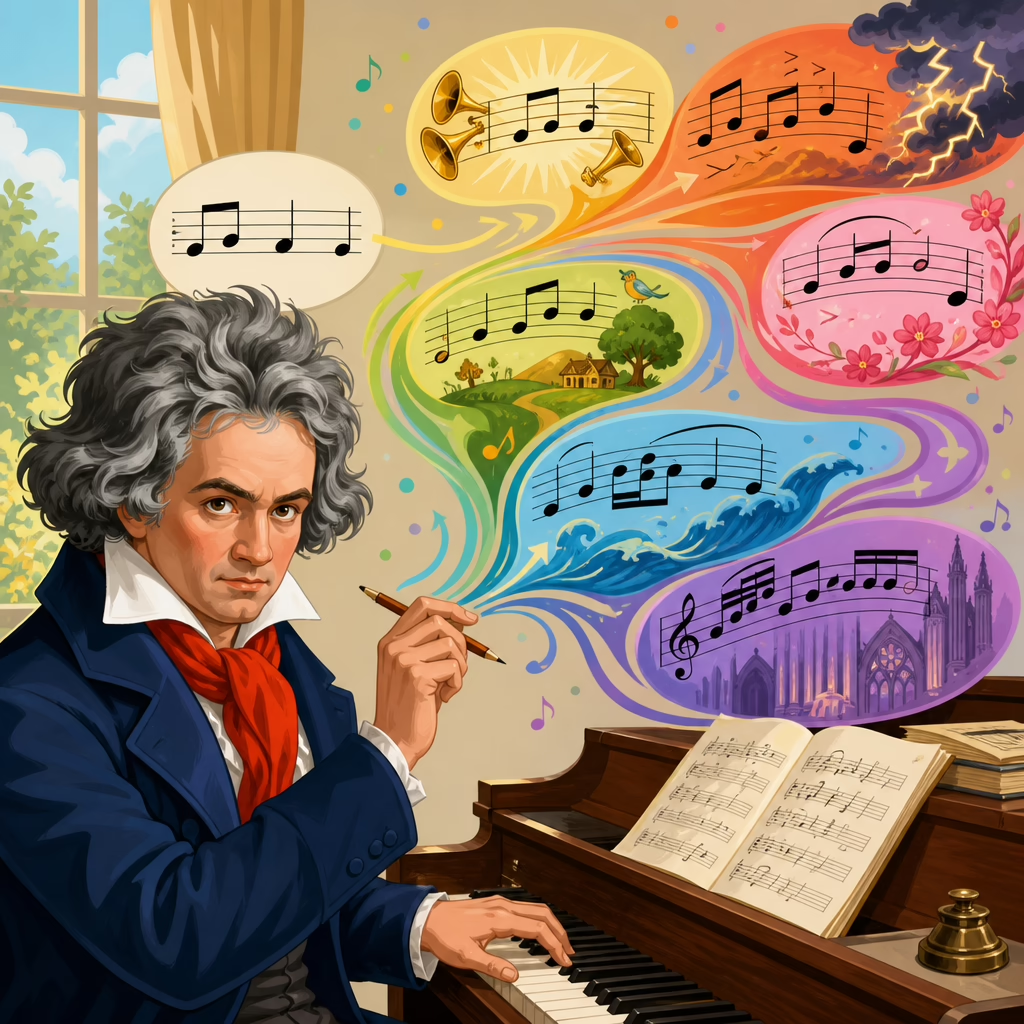
How Beethoven Used Variation to Expand a Simple Idea
Variation is one of Beethoven’s most revealing compositional tools because it shows, in real time, how he could take a short musical idea and turn it into a complete dramatic world. In Beethoven’s music, variation does not simply mean repeating a tune with decorative changes. It means rethinking rhythm, harmony, texture, register, dynamics, phrase structure, and even musical character so thoroughly that a basic motive can generate an entire movement, set, or finale. For listeners, performers, and students studying Beethoven’s compositional tools, this matters because variation sits at the center of how he built coherence without monotony. A few notes become argument, contrast, memory, surprise, and resolution.
When I analyze Beethoven with performers, I start by defining two related terms clearly. A theme and variations movement begins with a melody or harmonic pattern that returns in altered forms. Motivic variation is broader: a tiny cell, interval, rhythm, or contour is transformed across a work, sometimes without an obvious repeated tune. Beethoven used both approaches constantly. He inherited variation practice from Haydn and Mozart, but he expanded its structural weight. In his hands, variation became not just a form but a method of thinking. That method appears in piano sonatas, string quartets, symphonies, bagatelles, dances, and sets of standalone variations written for publication, teaching, and public performance.
This hub article covers Beethoven’s miscellaneous uses of variation across his output and connects the topic to related pages within Beethoven’s compositional tools, including motive, rhythm, texture, form, counterpoint, and development. The goal is practical: understand what Beethoven changes, why those changes feel inevitable, and how simple material acquires scale. Once you hear the technique clearly, many passages that seem spontaneous begin to reveal deliberate craft. Beethoven’s genius was not that he always invented long melodies. Often, it was the opposite. He selected material simple enough to survive pressure, then tested how far it could stretch without breaking.
What Beethoven Actually Changed When He Varied an Idea
The most direct answer is that Beethoven varied every parameter that could alter identity while preserving recognizability. He changed accompaniment patterns, moved melodies between voices, compressed or expanded note values, shifted accents against the meter, reharmonized repeated phrases, and redistributed the same idea across different registers. He also used textural variation with unusual boldness. A tune stated plainly might return as chordal writing, then as broken figuration, then as contrapuntal imitation, then as a nearly skeletal bass outline. The ear keeps hold of contour or harmonic route, but the surface keeps changing.
One reason Beethoven’s variation feels stronger than decorative eighteenth-century examples is his handling of rhythm. In many works, the rhythmic profile becomes the true anchor. If the pitch content changes, the listener still recognizes the pulse pattern or phrase gesture. In other cases, harmony is the anchor. The famous Diabelli Variations, Op. 120, show this brilliantly. Beethoven does not treat Diabelli’s waltz as a sacred melody to ornament politely. He isolates structural features, exaggerates banal turns, recasts the harmony, and turns a commonplace theme into a laboratory of character pieces. Some variations are comic, some severe, some learned, some expansive, and some astonishingly economical. The point is not sameness but controlled transformation.
He also varied function. A simple idea could serve as melody in one passage, bass support in another, inner-voice filler elsewhere, and fugue subject later. This flexibility is crucial for understanding Beethoven’s compositional process. He did not always ask, “How can I decorate this tune?” He often asked, “What jobs can this material perform?” That practical mindset links variation to development. It is also why studying this topic helps with related subtopics such as thematic economy and large-scale form.
Variation as Structure, Not Ornament
Beethoven elevated variation from a localized technique to a principle of form. Earlier composers certainly wrote major variation movements, but Beethoven regularly let variation shape the architecture of entire pieces. The slow movement of the Piano Sonata in A-flat major, Op. 26, is a landmark early example: a theme with variations placed where a sonata-form movement might be expected. Each variation does more than add difficulty. It adjusts texture, motion, and expressive temperature, creating directional growth. The movement teaches an essential Beethoven lesson: continuity can come from transformation rather than conventional contrast between separate themes.
The late works push this much further. In the Arietta of the Piano Sonata in C minor, Op. 111, Beethoven begins with extraordinary simplicity. The theme is spare, balanced, and transparent. Yet the subsequent variations do not merely embellish it; they gradually alter the listener’s experience of time. Rhythmic subdivision accelerates, trills suspend weight, and texture becomes increasingly immaterial. Performers often describe the movement as a journey from song to vibration. The underlying harmonic and phrase framework remains legible, but the idea has expanded into something almost metaphysical. That is Beethoven at his most radical: variation creating transcendence from the plainest material.
The finale of the Third Symphony, Op. 55, offers another structural model. Beethoven reuses material associated with his Prometheus music and builds a symphonic finale that mixes variation, fugato, dance, and dramatic interruption. He withholds the full theme at first, presenting only fragments and bass line. This is important. By varying partial components before the complete melody appears, he trains the ear to hear structure beneath surface. The result is a finale in which variation is inseparable from symphonic argument.
| Work | Basic Idea | How Beethoven Expands It | Why It Matters |
|---|---|---|---|
| Op. 26, slow movement | Plain lyrical theme | Texture, motion, and figuration change each return | Shows variation as formal engine |
| Symphony No. 3, finale | Bass pattern and theme fragments | Fragmentation, counterpoint, delayed full statement | Builds large-scale symphonic unity |
| Op. 111, Arietta | Simple, balanced theme | Rhythmic subdivision, registral expansion, trills, suspension | Transforms variation into a spiritual arc |
| Diabelli Variations, Op. 120 | Common waltz by Diabelli | Parody, fugue, character contrast, harmonic reinterpretation | Proves any material can yield depth |
How Small Motives Become Large Statements
If you want the shortest explanation of Beethoven’s method, it is this: he trusted small motives more than extended themes. A motive could be repeated, sequenced, inverted, fragmented, displaced, and layered. Because it was compact, it remained recognizable under stress. The opening four-note idea of the Fifth Symphony is the obvious example, but the principle appears everywhere. In variation writing, Beethoven often strips a melody down until motive and harmonic skeleton are enough. Then he rebuilds from there.
In workshop settings, I often compare Beethoven’s technique to architectural modularity. A builder who relies on one flexible unit can create walls, arches, and patterns without inventing new material for every space. Beethoven does something similar musically. In the Thirty-Two Variations in C minor, WoO 80, the repeating bass and harmonic progression provide a severe ground. Above it, Beethoven constructs sharply contrasted textures and affects. The power comes from restraint. Because the foundation does not move, every surface change registers strongly.
This is also where listeners can connect variation to Beethoven’s use of rhythm and accent. A motive may expand not by adding notes but by changing metrical placement. An upbeat can become a downbeat; a stable pattern can be syncopated; repeated notes can be redistributed between hands or instruments. These shifts create new energy from old material. For a deeper study, this hub should lead naturally to articles on Beethoven’s rhythmic disruption and his treatment of accompaniment as thematic substance.
Character Variation: Comedy, Force, Intimacy, and Learned Style
Beethoven did not vary ideas only technically; he varied them dramatically. This is one reason his variation sets avoid predictability. A single theme can become military, pastoral, comic, solemn, brilliant, or introspective. In practical terms, he changes articulation, tempo implication, texture, mode, register, and contrapuntal density to create character variation. The listener does not hear “the same tune again.” The listener hears the same idea viewed through different emotional and social lenses.
The Diabelli Variations remain the clearest case study. Variation 1 answers Diabelli’s theme with muscular bluntness, as if Beethoven is announcing that the material will be tested. Elsewhere he writes a mock-learned fugue, delicate ornamental writing, and a sublime minuet-like late variation that reimagines the source completely. Scholars have long noted Beethoven’s use of parody in this set. He hears triviality in the original and turns that triviality into fuel. Yet parody is only one layer. The cycle also demonstrates respect for craft: every transformation is exact, and the cumulative plan is disciplined.
Character variation also appears in smaller published sets and in movements embedded within larger works. Beethoven’s song-like themes often invite tenderness in one variation and virtuosity in the next. This alternation teaches a broader lesson about his style. Contrast does not require unrelated material. It can emerge from the same source if the source is conceptually strong enough. That principle links variation to the way Beethoven controls emotional pacing across sonatas and quartets.
Late Beethoven and the Limits of Simplicity
In the late period, Beethoven’s variation technique becomes both stricter and freer. It is stricter because the underlying designs are often exceptionally clear: chorale-like themes, balanced phrases, bare harmonic frameworks. It is freer because the transformations reach farther into texture, counterpoint, and temporal perception. The slow movement of the String Quartet in A minor, Op. 132, while not a textbook variation set, shows how repeated material can return with altered scoring, register, and expressive weight. Likewise, the Goldberg-like breadth some listeners hear in the Diabelli cycle comes from Beethoven’s willingness to let each variation become a self-contained world while still serving the whole.
One technical feature worth stressing is his use of cumulative intensification followed by release. Beethoven often drives variation sequences toward denser rhythm, wider range, and greater sonority, then clears the texture suddenly. That reset makes the next statement sound newly exposed. He also uses contrapuntal procedures not as academic display but as one more method of pressure-testing the theme. Canon, fugato, and invertible textures prove whether the material has true generative strength.
For performers, this means interpretation cannot stop at identifying the tune. You need to know what remains invariant from variation to variation and what Beethoven wants the audience to notice as newly changed. In some pieces the harmonic path is the constant; in others it is phrase length, bass pattern, or rhythmic cell. Once that hierarchy is clear, the movement’s rhetoric becomes easier to project.
How to Hear and Study Beethoven’s Variations More Effectively
A useful listening method is to track four things in order: bass line, phrase length, rhythmic profile, and texture. Most listeners focus first on melody, but Beethoven often hides continuity below the surface. If you can sing or tap the bass pattern, count whether phrases stay symmetrical, notice where accents fall, and identify whether the writing is chordal, figurated, or contrapuntal, you will hear the design much more clearly. This method works especially well in Op. 26, the Eroica finale, and the Diabelli Variations.
Score study helps, but even without reading music, comparison listening is effective. Hear the theme, then ask direct questions. What stayed the same? What changed first? Did Beethoven alter motion, harmony, or register? Did the variation become denser, lighter, louder, more fragmented, or more songful? These are the questions this miscellaneous hub should organize before you branch into more specialized articles on Beethoven’s piano writing, orchestration, counterpoint, and formal strategy. Variation is not an isolated chapter in his craft. It is the connective tissue linking many of his methods.
The key takeaway is simple. Beethoven expanded a simple idea by choosing material sturdy enough to survive transformation, then varying it across rhythm, harmony, texture, register, and character with exceptional discipline. He made variation structural, dramatic, and philosophical. In early works, that meant extending Classical procedures into stronger formal statements. In middle-period works, it meant using variation to generate symphonic and sonata-scale momentum. In late works, it meant turning modest themes into explorations of time, memory, and human expression. If you want to understand Beethoven’s compositional tools from the inside, variation is one of the best entry points because it reveals how invention and control operate together.
Use this hub as your starting place for the miscellaneous branch of Beethoven’s compositional tools. From here, move outward to focused studies of motive, development, rhythm, texture, counterpoint, and variation form in specific works. The more examples you compare, the clearer the pattern becomes: Beethoven did not need extravagant raw material to create greatness. He needed a small idea with possibilities, and the craft to unfold those possibilities completely. Return to a few core works, listen comparatively, and follow the transformations closely. That practice will sharpen your ear for Beethoven and for musical structure more generally.
Frequently Asked Questions
What does “variation” mean in Beethoven’s music?
In Beethoven’s music, variation means far more than taking a melody and adding surface decoration. He often begins with a concise musical idea, sometimes only a short motive, and then transforms it by changing rhythm, harmony, texture, register, dynamics, articulation, phrase length, and expressive character. The important point is that the original idea remains present, even when its shape has been altered so deeply that the listener feels both continuity and surprise at the same time.
This is one reason variation is such a revealing tool in Beethoven’s style. It lets us hear his compositional thinking in motion. Rather than presenting one finished tune and moving on, he asks what else that idea can become. A simple pattern can grow more urgent through rhythmic compression, more dramatic through sudden dynamic contrast, more expansive through harmonic exploration, or more intimate through thinning of texture. In that sense, variation is not an ornament added after the fact. It is a method of musical development and a way of building large forms from small materials.
For listeners, this means Beethoven’s variation technique rewards close attention. What may sound at first like repetition is usually purposeful transformation. For performers, it means each return of an idea needs its own identity. And for anyone studying Beethoven, variation offers a direct window into how he could generate an entire dramatic world from the smallest musical seed.
How did Beethoven use variation to expand a simple musical idea into something larger?
Beethoven expanded simple ideas by treating them as sources of unlimited potential rather than fixed statements. He could start with a plain theme, a bass pattern, or even a tiny rhythmic cell, and then test how that material behaved under pressure. He might shift the idea into a different register, place it in another voice, break it into fragments, intensify it with syncopation, or surround it with denser harmony. Each change reveals another side of the original material while also increasing the sense of dramatic growth.
What makes this process especially powerful is that Beethoven often uses variation to shape large-scale form. Instead of separating “theme” and “development” into completely different worlds, he allows one to flow into the other. A motive can first appear clearly, then return in altered harmonic contexts, then emerge in thicker textures or more forceful dynamics, and eventually become the driving force of an entire movement or finale. The listener feels that the music is evolving organically, as if everything springs from one central idea.
This approach also gives Beethoven’s music its remarkable sense of inevitability. Even when the transformations are bold, they rarely feel arbitrary. The music seems to unfold by discovering hidden possibilities already contained in the opening gesture. That is why Beethoven’s variation technique feels so dramatic: it combines discipline and imagination. He is not merely changing a tune for variety’s sake. He is showing how a modest beginning can generate tension, contrast, structure, and emotional depth on a much larger scale.
How is Beethoven’s approach to variation different from simple decorative variation?
Simple decorative variation usually preserves the core of a theme while embellishing its surface. A composer might add faster notes, graceful ornaments, or accompaniment changes, but the phrase structure, harmonic outline, and overall character often remain stable. Beethoven certainly knew how to write that kind of variation when he wanted to, but his most distinctive work goes much further. He often treats the theme as material to be reimagined from the inside out.
That means the changes can affect every layer of the music. Rhythm may become more urgent or more suspended. Harmony may darken, destabilize, or move into unexpected regions. Texture may shift from transparent to orchestral density, even in a solo instrument work. Registers may widen, pushing the idea into extremes of high and low range. Dynamics may become part of the transformation, turning a calm statement into a forceful declaration. Sometimes even the phrase structure itself changes, so that the original balance of the theme is stretched, compressed, interrupted, or reinterpreted.
The result is that Beethoven’s variations often feel like stages of psychological or dramatic evolution rather than decorative restatements. A theme can become playful, solemn, heroic, mysterious, or transcendent across a sequence of variations, yet still remain recognizably connected to its source. This is one reason his variation writing feels so modern and so compelling. It does not merely display ingenuity. It creates a narrative of transformation, showing how a musical idea can reveal deeper expressive possibilities over time.
Why is variation so important for understanding Beethoven as a composer?
Variation is central to understanding Beethoven because it highlights one of his greatest strengths: the ability to derive large, powerful structures from concentrated material. Many composers write memorable melodies, but Beethoven is especially remarkable for what he does after the initial idea appears. He probes it, tests it, reshapes it, and builds with it. Variation shows this process clearly because it exposes the link between invention and construction. We hear not only the idea itself but also the many ways Beethoven can make it work.
This matters because Beethoven’s music is often driven by motivic logic. A small rhythmic pattern, interval, or contour can influence an entire movement. Variation helps explain how that happens. By altering one element at a time or several at once, he demonstrates that musical coherence does not depend on literal repetition. It depends on underlying identity. Even when the surface changes dramatically, the listener senses an internal connection. That balance between unity and transformation is a hallmark of Beethoven’s style.
Variation is also important because it connects technique with expression. In Beethoven, transformation is rarely abstract. Changes in texture, pacing, harmony, and register often feel emotionally charged. A theme may grow from simplicity into conflict, from conflict into expansion, and from expansion into resolution. So variation is not just a compositional trick; it is one of the main ways Beethoven creates drama, momentum, and meaning. To understand his variation technique is to understand how his music thinks, moves, and speaks.
What should listeners and performers pay attention to when hearing Beethoven’s variations?
Listeners should pay close attention to what stays the same and what changes from one variation to the next. Sometimes the melody remains clear while the accompaniment transforms. In other cases, the harmonic foundation stays stable while rhythm or texture becomes more active. Beethoven often invites the ear to notice hidden continuities beneath obvious contrasts. A familiar motive may appear in a different voice, a changed register, or a new dynamic shape. Recognizing those links can make the music feel more coherent and dramatically satisfying.
It is also useful to listen for the broad trajectory of a variation sequence rather than treating each variation as an isolated event. Beethoven frequently organizes variations so that they accumulate tension, deepen character, or prepare a major climax. One variation may lighten the texture, another may intensify rhythmic drive, another may introduce expressive stillness, and another may expand the harmonic horizon. The sequence often functions like a drama with changing scenes, where each stage reveals a new possibility within the original idea.
For performers, the challenge is to make every variation distinct without losing the thread that binds them together. That requires careful attention to articulation, voicing, pacing, dynamic proportion, tone color, and structural awareness. The goal is not simply to play the notes accurately but to show the listener how Beethoven is thinking through the material. A strong performance clarifies why each transformation matters and how it contributes to the whole. When that happens, Beethoven’s variation technique becomes vivid and immediate: a living process of discovery rather than a static series of repeats.