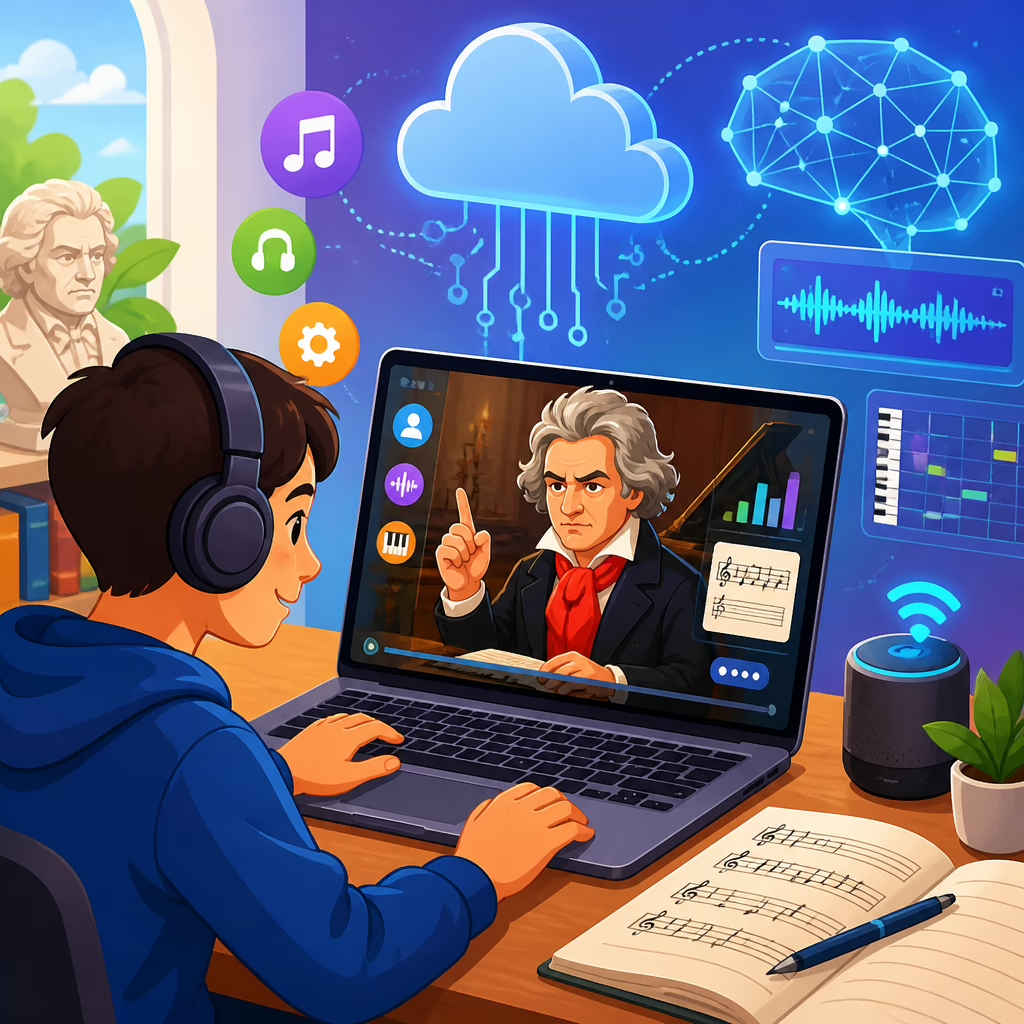
The Tech Behind Online Beethoven Courses
Online Beethoven courses look simple on the surface: a video lecture, a digital score, and a discussion forum. In practice, they rely on a tightly coordinated stack of music technology, web delivery systems, audio engineering, notation software, and analytics tools that make serious score study possible at a distance. When I have helped build and review music education platforms, the difference between a mediocre course and a compelling one usually came down to the invisible systems underneath it. Beethoven’s music exposes every weakness in those systems because students need to hear structural detail, compare editions, follow dense notation, and revisit passages repeatedly without losing context.
In this context, “online Beethoven courses” means structured digital learning experiences focused specifically on Beethoven’s works, style, manuscripts, performance practice, and analysis. They may be hosted by universities, conservatories, private academies, or independent educators using platforms such as Moodle, Canvas, Teachable, Kajabi, or custom learning management systems. The “tech behind” them includes far more than streaming video. It includes notation rendering engines, synchronized audio and score viewers, metadata schemas for movements and themes, microphone chains that capture dynamic nuance, copyright and licensing controls for editions and recordings, assessment tools that evaluate listening and analysis, and accessibility layers such as captions, transcripts, and keyboard navigation. Each piece matters because Beethoven study is unusually detail dependent.
That matters for learners and instructors alike. A student analyzing the motivic economy of the Fifth Symphony or the pedal indications in the late piano sonatas needs accurate notation display, low-friction navigation, and audio that preserves articulation and dynamic range. An instructor teaching the “Eroica” Variations or Op. 131 needs ways to annotate the score, isolate passages, compare interpretations, and track whether learners understand harmonic function rather than simply memorizing talking points. The best online Beethoven courses succeed because the technology supports deep musical attention instead of distracting from it.
Learning platforms and course architecture
The foundation of an online Beethoven course is the learning platform, but not every platform handles music instruction equally well. General-purpose learning management systems are good at enrollment, progress tracking, quizzes, and discussion boards. They are less naturally suited to long-form listening, score-following, and comparison of multiple media assets within one lesson. For Beethoven-focused teaching, the platform has to organize content at several levels: composer overview, genre, work, movement, passage, and concept. A useful lesson architecture might start with historical framing, move to guided listening, shift into annotated score study, and finish with a short written or aural assessment. If the platform cannot support that sequence cleanly, students experience Beethoven as fragmented content rather than coherent musical argument.
In strong course builds, lesson pages are mapped around musical navigation rather than only calendar modules. A sonata course may use indexing by opus number, key, form section, and technical issue such as voice leading, rhythm, or motivic transformation. Back-end tagging becomes crucial here. Metadata fields can identify movement tempo marks, date of composition, instrumentation, formal functions, or recurring motives. This is what allows a student to search for all examples of sforzando disruption, all introductions in sonata form, or all late-style fugal episodes. Without disciplined metadata, even excellent teaching materials become hard to retrieve.
Course architecture also depends on permissions and content delivery rules. Many educators use a drip schedule to release weekly modules, while advanced independent-study courses often allow immediate access to all works so learners can compare periods. For Beethoven, open navigation often works better because students naturally jump between the “Pathétique,” the “Waldstein,” the quartets, and the symphonies as analytical questions arise. Platforms that support prerequisite logic can still guide beginners while preserving the freedom needed by more experienced musicians. The technical point is simple: pedagogy drives platform configuration, and Beethoven pedagogy demands flexible, non-linear exploration.
Score rendering, annotation, and music notation systems
The most important specialized layer in an online Beethoven course is notation technology. Static PDFs are still common, but they are not ideal by themselves. Students need zoom without blurring, stable measure numbering, selectable systems, and often synchronized playback or annotation overlays. This is why many serious courses use MusicXML-based workflows, notation software such as Dorico, Sibelius, or Finale, and browser rendering libraries such as Verovio or OpenSheetMusicDisplay. These tools convert engraved notation into responsive digital views that can resize for desktop or tablet screens while preserving legibility.
Annotation is where technology starts to transform teaching rather than merely digitize it. In Beethoven courses, instructors frequently highlight motivic cells, phrase expansions, deceptive cadences, registral displacement, and rhythmic compression. Layered annotation systems let students toggle between harmonic labels, form maps, editorial comments, and performance notes instead of seeing everything at once. That matters because Beethoven’s textures are dense, and over-annotation can obscure what the score is trying to reveal. Better systems treat annotation as a series of views: one for thematic identity, one for harmonic function, one for manuscript or edition issues, and one for interpretive choices.
Digital notation tools also make comparison possible. An instructor can place an autograph reading beside a standard edition, or compare articulation differences across Henle, Bärenreiter, and older public-domain sources. This is especially useful in Beethoven because source criticism changes how passages are understood and performed. The technology must therefore support aligned excerpts, linked scrolling, and citation of source provenance. For readers who want a broader context for analytical tools used with digital scores, the main guide at https://lvbeethoven.com/how-ai-tools-can-help-analyze-beethoven-scores/ is a useful reference point.
Audio and video engineering for Beethoven instruction
Beethoven teaching fails quickly if the media quality is weak. His music depends on extreme dynamic contrast, sharply defined attacks, and layered textures that collapse under poor recording practice. In online course production, the audio chain matters as much as the camera. Educators who record piano demonstrations typically use matched condenser microphones in spaced pair, ORTF, or XY configurations, feeding clean preamps and high-resolution interfaces at 24-bit depth. That setup captures transients and room detail more reliably than a laptop microphone ever could. For chamber or orchestral examples, multi-mic recordings require careful mixing so analytical clarity is preserved without creating an artificial soundstage.
Compression is one of the most common technical mistakes. Streaming platforms routinely apply loudness normalization, and if the source audio is already over-compressed, Beethoven’s dramatic architecture flattens. A discussion of the opening of the “Appassionata” or the first movement of the Seventh Symphony needs enough dynamic headroom for whispered tension and explosive release. Producers also have to manage codec choices, bitrates, and sample rates so repeated student playback does not produce audible artifacts in reverberant passages or exposed string textures. AAC at an appropriate bitrate is usually a practical delivery format, but the master should remain uncompressed.
Video design matters too. A fixed talking-head shot is rarely enough for score-driven Beethoven teaching. Effective courses combine instructor view, overhead keyboard view, synchronized score capture, and sometimes waveform or spectrogram inserts when discussing articulation or pedaling. Multi-camera editing helps when an instructor demonstrates voicing in Op. 110 or bow distribution in a quartet excerpt. Captions are not optional extras; they improve comprehension, support accessibility, and make technical terminology searchable inside the platform. When generated automatically, captions need manual correction because movement titles, German tempo markings, and analytical jargon are often mistranscribed by generic speech-to-text systems.
Synchronized listening, interactivity, and assessments
The strongest online Beethoven courses do not separate listening from analysis. They use synchronization technology to bind time, notation, and commentary together. At a basic level, that can mean timestamped lesson notes linked to video chapters. At a higher level, it means score-following systems that highlight the active measure during playback, or clickable form maps that jump directly to an exposition, development, recapitulation, or coda. These features reduce cognitive friction. Instead of scrubbing through a lecture searching for the Neapolitan chord or the false recapitulation, students can move directly to the relevant musical event.
Interactivity is especially valuable because Beethoven study often requires comparison. Students may need to hear three recordings of the same transition, mark where tempo flexibility changes the phrase, and then explain which interpretation best supports the structure. Platform tools such as embedded quizzes, hotspot annotations, and timed reflection prompts make this possible. In well-designed courses, assessments are not limited to multiple-choice questions about dates and opus numbers. They ask students to identify a motive after rhythmic transformation, label a modulation by ear, compare editorial fingerings, or submit a marked-up score excerpt. Those tasks align technology with musicianship rather than with rote content recall.
| Course Feature | Technology Used | Why It Matters for Beethoven |
|---|---|---|
| Synced score playback | MusicXML rendering plus timestamp mapping | Keeps dense formal passages visually aligned with sound |
| Interpretation comparison | Chapter markers and parallel media embeds | Lets students evaluate tempo, articulation, and phrasing choices |
| Analytical annotation | Layered overlays and clickable measure notes | Clarifies motives, harmony, and form without clutter |
| Aural assessment | Quiz engine with audio prompts | Tests listening skill, not just memorized facts |
Assessment analytics can also reveal where instruction is failing. If a large share of students miss the same question about a late-quartet texture or a sonata-form boundary, the issue may be conceptual ambiguity in the lesson rather than weak student effort. Good platforms show item analysis, replay rates, drop-off points, and discussion activity around specific modules. Used carefully, those signals help instructors revise lessons, add examples, or simplify navigation. The goal is not surveillance. It is instructional refinement based on observable learning behavior.
Rights management, accessibility, and long-term reliability
Behind every polished Beethoven course is a quieter layer of operational technology: rights management, accessibility compliance, hosting resilience, and archival planning. Beethoven’s compositions are in the public domain in many jurisdictions, but editions, scholarly commentaries, engraved layouts, and recordings often are not. A course that embeds a famous commercial performance without proper licensing can face takedowns or geographic restrictions that break the student experience. That is why many educators either license recordings explicitly, create their own demonstration recordings, or rely on public-domain and open-license materials with verified provenance.
Accessibility is equally technical and equally central. Screen-reader compatibility, descriptive alt text for score excerpts, high-contrast viewing modes, keyboard navigation, and downloadable transcripts determine whether the course serves all learners. Music notation remains a hard problem for accessibility, but partial solutions exist. In practice, I have found that combining verbal walkthroughs, textual harmonic summaries, and timestamped descriptive notes significantly improves access for students who cannot rely on standard visual score reading. Accessibility should be designed from the start, not bolted on after launch.
Reliability matters because Beethoven courses attract repeated use. Students return to difficult works over months or years, and institutions may reuse modules across terms. That requires stable hosting, content delivery networks for media performance, routine backups, version control for revised score files, and careful documentation of plugins or integrations. When a notation viewer stops working after a browser update, an entire analytical lesson can become unusable. Durable courses treat technical maintenance as part of teaching quality. The best systems are not the flashiest ones. They are the ones that keep scores, audio, and annotations available and accurate every time a student returns.
The tech behind online Beethoven courses is not a collection of gadgets; it is an instructional infrastructure built for close listening, accurate score reading, and meaningful musical judgment. Effective platforms organize works intelligently, notation tools make complex passages legible and annotatable, audio and video engineering preserve the expressive detail Beethoven demands, and synchronized interactivity turns passive watching into active analysis. Rights management, accessibility, and maintenance then keep that experience lawful, inclusive, and dependable over time.
If you are choosing, building, or improving an online Beethoven course, evaluate the technology by one standard: does it help the learner hear, see, and understand the music more clearly? If the answer is yes, the course will feel rigorous rather than merely digital. Audit your current tools, strengthen the weak links, and build the learning experience Beethoven’s music deserves.
Frequently Asked Questions
What technologies make an online Beethoven course work beyond simple video lessons?
Although an online Beethoven course may appear to be just a combination of recorded lectures and downloadable PDFs, the real learning experience depends on a much broader technical framework. High-quality platforms usually combine a learning management system, secure video hosting, responsive web design, cloud storage, notation software integration, and communication tools that keep lessons, scores, listening examples, and assignments connected. This matters especially for Beethoven study because students are often moving between historical context, close score reading, harmonic analysis, and repeated listening to specific passages. A good system has to support all of that without creating friction.
Behind the scenes, course builders often rely on content delivery networks to stream lectures smoothly across regions, database systems to track user progress, and structured tagging systems so lessons can be organized by sonata, quartet, symphony, period, or analytical topic. In stronger programs, the technology stack is designed to let a student pause a lecture, open a synchronized score excerpt, compare recordings, and return to a discussion thread without losing continuity. In other words, the platform is not just delivering information. It is coordinating several types of music learning at once, and that coordination is what makes serious Beethoven study online feel coherent rather than fragmented.
How does audio technology affect the quality of an online Beethoven course?
Audio technology is one of the most important and most underestimated parts of any serious online music course. Beethoven’s music depends heavily on texture, dynamic contrast, articulation, motivic development, and structural pacing, so poor audio can flatten the very qualities students need to hear. If compression is too aggressive, subtle inner voices can disappear. If recording levels are inconsistent, comparisons between interpretations become less useful. If playback is unreliable across devices, students may miss the balance between melody and accompaniment or fail to notice why one performance choice sounds more convincing than another.
Well-designed online Beethoven courses usually pay close attention to recording standards, mastering consistency, and playback delivery. Lectures need clear spoken audio, but they also need music examples that retain enough fidelity for analysis. Some platforms use chaptered audio examples, waveform navigation, or embedded players that let students replay exact segments repeatedly. Better systems also optimize for headphones, speakers, tablets, and mobile devices, which is crucial because many learners switch between environments. When audio engineering is handled properly, students can actually hear voice leading, rhythmic tension, pedal effects, orchestral color, and interpretive nuance. That transforms listening from passive enjoyment into active analytical work, which is exactly what advanced Beethoven instruction requires.
Why is notation software so important in online Beethoven courses?
Notation software is central because Beethoven is best studied through direct engagement with the score, not just through commentary. In online settings, digital notation tools allow instructors to present excerpts clearly, annotate them in real time, highlight motivic cells, isolate harmonic events, compare revisions, and point students to structural landmarks without relying on static images alone. For a composer whose works reward repeated visual analysis, this is a major advantage. Students can often zoom into dense passages, follow rehearsal markings, track thematic transformation, and connect what they hear to what they see much more efficiently than in a purely text-based environment.
Advanced platforms may integrate interactive score viewers that synchronize notation with audio, support instructor markup, or allow side-by-side comparison of different movements, editions, or analytical layers. That is especially useful for Beethoven courses because students often need to see how a small rhythmic figure expands across a movement or how a harmonic disruption supports a formal turning point. Instructors can also use notation exports for quizzes, guided analysis assignments, and discussion prompts. The best implementations make the score a living part of the lesson rather than a separate reference file. That shift is significant because it brings online teaching closer to the way serious musicians and scholars actually study Beethoven: by constantly moving between score, sound, and interpretation.
How do web delivery systems and platform design improve the learning experience in Beethoven courses?
Web delivery systems shape whether a course feels fluid and immersive or clumsy and interrupted. In Beethoven education, learners often need to move quickly among lectures, score excerpts, listening examples, reading assignments, and peer discussion. If pages load slowly, embedded media break, or navigation is confusing, the intellectual momentum disappears. Strong platform design solves this by making access fast, organized, and intuitive. That usually involves responsive layouts, caching systems, reliable hosting, mobile compatibility, and interface decisions that reduce the number of clicks needed to reach a musical example or assignment.
Good delivery design also supports the sequence of learning. A well-built Beethoven course may present a lecture on sonata form, link directly to annotated excerpts from the “Pathétique” Sonata, follow with a listening comparison, and then lead into a discussion prompt or short analytical task. Each step should feel naturally connected. Accessibility is another major factor. Transcript support, captioned lectures, keyboard navigation, readable score displays, and adaptable playback speeds all help more students engage deeply with the material. In practical terms, excellent web delivery does not draw attention to itself. It removes technical distractions so students can focus on Beethoven’s structure, style, and expressive logic rather than on troubleshooting the platform.
What role do analytics and student data play in improving online Beethoven courses?
Analytics tools help course designers understand how students actually use the material, and that information can significantly improve course quality. In a Beethoven course, analytics might show where students pause or replay lectures, which listening examples are used most often, where quiz performance drops, or which units generate the strongest discussion. These patterns can reveal whether a lesson is too rushed, whether a score annotation is unclear, or whether students need more support on topics such as late-style harmony, variation technique, or formal analysis. Used thoughtfully, this data helps instructors refine the course so it better matches real learning behavior rather than assumptions about it.
At their best, analytics do more than measure completion rates. They can support adaptive learning paths, identify students who may need intervention, and show which combinations of lecture, score study, and listening activities produce the strongest engagement. For example, if data shows that students understand Beethoven’s motivic development better after using synchronized score-and-audio examples, course builders can expand that feature. If discussion participation rises after shorter, more focused analytical prompts, instructors can adjust accordingly. The key is using analytics as a teaching tool rather than a surveillance tool. In music education, especially at a high level, numbers are only useful if they lead to better explanations, stronger musical examples, and more effective opportunities for students to think and listen like serious Beethoven scholars.