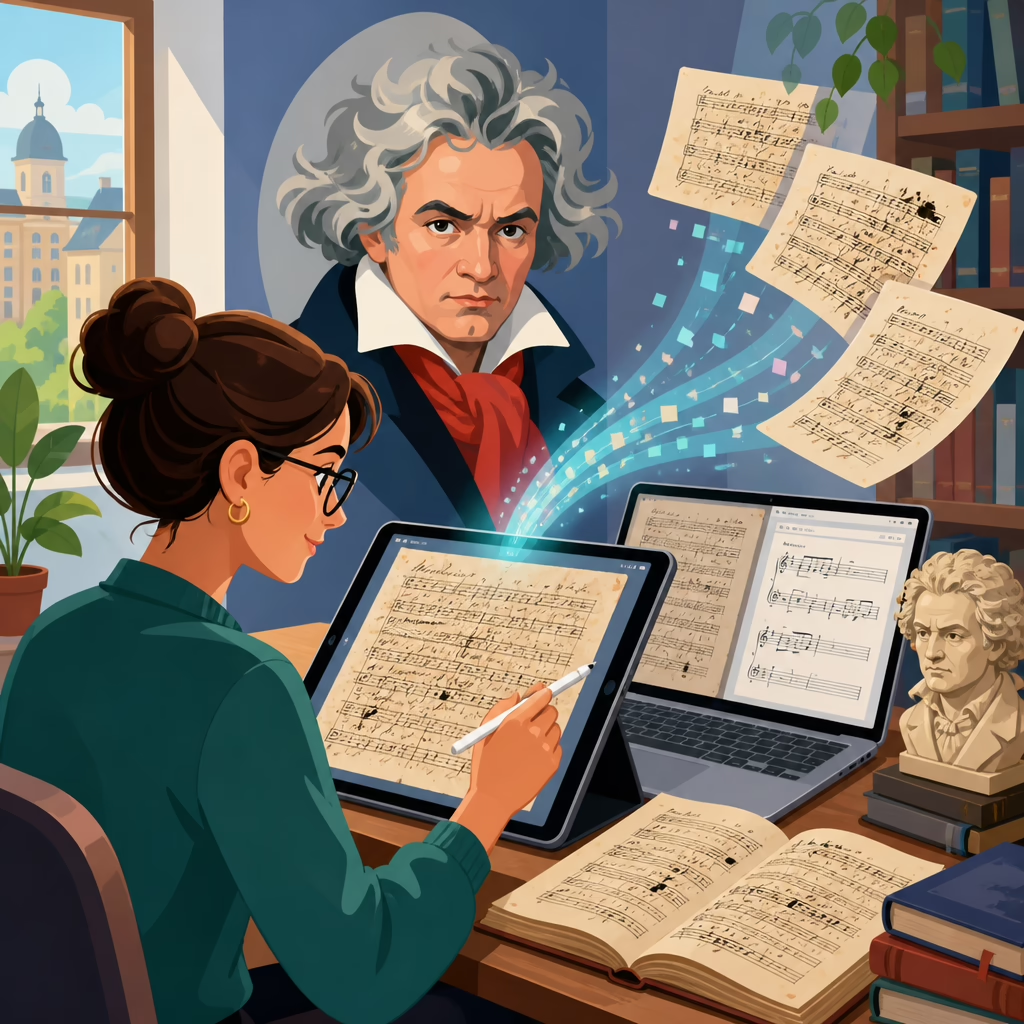
How Digital Facsimiles Change Beethoven Scholarship
Digital facsimiles have transformed Beethoven scholarship by making primary sources visible, comparable, and testable in ways that were impossible when researchers had to rely on printed editions, microfilm, or rare archive visits. In this context, a digital facsimile is a high-resolution photographic reproduction of a manuscript, sketchleaf, corrected proof, or early printed source presented through an online interface that preserves scale, color, texture, and sequencing. For Beethoven studies, that matters because the composer’s working process survives not in a single clean archive but in layers of paper evidence: autograph scores, pocket sketchbooks, desk sketchbooks, copyists’ manuscripts, publishers’ engravers’ copies, and annotated first editions. I have worked with these materials in both reading rooms and digital repositories, and the difference is practical, not merely convenient. A digital facsimile lets a scholar zoom into ink flow, compare rastrum lines across pages, track erasures under raking light photography, and verify whether an editorial claim actually matches the source. It changes the questions we can ask about chronology, authorship, revision, performance indications, and transmission. It also changes who gets to ask them, opening Beethoven scholarship to performers, teachers, and students who may never handle the original documents in Vienna, Bonn, Berlin, or New York.
The importance of this shift is easy to state directly: better access to better images produces better arguments. Beethoven’s manuscripts are notoriously difficult. His handwriting could be compressed, hurried, overwritten, and interrupted by pasted slips or later annotations. Printed editions often normalize that complexity. Even excellent critical reports summarize evidence rather than letting readers inspect it. Digital facsimiles narrow that gap between source and interpretation. They do not eliminate the need for philology, paleography, or archival judgment, but they make those disciplines more transparent. They also support newer methods, from synchronized source comparison to machine-assisted pattern recognition. For a field built on reconstructing compositional decisions from fragile documents, that is a methodological change, not just a format update.
Access reshapes the evidence base
Before widespread digitization, Beethoven scholars built projects around travel budgets, archive permissions, and photography restrictions. That created an uneven evidence base. Well-funded editors could inspect multiple repositories; younger researchers often had to trust transcriptions or printed plates. Digital facsimiles reduce that asymmetry. Major libraries now provide manuscript images that can be consulted repeatedly, at different magnifications, and alongside catalog metadata. In practice, this means a researcher studying the Eroica sketch tradition or the late quartets can revisit a troublesome page ten times in one afternoon instead of making a single hurried note in a reading room.
This broader access affects scholarship in two concrete ways. First, it improves verification. Claims about a missing accidental, an overwritten dynamic, or the order of bifolios can be checked against the image rather than repeated by citation chain. Second, it widens participation. Performers preparing historically informed interpretations, graduate seminars training source criticism, and independent scholars outside major universities can work from the same visual evidence. Access does not flatten expertise, but it does broaden the community of informed scrutiny, and Beethoven studies benefits when more eyes inspect difficult sources.
Revision becomes visible as process, not residue
Beethoven’s reputation as a laboring reviser has long been grounded in sketches and corrected manuscripts, yet digital facsimiles make that labor newly legible. A printed transcription can tell you that a motive was altered; a high-resolution image shows how the alteration happened. Was a note scratched out immediately with the same ink and pressure, suggesting instantaneous revision? Was a new phrase inserted above the staff in darker ink, implying later reconsideration? Did Beethoven compress notation to avoid recopying the page? These are not cosmetic details. They help establish sequence, intention, and the relative finality of readings.
Consider a typical late-style problem: a passage in which voice-leading appears awkward in one source and smoother in another. Without facsimiles, the smoother reading may look obviously preferable. With facsimiles, one may find that the “awkward” reading is Beethoven’s original layer and the smoother version a copyist’s intervention or publisher’s regularization. Conversely, facsimiles sometimes confirm that Beethoven himself revised toward the reading later adopted by editors. The key point is that revision stops being an abstract editorial note and becomes observable evidence. That shift has sharpened arguments about compositional chronology, especially in works whose genesis stretched across sketchbooks, score drafts, and proofs.
Source comparison is faster and more exact
Beethoven scholarship depends on comparing witnesses: autograph against copyist manuscript, corrected proof against first edition, one issue state against another. Digital facsimiles make this comparison materially easier. Two or more sources can be opened side by side, synchronized by measure number, and inspected at equivalent zoom levels. Features that once required memory or cumbersome photocopies now stand in immediate relation. I have found that this alone changes the quality of note-taking. Instead of summarizing differences vaguely, one can record exact spacing, stem direction, overwritten articulations, and page-turn logic.
That precision matters because not all variants carry equal weight. Some arise from routine engraving simplification; others reveal substantive musical decisions. Digital environments also support linked workflows: image viewers, metadata records, spreadsheets of variants, and notation software can all be used in tandem. For readers interested in adjacent methods, the broader context is outlined in this guide to technology-assisted Beethoven score analysis, but the essential point here is narrower. Better comparison of facsimiles improves stemmatic reasoning, helping scholars decide which source depends on which, where corruption entered the tradition, and when an apparent discrepancy is merely visual noise.
| Scholarly task | What digital facsimiles add | Why it changes conclusions |
|---|---|---|
| Dating a manuscript layer | Zoomable ink color, pen pressure, paper rulings, watermark visibility | Supports finer chronology and separates writing sessions |
| Evaluating a variant reading | Side-by-side comparison of autograph, copyist source, and first edition | Distinguishes authorial revision from transmission error |
| Studying notation habits | Repeated access to clefs, slurs, beams, and accidentals across sources | Identifies consistent habits versus isolated anomalies |
| Teaching source criticism | Shared online access for entire classes | Makes evidentiary method visible and reproducible |
Material features matter more when images improve
One underappreciated effect of digital facsimiles is renewed attention to the document as an object. Beethoven manuscripts are not just carriers of notes; they are paper artifacts with dimensions, gatherings, watermarks, stitching patterns, and damage histories. High-quality imaging allows scholars to inspect chain lines, paper tone, cropping, and pasted inserts with unusual care. These features can confirm whether leaves belong together, whether a page was reordered, or whether a source once formed part of a larger unit now dispersed across institutions.
Watermark study is a good example. Traditional paper analysis requires direct examination and specialized lighting, but well-made digital facsimiles can still reveal enough structure to support preliminary grouping, especially when combined with catalog descriptions and known paper types. Likewise, edge wear or trimming can explain why a barline or articulation appears incomplete. That may sound technical, but it directly affects editorial judgment. If a slur disappears into a cropped margin, the absence is not evidence that Beethoven omitted it. Digital facsimiles encourage this kind of restraint because they foreground the physical contingencies of the source.
Editing Beethoven becomes more transparent
Critical editions of Beethoven remain indispensable, but digital facsimiles have changed how editors justify their texts and how readers evaluate those justifications. An editor can no longer rely solely on authority or selective citation when many readers can inspect the same manuscript online. That has raised the standard of argument. Good editorial practice now tends to integrate image consultation, explicit source hierarchy, and fuller explanation of rejected readings. The result is not the end of disagreement; Beethoven sources are too messy for that. The result is more accountable disagreement.
This transparency is especially valuable in passages where notation and meaning diverge. Beethoven might write an irregular slur that reflects hurried pen movement rather than phrasing intention, or an accidental whose position creates ambiguity about note attachment. Editors must still decide what performers should read. Digital facsimiles do not automate that decision, but they let others test whether the decision is plausible. In my experience, this has made debates more concrete and less doctrinal. Scholars argue from visible evidence: stroke order, cancellation marks, spacing, and concordance with parallel passages. That is healthy for the field because it links interpretation back to the artifact.
Performance research gains a firmer documentary base
Performers have always consulted urtexts, but digital facsimiles deepen the documentary basis of interpretive choices. A pianist or string quartet can inspect Beethoven’s articulation density, pedal indications, accent placement, and page layout rather than receiving them only through editorial mediation. This does not mean performers should imitate every visual irregularity as intention. Beethoven’s notation is sometimes inconsistent within a single work. Yet seeing the source often clarifies where an editor has regularized a pattern that was not regular in the manuscript, or where a seemingly eccentric marking recurs often enough to deserve serious musical weight.
The practical impact is strongest in contested areas: staccato versus wedge marks, phrase slur extent, dynamic layering, and the distinction between compositional notation and engraver cleanup. Digital facsimiles also reveal constraints that shaped the notation. Cramped systems may explain abbreviated markings; corrected proofs may show Beethoven reacting to engraver misunderstandings. For performance scholarship, that moves discussion beyond generalized authenticity toward documented decision-making. The best interpretations still require style knowledge and musical imagination, but facsimiles anchor those choices in primary evidence.
Limits remain, and careful use is essential
Digital facsimiles are powerful, but they are not neutral windows onto truth. Image quality varies widely. Color calibration can distort ink differentiation. Compression artifacts may mimic erasures or obscure faint pencil. Interfaces sometimes detach images from complete metadata, making it hard to know whether one is viewing a full source, a selection, or a later rebinding order. Even excellent images flatten depth. A scholar examining an original manuscript can tilt the page, inspect verso bleed-through, assess paper stiffness, and detect layered corrections in ways a screen cannot fully reproduce.
There are also interpretive risks. Easy zoom can encourage overconfidence in tiny details detached from codicological context. Scholars may mistake visual sharpness for evidentiary certainty. Manuscript study still requires external controls: critical reports, archive catalogs, provenance history, watermark databases, and where possible direct inspection. In other words, digital facsimiles improve Beethoven scholarship most when they are integrated into disciplined source criticism rather than treated as replacements for it. The strongest recent work combines both habits: close reading of images and sober awareness of their limits.
Digital facsimiles have changed Beethoven scholarship because they reconnect interpretation with visible evidence at scale. They expand access to rare sources, expose revision as a sequence of actions, accelerate comparison among witnesses, highlight the material history of manuscripts, and make editorial and performance claims easier to test. Just as important, they change the culture of the field. Arguments can be more reproducible because readers can often inspect the same page that underlies the claim. That is a major advance for any discipline built on fragile, dispersed documents.
The central benefit is not convenience alone. It is methodological clarity. When scholars, editors, and performers can see more of what Beethoven actually wrote, crossed out, inserted, and corrected, they make stronger decisions about chronology, text, and meaning. The best work still depends on expertise, patience, and skepticism, but digital facsimiles give those virtues a better evidentiary foundation. If you study Beethoven sources, teach them, or perform from them, spend time with the facsimiles themselves and let the documents sharpen your next question.
Frequently Asked Questions
What is a digital facsimile, and why does it matter so much in Beethoven scholarship?
A digital facsimile is a high-resolution photographic reproduction of a source such as a Beethoven autograph manuscript, sketchleaf, corrected proof, or early printed edition, presented through an online interface that preserves visual features scholars care about: scale, color, texture, page order, marginal space, and the physical relationship between marks on the page. That may sound like a technical upgrade, but in Beethoven scholarship it represents a major methodological shift. For generations, researchers often had to work from printed editions, black-and-white plates, microfilm, or selective archival access. Those formats were useful, but they frequently flattened or obscured details that matter when interpreting Beethoven’s working process.
With digital facsimiles, scholars can inspect erasures, insertions, overwriting, changes in ink density, paper edges, ruling patterns, and page sequencing in ways that are far closer to direct source study. This matters because Beethoven’s manuscripts are not simply containers of finished musical text; they are evidence of composition in motion. His corrections, revisions, cancellations, and notational hesitations can reveal how an idea developed, how a passage was reworked, or how a later layer of thought altered an earlier one. A digital facsimile makes those layers more accessible to a wider scholarly community, which means interpretation becomes less dependent on secondhand description and more grounded in visible, testable evidence.
Just as important, digital facsimiles democratize access. Instead of limiting close manuscript study to the small number of people who can travel to specific archives and secure permission to consult fragile materials, online facsimiles let scholars, students, editors, performers, and informed readers examine primary sources from anywhere. That wider visibility has changed the culture of Beethoven studies by encouraging more comparison, more verification, and more collaborative debate about what the sources actually show.
How do digital facsimiles improve on older tools like printed editions, microfilm, and archival descriptions?
Digital facsimiles improve on older tools primarily by restoring visual information that earlier formats often lost. Printed editions usually present an editor’s interpretation of the text rather than the source itself. Even when an edition includes a critical apparatus, readers are still seeing a mediated reconstruction. Microfilm, by contrast, often preserves more of the original layout, but it can compress tonal range, distort scale, obscure paper color, and make it difficult to distinguish between different writing instruments, correction layers, or damage to the page. Archival descriptions and catalogs are valuable guides, but they summarize rather than display the evidence.
In Beethoven scholarship, these distinctions are crucial. A small mark may be a dynamic, an accent, a smudge, or the trace of a canceled note. The angle and pressure of a pen stroke can help determine whether a notation belongs to an original layer or a later revision. The spacing between systems can suggest whether Beethoven was planning ahead or crowding in a correction after the fact. A high-quality digital facsimile can preserve enough visual nuance to support these kinds of judgments far better than many older surrogates.
Another major advantage is comparability. Digital interfaces often allow users to move quickly between pages, zoom into details, and compare related sources side by side. That makes it easier to test editorial claims, trace variant readings, and study the relationship between a sketch, a fair copy, and an early print. Earlier generations of scholars certainly performed this work, but digital facsimiles reduce the logistical friction dramatically. Instead of piecing together evidence from scattered reproductions and limited visits, researchers can evaluate multiple witnesses more systematically and with greater visual precision.
Finally, digital facsimiles create a more transparent research environment. When a scholar argues that a reading should be interpreted in a particular way, other researchers can often inspect the same image and assess the claim directly. That visibility strengthens the evidentiary basis of Beethoven studies and helps move debate away from authority alone and toward shared examination of the primary source.
In what ways do digital facsimiles change how scholars understand Beethoven’s compositional process?
One of the most important effects of digital facsimiles is that they make Beethoven’s compositional process newly legible. Beethoven’s surviving sources often preserve layers of thought rather than a single clean text. He drafted, revised, canceled, expanded, compressed, and reimagined musical material across sketchbooks, loose leaves, manuscripts, and corrected proofs. When scholars can study these documents closely in digital form, they gain better access to the chronology and logic of his decisions.
For example, a digital facsimile may allow a researcher to distinguish between an initial notation and a later correction because of differences in ink tone, pen thickness, or placement on the page. It may reveal that a passage was not simply rewritten but reconceived structurally, or that a melodic figure migrated from one context to another before reaching its familiar final form. It may also expose practical aspects of Beethoven’s workflow, such as how he used page space, how densely he revised in certain genres, or how often he returned to a passage after apparently moving on.
This matters because Beethoven scholarship is deeply interested not only in what the final text says, but in how it came to be. Questions about genesis, revision, chronology, intention, and transmission are central to the field. Digital facsimiles give scholars stronger visual evidence for reconstructing those processes. Instead of relying primarily on transcriptions or editorial summaries of a source’s complexities, they can observe many of those complexities directly.
The result is often a more dynamic picture of Beethoven as a working composer. Rather than treating the manuscript as a flawed route toward a finished ideal text, digital source study encourages scholars to see revision itself as meaningful evidence. That shift has influenced critical editing, source criticism, performance interpretation, and broader historical understanding of Beethoven’s creative practice.
Do digital facsimiles replace the need to consult original Beethoven manuscripts in person?
No, digital facsimiles do not completely replace in-person consultation, but they substantially change when and why scholars need it. For many research questions, a high-quality digital facsimile provides enough information to support serious source analysis, preliminary conclusions, and even advanced comparative work. It can reduce unnecessary travel, expand access to rare materials, and allow scholars to revisit a source repeatedly without the limits imposed by reading-room schedules or conservation restrictions.
That said, there are still situations in which the physical object matters. Certain material features may be difficult to capture fully in even excellent digital imaging, such as paper thickness, watermarks visible only under specific lighting conditions, impressions from writing pressure, bindings, sewing structures, or subtle evidence of layering and damage. In some cases, the exact physicality of the source can affect conclusions about chronology, compilation, or use. Conservators, codicologists, and specialists in paper studies may need direct access for that reason.
Even so, the practical balance has changed. Where scholars once had to rely on costly archive visits simply to see a source at all, they can now use digital facsimiles to identify the most important questions before any travel occurs. That makes in-person work more targeted and efficient. It also means that many claims can be tested by a far larger group of researchers than before, because the initial visual evidence is no longer locked behind geography.
So the best way to think about digital facsimiles is not as a perfect substitute for originals, but as a transformative scholarly bridge. They bring researchers much closer to the source than older reproductions did, they support rigorous analysis on their own terms, and they reserve physical consultation for the cases where the object’s material properties become essential to the argument.
How have digital facsimiles affected music editing, teaching, and performance related to Beethoven?
Digital facsimiles have had a significant impact far beyond specialist manuscript study. In music editing, they strengthen the foundation of critical decisions by allowing editors to compare readings more carefully across autograph sources, early copies, corrected proofs, and first editions. Because the source image is more readily available, editorial choices can be justified with greater transparency. This has encouraged a more accountable editorial culture in which claims about difficult readings, ambiguous notation, or revision layers can be examined by others rather than accepted solely on trust.
In teaching, digital facsimiles have opened Beethoven scholarship to a much wider audience. Students can now encounter primary sources directly instead of meeting them only through edited notation or textbook description. That changes the classroom experience. It makes source criticism concrete, shows how unstable a musical text can be before editorial regularization, and introduces students to the realities of composition, revision, and transmission. It also helps them understand that Beethoven’s music did not emerge fully formed, but through a process visible on the page.
Performers benefit as well. A digital facsimile does not tell a performer exactly how to play, but it can sharpen awareness of articulation, dynamics, phrasing, accidentals, and notational emphasis in moments where editions differ or seem overdetermined by later editorial tradition. Seeing the source can prompt performers to ask whether a marking is original, revised, inconsistent, or perhaps normalized in modern print. That kind of inquiry can lead to more historically informed and more intellectually engaged interpretations.
More broadly, digital facsimiles create a common evidentiary space connecting scholars, editors, teachers, and performers. Instead of treating Beethoven’s manuscripts as inaccessible specialist territory, they