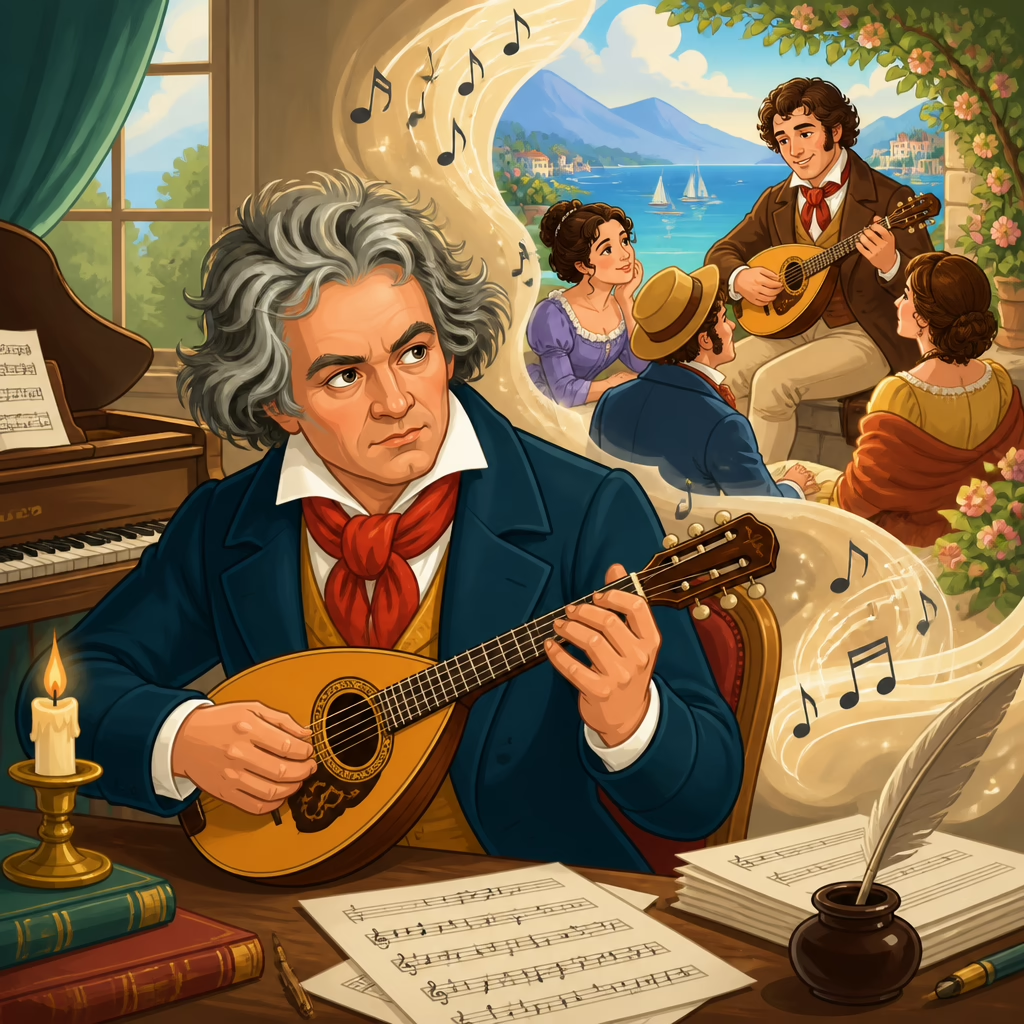
The Story of Beethoven’s Mandolin Music
Beethoven’s mandolin music occupies a tiny corner of his catalogue, yet it tells a remarkably vivid story about patronage, intimacy, experimentation, and the social world in which he built his career. When musicians speak of Beethoven, they usually mean symphonies, piano sonatas, string quartets, or the heroic rhetoric of his middle period. The mandolin pieces seem almost accidental beside those monuments. In practice, they are anything but trivial. They show the young composer in Vienna writing for a fashionable domestic instrument, adapting his style to amateur performance, and discovering how much expression can fit inside a few compact pages. For listeners, scholars, and performers, this repertoire matters because it reveals Beethoven at close range: less public, less monumental, and often more playful than the familiar image suggests.
The phrase “Beethoven’s mandolin music” usually refers to four short works composed in the mid-1790s for mandolin and keyboard, now catalogued as WoO 43 and WoO 44. They are the Sonata for Mandolin and Harpsichord in C major, WoO 43a; the Sonata for Mandolin and Harpsichord in C minor, WoO 43b; the Adagio ma non troppo in E-flat major, WoO 43b in some older sources but more securely grouped among the mandolin works; and the Andante con variazioni in D major, WoO 44b, along with a few related fragments and questions of attribution. Terminology can be messy because early manuscripts, later editions, and work-without-opus catalogues do not always align neatly. What remains clear is that Beethoven wrote a small but distinct body of music for the mandolin during his early Vienna years, probably around 1795 to 1796, and that these pieces were tied to a specific social context rather than a long-term commitment to the instrument.
That context is essential. Late eighteenth-century Vienna supported a lively culture of aristocratic salons and private music making. The mandolin, especially in its Neapolitan form, had become fashionable among noble amateurs, particularly women who were expected to cultivate elegant, refined accomplishments. Beethoven, newly established in Vienna and eager to secure patronage, wrote occasional pieces for people in that circle. These works therefore sit at the intersection of art and opportunity. They were practical gifts, social tools, and demonstrations of tact. At the same time, they are recognizably Beethovenian in gesture, harmony, and motivic economy. Their story is the story of how a major composer responded to immediate human circumstances without sacrificing craft.
Why Beethoven Wrote for Mandolin in Vienna
The most widely accepted explanation links the mandolin pieces to Countess Josephine von Clary-Aldringen, an aristocratic amateur mandolin player whom Beethoven knew in Prague and Vienna. Surviving autograph material includes dedications and inscriptions that strongly suggest the works were written for her use. This was not unusual behavior for Beethoven in the 1790s. I have often found that when examining his occasional works from this decade, the practical question “Who was expected to play this?” explains both the scale and the style better than abstract aesthetic theories. In the case of the mandolin music, the answer points directly to salon performance, not the concert hall.
Josephine’s role helps explain several features at once. The writing is idiomatic enough to flatter an accomplished amateur but not so difficult that it becomes virtuoso display. The keyboard part supports, comments, and occasionally takes the lead, yet it does not bury the plucked instrument. Phrases are concise. Textures are transparent. Dynamic contrasts are effective but manageable in a room rather than a theater. Beethoven understood that domestic music succeeded when it sounded polished quickly, rewarded repeated playing, and gave the featured player moments of charm and expressive focus. These are not downgraded values. They are the values of a specific performance culture.
The pieces also reflect Beethoven’s early-career strategy. In the mid-1790s he was known first as a formidable pianist and improviser, but he was still building relationships with patrons who could provide introductions, commissions, and social legitimacy. Writing for a noblewoman’s favored instrument was a sensible, targeted gesture. It displayed versatility and attentiveness. It also aligned him with a long tradition in which composers created occasional chamber works for elite households. In that sense, Beethoven’s mandolin music is not an anomaly but a document of professional adaptation. The same composer who could astonish with keyboard brilliance could also write with miniature precision when circumstances demanded it.
The Four Principal Mandolin Works
The core repertoire is small enough to survey clearly, and doing so makes the story easier to grasp. Each piece solves a different musical problem while remaining suitable for private performance. Together they offer a compact portrait of Beethoven’s early style in miniature forms.
| Work | Key | Likely Date | Character | What to Listen For |
|---|---|---|---|---|
| Sonatina | C major | 1795–1796 | Graceful, conversational | Balanced phrases, light accompaniment, elegant cadences |
| Sonatina | C minor | 1795–1796 | More dramatic, concentrated | Minor-key tension, sharper accents, compressed emotional weight |
| Adagio ma non troppo | E-flat major | 1795–1796 | Singing, lyrical | Ornamented melody, sustained line over supportive harmony |
| Andante con variazioni | D major | 1795–1796 | Decorative, witty | Variation technique, changing figuration, interplay between parts |
The C major Sonatina is often the first piece performers encounter. It shows Beethoven working within the language of late eighteenth-century galant chamber music while tightening the motivic profile more than a lesser craftsman would. The tune is easy to follow, but its phrase endings, accompanimental turns, and small rhythmic displacements prevent it from sounding generic. The mandolin sings rather than sparkles for its own sake. In performance, that means articulation matters more than volume. A player who shapes every two-bar idea clearly will reveal the design better than one who chases brilliance.
The C minor Sonatina is especially revealing because it condenses a darker expressive world into modest dimensions. Beethoven was already attracted to C minor as a key of tension, urgency, and rhetorical compression, and even this tiny work hints at that association. No one should mistake it for the emotional scale of the “Pathétique” Sonata or the Fifth Symphony, but the kinship of temperament is real. The sharper profile of the opening idea, the stronger contrast between melodic appeal and harmonic stress, and the concise handling of cadence all point toward a composer who could dramatize without inflating the form.
The Adagio ma non troppo shifts the focus to sustained cantabile. On mandolin, lyrical writing poses a challenge because the instrument cannot sustain a note like a violin or voice. Beethoven responds with ornamentation, repeated-note shaping, and supportive keyboard writing that carries the harmonic line forward while the plucked instrument suggests continuity through tasteful decoration. This is where performers either understand eighteenth-century style or expose themselves. Too much rubato turns the piece sentimental. Too little leaves it dry. The best readings treat embellishment as a means of vocal expression.
The Andante con variazioni may be the most instructive work in the set because variation form lets Beethoven display economy and invention together. He begins with a straightforward theme, then alters texture, rhythm, and figuration without losing the listener’s sense of orientation. In my experience coaching chamber players on compact classical variation sets, the main interpretive trap is sameness: every variation can feel like the same tune with extra notes. Beethoven avoids that through character contrast, and performers must underline those distinctions. One variation may become more ornamental, another more rhythmically alert, another more balanced between partners. The intelligence lies in proportion.
Style, Technique, and the Sound World of the Instrument
Beethoven did not become a mandolin specialist, but he wrote as someone attentive to the instrument’s strengths. The mandolin projects clean attacks, quick articulation, and a bright upper register. It handles arpeggiation, scale fragments, and decorative figuration naturally, but long-breathed legato is harder to simulate. In these pieces Beethoven leans into what works. He keeps many gestures short, aligns melodic contours with the instrument’s speaking qualities, and avoids overloading the texture. That restraint is a mark of skill. Composers unfamiliar with plucked strings often write either too thickly or too pianistically. Beethoven generally does neither here.
The keyboard part deserves equal attention. Original source descriptions often mention harpsichord, though modern performances frequently use fortepiano or piano. Historically, fortepiano is usually the most persuasive choice because it matches the era’s timbre and dynamic scale while allowing subtle dialogue with the mandolin. Harpsichord can sound elegant but risks reducing dynamic nuance. Modern piano provides convenience and wider availability, yet performers must scale back touch and pedal to avoid overwhelming the plucked line. Balance is not a secondary issue; it is the central technical challenge of this repertoire. When the keyboard dominates, the music’s social logic disappears.
Another important stylistic point is ornamentation. These works belong to a period when performers were expected to understand appoggiaturas, turns, light extempore inflection, and tasteful rhythmic flexibility within a stable pulse. Beethoven notates much, but not everything. A rigidly literal reading can sound undernourished, while an excessively romantic one distorts the idiom. The ideal approach borrows from informed classical practice: clean attacks, sparing vibrato, transparent voicing, and ornaments that clarify phrase direction. This is one reason the pieces continue to attract historically informed performers. Their scale is small, but the demands of style are exacting.
Sources, Attribution, and Scholarly Questions
Because Beethoven’s mandolin music survives in a limited and somewhat tangled documentary record, cataloguing has long required caution. The standard “Werke ohne Opuszahl” system groups pieces that Beethoven did not publish with opus numbers, but manuscript evidence, copyists’ habits, and later editorial decisions can blur boundaries. Some editions differ in naming conventions, and occasional references to additional mandolin-related fragments have created confusion among non-specialists. Reliable scholarship therefore depends on consulting critical editions and thematic catalogues rather than relying on old anthology titles alone.
What can be said confidently is that the principal works are authentic and tied to Beethoven’s early Vienna network. Autograph sources support their connection with Josephine von Clary-Aldringen, and their musical language aligns convincingly with the mid-1790s. Beyond that, precision matters. Claims that Beethoven maintained a sustained fascination with the mandolin are overstated. Claims that these pieces are merely salon trifles are equally misleading. The evidence supports a narrower and more interesting conclusion: Beethoven wrote a small, purposeful set of refined occasional works for a fashionable instrument in response to a patronage relationship and domestic performance context.
This distinction affects how the music should be valued. Great composers are not measured only by the largest forms. Miniatures can reveal choices that larger works conceal. In Beethoven’s case, the mandolin pieces show how he calibrated means to ends, wrote idiomatically under social constraints, and preserved expressive individuality inside conventional formats. That is why specialists continue to program, edit, and record them. For readers exploring this repertoire within Beethoven’s smaller-scale output, the broader context of his concise forms can be usefully compared with the piano miniatures discussed in this guide to Beethoven’s bagatelles, where brevity likewise becomes a serious artistic tool.
Reception, Performance Practice, and Modern Legacy
These works were never central to Beethoven’s public reputation, and they still appear less often in mainstream concert programming than music for violin, cello, or solo piano. Yet within mandolin circles they hold unusual prestige. Part of that prestige comes from rarity: the chance to play authentic Beethoven on an instrument with a comparatively modest canonical literature is attractive. Part comes from quality. The pieces are accessible enough for advanced students, but subtle enough that professionals can keep returning to them. Recordings by historically informed ensembles have strengthened their standing by showing how vivid the music becomes when period balance, articulation, and tempo relationships are respected.
Modern performers face several practical decisions. Instrument choice matters first. A Neapolitan mandolin can emphasize the music’s historical color, while modern bowlback or flatback instruments may project differently and encourage distinct articulation. Tuning, string material, plectrum technique, and tremolo use also influence style. In these works, heavy continuous tremolo often sounds anachronistic. Cleaner attack with selective sustain better suits classical rhetoric. Tempo is another recurring issue. Because the pieces are short, players sometimes rush them in pursuit of sparkle. That usually weakens phrase structure. Beethoven’s wit lands best when cadence, breathing space, and dialogue remain audible.
Their legacy, then, is not based on scale but on perspective. Beethoven’s mandolin music widens the portrait of the composer by restoring the world around the masterpieces: salons, patrons, amateur musicians, adaptable genres, and finely judged occasional composition. It reminds us that musical history is not only the history of monuments. It is also the history of rooms, relationships, and instruments that shaped what composers wrote from week to week. Listen to these pieces with that in mind and they stop sounding peripheral. They become evidence of Beethoven’s responsiveness, economy, and unfailing ability to make even modest materials speak with character.
The key takeaway is simple. Beethoven’s mandolin works are few, but they are important because they connect biography, social history, and musical craft in unusually concentrated form. They show why he wrote for the instrument, who likely played the pieces, how he adapted to its sound, and what these miniatures reveal about his early Viennese career. They also reward close listening: the C major Sonatina for grace, the C minor for tension, the Adagio for lyrical invention, and the variations for formal intelligence. If you want a fuller understanding of Beethoven beyond the standard canon, start with these intimate works and hear how much story fits inside a handful of pages.
Frequently Asked Questions
Why did Beethoven write music for the mandolin at all?
Beethoven wrote for the mandolin because it suited a very specific social and professional moment in his early Viennese career. Unlike his symphonies or piano sonatas, these works were not written to make a public artistic declaration on the largest possible scale. They grew out of a more intimate world: aristocratic salons, private music-making, personal connections, and the practical realities of patronage. In Vienna, a rising composer needed more than genius. He needed access, favor, and opportunities to demonstrate his versatility to influential people. Writing for an instrument like the mandolin was one way of doing that.
The mandolin was especially associated with domestic and aristocratic music-making at the end of the eighteenth century. It was not a central orchestral instrument, nor did it command the prestige of the piano or violin, but it had a refined, fashionable presence in certain circles. Beethoven’s surviving mandolin pieces are closely linked to Countess Josephine Clary, an aristocratic amateur who played the instrument. That connection matters, because it places the music within a setting of cultivated sociability rather than public concert life. These were works designed for a listener and player in close proximity, not for a large hall.
That context helps explain why the pieces feel so direct and personal. Beethoven was not “slumming” by writing for a minor instrument. He was responding intelligently to the musical life around him. The mandolin gave him a chance to write elegantly, economically, and with sensitivity to an instrument whose expressive world depended on charm, clarity, and nuance. In that sense, the mandolin music reveals an important side of Beethoven: a composer attentive to occasion, audience, and human relationships, even while building the career that would eventually produce much larger and more famous works.
Are Beethoven’s mandolin pieces important, or are they just curiosities?
They are absolutely important, even if they occupy a small place in his catalogue. It is easy to dismiss them because they are few in number, modest in scale, and written for an instrument that most listeners do not strongly associate with Beethoven. Yet historical importance is not measured only by size, fame, or heroic ambition. These works matter because they illuminate how Beethoven actually lived and worked as a young composer in Vienna. They give us a close-up view of his adaptability, his social world, and his ability to invest even occasional pieces with character and craft.
From a musical standpoint, the mandolin works show that Beethoven could think effectively in miniature. The writing is concise, but not careless. He shapes melody with elegance, supports it with clear harmonic movement, and understands the balance needed between plucked mandolin and accompanying keyboard. That alone is revealing. Beethoven is often imagined primarily as the titan of struggle and monumental form, but these pieces remind us that he also possessed refinement, wit, and sensitivity to intimate expression. They complicate the stereotype in a useful way.
They are also important because they document a part of musical culture that grand narratives often overlook. Beethoven did not emerge in isolation, fully formed as the composer of the “Eroica” or the late quartets. He moved through drawing rooms, patronage networks, and amateur performance circles. The mandolin pieces belong to that ecosystem. For historians, performers, and listeners, they are valuable evidence of how elite domestic music-making intersected with a major composer’s development. So while they may be less famous than the symphonies, they are far more than curiosities. They are small works with large documentary and artistic significance.
What do Beethoven’s mandolin works reveal about his early years in Vienna?
They reveal a composer who was still establishing himself, navigating relationships with patrons, and proving that he could succeed in many different musical settings. Beethoven arrived in Vienna with extraordinary talent, but talent alone did not guarantee stability or influence. In the late eighteenth-century musical world, a young composer needed to attract support from nobles, impress amateur musicians, and participate in the private cultural life of the city. The mandolin pieces offer a vivid glimpse of that process.
Most importantly, they show Beethoven working within the intimate scale of salon culture. This was a world where music was often performed in homes rather than concert halls, and where social grace mattered alongside artistic invention. Writing for mandolin and keyboard suggests responsiveness to the tastes and abilities of specific people in his circle. It tells us that Beethoven was not simply composing according to some abstract idea of greatness. He was engaging with the actual demands and opportunities of Viennese life, where patronage and personal contact could shape what a composer wrote.
These works also reveal his experimental intelligence. Even in a modest format, Beethoven explores contrast, lyricism, and instrumental color. He treats the mandolin not merely as a novelty but as an expressive partner. That indicates a practical imagination: he was willing to learn what an instrument could do and write accordingly. In broader biographical terms, the pieces remind us that Beethoven’s path to artistic independence passed through a period of negotiation, flexibility, and close social observation. The mandolin music is a trace of that early stage, when private commissions and personal connections were deeply entwined with creative work.
How does Beethoven’s mandolin music differ from his better-known piano sonatas, quartets, and symphonies?
The most obvious difference is scale. Beethoven’s major piano sonatas, string quartets, and symphonies often aim for architectural breadth, dramatic conflict, and long-range development. They are designed to sustain attention over larger spans of time and to project strong formal arguments. The mandolin pieces operate in another dimension entirely. They are short, intimate, and socially immediate. Instead of public drama, they offer concentrated lyricism and elegant exchange between players.
That difference in scale produces a different expressive atmosphere. In the symphonies, Beethoven often sounds confrontational, expansive, or transformative. In the mandolin works, he sounds conversational. The music speaks in a more private voice. Phrases are shaped with grace rather than with the sense of struggle and propulsion that many listeners associate with his middle-period style. The textures are lighter, the gestures more delicate, and the emotional world more closely tied to charm, tenderness, and cultivated poise.
At the same time, the contrast should not be overstated. These pieces are still recognizably Beethovenian in their alert handling of motif, their sense of balance, and their refusal to be merely decorative. Even on a small canvas, he brings purpose to his writing. The accompaniment is not random, the melodic lines are carefully profiled, and the interaction between instruments is thoughtfully controlled. What changes is not the seriousness of his craftsmanship, but the kind of occasion he is writing for. The mandolin music shows Beethoven adjusting his voice to a private room rather than a public stage, without abandoning musical intelligence or expressive individuality.
Why should modern listeners and performers pay attention to Beethoven’s mandolin music today?
Modern listeners and performers should pay attention to it because it expands and humanizes our understanding of Beethoven. So much of his reputation rests on music of overwhelming power and historical consequence that it is easy to forget he also wrote for real people, in specific rooms, for specific relationships. The mandolin pieces restore that sense of proximity. They let us hear Beethoven not only as the monumental master of large forms, but also as a socially aware, responsive, and finely detailed composer capable of warmth and restraint.
For performers, the music offers rewarding interpretive challenges. Because the pieces are intimate, every phrase matters. The balance between mandolin and keyboard must be carefully judged, ornamentation and articulation must sound natural, and the performer has to sustain expressive interest without relying on sheer volume or grand rhetoric. That requires taste, control, and historical awareness. For mandolin players in particular, these works occupy a special place, since they connect the instrument to one of the central figures in Western music history in a direct and meaningful way.
For listeners, the appeal lies partly in discovery. Hearing Beethoven in this context can be surprisingly fresh. The mandolin pieces reveal an unexpectedly delicate side of his musical personality and place him within the living social fabric of Vienna rather than on a distant pedestal. They also remind us that a composer’s smaller works can carry major interpretive value. If you want to understand not just Beethoven’s greatness, but the world that helped shape it, the mandolin music is well worth your attention.