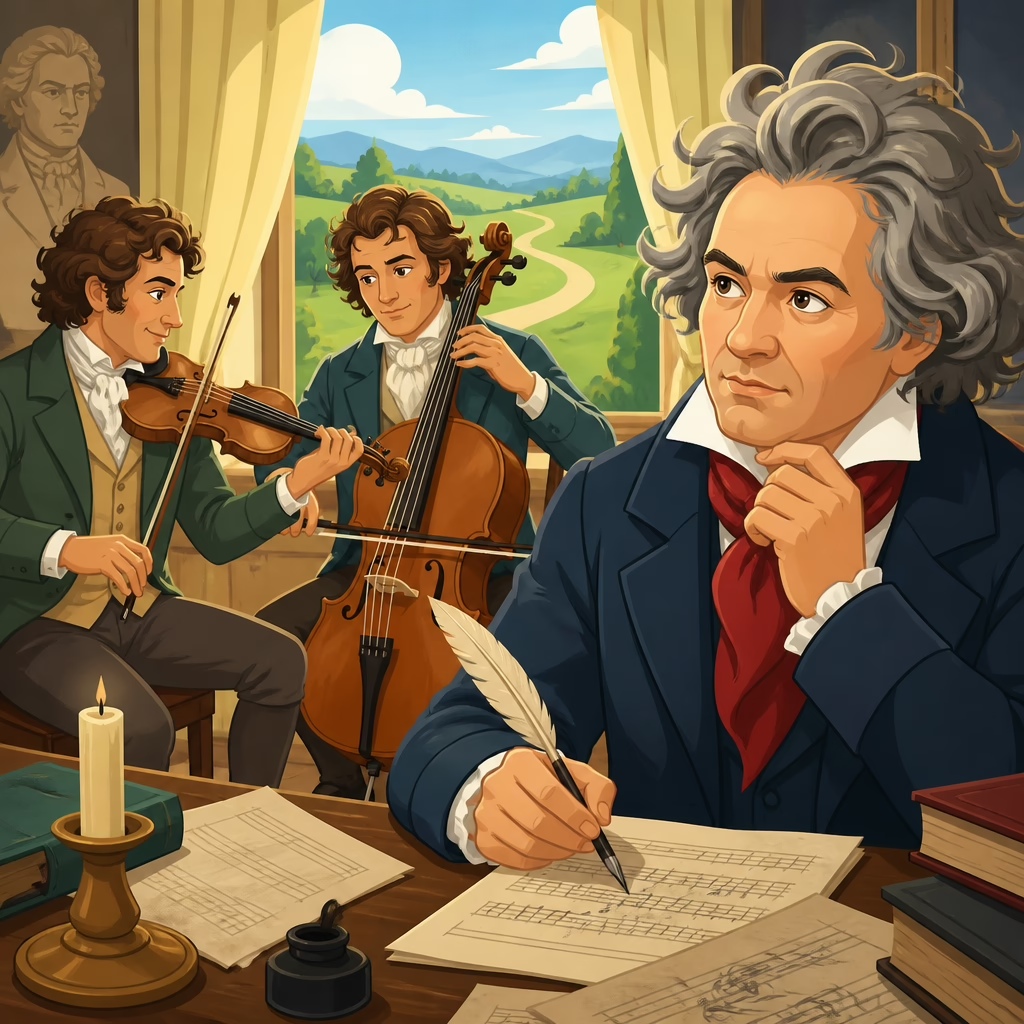
Beethoven’s String Trios and the Road to Op. 18
Beethoven’s string trios occupy a crucial, often underestimated place in his development, and they lead directly to the artistic breakthrough of the Op. 18 string quartets. Written mainly in the 1790s, these works show the young composer testing formal balance, conversational writing, motivic compression, and instrumental drama within a medium leaner than the quartet. A string trio, scored for violin, viola, and cello, removes the second violin that often cushions texture in quartet writing; every line is exposed, and weaknesses in counterpoint, pacing, or thematic economy become immediately audible. That exposure is exactly why these pieces matter. In my experience studying Beethoven’s chamber music, the trios reveal the workshop in which he learned how to distribute argument among three equal players, sharpen transitions, and turn Classical models into something unmistakably personal. To understand how Beethoven reached the six quartets of Op. 18, it is not enough to jump from Haydn and Mozart to the mature masterpieces. The string trios show the road itself: deliberate, technically demanding, sometimes experimental, and increasingly confident in a voice that would soon transform the quartet tradition.
The trio as Beethoven’s proving ground
When Beethoven arrived in Vienna in 1792, the chamber music field he entered was dominated by the examples of Haydn and Mozart, especially in the string quartet. For a young composer, however, the string trio offered a practical intermediate space. It was prestigious enough to attract serious players and patrons, yet small enough to permit concentrated technical experimentation. Beethoven’s published trios Opp. 3, 8, and 9 belong to this environment. The Divertimento in E-flat major, Op. 3, probably dates from the mid-1790s and adopts the expansive six-movement design associated with serenade and divertimento traditions. The Serenade in D major, Op. 8, takes a lighter, more social stance. The three trios of Op. 9, published in 1798, are the real watershed. Beethoven reportedly valued them highly, and with reason: they are not salon pieces but serious chamber works in which the three instruments debate, interrupt, accompany, and challenge one another with unusual intensity.
Why does this matter for Op. 18? Because quartet writing demands more than good themes. It requires structural control over long spans, differentiation of instrumental roles without rigidity, and the ability to sustain four-part texture through contrast rather than thickness alone. In the trios, Beethoven learned to do more with less. Without a second violin, the viola cannot merely fill harmony, and the cello cannot remain a bass foundation for long. Both must assume thematic responsibility. This redistribution of function prepared Beethoven for quartet textures in which each part can emerge independently. In rehearsal, players quickly discover that these trios tolerate no laziness: intonation, articulation, and timing are exposed, but so are compositional choices. The writing teaches its own lessons. Beethoven found out what happened when a motive was handed from violin to viola over a restless cello, or when a slow introduction needed to generate a fast movement rather than just precede it decoratively. Those lessons reappear, refined, in Op. 18.
Op. 3 and Op. 8: inheritance, experiment, and texture
Op. 3 and Op. 8 are sometimes treated as preliminaries, but they already show Beethoven using inherited forms to solve future quartet problems. Op. 3, in E-flat major, clearly engages Mozart’s Divertimento for string trio, K. 563, one of the supreme models in the genre. Beethoven does not imitate passively. He adopts the broad scale and multi-movement plan, then tightens motivic relationships and heightens dynamic contrast. The first movement balances elegance with pressure; cadences are often energized rather than simply confirmed. The slow movement explores lyrical suspension while keeping the inner voice active, an important sign that Beethoven was thinking beyond melody-plus-accompaniment. Minuets in this period are especially revealing. Beethoven uses them not merely as courtly dance remnants but as engines of character contrast, with trios that alter register, texture, or harmonic shading enough to reset the ear.
Op. 8, the Serenade in D major, is lighter in profile but not trivial. Serenade conventions gave Beethoven room to experiment with sequence, variation, and instrumental color under a less argumentative surface. In performance, the apparently relaxed tone can mislead listeners into underestimating the discipline of the part writing. The cello often speaks with melodic independence, while the viola negotiates a genuine middle-voice identity rather than harmonic padding. Beethoven was learning how transparency can intensify attention. If a texture thins to two voices and then reopens into three, the effect is structural, not merely ornamental. This sensitivity to exposed texture becomes essential in Op. 18, where quartet sonority frequently depends on carefully staged entrances and departures rather than constant fullness. For readers exploring Beethoven’s chamber output in relation to his smaller forms, the broader context at this guide to Beethoven’s Bagatelles is useful, but the string trios remain a distinct workshop in compositional architecture.
Why Op. 9 marks the decisive turn
The three string trios of Op. 9 in G major, D major, and C minor are the key works in this story. Beethoven himself seems to have regarded them as among his finest early compositions, and they justify that confidence. Here the trio medium becomes fully serious, with symphonic breadth compressed into chamber discourse. The first trio, in G major, Op. 9 No. 1, opens with a spacious Adagio introduction that does real structural work. It creates tension, establishes rhetorical stakes, and prepares the Allegro con brio through motivic implication rather than ceremonial framing. This is exactly the kind of opening strategy Beethoven would use powerfully in later quartet and symphonic writing. The movement that follows displays an increasingly disciplined sonata process: themes are less closed, transitions carry argumentative weight, and development arises from small cells rather than decorative expansion.
Op. 9 No. 2 in D major shows another side of the same progress. Its wit is sharper, and the interplay among instruments feels less hierarchical than in the earlier works. Beethoven experiments with registral exchange and rhythmic feint so that no player can settle into a fixed role. The slow movement, one of the score’s great achievements, sustains lyric breadth without losing tensile inner motion. That combination would become one of Beethoven’s hallmarks. Op. 9 No. 3 in C minor is perhaps the most prophetic. C minor would remain a Beethovenian key of drama, conflict, and concentrated drive, and this trio already treats it as a field of compressed energy. The emotional atmosphere is not yet that of the middle-period works, but the rhetoric points forward unmistakably. Syncopations bite harder, harmonic turns darken more quickly, and phrase structure resists easy symmetry. Beethoven is no longer simply mastering Classical decorum. He is probing how far he can intensify it from within.
| Work | Likely function in Beethoven’s development | Feature that points toward Op. 18 |
|---|---|---|
| Op. 3 | Large-scale control within inherited multi-movement form | Active inner voices and expanded formal planning |
| Op. 8 | Experiment with lighter genres and transparent texture | Flexible role-sharing among the three instruments |
| Op. 9 No. 1 | Serious sonata thinking in trio form | Structural slow introduction and motivic development |
| Op. 9 No. 2 | Greater conversational equality and rhythmic wit | Independent part writing across all voices |
| Op. 9 No. 3 | Compression of dramatic rhetoric | C minor tension, sharper contrasts, stronger developmental pressure |
Technique Beethoven learned before writing the quartets
The strongest case for the trios as preparation for Op. 18 lies in technique. First, Beethoven refined economy of means. In three-part writing, doublings are limited, so thematic material must generate harmony, counterpoint, and momentum simultaneously. This forced him to build movements from concentrated motives rather than from melodies that depended on accompanimental support. Second, he improved voice leading under pressure. Because there are only three lines, awkward spacing or harmonic redundancy becomes immediately obvious. The result is a leaner compositional reflex, audible in Op. 18 where textures can sound both full and precise. Third, the trios trained Beethoven in balance between equality and hierarchy. Classical chamber music rarely treats all instruments identically at all times; the art lies in shifting prominence naturally. In the best passages of Op. 9, leadership circulates without confusion, an ability central to the quartets.
He also learned about pacing. Young composers often mistake intensity for constant activity, but Beethoven discovered in these works that contrast sustains long forms more effectively than perpetual insistence. A transition can relax before tightening; a lyrical second theme can carry latent rhythmic pressure; a scherzo-like impulse can emerge from minuet writing before the scherzo becomes a standard label in his chamber music. Even cadences become laboratories. In the trios, Beethoven repeatedly approaches closure only to re-energize the line with syncopation, sequential extension, or registral surprise. Those maneuvers later help Op. 18 avoid square periodicity. Another technical lesson concerns instrumental character. Beethoven was not writing for abstract lines alone. He was learning what each instrument can assert, conceal, or transform. The viola’s darker middle register, the cello’s singing upper range, and the violin’s rhetorical edge become compositional resources rather than generic colors. By the time he turned decisively to the quartet, he had already tested how string voices converse when each is indispensable.
From trio discourse to the world of Op. 18
The six string quartets of Op. 18, composed around 1798 to 1800, do not sound like enlarged trios, but the habits Beethoven formed in the trio medium are everywhere within them. Consider the independence of inner parts. In Op. 18, the second violin and viola are not passive fillers; they often carry motives, destabilize harmony, or redirect momentum. That confidence comes from years of writing where the middle and lower voices could not hide. Consider also the sharpened use of introductions, transitions, and codas. The quartets show a composer who understands that every formal zone must do expressive work. This is already evident in Op. 9. Even when Beethoven adopts conventions inherited from Haydn and Mozart, he increasingly treats them as dynamic processes rather than fixed compartments.
The connection is especially clear in matters of argument. Beethoven’s mature chamber music is often praised for conversational drama, but conversation in his hands is not polite turn-taking. It is dialectical: one idea exposes the limitation of another, a texture challenges a theme, a rhythmic profile survives after its melody disappears. The string trios are where that practice becomes audible in concentrated form. They also reveal Beethoven discovering how seriousness can coexist with clarity. Op. 18 still belongs to the Classical world in proportions and surface grammar, yet its best movements already push toward stronger conflict and deeper integration. The trios make that possible. They are not side roads or apprentice exercises to be checked off before reaching the quartets. They are the road to Op. 18 in the strictest sense: the place where Beethoven developed the compositional habits that let him enter the quartet tradition as a peer of Haydn and Mozart rather than as a talented follower.
Listening to Beethoven’s string trios with Op. 18 in mind changes how both sets of works are heard. Op. 3 and Op. 8 show him absorbing models, probing texture, and learning how exposed three-part writing disciplines invention. Op. 9 shows the decisive leap: larger forms cohere more strongly, motivic work deepens, instrumental equality becomes more persuasive, and drama intensifies without sacrificing Classical control. Those achievements feed directly into the Op. 18 quartets. The practical lesson is simple. If you want to understand how Beethoven became Beethoven in chamber music, start before the famous quartets and follow the string trios carefully. They document the transformation in real time. Study their introductions, their voice exchanges, their cadence extensions, and their treatment of viola and cello as argumentative partners. Then return to Op. 18 and notice how natural those procedures now seem inside four-part writing. The reward is a clearer picture of Beethoven’s growth: not a sudden leap to mastery, but a disciplined ascent built through the exacting, revealing medium of the string trio. Put the trios into your listening sequence, and the road to Op. 18 will become unmistakable.
Frequently Asked Questions
Why are Beethoven’s string trios so important to understanding his early development?
Beethoven’s string trios are essential because they show him working out many of the compositional problems he would later solve on a larger and more famous scale in the string quartets, especially Op. 18. Far from being minor side projects, these pieces reveal a young composer learning how to balance clarity and intensity, discipline and invention, Classical proportion and a more dramatic, individualized voice. In the trio medium, with only violin, viola, and cello, there is nowhere to hide. Every line is exposed, every motivic idea must justify itself, and every shift in texture or register has structural consequences. That makes the trios an unusually clear window into Beethoven’s workshop.
They are also important because they belong to the 1790s, the decade in which Beethoven was absorbing the legacy of Haydn and Mozart while deliberately pushing beyond it. In the trios, you can hear him testing formal plans, expanding transitions, tightening thematic relationships, and giving each instrument a more active role in the argument. Instead of treating chamber music as elegant conversation alone, he often treats it as a field of tension, contrast, and momentum. Those instincts become central in the quartets.
Most importantly, the trios demonstrate that Beethoven’s breakthrough in Op. 18 did not arrive suddenly. It was prepared through patient experimentation. The string trio’s lean texture forced him to think rigorously about voice leading, pacing, thematic economy, and instrumental character. In that sense, the trios are not just preliminary works; they are the proving ground for the quartet style that would soon emerge.
How does the string trio medium differ from the string quartet, and why did that matter for Beethoven?
A string trio is scored for violin, viola, and cello, whereas a string quartet adds a second violin. That single change has major consequences. In a quartet, the second violin can help fill the harmonic texture, reinforce inner movement, smooth transitions, and create a richer middle layer between the top and bass voices. In a trio, that cushion is gone. The result is a more transparent, sometimes more exposed sound world, one that places enormous pressure on the composer’s control of line, spacing, and texture.
For Beethoven, this mattered because transparency sharpened every compositional decision. If a theme was weak, the trio would expose it. If a transition was clumsy, there would be no dense texture to disguise the problem. If the parts were unbalanced, the listener would hear the imbalance immediately. That makes the trio medium a demanding training ground for a composer intent on mastering chamber music at the highest level.
It also encouraged a different kind of instrumental dialogue. Without the second violin, the viola and cello cannot remain merely supportive for long; they must take on more thematic and rhetorical responsibility. Beethoven uses that condition to explore a more active, genuinely conversational style, where lines are passed, challenged, interrupted, and transformed. This sharpened sense of exchange becomes crucial in the quartets, where all four players increasingly act as independent participants in a shared argument.
Just as importantly, the trio taught Beethoven how to generate drama with fewer resources. He had to create contrast through rhythm, register, articulation, silence, and motivic manipulation rather than through sheer fullness of sound. That economy of means is one reason the trios point so directly toward Op. 18: they show Beethoven learning how to make chamber music feel urgent, purposeful, and structurally alive.
In what ways do the string trios anticipate the Op. 18 string quartets?
The connection lies above all in craft. In the string trios, Beethoven is already developing the habits of mind that define Op. 18: concise motivic work, strong formal direction, dynamic interplay among instruments, and a growing taste for tension within Classical designs. Rather than presenting themes as decorative melodies and then simply repeating them, he tends to compress ideas into memorable cells that can be varied, fragmented, sequenced, and redistributed among the players. That kind of motivic concentration becomes one of the hallmarks of his mature style.
The trios also anticipate the quartets in their treatment of texture. Beethoven experiments with conversational writing that is more equal and dramatic than much earlier chamber music. He tests how quickly a musical idea can move from one instrument to another, how accompaniment can become theme, and how contrast in register or articulation can energize a passage. In Op. 18, these procedures become more expansive and confident, but the underlying approach is already visible in the trio works.
Another anticipatory feature is formal boldness within a basically Classical frame. Beethoven respects inherited movement types and tonal plans, yet he increasingly charges them with stronger contrasts, more searching transitions, and more purposeful development. The listener senses that form is not just an external template but an arena for conflict and resolution. That dramatic understanding of form is vital to the Op. 18 quartets, which remain rooted in late eighteenth-century conventions while unmistakably sounding like Beethoven.
Finally, the trios prepare the expressive world of the quartets. Even in these early chamber works, Beethoven shows a fascination with wit, abruptness, lyric poise, and muscular drive existing side by side. The Op. 18 quartets deepen and broaden that range, but they do not invent it from nothing. The trios trace the path toward that breakthrough with remarkable clarity.
Which Beethoven string trios are most important for listeners exploring this stage of his career?
The most important place to start is the set of three string trios, Op. 9. These works are often considered the summit of Beethoven’s writing for the medium and among the strongest chamber compositions of his early period. They are ambitious, formally assured, and rich in personality, showing a composer who is no longer merely imitating models but reshaping them. Beethoven himself is said to have held Op. 9 in high regard, and it is easy to hear why: the writing is taut, the textures are imaginative, and the expressive range is striking.
Listeners should also pay attention to the earlier trios, including the Trios in E-flat major, G major, and C minor, Op. 3 and Op. 8, as well as the Serenade-like dimensions of some related works. These pieces may not carry the same level of concentrated weight as Op. 9, but they are highly revealing. They show Beethoven working within fashionable late eighteenth-century chamber genres while steadily intensifying the discourse. One can hear him moving from charm and fluency toward greater compression, sharper contrast, and stronger structural integration.
If the goal is to understand the road to Op. 18, Op. 9 is especially central because it sounds like a threshold. The musical thought is broader and more commanding, the interplay more sophisticated, and the dramatic instincts more forceful. Yet hearing the earlier works first can make that achievement even more vivid. The progression lets listeners experience Beethoven’s development not as an abstract musicological claim but as something audible: an increase in confidence, concentration, and expressive reach from piece to piece.
How should listeners approach Beethoven’s string trios if they already know the Op. 18 quartets?
Listeners who know the Op. 18 quartets should approach the string trios not as reduced quartets, but as works with their own logic and expressive strengths. The temptation is to hear them mainly as preparatory studies, and while they certainly do prepare the quartets, that perspective can undersell their individuality. A better approach is to listen for what the trio medium makes possible: exceptional transparency, quicksilver shifts in conversational leadership, and a sense of structural exposure that can make Beethoven’s craft especially vivid.
It helps to focus on texture first. Notice how Beethoven handles the absence of a second violin. Listen to the way the viola and cello step forward, not just harmonically but rhetorically. Observe how often the music depends on sharply etched motifs, registral contrast, and rhythmic profile rather than a full sonorous blend. In a trio, these elements become easier to track, which can deepen one’s understanding of Beethoven’s methods.
Then listen for continuities with Op. 18. You may hear familiar Beethovenian traits in embryo: terse thematic germs, purposeful development, sudden dynamic turns, playful yet exacting exchanges among parts, and a strong sense that the music is going somewhere. The quartets refine and enlarge these qualities, but the trios let you witness them in a more exposed state. That can be thrilling, because it reveals the emergence of Beethoven’s chamber voice in real time.
Above all, listen with patience and curiosity. These works reward close attention not because they are historical stepping stones alone, but because they are compelling chamber music in their own right. When heard on their own terms, they make the achievement of Op. 18 seem less like an isolated leap and more like the result of sustained experimentation, technical discipline, and artistic ambition.