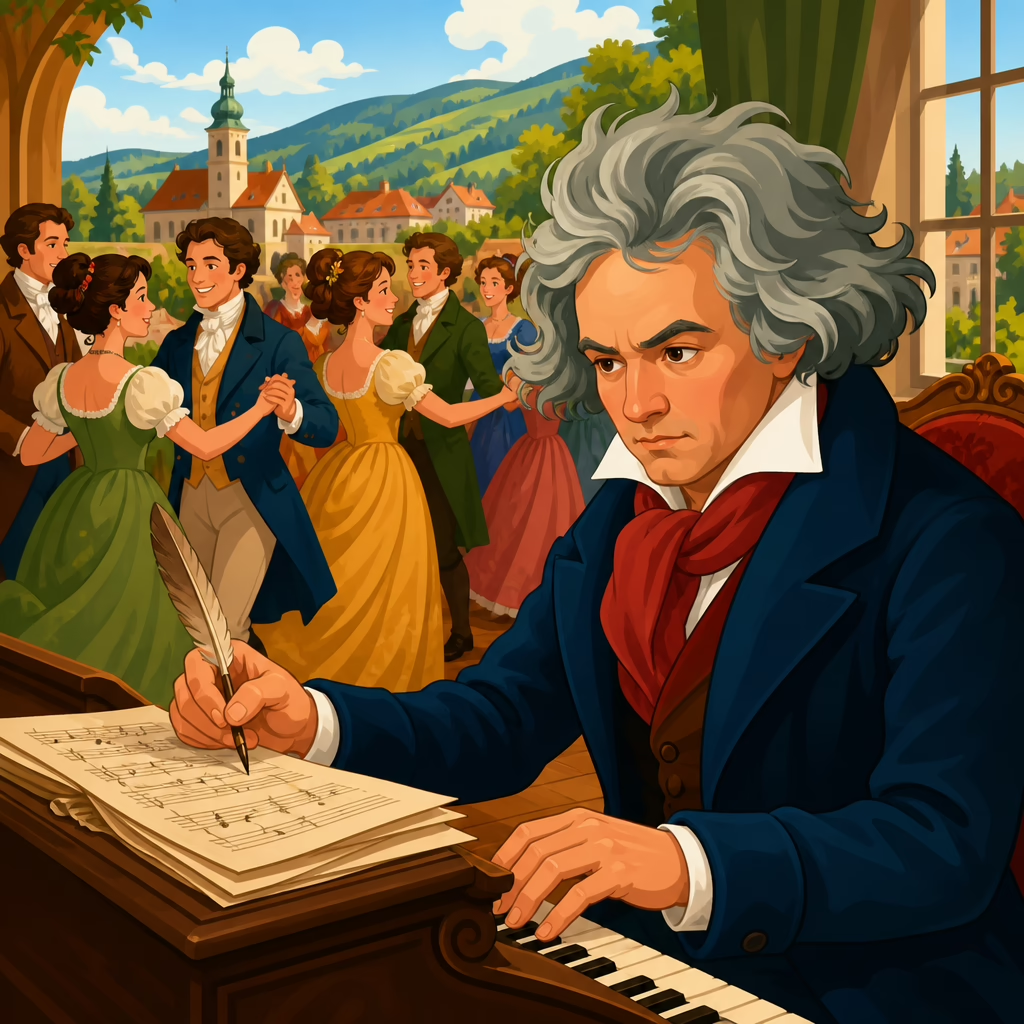
Beethoven’s Twelve German Dances in Context
Beethoven’s Twelve German Dances sit at an instructive crossroads in his output: modest in scale, social in function, and revealing in craft. The set, commonly identified as WoO 8, belongs to the world of late eighteenth-century dance music, where elegance, clarity, and immediate appeal mattered as much as compositional invention. A German dance was not an abstract concert form but a practical genre designed for actual movement, usually in triple meter, with clear phrase structure and a pulse dancers could trust. Yet when Beethoven writes within this frame, even at an early stage of his career, the music carries fingerprints that make it recognizably his: rhythmic bite, compact motivic logic, sly harmonic turns, and a sharpened sense of contrast.
These pieces matter because they show Beethoven operating below the level of the symphony, sonata, or string quartet without lowering his standards. In my own work tracing how Beethoven handles small forms, I keep returning to these dances because they demonstrate a central truth about his style: he could compress character into a few bars more effectively than many composers managed across a full movement. The Twelve German Dances are not juvenilia to be dismissed, nor are they grand statements in miniature. They are occasional works that illuminate how Beethoven engaged with Viennese social culture, how he adapted inherited forms, and how he tested gestures that later became more expansive and dramatic in larger works.
Context also matters because these dances are often overshadowed by more famous short piano pieces, especially the bagatelles. That is understandable, but it can distort the picture. The German dances belong to a different expressive economy. They are shaped less by inward reflection than by public use, less by aphoristic keyboard poetry than by bodily rhythm and communal style. Hearing them on their own terms clarifies Beethoven’s versatility and gives listeners a fuller map of his “small” works. They also reward performers who want concise repertoire with historical substance, and they offer scholars a compact case study in genre, function, and authorship at the turn of the nineteenth century.
What the Twelve German Dances Are and When Beethoven Wrote Them
The Twelve German Dances, WoO 8, are a set of short orchestral dances generally dated to Beethoven’s early Vienna years, a period when he was absorbing local taste while establishing himself as pianist, improviser, and composer. “WoO” stands for “Werke ohne Opuszahl,” the catalog category used for works published without opus numbers or transmitted outside Beethoven’s main numbered sequence. That label can mislead modern readers into assuming secondary importance. In practice, it often marks a publication history rather than an artistic verdict. Many WoO works are essential for understanding Beethoven’s development, and these dances are a strong example.
The genre itself was familiar to Viennese audiences. The German dance, or Deutscher Tanz, descended from older Austro-German social dance traditions and stood alongside the minuet, contredanse, and later the waltz. Its basic profile was straightforward: triple time, balanced phrases, and a clear periodic design suitable for ballroom use. Composers from Haydn to Schubert wrote such pieces, and publishers circulated them widely for domestic and public performance. Beethoven therefore entered a living market, not an antiquarian form. He was expected to provide danceable music, but he also had room to individualize tone, texture, and pacing.
Each dance in the set is concise, often built from eight-bar units and simple repeats, yet the sequence avoids monotony through shifts of accent, register, scoring, and harmonic color. That variety is one reason the set works so well in performance. Another is that Beethoven resists treating the collection as filler. He gives each number a distinct profile, making the whole feel like a gallery of social characters rather than a string of interchangeable miniatures.
Viennese Dance Culture and the Function of the Set
To understand these pieces, it helps to picture the musical environment in which they circulated. Late eighteenth-century Vienna relied on dance music as a social necessity. Aristocratic balls, civic festivities, and seasonal entertainments all required repertory that could be learned quickly, played reliably, and enjoyed immediately. Composers frequently supplied sets of dances because audiences wanted novelty within a recognizable frame. The practical demand shaped musical choices: steady tempo, regular phrase lengths, and cadences placed where dancers expected them.
Beethoven, newly active in Vienna after leaving Bonn, was ambitious enough to write monumental works and pragmatic enough to accept genres tied to social use. That balance is important. In this repertory, he was not merely “slumming.” He was participating in one of the city’s central musical economies. Writing dances could strengthen professional connections, satisfy patrons, and display fluency in current style. Haydn and Mozart had done the same in different contexts. A composer who could not write effective dance music would have seemed oddly detached from the world around him.
The Twelve German Dances therefore function as both occasional music and evidence of social integration. They show Beethoven navigating expectations shared by performers, dancers, publishers, and listeners. They also remind us that his early career was not built solely on heroic originality. It was built on mastery of existing forms, strategic responsiveness to local taste, and the ability to stamp personality onto conventional materials without disrupting their purpose.
Musical Design: How Beethoven Makes Short Dances Distinct
The strongest reason to study the set closely is compositional economy. Beethoven uses limited means, but he uses them with discipline. Most dances rely on compact motives, often just a turn figure, a repeated-note pattern, or a small arpeggiated cell. Instead of spinning long melodies, he creates identity through rhythm and articulation. A syncopated push, a clipped upbeat, or a sudden accent can define an entire number. That preference already points toward later Beethoven, for whom motivic concentration became a structural principle.
Harmony is equally telling. These are not harmonically radical works, nor should they be. Dance music needs orienting clarity. Still, Beethoven enlivens the expected tonic-dominant framework with passing modal color, brief tonicizations, and strategic surprises at phrase edges. He understands that in a piece lasting well under a minute, one altered chord or off-center cadence can be enough to refresh the ear. This is not complexity for its own sake; it is proportionate invention.
Texture also matters. Orchestral dance writing can easily become generic if inner parts merely fill out chords. Beethoven avoids that trap by varying registral spacing and instrumental dialogue. Winds may punctuate a phrase, strings may carry the main rhythmic swing, and tuttis may arrive sparingly for emphasis rather than blanket every bar. The result is transparency. Dancers receive a clear beat, while listeners receive character and color.
| Feature | Typical German dance convention | Beethoven’s treatment in WoO 8 |
|---|---|---|
| Meter and pulse | Triple time with stable accent pattern | Stable beat preserved, but enlivened by offbeat stress and energetic pickups |
| Phrase structure | Balanced four- and eight-bar units | Regular phrases retained, with sharper cadential rhetoric and compact contrasts |
| Harmony | Primarily tonic and dominant relations | Simple tonal plans enriched by fleeting color and pointed transitions |
| Melodic writing | Singable, symmetrical lines | Less reliant on long melody, more on motive and rhythmic identity |
| Orchestration | Functional, often lightly varied | Greater contrast of register, punctuation, and instrumental timing |
Another notable trait is pacing across the full set. Beethoven sequences neighboring dances so that profiles contrast rather than blur. One may feel rustic and grounded, another urbane and light-footed, another almost comic in its emphatic gestures. This programming instinct matters because collections of social dances were often consumed in succession. Beethoven thinks not only in units but in adjacency, and that broadens the set’s artistic interest.
Relation to Beethoven’s Other Small-Scale Works
The Twelve German Dances become clearer when placed beside Beethoven’s other compact genres, especially bagatelles, ecossaises, minuets, and contredanses. The most useful comparison is not to the late bagatelles, whose inwardness and harmonic compression belong to another expressive world, but to Beethoven’s broader practice of testing ideas in short forms. He often used miniatures to refine rhythmic profiles, abrupt contrasts, and concentrated gestures that later found more elaborate homes.
That is one reason listeners interested in his shorter pieces should connect these dances with the broader repertory surveyed in the main guide to Beethoven’s bagatelles. The link is not that the German dances “anticipate” every feature of the bagatelles. They do not. The link is methodological: both repertories show Beethoven treating brevity as a compositional challenge rather than a limitation. In a dance, he must preserve public legibility; in a bagatelle, he may permit more introspection or wit. In both, every bar counts.
The contrast is revealing. Bagatelles often invite close listening to nuance, ambiguity, and interruption. The German dances ask for kinetic immediacy. A performer can linger less, shape less rubato, and cannot afford to obscure the beat. Yet Beethoven still finds room for personality. This is the same composer working under different contracts with the listener. Seeing that distinction helps prevent category mistakes, especially the common habit of hearing all short Beethoven works as proto-romantic miniatures.
Performance, Reception, and Why the Set Still Deserves Attention
Modern performances of the Twelve German Dances are less common than they should be, partly because the repertory sits awkwardly between categories. It is too slight for programs seeking overt monumentality, yet too sophisticated to be treated as anonymous salon music. Historically informed ensembles, however, have shown how effective the set can be when played with buoyant articulation, moderate tempos, and crisp dynamic definition. Using period bows, natural horns, and lighter timpani where applicable can clarify the sprung rhythm and preserve the music’s social ease. Even on modern instruments, the essential principle is the same: keep the texture transparent and the beat alive.
Reception history has often undervalued pieces like these because nineteenth- and twentieth-century criticism favored Beethoven the revolutionary. That image, powerful as it is, narrows the field. It leaves too little room for Beethoven the craftsman of public entertainment, the observer of dance convention, and the composer who could write for use without writing mechanically. Recent scholarship on everyday musical culture in Vienna has corrected that imbalance by taking occasional genres seriously. Once these dances are heard within that context, their achievement becomes easier to recognize.
For listeners, the reward is immediate. The set offers concentrated access to Beethoven’s early Viennese voice: alert, pragmatic, witty, and already highly controlled. For performers, it provides repertory that can anchor educational programs about Classical dance styles or enrich concerts devoted to Beethoven beyond the standard canon. For scholars, it supplies a compact example of how genre expectations shape invention. None of those uses requires inflating the works into something they are not. Their value lies precisely in how much they reveal while remaining what they were meant to be: excellent dances.
Beethoven’s Twelve German Dances deserve a place in serious discussion because they show artistic identity operating under practical constraints. They define the German dance clearly, fulfill its social purpose, and still project a voice that is unmistakably Beethoven’s. In these miniatures, rhythm does much of the expressive work, harmony speaks efficiently, and orchestration serves both feet and ears. The set also corrects a common imbalance in Beethoven reception by reminding us that his mastery was not confined to large forms or high seriousness. He understood public genres from the inside and could enrich them without breaking them.
The most useful takeaway is simple: hearing these dances in context changes what “minor Beethoven” means. They are minor only in scale, not in intelligence, finish, or historical value. If you want a sharper understanding of how Beethoven adapted inherited conventions, shaped concise forms, and moved within Viennese musical life, this set is indispensable. Revisit the Twelve German Dances with those questions in mind, then explore his other short works to see how consistently he turned brevity into substance.
Frequently Asked Questions
What are Beethoven’s Twelve German Dances, and why do they matter?
Beethoven’s Twelve German Dances, commonly catalogued as WoO 8, are a set of short dance pieces that belong to the practical musical culture of the late eighteenth century. They were written for social use rather than for the concert hall in the modern sense, which means their purpose was immediate: to accompany dancing, create atmosphere, and appeal quickly to listeners and participants. That functional background is essential to understanding them. These are not large-scale symphonic statements or overtly philosophical works, but they are far from insignificant. In fact, they show Beethoven working within a popular and highly recognizable genre, shaping music that had to be clear, rhythmic, and usable while still revealing a distinctive musical mind.
What makes them especially important is the way they sit at a crossroads in Beethoven’s output. On one side is the inherited world of eighteenth-century dance music, with its balanced phrases, triple meter, and accessible charm; on the other is the emerging Beethoven known for strong motivic thinking, economy of material, and expressive precision. In these pieces, we can hear how he handled modest forms with care and intelligence. Their value lies not in monumentality but in concentration. They remind us that Beethoven’s artistry did not depend on scale alone. Even in music designed for social dancing, he could create character, contrast, and memorable turns of phrase.
What exactly is a German dance, and how does that genre shape this set?
A German dance, or Deutscher Tanz, was a familiar social dance type in the late eighteenth century, especially in Austrian and southern German musical life. It was typically in triple meter and organized in clear, regular phrases that supported actual dancing. Unlike an abstract keyboard form or a deeply developmental sonata movement, a German dance needed to communicate its rhythm and structure immediately. Dancers had to feel the pulse, anticipate the phrasing, and move comfortably within a predictable yet lively framework. That practical requirement shaped the music at every level, from tempo and accentuation to length and formal design.
Beethoven’s set reflects those expectations. The dances favor clarity over complexity, direct rhythmic profiles over prolonged argument, and compact structures over expansive development. Yet within those boundaries, Beethoven introduces variety in mood, gesture, and texture. Some dances project rustic energy, others a more polished urban grace. The genre itself encourages concise musical thinking: a dance must establish its character quickly and sustain it efficiently. That is why these works can seem deceptively simple. Their craftsmanship lies in how effectively they balance utility and invention. Beethoven respects the social function of the genre, but he also uses it as a space for subtle individuality, showing how much can be achieved within a form built for immediate physical and social response.
How do these dances fit into Beethoven’s development as a composer?
The Twelve German Dances are valuable because they illuminate Beethoven’s compositional habits in a smaller, more everyday format. When listeners think of Beethoven’s development, they often focus on major milestones such as the piano sonatas, string quartets, or symphonies. But works like WoO 8 reveal something equally important: how he handled convention. A developing composer does not only prove himself in ambitious masterpieces; he also learns by writing occasional music, functional music, and genre pieces that demand concision and control. In these dances, Beethoven works with inherited patterns and accepted stylistic norms, but he does so with a clear sense of shape and a keen instinct for memorable material.
These pieces also show his early command of contrast and economy. Because each dance is brief, every gesture matters. There is little room for excess, so the music depends on well-defined themes, effective cadences, and efficient character-setting. That kind of discipline carries over into Beethoven’s larger works, where even expansive movements often grow from sharply profiled ideas. The dances therefore help us hear continuity rather than separation between “minor” and “major” Beethoven. They suggest that his larger achievements were supported by a deep fluency in smaller forms and practical genres. In historical context, they also place him squarely within the musical life of his time, engaging not only with elite art music but with the social repertory that audiences and performers knew intimately.
What should listeners pay attention to when hearing Beethoven’s Twelve German Dances?
Listeners should begin with rhythm and phrase structure, because those are the foundations of the genre. The triple meter is not just a background feature; it gives the music its bodily logic and social energy. Notice how firmly the pulse is established and how clearly the phrases articulate beginnings, continuations, and cadential arrivals. These features are what would have made the dances functional in performance. The music needs to feel balanced and dependable, but not mechanical. Beethoven’s skill lies in making that clarity engaging rather than merely routine.
Beyond rhythm, pay attention to character. Although the set belongs to a practical dance tradition, the individual numbers are not interchangeable. Beethoven differentiates them through contour, dynamics, harmonic color, and texture. A seemingly simple turn of melody or a slight shift in emphasis can alter the whole atmosphere of a dance. It is also worth listening for moments where the music feels especially compressed and purposeful. Beethoven often gives even short pieces a strong profile, so a few bars can establish a complete expressive world. If heard in sequence, the dances reveal variety within constraint: elegance alongside energy, charm alongside structural neatness. That balance is one of the reasons the set remains so instructive for listeners interested in how style, function, and compositional personality interact.
Why are these dances often considered modest works, yet still important in Beethoven scholarship and appreciation?
They are considered modest because they do not aim at the scale, depth, or dramatic sweep associated with Beethoven’s most famous compositions. They were written for a social environment in which immediacy mattered more than long-range development, and they belong to a category often treated as occasional or utilitarian music. In that sense, their modesty is real: they do not ask to be heard as grand artistic manifestos. Their technical demands, formal dimensions, and expressive range are comparatively restrained, and that is entirely appropriate to their function.
At the same time, scholars and attentive listeners value them precisely because they reveal Beethoven without the magnifying effect of prestige genres. They show how he worked when the task was to be concise, practical, and appealing. That can tell us a great deal about his stylistic inheritance, his craftsmanship, and his participation in everyday musical culture. These dances also enrich our understanding of the period itself. They remind us that late eighteenth-century composition did not consist only of monumental works destined for posterity; it also included music written for dancing, sociability, and immediate pleasure. Hearing Beethoven in that context makes him more historically legible and, in a sense, more human. The Twelve German Dances may be small in scale, but they offer a clear and revealing view of the composer’s discipline, adaptability, and command of genre.