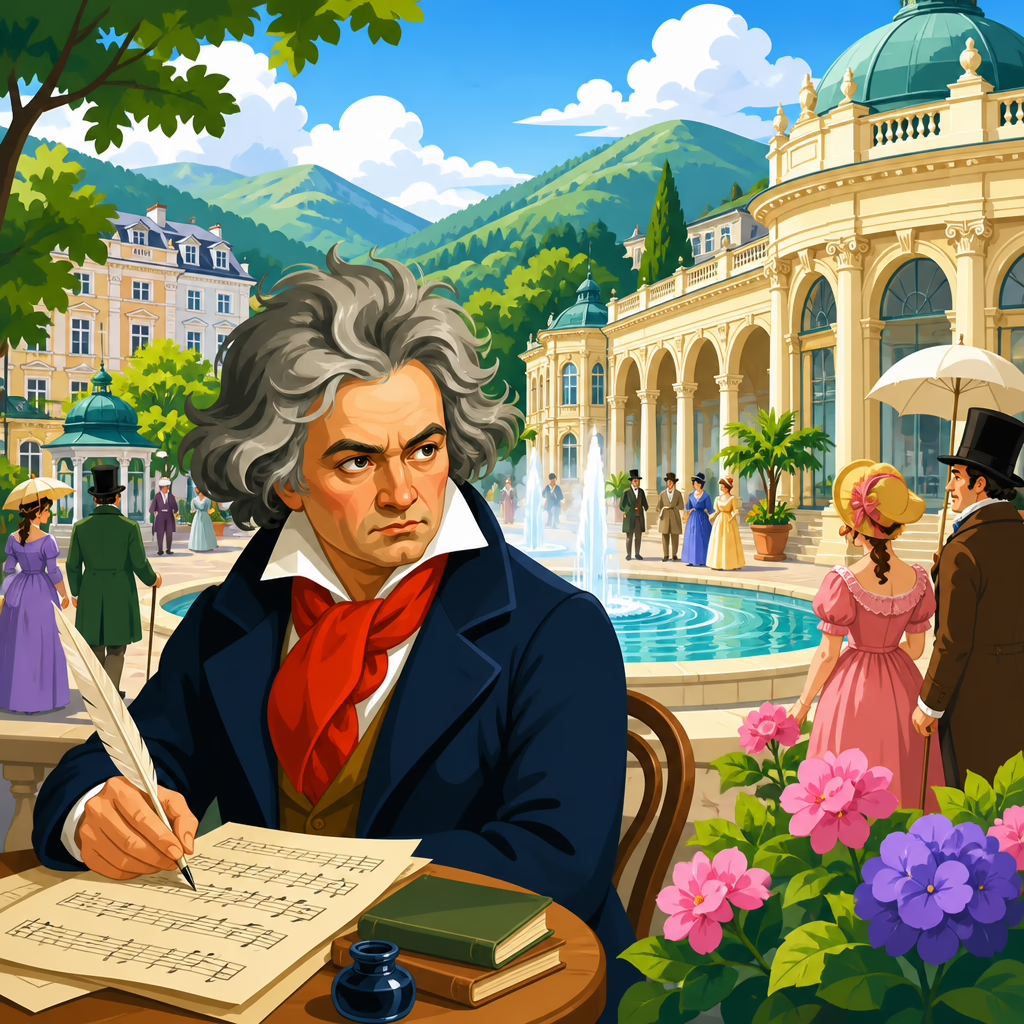
Beethoven and the Culture of Spa Towns
Ludwig van Beethoven’s relationship with spa towns reveals a practical, social, and artistic side of his life that is often overshadowed by the mythology of the solitary genius. In the late eighteenth and early nineteenth centuries, spa towns were not simply places for bathing or mineral cures. They were seasonal cultural hubs where health, class performance, music making, tourism, and contact with nature converged. For Beethoven, whose worsening deafness, digestive troubles, and chronic physical discomfort shaped daily existence, these places offered both medical hope and a workable rhythm of retreat. They also placed him in landscapes and social settings that mattered to his creativity.
When historians speak of spa town culture, they mean the institutions and habits that grew around mineral springs and summer cures: promenades, bathhouses, rented lodgings, gardens, concerts, strict drinking regimens, visiting elites, and a service economy built around health. In Central Europe, towns such as Baden bei Wien, Teplitz, Karlsbad, and Franzensbad became stages on which aristocrats, diplomats, artists, physicians, and invalids mingled. Beethoven moved through that world with mixed feelings. He needed treatment and valued country air, yet he disliked empty social ritual and guarded his independence fiercely. That tension is exactly why spa towns are so revealing in his case.
The topic matters because Beethoven’s spa visits were not peripheral episodes. They intersected with his medical history, patronage networks, working habits, and experience of the natural world. I have found that when you trace his stays in places like Baden carefully, a clearer picture emerges: Beethoven used spa environments less as fashionable escapes than as semi-structured working retreats. He walked, took lodgings, managed cures, met friends and patrons, revised scores, and absorbed a landscape culture centered on parks, hills, vineyards, and therapeutic routines. Understanding that setting helps explain how nature in Beethoven’s life was not abstract scenery but part of a lived system of health, movement, and composition.
Spa towns in Beethoven’s era were health resorts and social theaters
By Beethoven’s lifetime, spa towns across the Habsburg lands and German-speaking Europe had developed highly organized seasonal cultures. A visitor did not merely arrive, drink some mineral water, and leave. The day usually followed a pattern: early rising, prescribed water intake from specific springs, walking after drinking, supervised bathing, dining at set hours, afternoon rest, evening conversation, and public entertainment. Physicians attached to the resort directed treatment, while inns, villas, gardens, reading rooms, and concert venues supported a mobile summer society. In that sense, the spa town functioned like a temporary city with health as its official purpose and sociability as its operating system.
This world suited some of Beethoven’s needs. His letters and documented movements show repeated concern with intestinal complaints, inflammatory episodes, eye problems, and the mounting consequences of hearing loss. Medical treatment in his period was inconsistent, but spa cures were mainstream and respectable. Mineral waters, sulfur baths, and country air were prescribed for nervous conditions, digestive disorders, skin diseases, and general debility. Even when the therapies had limited physiological effect, the environment itself could help: cleaner air than central Vienna, quieter lodgings, routine, reduced urban pressure, and access to walking terrain. For a composer whose concentration depended on movement and withdrawal, that combination was useful.
Spa towns also mattered because they concentrated people Beethoven needed to see. Members of the aristocracy who supported him financially or socially often spent summers at resorts. Diplomats, publishers, amateur musicians, and cultured travelers circulated there as well. A stay at a spa could therefore serve several functions at once: treatment, networking, recreation, and work. Yet Beethoven never fit neatly into the polished manners of resort life. Contemporary accounts repeatedly describe him as absent-minded, abrupt, absorbed, and indifferent to the codes of graceful conversation that governed elite leisure. That mismatch between setting and temperament gives the story much of its energy.
Baden bei Wien became Beethoven’s most important spa refuge
If one spa town stands at the center of Beethoven’s mature life, it is Baden bei Wien, south of Vienna. Baden was famous for its thermal sulfur springs and had long served the imperial court and Viennese upper classes. Its appeal was obvious: close enough to Vienna for practical access, yet distinct enough to offer country air, vineyards, wooded walks, and a resort atmosphere. Beethoven spent multiple summers there, especially in the 1820s. These were not casual tourist visits. Baden became one of his preferred seasonal bases, a place where treatment, seclusion, and composition could coexist.
In practice, Baden offered Beethoven something like a manageable distance from the city. He could leave behind some of Vienna’s noise and demands without severing contact completely. Surviving addresses and local commemorations show how often he changed lodgings, which was typical for him, but the pattern still indicates attachment. He worked there on some of his most significant late music, including parts of the Ninth Symphony and late string quartets. That fact alone should caution against treating spa stays as interruptions to creativity. In Beethoven’s case, they were often conditions that supported it.
The environment of Baden helps explain why. The town’s spa infrastructure sat within an appealing natural frame of hills, vineyards, and paths. Beethoven could walk extensively, and walking was not leisure in a trivial sense for him; it was bound to thinking, sketching, and emotional regulation. Readers interested in that larger habit can see the broader context in this guide to Beethoven’s love of walking and what it meant for his music. In Baden, the spa regimen and the walking landscape reinforced each other. A cure prescribed motion after drinking the waters, and Beethoven already relied on motion as part of his creative method.
| Spa town | Why it mattered to Beethoven | Cultural character |
|---|---|---|
| Baden bei Wien | Repeated summer stays, health treatments, major late compositional work | Thermal resort near Vienna with parks, vineyards, promenades, and elite visitors |
| Teplitz | Important 1812 stay, meetings and correspondence context, health retreat | Bohemian spa known for aristocratic and diplomatic society |
| Karlsbad | Part of the wider cure circuit familiar to many patrons and artists | International spa center with formal cure routines and social prestige |
| Franzensbad | Representative of the medical resort culture shaping expectations of treatment | Planned spa environment centered on springs, promenades, and health tourism |
Teplitz shows how spa culture mixed medicine, politics, and art
Teplitz, in Bohemia, offers another revealing case. Beethoven stayed there in 1811 and 1812 while seeking relief for his health, especially conditions related to digestion and his general physical state. Teplitz was more than a treatment site. It was a prestigious meeting place where members of European high society and political elites gathered during the Napoleonic era. The town’s significance lay partly in concentration: one could pursue a cure and, in the same season, encounter princes, writers, diplomats, and fellow musicians. This was the social ecology of the spa.
Beethoven’s Teplitz period is remembered in part because it intersects with broader cultural history, including his connection with Goethe in 1812. The famous stories about their contrasting reactions to aristocratic company, though simplified in later retelling, capture a real distinction. Goethe navigated courtly society with ease. Beethoven did not. He believed artistic worth outranked inherited rank and often acted accordingly. In a spa town, where status display was built into the promenade, the dinner table, and the chance encounter, that attitude stood out sharply. Spa culture brought Beethoven into contact with power, but it also gave him occasions to resist social deference.
That resistance should not be romanticized into total isolation. Beethoven did use the resort world strategically. He accepted patronage, maintained important relationships, and understood where useful conversations happened. But Teplitz demonstrates that he engaged the spa town on his own terms. He was there for health, for work, and for selective human contact, not for graceful participation in every social ritual. This distinction matters because it prevents us from confusing his presence in fashionable resorts with wholehearted identification with fashion. He used the institution without surrendering to its values.
Medical hope, daily routine, and the reality of chronic illness
To understand why spa towns kept drawing Beethoven back, it helps to be direct about illness. He lived with chronic and fluctuating symptoms for years. Modern retrospective diagnosis has limits, and responsible scholars avoid false certainty, but the documentary record leaves no doubt that he suffered recurrent gastrointestinal distress, painful inflammations, and progressive hearing loss. In his time, spa medicine offered one of the most plausible noninvasive treatment frameworks available. Doctors prescribed mineral waters internally and externally, regulated diet, and recommended fresh air and measured exercise.
From practical experience studying musicians’ working lives, I think routine is the overlooked factor. A spa cure imposed a sequence on the day. That could be therapeutic even when the medical theory behind the spring was exaggerated. Beethoven’s life in Vienna was frequently chaotic: irregular meals, domestic frustration, money concerns, legal conflict over his nephew, and constant artistic pressure. In a spa setting, waking early, walking to the spring, following a prescribed path, and retreating to a room for work created a rhythm that countered disorder. The cure was not only in the water; it was in the structure.
There were limits, of course. Spa treatments did not halt Beethoven’s deafness, and they did not free him from recurring distress. Nineteenth-century balneology often promised more than it could deliver. Yet it would be wrong to dismiss the spa town as mere placebo. Relief can be partial and still significant. Better sleep, quieter surroundings, improved digestion during a stay, reduced stress, and renewed concentration all matter, especially for someone composing at the highest level under physical strain. Beethoven kept returning because the setting offered enough benefit to justify the effort.
Nature in spa towns was curated, walkable, and creatively useful
The nature Beethoven encountered in spa towns was not wilderness. It was shaped landscape: tree-lined promenades, bath gardens, hillside paths, vineyard roads, and managed views. That distinction is important. Spa culture domesticated nature into something therapeutic and accessible. Visitors were expected to move through it in measured ways, often under medical advice. For Beethoven, this curated natural environment was ideal. He did not need remote mountain solitude to think musically. He needed spaces where walking could unfold without constant interruption and where sensory experience, especially visual rhythm and bodily motion, could restore attention.
Baden is exemplary here. The town’s surroundings offered a sequence of environments rather than a single scenic backdrop: urban resort streets, garden spaces, rising paths, and nearby wooded areas. Such terrain supports the kind of modular walking that suited Beethoven’s work. He could leave lodging, pass through sociable zones, and then enter more private stretches where sketches or musical ideas could be turned over mentally. This movement between contact and withdrawal mirrors the social structure of the spa itself. The resort supplied company when needed and distance when desired.
For listeners trying to connect environment with composition, caution is necessary. No one should claim that a particular spring produced a specific melody. What can be said confidently is narrower and stronger: spa towns gave Beethoven recurring access to restorative landscapes integrated with daily habit, and those conditions supported sustained creative labor. The late works associated with Baden were produced not because the spa was magical, but because it enabled a viable pattern of living for a composer under severe strain.
What spa town culture reveals about Beethoven’s character and legacy
Seen closely, Beethoven’s spa town life dissolves two persistent stereotypes. The first is that he was purely urban, chained to Vienna’s musical institutions. The second is that his relationship with nature was only inward and symbolic. Spa towns show something more concrete. He sought environments where health practices, walking, scenery, and work met. He entered a shared European culture of cure and travel, but he adapted it to his own needs. He was neither a fashionable resort-goer nor a hermit outside society. He was a working artist using the infrastructures available to preserve function.
This perspective also sharpens our sense of his independence. In resorts built on rank, display, and etiquette, Beethoven remained stubbornly committed to artistic dignity. He would meet nobles, accept support, and benefit from proximity to influence, yet he resisted the idea that culture existed to flatter status. That attitude is one reason spa town episodes have stayed vivid in Beethoven biography. They expose him in a setting designed for sociability and show how selectively he participated in it.
The lasting benefit of studying Beethoven and the culture of spa towns is clarity. These places were not side notes in the margins of genius. They were working environments where medicine, landscape, and society intersected. Baden and Teplitz especially help us see how Beethoven managed chronic illness, protected his creative routine, and found usable forms of nature within a highly social world. If you want a more grounded understanding of Beethoven’s daily life, start with the spa town: it is where health, movement, and music come into focus together. Explore that setting closely, and much else in Beethoven begins to make practical sense.
Frequently Asked Questions
Why were spa towns so important in Beethoven’s time?
Spa towns occupied a distinctive place in late eighteenth- and early nineteenth-century European life because they combined medicine, leisure, social display, and culture in one setting. People traveled to them not only for mineral waters, baths, and medical supervision, but also for the sociability that surrounded the season. Aristocrats, officials, artists, merchants, and visitors from different regions gathered in promenades, gardens, concert rooms, dining spaces, and lodging houses, creating a temporary but highly visible public world. In that environment, health was never just private. It was tied to reputation, status, manners, and participation in elite or aspiring elite culture.
For musicians and composers, spa towns could function as unusually productive and strategic environments. They offered access to patrons, amateur performers, and audiences who were receptive to music as part of the season’s entertainments. Concerts, private musicales, casual performances, and salon-style gatherings all created opportunities for networking and artistic exchange. This helps explain why spa culture mattered so much to Beethoven’s world. To understand spa towns is to understand a broader social system in which music circulated alongside therapy, tourism, and fashionable sociability.
In Beethoven’s case, spa towns also mattered because they aligned with several recurring needs in his life. He sought relief from physical ailments, including digestive problems and the mounting consequences of deafness. At the same time, he depended on aristocratic support and maintained relationships within educated social circles. Spa towns brought together those two sides of his existence: the practical search for health and the public life of a major composer. Rather than being marginal to his career, these places reveal how deeply artistic work could be embedded in everyday routines of travel, treatment, conversation, and seasonal society.
What did Beethoven gain personally from visiting spa towns?
Beethoven’s visits to spa towns can be understood as part of a practical effort to manage chronic illness in a period when medical options were limited and often experimental by modern standards. Mineral waters, baths, prescribed walks, dietary regimes, and carefully structured daily routines were commonly recommended for persistent physical complaints. Beethoven, who endured digestive distress, bodily discomfort, and the escalating emotional and functional strain of hearing loss, had strong reasons to seek these environments. Even if cures were uncertain, spa towns offered the hope of relief, regulation, and temporary improvement.
Just as important was the psychological dimension. Spa settings frequently placed visitors in landscaped natural surroundings, with hills, parks, paths, and quieter rhythms than crowded urban centers. For Beethoven, who was deeply responsive to nature and often found creative energy in outdoor movement and observation, this setting could be restorative in more than a medical sense. Walking, reflecting, and spending time away from the pressures of city life could support concentration and emotional balance. In his case, health and artistic life were not separate spheres. Physical routine, mental state, and musical imagination were often intertwined.
He also gained social access. Spa towns brought him into contact with patrons, acquaintances, and cultivated listeners outside the formal structures of court or city institutions. These encounters could reinforce his reputation, support ongoing relationships, and situate him within influential networks. So while it is easy to imagine a famous composer traveling solely for treatment, Beethoven’s experience was likely far more layered. Spa visits offered a combination of medical hope, scenic retreat, and social opportunity, all of which could shape both his daily life and his creative world.
How do spa towns change the way we think about Beethoven’s personality and public image?
Spa towns complicate the familiar image of Beethoven as an isolated, suffering genius cut off from ordinary social life. That image contains some truth, especially given his deafness, personal struggles, and intense artistic drive, but it can become too narrow if treated as the whole story. His relationship with spa culture reminds us that he operated within lively social environments and that he actively participated in the practical habits of his age. He was not simply withdrawing from the world; he was also navigating it through travel, treatment, conversation, patronage, and public presence.
This perspective makes Beethoven appear less mythical and more historically grounded. In spa towns, one sees him as a man dealing with health problems in recognizable ways, trying available remedies, adapting routines, and entering spaces where social interaction mattered. These visits place him among other travelers seeking improvement, entertainment, distinction, and connection. They also show that artistic greatness did not remove him from the systems of class, etiquette, and networking that shaped cultural life in his era. In fact, his career depended in part on moving through those systems effectively, even if he often did so on his own terms.
At the same time, this view does not diminish his individuality. Instead, it enriches it. Seeing Beethoven in spa towns reveals a figure who was practical as well as visionary, socially engaged as well as inwardly driven, and physically vulnerable as well as artistically formidable. It helps readers move beyond a one-dimensional legend and toward a fuller understanding of how great composers actually lived. The result is not a less interesting Beethoven, but a more human and historically credible one.
What role did music play in the culture of spa towns Beethoven visited?
Music was central to spa-town culture because these places were designed not only for treatment but also for refined public life. Visitors expected a season filled with diversions that signaled cultivation and taste, and music was among the most important of them. Performances could occur in assembly rooms, gardens, salons, hotels, and private residences. Some were formal concerts, while others were lighter social occasions tied to dancing, dining, promenading, or evening gatherings. This meant that spa towns were not cultural sidelines; they were active sites of listening, performing, and musical exchange.
For Beethoven, such environments would have carried multiple meanings. As a composer of immense stature, he could benefit from association with settings where music was valued by educated and affluent audiences. Spa towns offered occasions for his work to circulate, for his name to remain visible, and for connections to deepen among patrons and admirers. Even where a visit was motivated by health, the local musical culture could not be separated from the overall experience. In the early nineteenth century, reputation was sustained not only through publication and metropolitan premieres but also through presence in networks of sociability where art was discussed and performed.
There is also a broader interpretive point. Spa-town music culture shows how art functioned in lived social space rather than in isolation. Beethoven’s world was one in which compositions, performances, conversation, and public identity all interacted. A spa town could be a place where music was heard against the backdrop of recovery, travel, and fashionable encounter. That context helps modern readers understand why these towns mattered to composers and audiences alike. They were places where music helped define the season’s emotional and cultural atmosphere, and where a figure like Beethoven could be both patient and artist at once.
Why does Beethoven’s connection to spa towns matter for understanding his legacy today?
Beethoven’s connection to spa towns matters because it expands our understanding of what shaped his life and work beyond the narrow focus on masterpieces alone. Biography is most useful when it restores context, and spa culture provides exactly that. It places Beethoven within the medical beliefs, travel habits, class rituals, and cultural institutions of his own time. Instead of presenting genius as something detached from ordinary conditions, it shows how artistic production coexisted with bodily vulnerability, social obligation, and the search for relief. That makes his achievements more, not less, impressive.
This connection also helps modern readers appreciate the social history surrounding great music. Spa towns were spaces where health tourism, nature, performance, and public identity converged. By looking at Beethoven through that lens, we can see how composers moved through networks of people and places that influenced their routines, opportunities, and emotional landscapes. It encourages a more interdisciplinary view of musical history, one that links art to medicine, mobility, environment, and leisure culture. For scholars and general readers alike, that produces a richer and more realistic portrait of the period.
Finally, the topic resonates today because it humanizes Beethoven in a deeply accessible way. Contemporary audiences understand what it means to seek wellness, escape urban pressure, travel for treatment, and look to nature for renewal. While the medical theories of Beethoven’s era were different from our own, the impulse behind spa travel remains familiar. His experiences in these towns remind us that even the most monumental artists lived through recurring concerns about health, routine, community, and resilience. That recognition brings Beethoven closer to us and helps explain why his life continues to invite fresh interpretation.