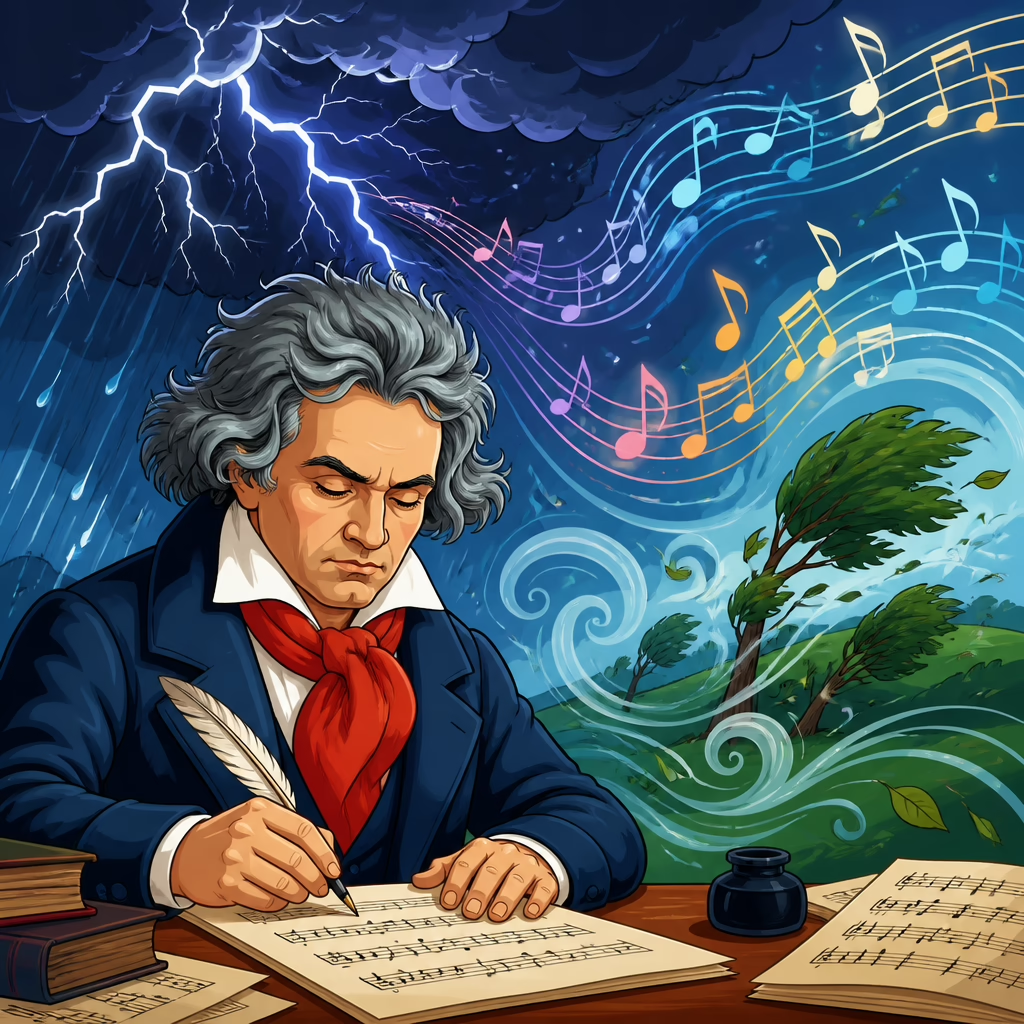
The Sound of Rain Thunder and Wind in Beethoven
Rain, thunder, and wind appear in Beethoven not as decorative background but as charged musical events, shaped with unusual precision to make listeners feel weather as motion, pressure, and atmosphere. In this focused study of the sound of rain thunder and wind in Beethoven, the key question is simple: how did he turn natural forces into musical language without reducing them to mere imitation? The answer matters because Beethoven stood at a turning point. Earlier composers had long used storms, pastoral murmurs, and hunting calls, yet Beethoven gave meteorological sound a new dramatic function. He made weather structural. It could prepare a transformation, interrupt human calm, or reveal the emotional scale of a scene. When I have studied his scores alongside performances and sketches, the striking fact is how carefully he controls instrumental texture, rhythm, register, and dynamics to suggest specific physical sensations: distant rumble, gathering gusts, sudden flash, pelting drops, and clearing air. This article stays tightly on that subject. It examines how Beethoven evokes rain, thunder, and wind, why the “Pastoral” Symphony remains central, where related effects appear elsewhere, and what these sounds reveal about his larger artistic method.
Why weather sounds in Beethoven are more than sound effects
Beethoven inherited a musical tradition in which nature could be represented through convention. Baroque and Classical composers used tremolo for agitation, descending scales for rain, and drums for thunder. What sets Beethoven apart is not simply louder orchestration or more vivid drama. It is the way he binds natural sound to musical argument. In his works, weather usually arrives with directional force. The listener hears a process: stillness disturbed, tension accumulated, release achieved, and a changed state afterward. That is why his storm writing remains convincing even when heard by modern audiences used to cinematic sound design.
The practical means are concrete. Rain is often suggested through repeated notes, pattering rhythmic cells, and close-knit figuration that creates a surface of continuous impact. Thunder depends on low register, rhythmic weight, timpani articulation, and harmonic suspense as much as volume. Wind emerges through swirling scales, unstable accompaniment patterns, offbeat accents, and registral sweep, especially in the strings. Beethoven understood that no single gesture could carry the illusion by itself. He layers cues. A listener perceives weather because meter, harmony, orchestral color, and dynamic contour all point toward the same phenomenon.
This focus also aligns with Beethoven’s lived relationship to the outdoors. His long walks were not a poetic accessory; they were part of his working life, and that biographical fact helps explain the physical realism of his weather scenes. A broader discussion of those habits appears in the main guide on Beethoven’s love of walking and what it meant for his music. For the present topic, what matters is that his music often feels observed rather than invented from convention alone. He writes as someone who knew the difference between distant thunder rolling across open land and a sudden violent burst overhead.
The “Pastoral” Symphony: Beethoven’s definitive study in rain, thunder, and wind
The Sixth Symphony in F major, Op. 68, is the indispensable example because Beethoven names the scene and controls its dramatic placement. The fourth movement, “Gewitter, Sturm,” follows the “Scene by the Brook” and the peasants’ merry gathering, so the storm does not stand alone. It breaks into an already established rural world. That sequence matters. The storm gains force because Beethoven lets us inhabit calm before he disturbs it. He also adds a clarifying note for the whole symphony: it is “more the expression of feeling than painting.” This is often misunderstood. It does not mean Beethoven avoids depiction. It means depiction serves emotional and formal ends.
The storm begins with ominous stirrings rather than immediate explosion. Cellos and basses create an unsettled groundwork; violins and violas intensify the air with agitated motion. Harmonic stability weakens. The listener senses pressure change. Then the orchestra thickens, brass and timpani add weight, and the scene crosses from disturbance into danger. Beethoven’s handling of timpani is especially important. Thunder is not represented by random noise but by placed attacks that punctuate larger waves of orchestral energy. Because the timpani strikes are embedded in harmonic and rhythmic design, they sound inevitable, like storm bursts produced by the same atmosphere already gathering in the strings.
Rain in this movement is not one isolated figure. It is conveyed through persistent rapid note patterns and textural saturation. Strings supply the sense of countless impacts, while woodwinds sharpen the edge of the weather, sometimes seeming to cut through the texture like exposed currents of air. Wind is equally vivid. Beethoven writes rushing scales and directional surges that make the orchestra feel swept laterally. The effect is kinetic rather than pictorial. We do not merely imagine drops or gusts; we feel changing resistance, as if the musical surface itself were being pushed and beaten by external force.
| Weather element | Primary musical devices in Beethoven | Listener’s effect |
|---|---|---|
| Rain | Repeated-note figures, dense string motion, continuous rhythmic patter | Sensation of pelting, accumulation, surface impact |
| Thunder | Low register, timpani strokes, brass reinforcement, harmonic tension | Weight, distance, shock, rolling force |
| Wind | Swirling scales, tremolando textures, offbeat accents, registral sweep | Motion through space, gusts, instability, directional surge |
What I find most masterful is Beethoven’s pacing. He avoids a monotone storm. There are intensifications, partial withdrawals, and renewed assaults. That ebb and return resemble real weather more than a continuous orchestral climax would. The culmination arrives through accumulation of layers, not simple increase in loudness. When piccolo, trombones, and timpani join the full orchestral fabric, Beethoven expands the sonic horizon. These instruments had dramatic associations in late eighteenth- and early nineteenth-century orchestral writing, and here they enlarge the storm’s scale beyond the intimate countryside established earlier.
Just as important is the aftermath. The fifth movement, the “Shepherds’ Song,” is not detachable sweetness after spectacle. It proves that the storm transformed the expressive field. The calm that follows feels earned and cleansed. If the storm were only a descriptive interlude, the transition would be weaker. Instead Beethoven uses rain, thunder, and wind to create one of his clearest examples of disturbance leading to renewal.
How Beethoven builds the acoustic illusion of weather
Beethoven’s weather writing works because he thinks like both dramatist and engineer. He calibrates attack, decay, density, and spacing with exceptional care. In practical orchestral terms, thunder needs mass and delayed resonance. A single loud hit can startle, but it does not evoke atmospheric rumble unless supported by harmonic darkness and continuation around it. Beethoven therefore combines percussion with sustained orchestral unrest. Modern conductors who over-isolate timpani often flatten the effect; the best performances let thunder emerge from the total texture.
Rain presents a different problem. Real rain consists of innumerable small impacts, not one grand gesture. Beethoven solves this through distributed activity. Violins may provide fine-grained movement, inner strings add body, and winds articulate streaks within the larger field. The ear reads multiplicity. This is similar to how later orchestrators, including Berlioz and Wagner, would build complex sonic environments, though Beethoven does it with Classical economy. He seldom wastes a line.
Wind depends heavily on rhythmic asymmetry and contour. Even when the pulse remains firm, Beethoven can make the surface feel windblown by displacing accents and sending figures upward or downward in quick arcs. He also understands that wind is often heard indirectly, through what it agitates. In music, that means a stable accompaniment can be made to seem unsettled by intrusive syncopation or sudden registral sweep. The listener hears not “wind” in the abstract but the effect of wind on the musical environment.
There is also a harmonic dimension. Storm music in Beethoven rarely sits comfortably in diatonic repose. Chromatic inflection, diminished sonorities, and abrupt dynamic turns increase volatility. Yet he never abandons coherence. The weather scene remains legible because harmonic tension and release are directed. This control is one reason the “Pastoral” storm still feels modern: its power comes from organization, not from sheer noise.
Beyond the Sixth Symphony: related sounds of storm and air in other works
Although the “Pastoral” offers Beethoven’s most explicit portrayal of rain thunder and wind, the underlying vocabulary appears elsewhere. The overture to The Creatures of Prometheus shows how rapid string energy and emphatic orchestral punctuation can produce elemental agitation, even without a labeled storm. In the Egmont Overture, Beethoven uses dark orchestral mass and propulsive tension to create an atmosphere of pressure and impending violence. This is not weather painting in a literal programmatic sense, but the same techniques that make thunder persuasive in the Sixth help generate those larger fields of force.
The Piano Sonata in D minor, Op. 31 No. 2, commonly nicknamed “Tempest,” deserves careful treatment. The nickname did not come from Beethoven in any secure documentary way, and it can mislead listeners into hearing a meteorological narrative where none is specified. Even so, the sonata does contain storm-like rhetoric: broken arpeggiation, abrupt silences, recitative-like interruption, and volatile contrasts that resemble gusting force and charged atmosphere. The point is not that this piece depicts rain or thunder directly. Rather, it shows Beethoven translating similar sensations into piano terms, where pedaling, register, and articulation replace orchestral color.
Fidelio also contains moments of atmospheric turbulence. The dungeon world and the opera’s rescue trajectory rely on sonic pressure, darkness, and release. Again, this is not a rainstorm scene, yet Beethoven’s instinct for making space feel oppressive or suddenly opened by light belongs to the same expressive arsenal. Across genres, he knew how to render air itself as dramatic medium.
Interpretation, performance, and what listeners should hear
Performance choices strongly affect whether Beethoven’s weather sounds vivid or generic. Tempo is the first issue. If the “Pastoral” storm is taken too heavily, wind becomes lumbering and rain loses pointillistic attack. If taken too quickly, thunder lacks weight and harmonic turns pass before they register. Conductors such as Nikolaus Harnoncourt, John Eliot Gardiner, and Carlos Kleiber, though very different, demonstrate that successful readings balance propulsion with mass. Period-instrument performances often sharpen the texture because natural brass, hard-stick timpani, and leaner strings make articulations more distinct. Modern orchestras can achieve equal force, but they must preserve detail inside the tutti.
Balance matters just as much. In live performance, I listen for whether timpani integrate with bass lines or sit unnaturally on top. Beethoven’s notation assumes a relationship among sections, not a cinematic percussion spotlight. Woodwinds should also remain audible enough to register as currents within the storm. If they disappear, the listener gets volume without atmosphere.
For listeners approaching the music analytically, a useful method is to track three layers at once: pulse, texture, and register. Ask where the pulse remains stable and where surface motion accelerates around it. Notice when texture thickens from a few lines to many. Listen for the descent into low register at moments of thunder and the upward rushes that suggest wind. This way of hearing reveals Beethoven’s craft clearly and prevents the storm from becoming a vague impressionistic blur.
Why Beethoven’s weather still sounds alive
Beethoven’s rain, thunder, and wind endure because they are based on physical truth filtered through compositional discipline. He does not imitate nature mechanically. He identifies the traits the ear and body recognize—impact, roll, sweep, pressure, release—and then translates them into rhythm, harmony, and orchestration. The result is both representational and deeply musical. That dual success explains why the “Pastoral” storm has influenced generations of composers while remaining unmistakably Beethovenian.
The central lesson is clear. In Beethoven, weather is never filler between themes. Rain activates texture, thunder gives structural weight, and wind drives motion through space. These elements shape how a movement breathes and how a listener experiences time. If you want to hear Beethoven at his most vivid, return to the storm in the Sixth Symphony and follow its transition into the shepherds’ thanksgiving. Listen for the patter in the strings, the low surge of thunder, and the sweeping gusts that cross the orchestra. Then compare those techniques with the charged atmospheres of works like Egmont and Op. 31 No. 2. The more closely you listen, the more clearly you hear a composer who made weather speak with dramatic necessity. Start with one recording you trust, score in hand if possible, and hear how precisely Beethoven turns the natural world into sound.
Frequently Asked Questions
How did Beethoven use rain, thunder, and wind as musical language rather than simple sound effects?
Beethoven’s achievement lies in the fact that weather in his music rarely functions as surface-level imitation. He certainly knew how to suggest natural sounds, but he did not stop at making an orchestra “sound like” rain or thunder. Instead, he transformed those elements into expressive musical processes. Rain can become a pattern of accumulation, thunder can emerge as harmonic and rhythmic force, and wind can be conveyed through motion, instability, and shifting orchestral color. In other words, he treated weather as something that changes the listener’s sense of tension, space, pressure, and release.
This is why his storm writing feels so vivid. The effect comes not only from obvious devices such as tremolos, rolling bass figures, sudden dynamic contrasts, or brass outbursts, but from the way those devices are embedded in larger musical structure. A storm in Beethoven often has direction: it gathers, breaks, intensifies, and passes. The listener hears not just a sound image but an event unfolding in time. That sense of development is central to Beethoven’s style and is one reason his depictions of nature feel dramatically alive rather than merely picturesque.
He also avoided reducing nature to an external spectacle. In Beethoven, weather often interacts with human feeling, memory, and perception. Rain, thunder, and wind are not neutral background details; they are part of a larger expressive world in which landscape and emotion are closely linked. This helps explain why his natural imagery still feels modern. It is not static illustration. It is music that lets natural forces become part of the language of form, drama, and psychological experience.
Which Beethoven work is most famous for depicting a storm, and why is it so important?
The most famous example is the “Storm” movement in the Symphony No. 6 in F major, known as the Pastoral Symphony. This movement is especially important because it shows Beethoven at the point where musical depiction of nature becomes more than a set of inherited conventions. Earlier composers had written storm scenes, and audiences already recognized the general vocabulary of agitation, rushing scales, rumbling bass, and sudden orchestral violence. Beethoven inherited that tradition, but in the Pastoral he sharpened it with unusual control and dramatic realism.
What makes the movement so compelling is its precision. The orchestration, rhythmic energy, and dynamic shape work together to create a storm that seems physically present. One hears the approach of disturbance, the outbreak of thunder, the sweep of wind, and the eventual clearing of the atmosphere. Yet the movement never feels random or chaotic. It is carefully built, and that architecture is exactly what gives it power. Beethoven makes the storm feel both immediate and inevitable.
The movement is also important because it sits within a larger narrative arc. In the Pastoral Symphony, nature is not just an object to be described. It is experienced over time: arrival in the countryside, scenes by the brook, peasant festivity, the storm, and then gratitude after its passing. The storm therefore has structural and emotional meaning. It interrupts, transforms, and prepares. That larger context is crucial, because it shows Beethoven using meteorological imagery not as a detached episode but as a turning point within a broader vision of human life in relation to nature.
What musical techniques did Beethoven use to suggest rain, thunder, and wind so convincingly?
Beethoven relied on a combination of rhythm, harmony, orchestration, texture, and dynamic control to convey weather with extraordinary force. To suggest rain, he often used repeated-note patterns, murmuring accompaniment figures, and dense textures that create the sensation of steady descent or accumulation. These patterns can feel like droplets, but more importantly they establish an atmosphere: something is filling the air, gathering momentum, and altering the sonic space.
Thunder is frequently conveyed through low-register power, sudden accents, timpani, brass, and harmonic weight. Beethoven understood that thunder in music is not just loudness. It is also depth, distance, and shock. A thunder-like event can be created by a dark orchestral foundation, abrupt rhythmic impact, and harmonies that feel unstable or forceful. The listener experiences something not merely noisy but physically imposing. That is why Beethoven’s thunder often seems to roll through the orchestra rather than simply burst out of it.
Wind is perhaps the most subtle of the three, because it often depends on motion more than on a single identifiable sound. Beethoven evokes it through restless scales, swirling string figures, unstable rhythmic currents, and shifting instrumental colors that seem to move across the ensemble. Wind in his music can feel like invisible force: it pushes, circles, rises, or unsettles. This is one of the clearest examples of his genius for turning natural sensation into musical motion. Instead of literal imitation, he creates the bodily impression of moving air.
Another reason these effects work so well is timing. Beethoven knew when to thin the texture, when to intensify it, and when to interrupt a flow with sudden force. He used contrast as a dramatic tool, allowing the ear to register change in pressure and atmosphere. This control of pacing gives his weather imagery a realism that goes beyond mere technique. The storm feels believable because it behaves like an event with contour, energy, and consequence.
How was Beethoven different from earlier composers who wrote musical storms?
Earlier composers had already developed recognizable methods for depicting storms and other natural scenes. In Baroque and Classical music, audiences were familiar with musical signs for tempests, flowing water, birdsong, and pastoral calm. These could be effective and even exciting, but they often remained closer to convention: a storm scene might display compositional skill, paint a vivid moment, or provide theatrical contrast without fundamentally reshaping the work around it.
Beethoven’s difference lies in intensity, integration, and expressive depth. He did not discard inherited storm vocabulary; he expanded it. He gave weather greater structural importance and made it part of a larger dramatic or emotional argument. In his hands, natural events are not just episodes inserted for color. They become agents of transformation within the music. A storm can alter the meaning of what comes before and after it, creating a deeper sense of journey.
He also brought unusual precision to the relationship between sound and sensation. Rather than treating thunder or wind as abstract symbols, he made them feel physical. Listeners sense build-up, turbulence, weight, and release. This is one reason Beethoven occupies such an important position in music history: he stands between older traditions of musical imitation and later Romantic ideas in which nature becomes emotionally and spiritually charged. His weather writing points forward by showing that depiction can be psychologically powerful without losing formal discipline.
In that sense, Beethoven changed the artistic stakes of storm music. He proved that nature in instrumental music could be vivid, dramatic, and intellectually serious all at once. That combination would influence generations of composers after him.
Why does Beethoven’s musical portrayal of weather still resonate with listeners today?
It still resonates because Beethoven captured something deeper than a historical style of “nature painting.” Even when listeners are not consciously identifying specific devices, they respond to the physicality of the music. His rain feels like gathering motion, his thunder feels like pressure and impact, and his wind feels like unstable movement through space. These are basic human experiences, and Beethoven translates them into sound with remarkable directness.
There is also an emotional truth in the way he handles weather. Storms in Beethoven are rarely just meteorological. They carry tension, disruption, vulnerability, awe, and eventual release. That makes them meaningful even for modern audiences far removed from the cultural world in which the music was written. We hear not just an 18th- or 19th-century representation of nature, but a drama of exposure and endurance. The weather becomes a way of thinking about human feeling under pressure.
Another reason for the lasting appeal is Beethoven’s balance between clarity and imagination. His musical ideas are strong enough to stand on their own, yet evocative enough to spark vivid sensory response. He never traps the listener in a narrow, literal reading. Instead, he opens a space where sound can suggest landscape, movement, danger, and renewal at the same time. That flexibility gives the music longevity. It can be appreciated analytically, emotionally, or purely viscerally.
Ultimately, Beethoven’s portrayals of rain, thunder, and wind endure because they are not decorative details attached to great music; they are part of the greatness itself. He showed that natural force could become musical force, and that transformation remains compelling every time the music is heard.