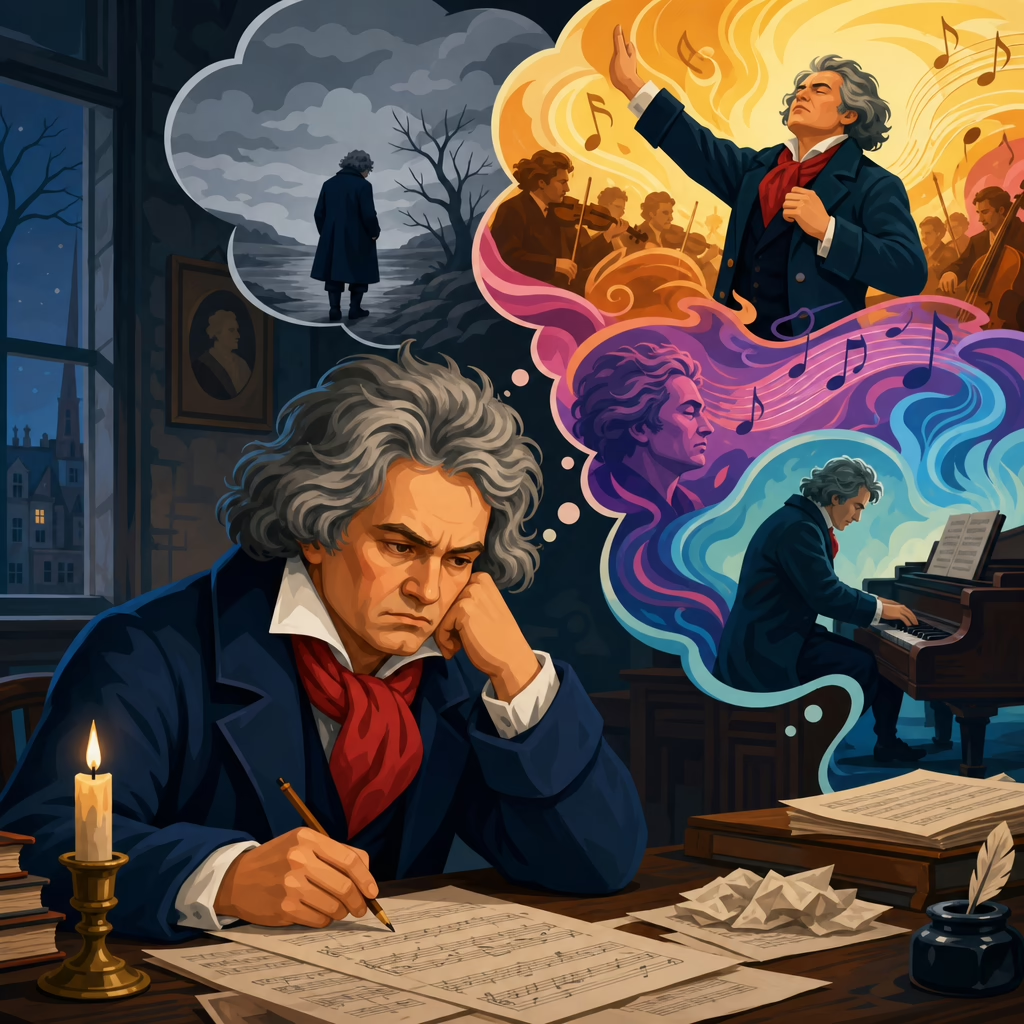
The Psychology of Beethoven’s Isolation
Ludwig van Beethoven’s isolation was not a single condition but a shifting psychological state shaped by deafness, chronic illness, artistic ambition, family conflict, and the social pressures of Vienna. To understand the psychology of Beethoven’s isolation, it helps to define isolation in two ways: external separation from ordinary social life, and internal estrangement from one’s own body, emotions, and future. In Beethoven’s case, both forms were present. His hearing loss progressively removed him from conversation and performance, while pain, digestive distress, and anxiety narrowed his daily world. Yet isolation did not simply diminish him. It became a force that intensified introspection, hardened self-discipline, and redirected his identity from celebrated pianist to visionary composer.
This subject matters because Beethoven’s deafness is often treated as a dramatic biographical fact rather than a lived psychological reality. The common image is heroic: a genius overcoming adversity through willpower alone. That image is incomplete. In my work reviewing letters, conversation books, medical accounts, and the social history of early nineteenth-century Vienna, the pattern is clearer: Beethoven’s solitude had costs as well as creative consequences. It disrupted friendships, complicated romance, deepened mistrust, and increased emotional volatility. At the same time, it protected his artistic concentration and encouraged a new inward style that changed Western music.
As a hub within the broader subject of Beethoven’s health and deafness, this article covers the miscellaneous psychological dimensions that tie the subtopic together. It addresses the main questions readers usually ask: Was Beethoven lonely or deliberately withdrawn? Did deafness directly cause his temperament to worsen? How did shame, pride, and class anxiety affect his behavior? What role did illness, alcohol, guardianship disputes, and the famous Heiligenstadt Testament play in his mental life? The answers require nuance. Beethoven was never merely a victim of disability, nor merely a noble sufferer. He was a highly sensitive, often difficult man adapting to relentless bodily change under public scrutiny.
Psychologically, Beethoven’s isolation can be understood through several interacting forces. First, sensory loss reduced spontaneous social feedback; people who cannot hear well often miss tone, timing, and subtle emotional cues, leading to fatigue and withdrawal. Second, stigma mattered. In Beethoven’s world, a virtuoso pianist who could not hear risked humiliation and professional ruin. Third, his personality already leaned toward intensity, independence, and suspicion. Finally, his creative standards were extreme. When these factors converged, isolation became both defense and destiny. The rest of this article explains how that process unfolded and why it remains essential for understanding Beethoven’s life, health, and music.
Deafness, shame, and the slow collapse of ordinary sociability
Beethoven’s hearing loss did not begin as total silence. It emerged gradually, probably from the late 1790s, with tinnitus, difficulty hearing high frequencies, and increasing trouble following speech in groups. That gradual onset is psychologically important. Sudden loss can shock a person into immediate adaptation; progressive loss often creates years of concealment, compensation, and dread. Beethoven tried to hide his condition, avoided admitting its severity, and withdrew from situations in which failure would be obvious. In practical terms, that meant fewer dinners, strained rehearsals, and less ease in salons, the social engines of Viennese musical culture.
The shame attached to deafness was not abstract. Beethoven had built his early reputation partly as an improvising pianist whose authority depended on acute listening and immediate response. Missing a cue or misunderstanding a remark risked embarrassment before patrons and rivals. His letters show frequent concern about being perceived as rude, distracted, or incapable. Many hearing-impaired people today describe the same psychological chain: effortful listening leads to exhaustion; exhaustion produces avoidance; avoidance is misread as arrogance; that misreading then reinforces further withdrawal. Beethoven appears to have lived inside that loop for years.
The Heiligenstadt Testament of 1802 reveals the emotional cost. Addressed to his brothers and never sent, it describes despair, social retreat, and thoughts of suicide while insisting that art held him back from self-destruction. This is not merely a confession of sadness. It is evidence of identity fracture. Beethoven felt cut off from “society” because he could not say, “I am deaf.” The inability to disclose a stigmatized condition trapped him between longing for connection and terror of exposure. His isolation therefore had a distinctly psychological texture: secrecy, anticipatory shame, and defensive pride operating at the same time.
Personality structure: pride, irritability, sensitivity, and control
Deafness alone does not explain Beethoven’s isolation. Accounts from friends, pupils, and patrons suggest that he was already forceful, emotionally reactive, and determined to govern his own terms of engagement. He could be generous and loyal, but also suspicious, abrupt, and intolerant of incompetence. In modern language, he seems to have had high sensitivity combined with low willingness to mask displeasure. Once hearing loss increased social strain, those traits became harder for others to absorb. What might earlier have seemed passionate eccentricity began to look like volatility.
Control was central to his psychology. Beethoven organized notebooks, revised obsessively, changed lodgings repeatedly, and argued over money, domestic order, and artistic decisions. Such behavior is often dismissed as difficult temperament, but in the context of chronic illness it also reads as compensation. When the body becomes unpredictable, people often seek greater control over environment and routine. Beethoven’s demands regarding meals, housekeeping, schedules, and correspondence fit that pattern. They were not always reasonable, yet they served a psychological purpose: preserving agency against a body that increasingly betrayed him.
This mix of pride and vulnerability made intimacy difficult. Beethoven wanted admiration, loyalty, and emotional understanding, but he resisted dependence. He could idealize friends and then break with them over slights, debts, or perceived disloyalty. In clinical terms, one sees repeated cycles of attachment and rupture. The result was a social world marked by instability. Isolation was partly imposed by deafness, but partly produced by Beethoven’s own protective style. He often chose distance before others could reject or pity him.
Illness beyond deafness and the psychology of bodily siege
Any serious account of Beethoven’s isolation must extend beyond hearing loss. He suffered recurrent gastrointestinal problems, abdominal pain, diarrhea, inflammatory episodes, probable liver disease, and periods of profound physical weakness. Historical diagnoses remain debated; possibilities discussed by scholars and physicians have included irritable bowel disease, chronic pancreatobiliary problems, cirrhosis, and systemic inflammatory conditions. What matters psychologically is not diagnostic certainty but cumulative burden. Long-term pain and digestive distress are strongly associated with irritability, disrupted sleep, reduced frustration tolerance, and social avoidance.
I have found that readers often underestimate how embarrassing digestive illness can be in a premodern urban setting. Vienna offered limited privacy, inconsistent sanitation, and constant domestic inconvenience. Frequent bowel symptoms alone could make invitations, travel, and cohabitation stressful. Add tinnitus, headaches, and hearing difficulty, and ordinary participation becomes a daily negotiation. Beethoven’s complaints about lodgings, food quality, servants, and noise therefore deserve to be read not only as bad temper but as signs of someone living under continuous somatic pressure.
Chronic illness also narrows time perspective. Instead of planning freely, sufferers begin conserving energy, avoiding uncertainty, and prioritizing work that feels essential. Beethoven’s increasing concentration on composition reflects artistic maturity, but also the psychology of constrained resources. When health is unstable, attention becomes precious. Many of his conflicts can be understood through that lens. He defended his working time fiercely because he experienced interruptions more intensely than healthier peers. Isolation, then, was reinforced by a body that made engagement costly.
Isolation in daily life: work habits, conversation books, and domestic friction
By Beethoven’s later years, isolation had become materially embedded in routine. Conversation books, used especially from 1818 onward, allowed visitors to write questions or remarks while Beethoven often replied aloud. These books are invaluable records because they show social contact continuing under altered conditions. They also reveal its awkwardness. Written exchange is slower, less spontaneous, and more vulnerable to misunderstanding than ordinary conversation. Jokes flatten, emotional nuance thins, and power shifts toward the person who controls the setting. Beethoven remained connected, but through a medium that constantly reminded everyone of loss.
His domestic life amplified this strain. He moved often, argued with landlords, criticized servants, and struggled to maintain stable household management. Such friction was common in Vienna, but Beethoven’s case was intensified by sensory and emotional stress. A hearing person can absorb minor disturbances while cooking, conversing, or working; a deaf, unwell, highly concentrated composer may experience the same disturbances as intolerable intrusions. Several contemporaries describe scenes in which small practical failures provoked disproportionate anger. Those outbursts damaged relationships and made companionship more fragile.
| Factor | How it increased isolation | Concrete example from Beethoven’s life |
|---|---|---|
| Progressive deafness | Reduced ease in conversation and public performance | Avoidance of salons and growing reliance on written exchange |
| Chronic illness | Lowered energy and patience for social demands | Repeated complaints about pain, digestion, and weakness |
| Pride and secrecy | Blocked candid disclosure and help-seeking | Efforts to conceal hearing problems during early decline |
| Family conflict | Turned emotional life toward legal and domestic struggle | Lengthy custody battle over his nephew Karl |
| Artistic perfectionism | Made solitude feel productive and necessary | Obsessive revision in sketchbooks and controlled routines |
Yet it would be wrong to imagine Beethoven as wholly cut off. He still met publishers, patrons, pupils, copyists, and close associates. The better formulation is selective isolation. He remained socially active where purpose overrode friction. He withdrew most sharply from settings requiring effortless hearing, light sociability, or emotional reciprocity. That distinction matters because it explains why he could appear both solitary and densely connected depending on the context.
Love, friendship, and the emotional cost of guardedness
Beethoven’s letters to female correspondents and the enduring mystery of the “Immortal Beloved” show a man capable of deep attachment, longing, and tenderness. They also show barriers he struggled to cross. Class differences, unstable health, erratic finances in certain periods, and his own difficult temperament all complicated romantic possibility. Deafness added another layer: it threatened self-presentation. Courtship depends heavily on conversational confidence, subtle emotional attunement, and social timing, all areas made harder by hearing loss. The result was a pattern of idealized affection more often consummated in letters than stable partnership.
Friendships followed a similar logic. Beethoven inspired devotion in some companions because his sincerity and genius were unmistakable. But he tested loyalty repeatedly. He could accuse friends of negligence, resent advice, or react harshly to practical disagreements. Once trust eroded, reconciliation was possible but never simple. Isolation thus became self-reinforcing. The fewer easy relationships he had, the more pressure fell on the remaining ones; the more pressure those relationships carried, the more volatile they became. This is a familiar psychological pattern in chronically ill or disabled adults whose social worlds contract over time.
There is also evidence that Beethoven feared pity almost as much as abandonment. Pity threatens equality. For a man fiercely committed to artistic and personal dignity, being treated as an object of sympathy could feel intolerable. That helps explain his alternating demands for support and resistance to it. He needed others, but wanted the need to remain invisible. Such guardedness preserved pride while intensifying loneliness.
From suffering to style: how isolation shaped creative thought
The strongest claim that can be made is not that isolation caused Beethoven’s genius, but that it altered the conditions under which his genius operated. As performance became harder and social participation more strained, composition assumed even greater psychological importance. It offered mastery where daily life offered frustration. In sketchbooks, drafts, and large formal plans, Beethoven could turn inward without becoming passive. He imposed order, tested alternatives, and transformed private struggle into public form. That is one reason the middle and late works feel so concentrated: they arise from a life in which inner audition had to outgrow external hearing.
This should not be romanticized. Deafness was not a gift, and suffering is not inherently ennobling. Many disabled artists are diminished by barriers rather than improved by them. Beethoven’s achievement was exceptional because he possessed unusual technical command, relentless discipline, and access to enough patronage and publishing support to continue working. Still, the psychological effect of isolation on style is real. The late quartets, the Missa solemnis, and the Ninth Symphony display an inward authority that many listeners recognize immediately. Their intensity reflects not simple pain, but a mind forced to rely less on ordinary social-musical feedback and more on internal conviction.
For readers exploring this subtopic further, that connection links naturally to articles on the Heiligenstadt Testament, the conversation books, Beethoven’s medical history, and the final years. Together they show that his isolation was never just biographical scenery. It was an active mental environment shaping decisions, relationships, and art.
Conclusion
The psychology of Beethoven’s isolation emerges most clearly when deafness is placed alongside illness, temperament, shame, pride, and social context. He was isolated because hearing loss disrupted the mechanics of social life, because chronic physical suffering reduced resilience, and because his own defensive habits made closeness difficult. He was also isolated in a more existential sense: separated from the musical world he had entered as a performer, from the easy reciprocity of conversation, and often from the security he wanted in love and family. None of that can be reduced to a single trait or diagnosis.
The lasting lesson is balance. Beethoven’s solitude was destructive in some respects, productive in others, and inseparable from the conditions under which he composed his greatest works. Understanding that complexity gives a truer picture than the familiar myth of the invincible genius. It shows a man under pressure adapting imperfectly, sometimes nobly, sometimes badly, but always intensely. If you are building a fuller view of Beethoven’s health and deafness, continue with the related pages on his hearing loss timeline, medical theories, private writings, and late-life communication methods to see how each piece deepens this psychological portrait.
Frequently Asked Questions
What does “isolation” really mean in Beethoven’s psychological life?
In Beethoven’s case, isolation was far more complex than simple loneliness or physical seclusion. Psychologically, it can be understood in two overlapping ways. First, there was external isolation: a growing separation from ordinary social life, conversation, public music-making, and the spontaneous human contact that hearing makes possible. As his deafness advanced, Beethoven lost access to the easy reciprocity that allows people to feel socially anchored. Meals, salons, rehearsals, and friendships became more difficult to navigate, not necessarily because he lacked interest in others, but because communication itself became strained, frustrating, and often humiliating.
Second, there was internal isolation, which may have been even more painful. Beethoven became estranged not only from society, but from his own body and future. His hearing loss undermined his identity at the deepest level because music was not merely his profession; it was his central mode of being in the world. Add to this his chronic illnesses, emotional volatility, and repeated disappointments in family and romantic life, and isolation begins to look like a condition of psychological division. He was often cut off from others, but also from the sense of continuity and ease within himself. That dual isolation helps explain why his letters and personal documents can shift so sharply between defiance, despair, tenderness, rage, and visionary purpose.
How did Beethoven’s deafness shape his emotional and social isolation?
Deafness was one of the most decisive forces in Beethoven’s psychological world because it attacked both his social confidence and his personal identity. In public, hearing loss made him vulnerable to embarrassment, misunderstanding, and withdrawal. He could no longer participate naturally in conversation, and because social life in Vienna depended heavily on verbal wit, etiquette, and musical exchange, he increasingly found himself shut out of the very circles where he had once flourished. This did not mean he became permanently antisocial by nature; rather, the effort and pain involved in communication made social contact exhausting and unpredictable.
Emotionally, deafness intensified feelings of shame, anger, grief, and fear. For a composer and pianist, hearing loss was not simply a medical condition; it was a profound existential injury. Beethoven understood early that the condition threatened the core of his vocation, and that awareness appears to have produced a sustained inner crisis. He could still compose, and eventually in astonishing ways, but that creative triumph should not obscure the psychological cost. Deafness forced him into a paradox: he became increasingly unable to hear the external world while becoming ever more absorbed in an internal musical world of extraordinary intensity. That inward turn may have deepened his art, but it also heightened his distance from ordinary social experience. His isolation, then, was not just the result of silence around him; it was the result of living between a damaged sensory reality and an exceptionally vivid inner imagination.
Was Beethoven’s isolation only caused by deafness, or were other psychological pressures involved?
Deafness was central, but it was not the whole story. Beethoven’s isolation emerged from several interlocking pressures that reinforced one another over time. Chronic illness contributed to physical discomfort, irritability, and unpredictability, all of which can wear down emotional resilience and make relationships harder to sustain. Family conflict, especially his troubled and consuming involvement with his nephew Karl, added another layer of stress. These conflicts were not minor background details; they deeply affected Beethoven’s emotional life, sense of control, and capacity for trust.
His artistic ambition also mattered. Beethoven held himself to unusually severe standards, and that intensity could create isolation even in the absence of illness. Great ambition often requires discipline and inwardness, but in Beethoven’s case, the demands of artistic purpose could merge with personal suffering in ways that made compromise difficult. Social pressures in Vienna added still more complexity. He depended on aristocratic patronage yet retained a fiercely independent sense of self, and that tension often placed him in an awkward psychological position: he needed the system without fully belonging to it. Taken together, these factors suggest that Beethoven’s isolation should be understood as dynamic rather than singular. Deafness may have triggered or magnified it, but chronic pain, emotional instability, family battles, social dependence, and relentless artistic striving all helped shape the specific psychological pattern of his isolation.
Did Beethoven’s isolation damage him psychologically, or did it also contribute to his creativity?
The most accurate answer is that it did both. Psychologically, isolation clearly caused suffering. It exposed Beethoven to prolonged grief, frustration, suspicion, and episodes of emotional extremity. His letters reveal moments of hopelessness, intense resentment, and profound exhaustion, all of which suggest that isolation was not romantically noble in itself but genuinely painful. Human beings generally require connection, recognition, and a sense of being understood, and Beethoven was no exception. The fact that he continued to create does not erase the burden he carried.
At the same time, isolation appears to have altered the conditions of his creativity in powerful ways. As his access to ordinary hearing diminished, Beethoven relied more deeply on inner audition, structural imagination, and mental concentration. This may have encouraged a more inward, expansive, and radical musical language. In other words, isolation did not magically produce genius, but it changed the psychological environment in which his genius operated. He was increasingly driven to build musical worlds from within, and those worlds often display unusual boldness, spiritual intensity, and formal innovation.
Still, it is important not to oversimplify this relationship. Isolation was not a gift in disguise, nor was suffering a necessary prerequisite for greatness. Rather, Beethoven’s achievement lies partly in the fact that he transformed psychic distress into disciplined artistic work without being fully defeated by it. His creativity was not caused by pain alone; it emerged from the interaction of pain, extraordinary talent, relentless will, and a deep commitment to meaning. That is why his isolation remains psychologically compelling: it wounded him, but it also became material he struggled with, interpreted, and reshaped through art.
Why does Beethoven’s isolation still matter to modern readers and listeners?
Beethoven’s isolation remains deeply relevant because it speaks to experiences that are still psychologically familiar: chronic illness, disability, social disconnection, identity loss, family strain, and the fear of becoming cut off from one’s own future. Modern readers can recognize in Beethoven not only a legendary composer, but a person trying to preserve dignity while his body betrayed him and his relationships became increasingly difficult. His life shows that isolation is rarely just physical aloneness. It often includes shame, miscommunication, frustration, and the painful sense that others cannot fully grasp what one is enduring.
His story also matters because it complicates common cultural myths. We often imagine genius as solitary by nature, as though isolation automatically deepens insight. Beethoven’s life offers a more honest picture. Isolation can sharpen inner life, but it can also wound, distort, and exhaust. What makes Beethoven compelling is not that he was isolated, but that he continued to create meaning under conditions that might have broken many people. For listeners, this adds emotional depth to the music. Works from his later years can be heard not merely as abstract masterpieces, but as expressions of a mind wrestling with separation, endurance, and transcendence.
Ultimately, Beethoven’s isolation matters because it reveals how psychological suffering and human aspiration can coexist. He reminds us that inner estrangement does not cancel the possibility of connection; sometimes it intensifies the need for it. Through his music, Beethoven reached others across barriers that his daily life could not overcome. That enduring paradox is one reason his life and work continue to resonate so strongly today.