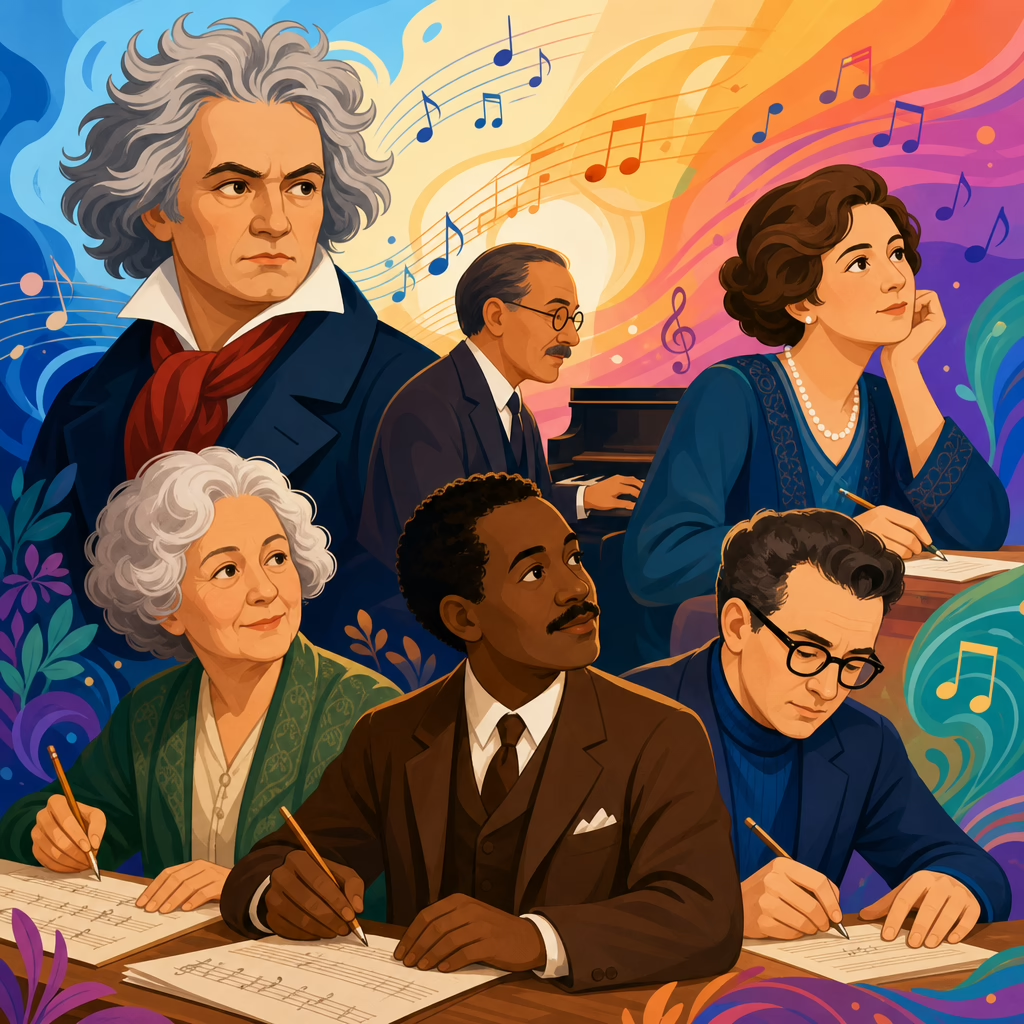
Deaf Composers After Beethoven: A Legacy of Possibility
Beethoven remains the most famous deaf composer in Western music, but his story did not end the conversation; it opened a lineage of artists, educators, and advocates who proved that hearing loss does not cancel musical imagination. In the context of Beethoven’s health and deafness, deaf composers after Beethoven represent a legacy of possibility because they transformed a biographical tragedy into a broader history of adaptation, craft, and creative authority. The key terms matter here. A deaf composer is not always a person with complete silence; many worked with partial hearing, progressive loss, tinnitus, fluctuating perception, or the residual sensation of vibration. Deafness in music therefore includes a spectrum of listening conditions, from severe sensorineural loss to late-deafened adulthood. That distinction is important because composition depends on inner hearing, structural memory, notation fluency, tactile feedback, and rehearsal methods as much as on direct acoustic input.
I have worked on music history content around disability, archival interpretation, and performance practice, and one pattern appears consistently: popular writing often treats Beethoven as a miraculous exception. The record is richer than that. Across the nineteenth, twentieth, and twenty-first centuries, composers with significant hearing loss continued to write chamber music, orchestral scores, songs, film music, electronic works, and pedagogical materials. Some used hearing aids or cochlear implants; some relied on assistants, piano resonance, visual tuners, spectrograms, or intense knowledge of harmony and orchestration. Their careers matter not only as inspiring stories but also as evidence that musical cognition is broader than ear-to-air sound alone. This hub article maps that miscellaneous field comprehensively, showing the principal figures, working methods, recurring barriers, and reasons their music belongs within mainstream music history rather than on a separate inspirational shelf.
Why Beethoven Is the Starting Point, Not the Endpoint
Beethoven dominates the subject because his deafness developed while he was already recognized, and because documents such as the Heiligenstadt Testament make the crisis legible to later readers. By the time he wrote many late works, including parts of the late string quartets and the Ninth Symphony period, he depended increasingly on inner hearing and conversation books. Yet focusing only on Beethoven can distort the lesson. The deeper historical point is that composition is partly auditory, partly conceptual, and partly physical. Skilled composers hear relationships on the page: interval size, registral density, instrumental balance, harmonic tension, and formal pacing. They can test these relationships at a keyboard, through vibration, through memory, or through rehearsal. That is why Beethoven’s case became foundational. He demonstrated publicly that musical authority could survive severe hearing loss.
After Beethoven, later composers inherited both an example and a burden. The example was liberating: if the canonical master could continue working, deafness need not equal artistic exit. The burden was restrictive: journalists repeatedly compared every deaf composer to Beethoven, often reducing them to medical case studies. A useful hub article must hold both truths. Beethoven’s health and deafness created the reference point, but the later legacy includes people with different genres, technologies, identities, and solutions. Some were child prodigies who later lost hearing; some were deaf from early life; some moved between deaf and hearing communities; some foregrounded disability politics, while others simply wanted to be evaluated as composers. Understanding that range is essential for anyone exploring this subtopic in depth.
Key Deaf Composers After Beethoven and What Their Careers Show
Bedřich Smetana is one of the clearest nineteenth-century examples. Best known for Má vlast and the opera The Bartered Bride, he became profoundly deaf in the 1870s, likely after illness associated with syphilis. His String Quartet No. 1, From My Life, includes the famous high sustained E that represents the intrusive tinnitus tone he experienced. That is not a vague anecdote; it is a compositional decision that turns a medical symptom into formal material. Smetana’s case shows that deafness can enter the score not merely as adversity but as subject matter.
Gabriel Fauré, though not usually labeled a deaf composer in popular summaries, experienced severe hearing deterioration later in life. He described a distorted auditory world in which pitch relationships sounded altered, making familiar music seem transposed or warped. Despite that, he completed major late works such as the Piano Trio in D minor and String Quartet in E minor. Fauré demonstrates that progressive hearing loss does not always present as silence. Distortion, frequency loss, and unstable perception may be even harder for musicians because they undermine confidence in what is heard.
In the twentieth century, several prominent figures made the legacy unmistakable. The Welsh composer Ludwig van Beethoven’s distant successor in public imagination was not one person but a cluster. Czech composer Josef Labor, blind and hard of hearing, composed chamber music admired by Brahms’s circle. Russian composer Vissarion Shebalin continued writing after substantial hearing loss, relying on memory and theory. More widely recognized today is Kaikhosru Shapurji Sorabji, who became significantly hard of hearing in later life while producing immense, technically complex piano and organ works. His example matters because scale and complexity were never reduced to accommodate impairment.
In American music, Roger Sessions experienced major hearing decline in old age and still wrote rigorously argued modernist works. Malcolm Arnold also faced hearing-related difficulties amid broader health struggles. In popular and crossover traditions, the jazz world offers important parallels, even if not every figure fits the narrow classical label. These cases broaden the hub: deafness and composition are not confined to the symphonic canon.
The most influential contemporary example is Dame Evelyn Glennie, who is primarily known as a percussionist rather than a composer, yet her career changed how musicians discuss deafness, vibration, and performance. Glennie’s explanation that she learns to hear with the whole body has informed countless composers and educators. Within composition specifically, the British composer and sound artist Beethoven-inspired communities often cite is not a single celebrity but many less public figures working in conservatories, film, church music, and community arts. That is a historical reality. Deaf composers exist in greater numbers than standard textbooks suggest because institutions have not always indexed disability clearly.
How Deaf Composers Actually Compose
The practical question most readers ask is simple: how can a deaf person compose music? The direct answer is that composition is a multi-layered cognitive process. First, trained musicians develop audiation, the capacity to hear music internally without external sound. Second, notation externalizes thought; a score functions as a map of pitch, rhythm, dynamics, articulation, tempo, and instrumentation. Third, instruments provide tactile and visual feedback. A piano key has resistance, attack, and vibration. A string instrument transmits resonance through the body. Digital audio workstations display waveform density, MIDI notes, timing grids, and spectrographic information. Rehearsal then becomes a verification stage rather than the sole source of musical knowledge.
In my experience reviewing composer workflows and rehearsal reports, successful adaptation usually combines several methods rather than one dramatic workaround. Some composers sit at the piano and feel sympathetic resonance through the case and floor. Others sing internally while checking intervals visually on paper or software. Some depend on trusted performers to report balance, timbre, and dynamic proportion. Hearing aids can help in speech and selective listening but may compress or distort musical frequencies. Cochlear implants improve access for many users, yet music perception through implants remains variable, especially regarding timbre and complex harmonic texture. That does not make composition impossible; it changes what must be cross-checked.
| Method | What it provides | Common limitation | Real-world use |
|---|---|---|---|
| Inner hearing | Mental audition of melody, harmony, and form | Requires strong training and memory | Used by Beethoven, Smetana, Fauré, and many conservatory-trained composers |
| Piano or instrument vibration | Tactile sense of attack, register, and resonance | Less precise for orchestral color | Useful in drafting themes, bass motion, and rhythmic profile |
| Notation and theory | Structural control over voicing and orchestration | Cannot replace every timbral nuance | Central to professional scoring and revision |
| Assistive technology | Amplification, visual displays, recording playback | Music can sound distorted or flattened | DAWs, tuners, spectrum analyzers, captions, remote collaboration |
| Trusted performers and conductors | External feedback on balance and color | Requires communication and time | Workshop rehearsals, orchestrational checks, premiere preparation |
This process is not exotic. Even hearing composers rely on inner hearing, notation, software, and performer feedback. Deaf composers simply foreground tools that all composers already use. That is one reason the topic matters: it reveals what composition truly is.
Barriers, Misconceptions, and the Role of Technology
The largest barrier has usually been social, not musical. Conservatories, publishers, and critics often assume that hearing loss disqualifies a student from ear training, ensemble leadership, or professional composition. In practice, barriers cluster around access: captioning in rehearsals, visual conducting cues, quiet spaces for communication, flexible jury formats, and faculty willing to separate musicianship from narrow audiological norms. When these supports exist, progress is measurable. Modern notation software such as Sibelius, Finale, Dorico, and MuseScore allows instant visual review; DAWs such as Logic Pro, Cubase, and Pro Tools support MIDI mockups, frequency analysis, and iterative editing. Video conferencing with live captions, cloud score sharing, and sample libraries have reduced dependency on real-time acoustic audition.
Still, technology is not a miracle cure. Hearing aids are designed primarily for speech intelligibility, not for the full dynamic range and overtone complexity of orchestral sound. Cochlear implants can be transformative for communication, but many musicians report that pitch resolution, timbral richness, and polyphonic texture remain challenging. Scholars of music and disability therefore warn against a simplistic narrative in which devices restore normal hearing and solve the artistic problem. They improve access, but craft, training, and adaptation remain central. The misconception that deaf composers “feel the beat” and little else is equally misleading. Vibration helps, but advanced composition also depends on syntax, form, memory, and symbolic reasoning. Reducing deaf musicians to vibration alone understates their expertise and repeats old stereotypes.
Why This Legacy Matters for Music History, Education, and Inclusion
Deaf composers after Beethoven matter because they change the frame of music history. Instead of treating disability as an interruption to genius, we can see it as part of the conditions under which music is actually made. That shift improves scholarship. It encourages biographers to read medical evidence carefully, distinguish myth from documentation, and connect disability to technique rather than sentimentality. It improves education as well. Students who learn only Beethoven may conclude that deafness in music is a lone miracle. Students who also encounter Smetana, Fauré’s auditory distortion, late-deafened modernists, and contemporary disabled creators understand that musical authorship is plural.
For teachers and institutions, the practical lesson is straightforward. Build curricula that include disabled musicians in core repertory, not just special-topic weeks. Offer captioned lectures, accessible ensemble communication, alternative aural-skills assessment where appropriate, and exposure to tools that support different listening profiles. For readers using this page as a hub within the Beethoven’s health and deafness topic, the next logical step is to explore detailed articles on Beethoven’s hearing timeline, conversation books, medical theories, tinnitus, assistive devices, and comparisons with later deaf musicians. Together, those pages show a continuous story: deafness changed musical work, but it did not end it.
The enduring benefit of this legacy is not motivational rhetoric; it is evidence. Deaf composers after Beethoven demonstrate that composition can survive profound hearing change through training, adaptation, technology, and artistic stubbornness. Their careers deserve serious study because they reveal how music lives in the mind, the body, the page, and the rehearsal room at once. If you are building knowledge around Beethoven’s health and deafness, use this hub as your starting map, then follow the connected articles to examine each figure, method, and historical case in greater depth.
Frequently Asked Questions
Why do deaf composers after Beethoven matter so much in music history?
Deaf composers after Beethoven matter because they expand the story of musical achievement beyond a single extraordinary figure and show that deafness is not the end of musical creativity. Beethoven is often treated as the defining example of a composer creating despite hearing loss, but the broader historical record reveals a larger legacy: composers, performers, teachers, and advocates who developed their own methods for composing, rehearsing, teaching, and participating in musical life. That legacy shifts the conversation from individual tragedy to artistic possibility. It shows that musical imagination does not depend on one narrow model of hearing and that composition can be rooted in memory, theory, vibration, notation, inner hearing, physical sensation, collaboration, and disciplined craft.
This matters historically because it changes how we understand authorship and ability in classical music and beyond. Instead of presenting deafness as an exceptional obstacle overcome only by a genius, the history of deaf composers after Beethoven shows adaptation as a recurring part of musical culture. Some worked with partial hearing loss, some became deaf later in life, and others developed careers in communities shaped by deaf education and disability advocacy. Their work demonstrates that musicianship is not a fixed biological condition but a set of practices, techniques, and ways of thinking. In that sense, deaf composers after Beethoven are important not only because they continued to write music, but because they broadened the definition of who gets to be recognized as a legitimate musical creator.
Were there really important deaf composers after Beethoven, or is he still the only major example?
Beethoven is certainly the most famous example in Western music history, but he is not the only meaningful one. After Beethoven, a number of deaf and hard-of-hearing musicians contributed to composition, performance, pedagogy, and musical advocacy in ways that deserve serious attention. Some are less widely known not because their achievements were small, but because music history has often favored a narrow canon and has not consistently highlighted disability history. Looking beyond Beethoven reveals a more layered tradition in which hearing loss intersects with artistry, education, and public identity.
One important figure often discussed in this context is Gabriel Fauré, who experienced severe hearing problems later in life, including distortions in how he perceived pitch. Although he is not always labeled simply as a “deaf composer,” his later career is crucial for understanding how hearing impairment affected compositional process without ending it. Another widely cited example is Bedřich Smetana, whose profound hearing loss shaped the final phase of his life and work. In the twentieth century and beyond, the conversation broadens further to include deaf and hard-of-hearing composers, sound artists, and educators whose careers unfolded in more explicitly disability-aware contexts. The key point is not to force every composer into a single identity category, but to recognize that Beethoven inaugurated no dead end. He stands at the beginning of a continuing history in which hearing loss and musical creation coexist in many forms.
How can a deaf composer create music without hearing it in the usual way?
This is one of the most common questions, and it rests on an understandable but limited assumption: that composing is only the direct translation of external sound into notation. In reality, composition has always involved a range of mental and physical skills. Composers rely on inner hearing, memory, theoretical understanding, pattern recognition, instrumental knowledge, structural planning, and embodied sensation. A deaf composer may imagine relationships between notes, chords, textures, and forms internally rather than depending entirely on real-time auditory feedback. Many composers, whether deaf or hearing, work extensively at a desk with notation, sketching, revising, and mentally testing possibilities before any sound is produced.
Deaf composers may also use vibration, visual cues, technology, physical resonance, and collaboration as part of their process. The body can register rhythm and energy through touch and movement. Instruments and rooms produce vibrations that can be felt. Written notation provides a visual architecture for musical thought. Digital tools can offer visual representations of pitch, density, timing, and frequency. Trusted performers, assistants, teachers, or colleagues may help provide feedback, just as many composers throughout history have relied on performers and editors. None of this makes the music less authentic. On the contrary, it highlights that composition is an intellectual and creative art form built on multiple kinds of perception. Deafness may change the route to the finished work, but it does not cancel the ability to imagine and shape music with authority.
Did deaf composers after Beethoven influence disability culture as well as music?
Yes, and that influence is one reason this topic matters far beyond biography. Deaf composers after Beethoven contributed not only to repertoire and performance traditions, but also to broader cultural ideas about disability, education, communication, and artistic legitimacy. Their lives challenged the assumption that disability automatically places someone outside serious cultural production. By composing, teaching, publishing, conducting, or advocating, they made visible the fact that deaf people could hold creative authority in spaces that often excluded them. That visibility had symbolic power: it offered examples to students, families, institutions, and future artists who needed proof that musical life remained possible after hearing loss.
In many cases, the impact extended into questions of access and representation. Deaf and hard-of-hearing musicians helped expose how conservatories, concert halls, and educational systems were built around hearing norms that were treated as universal. Their careers pushed institutions to confront practical issues such as communication methods, instructional adaptation, rehearsal techniques, and the use of assistive technologies. They also influenced public understanding by reframing deafness from a story of pure deficit into one of adaptation, expertise, and alternative forms of perception. That is why the phrase “a legacy of possibility” is so fitting. The legacy is not just that music continued to be written; it is that deafness itself came to be seen, in part, through the lens of capability, craft, and cultural contribution.
What is the best way to write about Beethoven and later deaf composers without reducing them to inspirational stories?
The best approach is to treat deafness as historically significant without making it the only thing that matters. Writers should avoid turning composers into simplistic symbols of triumph over adversity, because that flattens both their art and their lived experience. A stronger and more accurate method is to connect hearing loss to concrete musical, social, and professional realities: how a composer worked, what adaptations were used, how colleagues responded, what institutions enabled or restricted access, and how the music itself developed over time. This keeps the focus on artistic practice rather than sentimentality.
It is also important to use careful language. Not every composer with hearing loss identified in the same way, and modern disability categories do not always map neatly onto earlier historical periods. A responsible article can acknowledge those nuances while still recognizing that deafness and hearing impairment shaped musical life in meaningful ways. Rather than asking whether a composer “overcame” deafness, it is often better to ask how they composed with it, around it, or through it. That framing respects complexity. In an article titled “Deaf Composers After Beethoven: A Legacy of Possibility,” the strongest FAQ answers will emphasize continuity, adaptation, and creative authority. They should show that Beethoven’s story opened a wider history, one in which deaf and hard-of-hearing musicians did not merely survive exclusion, but actively reshaped the meaning of musicianship itself.