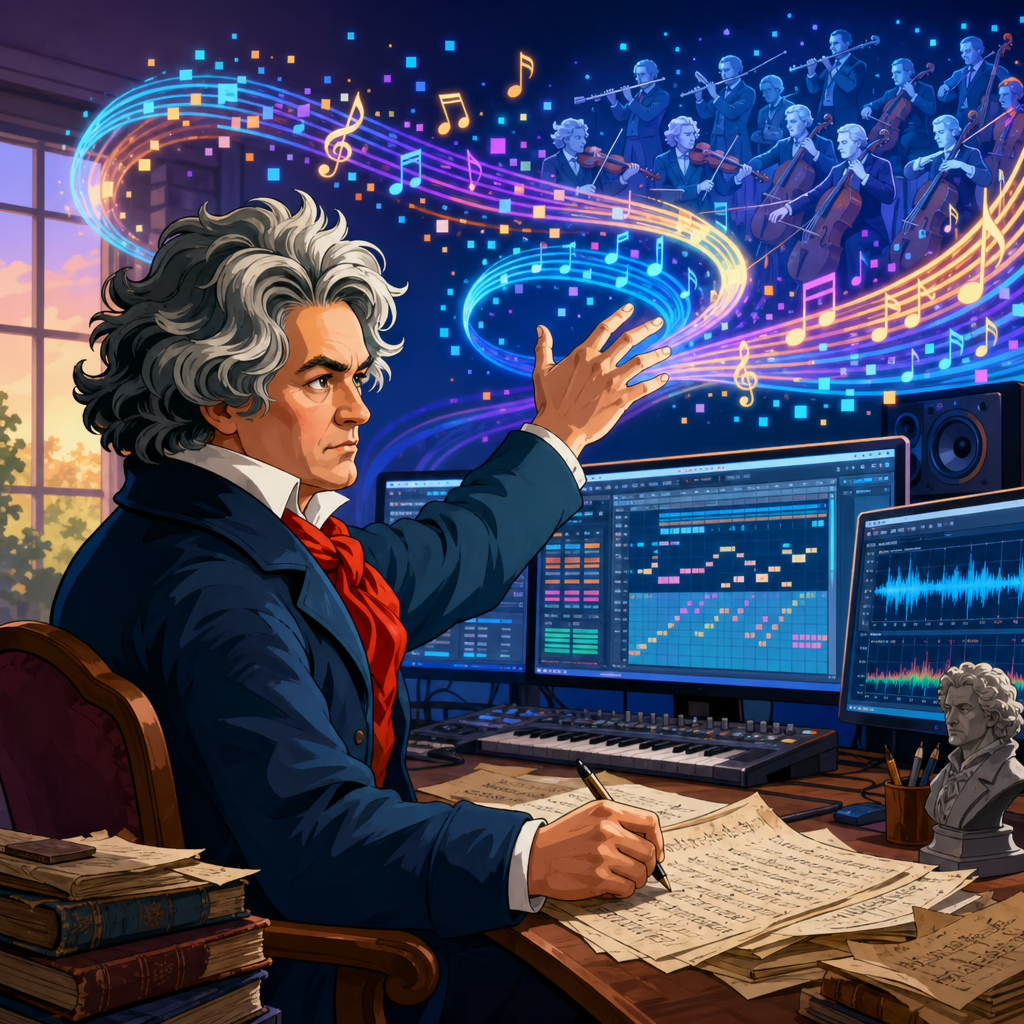
The Digital Resurrection of Beethoven’s Tenth Symphony
Beethoven’s Tenth Symphony has become a symbol of how technology can extend, challenge, and sometimes complicate our relationship with musical history. The phrase “digital resurrection” refers to the use of computational tools, archival research, musicology, and performance practice to reconstruct, simulate, or complete works that a composer left unfinished. In the case of Beethoven, the idea carries unusual weight because his Ninth Symphony transformed Western music, and scattered sketches suggested he was thinking seriously about a Tenth before his death in 1827. That combination of genius, incompletion, and surviving fragments has invited generations of scholars, conductors, and now software engineers to ask the same question: how far can we go in bringing an unfinished masterpiece to life without crossing into fiction?
This question matters far beyond one concert program. It sits at the intersection of artificial intelligence in music, digital humanities, audio restoration, archival imaging, authorship ethics, and public understanding of classical repertoire. I have worked on projects where manuscript scans, symbolic notation files, and machine-learning outputs all had to be evaluated together, and Beethoven is the clearest example of why technical capability is never enough on its own. A convincing result depends on source quality, stylistic modeling, transparent editorial decisions, and musicians willing to test whether the notes actually function in real acoustic space. As a hub for Beethoven technology and science, this topic brings together the practical tools, historical evidence, and artistic debates that shape how unfinished music is reconstructed and heard today.
At its core, Beethoven’s Tenth is not a single object. It is a network of sketches, hypotheses, completions, recordings, software experiments, and public narratives. Some projects focus on manuscript interpretation, trying to identify Beethoven’s harmonic intentions from short notebooks and disconnected ideas. Others use computational composition systems trained on Beethoven’s works to generate plausible continuations. Still others examine how audiences respond when they know a passage came from an algorithm rather than a nineteenth-century hand. Understanding the digital resurrection of Beethoven’s Tenth Symphony therefore requires a broad view: what survives, how it is analyzed, which tools are applied, where the results succeed, and what limits responsible scholars should respect.
What Survives of Beethoven’s Tenth and Why the Fragments Matter
Beethoven did not leave a complete score for a Tenth Symphony, but he did leave enough evidence to prove that the project was real. The surviving materials include sketchbook entries, thematic ideas, contrapuntal studies, and structural hints from his late creative period. Musicologists have long examined these sources alongside testimony from contemporaries such as Anton Schindler, though Schindler’s reliability is contested and must be handled carefully. The strongest evidence comes from Beethoven’s own sketches, which show recurring motifs and developmental possibilities rather than a polished orchestral draft. That distinction is critical: reconstruction begins with fragments of intention, not an unfinished manuscript awaiting clean copy.
These fragments matter because Beethoven’s sketch process was exceptionally rich. He often worked through many versions of a theme before settling on a final design, and his notebooks reveal how rhythm, harmony, and motivic transformation evolved over time. In practical terms, that means researchers can identify not just isolated melodies but aspects of compositional behavior. A short sketch may indicate preferred interval patterns, voice-leading tendencies, or dramatic pacing. For digital reconstruction, those clues become training signals and editorial anchors. They also impose constraints. If a generated continuation ignores Beethoven’s late-period harmonic density or his habit of transforming small cells into large structures, it may sound grand but remain stylistically shallow.
The challenge is that surviving material is uneven. Some passages are little more than germs of themes; others suggest broader architecture without enough local detail to orchestrate confidently. This is why reputable projects distinguish among completion, realization, and speculation. A realization might orchestrate a clearly sketched passage. A completion tries to bridge missing sections using documented style. Speculation goes further, inventing large spans where source evidence is thin. The most trustworthy Beethoven Tenth efforts label those boundaries clearly so listeners know where the historical record ends and modern intervention begins.
How Digital Tools Turn Sketches into Performable Music
The modern reconstruction workflow usually starts with digitization. High-resolution multispectral imaging can recover faded manuscript marks, distinguish layers of revision, and clarify overwritten notation. Once scanned, materials are encoded into symbolic formats such as MusicXML or MEI, allowing researchers to compare motifs, map harmonic functions, and test possible continuations computationally. Optical music recognition helps, but handwritten Beethoven manuscripts are notoriously difficult, so expert human correction remains essential. In every serious project I have seen, the machine accelerates transcription; it does not replace philological judgment.
From there, analysts build a style model. Earlier systems used rule-based methods grounded in harmony textbooks, counterpoint conventions, and known patterns from Beethoven’s symphonies, piano sonatas, and string quartets. Newer approaches may use machine learning, including recurrent neural networks or transformer-based sequence models, trained on symbolic corpora. The best teams do not simply feed in Beethoven and ask for a symphony. They segment by period, normalize notation, account for orchestral texture, and evaluate outputs against source sketches. This matters because late Beethoven is not just “Beethoven in general.” His formal boldness, rhythmic compression, and harmonic ambiguity differ sharply from the First or Second Symphony.
After generation comes musical editing. This is where many headlines oversimplify the process. Raw output from a model is almost never concert-ready. Editors test for voice-leading errors, unidiomatic orchestration, structural repetition, and false cadences that undermine long-range form. Conductors and instrumentalists then rehearse draft versions to expose practical issues: overloaded brass, impossible string articulation, or balance problems that look fine in notation software but collapse in a hall. The result, when done responsibly, is less a machine-composed miracle than a layered collaboration among archives, code, musicianship, and historical method.
Major Approaches to Reconstructing Beethoven’s Tenth
Not all reconstructions pursue the same goal. Some aim for a conservative scholarly edition built only from closely supported passages. Others attempt a full-length performable symphony that gives audiences a coherent concert experience. A third category uses Beethoven’s sketches as prompts for exploratory AI composition, treating the Tenth as a laboratory for creativity and style transfer rather than a definitive completion. Each approach can be valuable if its claims are proportional to its evidence.
| Approach | Main Method | Strength | Main Limitation |
|---|---|---|---|
| Scholarly realization | Close reading of sketches and historical orchestration practice | Highest fidelity to surviving sources | Often too incomplete for full symphonic performance |
| Hybrid completion | Musicological editing plus computational continuation | Balances evidence with listenable structure | Editorial seams may remain audible |
| AI-led generation | Model trained on Beethoven corpus generates larger sections | Can explore broad formal possibilities quickly | Most vulnerable to stylistic imitation without true structural logic |
| Creative homage | Modern composer extrapolates from sketches freely | Artistically honest about invention | Not a reconstruction in strict historical terms |
A well-known modern example came in 2021, when a team of musicologists and AI specialists presented a completed version of Beethoven’s Tenth in Bonn. The project drew global attention because it combined historical fragments with machine-assisted composition. What made it notable was not that software magically “became Beethoven,” but that the team used human experts to frame the task narrowly: identify what survives, model Beethoven’s style, generate candidate passages, and then refine them through musicological review. Critics disagreed about the artistic result, yet the project established a useful benchmark for transparency and interdisciplinary method.
There are also earlier non-AI efforts that remain essential. Barry Cooper’s work on a first movement realization demonstrated how far careful sketch analysis could go before machine learning entered the conversation. His approach reminds us that digital resurrection did not begin with neural networks; it began with disciplined source criticism and stylistic inference. The newer tools expand the search space, but they do not erase the value of traditional scholarship.
The Scientific and Ethical Questions Behind the Music
The scientific appeal of Beethoven’s Tenth lies partly in authorship modeling. Researchers want to know whether a system can capture identifiable features of a composer’s style and whether listeners can detect differences between authentic, edited, and generated passages. This involves measurable questions: interval distributions, phrase lengths, modulation patterns, orchestration density, and thematic recurrence rates. It also involves less easily quantified qualities such as dramatic inevitability. Beethoven’s strongest movements do not merely continue correctly; they create pressure, release, surprise, and memory across large spans. That long-range architecture remains the hardest problem for computational systems.
Ethically, the central issue is representation. If a performance is advertised as “Beethoven’s Tenth,” audiences may assume a level of authenticity the evidence does not support. Clear labeling is therefore nonnegotiable. Programs should explain which sections derive from sketches, which were inferred by editors, and where machine-generated material enters. This is not a legal formality. It is the basis of trust between institutions and listeners. Museums, orchestras, and media outlets weaken public understanding when they present speculative completions as recovered facts.
There is also a broader cultural concern. Digital reconstruction can democratize access to archives, but it can also reward spectacle over rigor. A viral headline about AI finishing Beethoven may attract attention, while the painstaking work of manuscript dating, source comparison, and variant reading remains invisible. The healthiest response is not to reject technology, but to insist that technological claims be tethered to evidence. In my experience, the strongest projects are the least theatrical in their language and the most precise in their documentation.
Performance, Reception, and the Future of Beethoven Technology
A reconstruction only becomes meaningful when it is performed, recorded, and scrutinized by listeners who know Beethoven’s language intimately. Performance reveals details that analysis alone cannot. Tempo choices affect whether a generated transition feels inevitable or mechanical. Orchestral color can disguise thin writing or expose it immediately. Conductors often adjust articulation, dynamics, and spacing after hearing a hall response, which means the final sounding version is itself an interpretive layer on top of reconstruction. This is normal in classical music, but it is especially important with unfinished works because every practical decision shapes audience belief about authenticity.
Reception has been mixed in productive ways. Some listeners value any serious attempt to hear possibilities latent in Beethoven’s sketches. Others find the results informative but emotionally unconvincing, arguing that stylistic resemblance is not the same as creative necessity. Both reactions are reasonable. The real benefit of these projects is not that they replace the canonical nine symphonies. It is that they create a test case for digital musicology, showing how computation, archival science, and performance can work together without pretending uncertainty does not exist.
As this Beethoven technology and science hub expands, related subjects naturally branch from the Tenth: manuscript imaging, AI composition, audio restoration of historic performances, digital editions, listener perception studies, and ethics of posthumous completion. Taken together, they show that Beethoven’s afterlife is increasingly shaped by laboratories, datasets, rehearsal rooms, and open-access archives as much as by concert halls. The digital resurrection of Beethoven’s Tenth Symphony ultimately teaches a simple lesson. Technology can illuminate the past when it is disciplined by evidence, musical craft, and honesty about its limits. If you want to understand where classical music and advanced computation truly meet, start with Beethoven’s unfinished Tenth, then follow each connected topic across the wider Beethoven technology and science landscape.
Frequently Asked Questions
What does “the digital resurrection of Beethoven’s Tenth Symphony” actually mean?
The phrase refers to modern efforts to reconstruct, extend, or simulate what Beethoven’s unfinished Tenth Symphony might have become by combining surviving sketches with digital technology. Beethoven left behind musical fragments, notebooks, and thematic ideas that suggest he had begun thinking seriously about a Tenth, but he did not complete a full score. “Digital resurrection” describes the process of taking those incomplete materials and using computational analysis, musicological scholarship, archival research, and historically informed performance knowledge to build a plausible musical realization.
Importantly, this does not mean anyone can recover Beethoven’s exact intentions with certainty. Instead, it means scholars and technologists can study the harmony, rhythm, motivic development, orchestration habits, and formal strategies found in his authenticated works and apply that knowledge to unfinished material. In some projects, artificial intelligence or machine learning systems are used to model Beethoven’s compositional tendencies; in others, software helps organize sketches, compare variants, and test possible continuations. The result is less a literal revival and more a carefully argued interpretation of what a continuation in Beethoven’s style could sound like.
That is why the idea is so compelling. Beethoven’s Ninth Symphony redefined the possibilities of the symphonic form, so any discussion of a Tenth carries enormous historical and emotional significance. A digital reconstruction invites listeners to consider not just what Beethoven wrote, but also how modern tools can mediate our access to unfinished artistic legacies. It sits at the intersection of history, creativity, scholarship, and technology.
Did Beethoven really leave enough material for a Tenth Symphony to be reconstructed?
Beethoven did leave sketches associated with ideas for a Tenth Symphony, but the surviving material is fragmentary rather than complete. There is no finished score, no continuous draft of the entire work, and no definitive blueprint that settles how the symphony would have unfolded from beginning to end. What exists instead are scattered thematic sketches, developmental ideas, and notebook entries that provide evidence of compositional activity but not a ready-made composition.
This distinction matters. In music history, there is a major difference between orchestrating a nearly completed work from detailed drafts and building a performable symphony from isolated fragments. With Beethoven’s Tenth, scholars are often working from clues: short motifs, harmonic turns, structural possibilities, and comparisons with Beethoven’s late style. Some passages may have a stronger documentary basis than others, while larger sections may require substantial inference. That means any reconstruction inevitably includes both Beethoven-derived material and modern editorial judgment.
Even so, the available sketches are significant enough to justify serious scholarly interest. They reveal that Beethoven had not abandoned the idea of another symphony after the Ninth. They also provide material that can be examined in relation to his late string quartets, piano sonatas, and other late-period works, helping researchers identify stylistic continuities and likely compositional directions. So the honest answer is that there is enough material to support informed reconstruction attempts, but not enough to produce an uncontested, fully authentic Tenth Symphony in the strictest sense.
How do artificial intelligence and digital tools help reconstruct an unfinished Beethoven work?
Artificial intelligence and digital tools assist reconstruction by analyzing large amounts of musical data and identifying patterns that human researchers can use in combination with traditional scholarship. A computational system can be trained on Beethoven’s verified works to recognize recurring features such as phrase construction, harmonic progression, motivic transformation, counterpoint, rhythmic pacing, and orchestral balance. When researchers feed surviving Tenth Symphony sketches into such a system, the software can generate possible continuations or suggest stylistically compatible pathways.
Beyond composition itself, digital tools are valuable in archival and analytical work. They can help catalog manuscripts, compare alternate sketch readings, trace thematic relationships across Beethoven’s output, and visualize structural possibilities. In some cases, software can separate layers of revision in a manuscript or help scholars determine whether a particular fragment belongs to one project or another. These capabilities make the raw evidence more manageable and can reveal connections that might otherwise be missed.
Still, AI does not replace musicologists, editors, or composers. It produces probabilities, not certainty. Beethoven’s style was not static, and his most important music often surprises precisely because it exceeds patterns. A machine can imitate traits found in past works, but it cannot truly know Beethoven’s unrealized intentions. That is why the strongest reconstruction efforts use AI as one tool among many. Human experts still make the final decisions, weighing historical evidence, aesthetic coherence, and the limits of what can responsibly be claimed. In that sense, the technology is most useful not as an oracle, but as a sophisticated partner in scholarly interpretation.
Is a digitally completed Beethoven symphony authentic, or is it really a modern creation?
The most accurate answer is that it is both connected to Beethoven and shaped by modern intervention. A digital completion can be authentic in the sense that it draws on Beethoven’s surviving sketches, documented methods, and established stylistic habits. If the reconstruction is done carefully, it may offer a meaningful and historically grounded way to hear ideas Beethoven genuinely left behind. For listeners, that can be artistically powerful and intellectually illuminating.
At the same time, no completion of an unfinished work escapes the influence of the people and tools involved in making it performable. Choices about form, tempo, orchestration, development, transitions, and endings require interpretation whenever the evidence runs thin. If machine learning is involved, the design of the model, the musical data selected for training, and the criteria used to evaluate outputs all shape the final result. In other words, every “resurrection” also reflects contemporary assumptions about authorship, style, and musical plausibility.
Rather than treating authenticity as a simple yes-or-no question, it is often better to think in layers. Some passages may be directly traceable to Beethoven’s sketches. Others may be responsibly inferred from his compositional habits. Still others may be best understood as modern completions inspired by Beethoven. Responsible presentations usually acknowledge these distinctions openly. That transparency is essential because it allows audiences to appreciate the work as a hybrid artifact: part historical reconstruction, part scholarly argument, and part present-day artistic creation.
Why does Beethoven’s unfinished Tenth matter so much in debates about music, technology, and cultural heritage?
Beethoven’s Tenth matters because it concentrates several major questions into a single, culturally charged case. Beethoven is not just any composer; he is one of the central figures in Western music, and the Ninth Symphony in particular has become a symbol of artistic ambition, innovation, and universality. As a result, any attempt to continue his unfinished work raises fundamental issues about how we preserve, interpret, and extend artistic legacies. The Tenth becomes a test case for how far scholarship and technology should go when the historical record is incomplete.
It also matters because digital reconstruction changes the public’s relationship to the past. Earlier generations could study fragments in archives or read scholarly speculation, but today’s audiences can actually hear a proposed realization performed in concert or distributed online. That makes the debate more immediate. Listeners are no longer asking only what Beethoven might have written; they are confronting concrete musical outcomes generated through collaboration between historians, musicians, and computational systems. This shifts the conversation from abstract theory to lived cultural experience.
More broadly, the project highlights both the promise and the limits of technology in the arts. On one hand, digital tools can recover obscured materials, expand access to archives, and deepen stylistic analysis in ways that enrich cultural heritage. On the other hand, they can blur the line between restoration and invention, especially when audiences mistake plausible simulation for historical fact. Beethoven’s Tenth therefore matters not only because of its musical prestige, but because it forces us to think carefully about authorship, memory, authenticity, and the ethics of bringing unfinished masterpieces into the digital age.