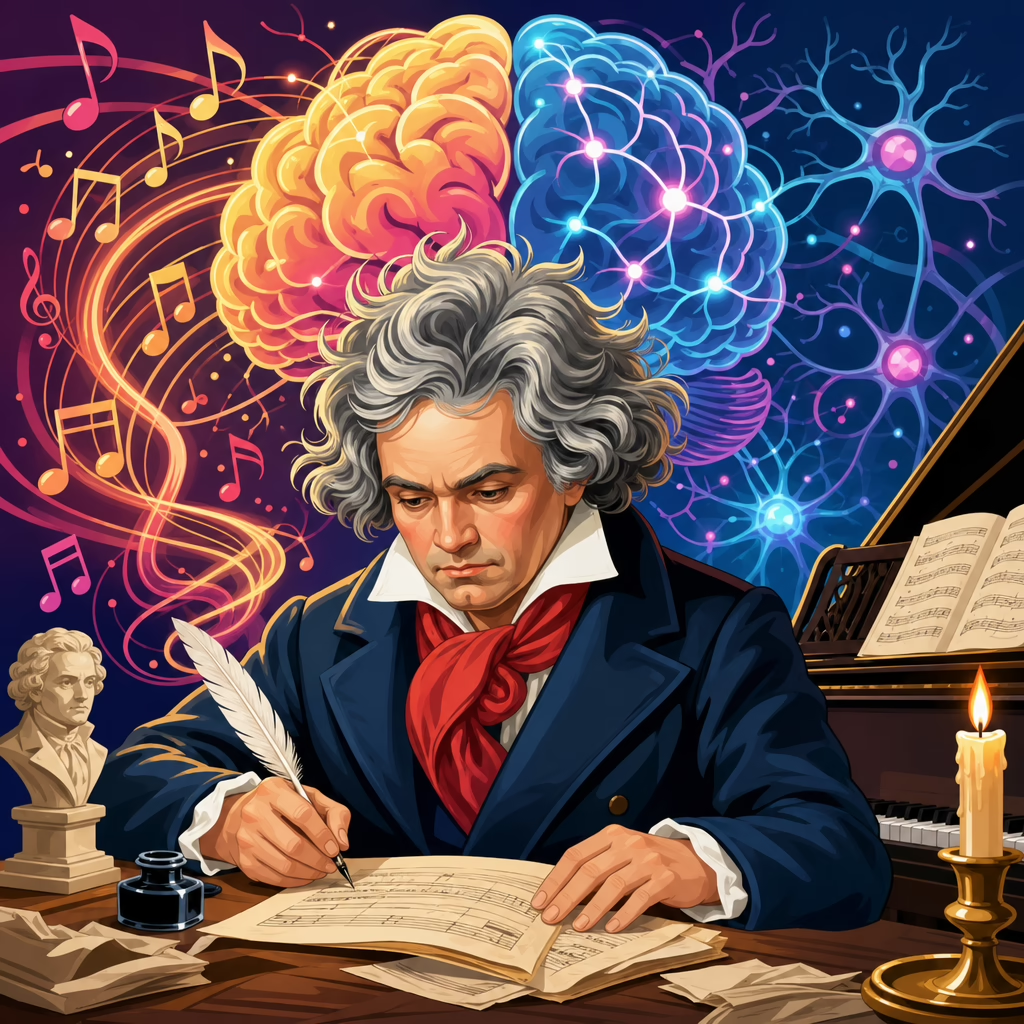
How Brain Science Is Unraveling Beethoven’s Musical Genius
How brain science is unraveling Beethoven’s musical genius is no longer a romantic question reserved for biographers and conductors; it is an active area of research that draws on neuroscience, audiology, psychology, music theory, and digital analysis. In this miscellaneous hub within Beethoven Technology & Science, the central aim is to explain how modern investigators study Beethoven’s creative mind, what they can infer from manuscripts and medical records, and where the evidence still stops. “Brain science” here includes cognitive neuroscience, the study of perception and memory, and clinical research on hearing loss, stress, and neurological adaptation. “Musical genius” does not mean mystical talent beyond explanation. In practice, it refers to an unusual combination of auditory imagination, structural control, emotional range, and productive resilience. Beethoven matters to science because his life offers an extraordinary case: a composer with progressive deafness who continued to produce works of immense complexity, from the Eroica Symphony to the late string quartets. For researchers, that combination raises precise questions. How does a brain compose when sensory input changes? What role do memory, pattern prediction, and motor imagery play? Can manuscript revisions reveal cognitive strategy? The answers do not reduce art to biology, but they do show that Beethoven’s achievements were grounded in identifiable mental processes, sharpened by training, struggle, and relentless revision.
What scientists mean when they study Beethoven’s mind
Researchers cannot scan Beethoven’s living brain, so they rely on converging evidence. The strongest approach combines surviving letters, conversation books, autopsy reports, ear-related symptoms, compositional sketches, and the music itself. In my experience reviewing work at the intersection of music cognition and historical medicine, the most reliable studies avoid sensational claims and instead ask narrow, testable questions. For example: how much working memory would it take to sustain a long-range harmonic plan? How does internal hearing support composition without full acoustic feedback? Which features of Beethoven’s sketchbooks suggest iterative problem solving rather than spontaneous dictation?
Music cognition gives useful terminology for this. Auditory imagery is the capacity to hear music internally without external sound. Chunking is the grouping of notes, rhythms, or harmonic functions into larger units that reduce cognitive load. Predictive processing describes how the brain constantly anticipates what will come next, then reacts when expectations are confirmed or violated. Beethoven’s music is a rich field for all three. He often establishes a pattern, destabilizes it, and then resolves it on a larger timescale than listeners expect. That is not simply emotional instinct. It reflects exceptional command of expectation, memory, and formal architecture.
Neuroscientists also distinguish between domain-general abilities and domain-specific expertise. Beethoven likely had unusually strong general traits such as persistence and attentional control, but his most remarkable skills were highly trained musical capacities. By adulthood he had absorbed counterpoint, keyboard technique, improvisation practice, orchestral color, and the conventions of Viennese classicism. Brain science supports the idea that expertise changes perception itself. Expert musicians do not just know more facts about music; they encode rhythm, pitch relations, and structure more efficiently. Beethoven’s notebooks show a mind refining these encodings constantly.
Deafness, adaptation, and the neuroscience of internal hearing
The most famous scientific question about Beethoven asks how he composed after severe hearing loss. The answer is not that deafness improved his art, nor that hearing was irrelevant. Progressive hearing loss was devastating, socially isolating, and professionally threatening. Yet modern neuroscience helps explain how composition remained possible. The brain does not depend solely on incoming sound. Skilled musicians develop robust internal models of pitch, timbre, meter, and instrumental response. They can simulate music mentally with surprising precision, and studies of auditory imagery show activation in cortical regions that overlap with those used in actual listening.
Beethoven’s Heiligenstadt Testament makes clear that his condition caused despair. Historical evidence suggests sensorineural hearing loss, though the exact cause remains debated. Tinnitus, reduced speech discrimination, and worsening auditory distortion are all consistent with the record. For a composer, this would have altered not just loudness but clarity. That matters because composing is not merely hearing notes; it is evaluating relationships among lines, balances, registral spacing, and dynamic impact. Beethoven increasingly relied on internal hearing, keyboard vibration, and deeply learned instrumental knowledge. Reports that he used ear trumpets and even attempted to sense sound through physical contact fit what clinicians know about compensation strategies.
Modern work on neuroplasticity offers context. When sensory channels degrade, the brain can reorganize, strengthening top-down prediction, memory retrieval, and cross-modal support. This does not create effortless genius. It means an expert with decades of training may preserve high-level functions despite severe input loss. Beethoven’s late works, especially the Ninth Symphony and late quartets, suggest not absence of sound-world imagination but extraordinary independence from external verification. He could hold vast spans in mind, compare alternatives, and commit to daring structures that many hearing composers would still struggle to manage.
Sketchbooks as evidence of cognitive process
If one source reveals Beethoven’s mind at work better than any myth, it is the sketchbook archive. He almost never produced masterpieces in a single burst. Instead, he drafted motives, altered transitions, tested accompaniment patterns, and rebalanced sections repeatedly. For cognitive science, these pages are gold. They show that creativity often depends less on sudden inspiration than on generating many variants, then selecting and refining them under clear constraints. Beethoven’s revisions are especially informative because they display both local tinkering and long-range planning.
Consider the opening motive of Symphony No. 5. Its famous short-short-short-long rhythm feels inevitable now, but Beethoven’s handling of it across movements demonstrates procedural thinking. He turns a compact cell into a structural engine. That is a hallmark of expert cognition: extracting maximum yield from minimal material. In laboratory terms, he compresses information and expands consequence. The same pattern appears in the Diabelli Variations, where a seemingly trivial waltz becomes the basis for a vast compositional inquiry. Beethoven does not merely decorate a theme; he interrogates its latent possibilities.
Scholars using digital manuscript comparison have shown how often Beethoven shifted from symmetrical phrasing to more dynamic asymmetry. This matters cognitively because asymmetry can heighten attention. The listener senses instability and leans forward. Beethoven understood this intuitively through practice, but neuroscience gives a framework: brains are prediction machines, and controlled surprise increases salience. His sketchbooks repeatedly document the search for exactly the right degree of disruption. Too little and the passage is generic. Too much and coherence breaks. His greatness lies in calibrating that threshold.
Pattern, emotion, and why Beethoven feels so powerful
One reason Beethoven’s music remains neurologically compelling is that it couples formal rigor with strong affective timing. Emotion in music is not a simple property of “sad” melodies or “happy” major keys. It emerges from tension, release, contour, rhythm, texture, learned style conventions, and bodily entrainment. Beethoven was a master of all of them. He could delay harmonic resolution until the listener’s expectation was stretched to the limit, then release it with overwhelming force. He could also build intensity through rhythmic insistence, dynamic contrast, and registral expansion rather than melody alone.
Studies in music psychology consistently show that listeners respond strongly to violated expectation, especially when the violation remains intelligible within an established frame. Beethoven excels here. The first movement of the Eroica Symphony opens with blunt, stabilizing tonic chords, then quickly enters a field of disruption and expansion. The opening of the Ninth Symphony is even more radical: a seeming emergence from harmonic ambiguity rather than a clean thematic announcement. Such passages activate attention because the brain is forced to update its model of where the music is going.
Motor systems also matter. Beethoven’s rhythmic writing often invites embodied response, whether through march energy, dance-derived pulse, or obsessive repetition. Neuroscience has shown tight coupling between auditory rhythm and motor planning networks, even when the listener is still. That helps explain the visceral drive of works like Symphony No. 7. Wagner famously called it the “apotheosis of the dance,” and while that phrase is subjective, it points to something measurable: Beethoven’s rhythms are physically legible. They recruit the body’s timing systems as well as the ear’s.
What modern tools reveal about Beethoven’s compositional style
Technology has expanded Beethoven research beyond close reading of scores. Digital humanities projects encode works in machine-readable formats, allowing analysts to trace motif recurrence, harmonic trajectories, phrase lengths, and orchestration patterns across large corpora. Audio analysis tools can compare tempo choices across recorded performances, while network models map relationships among themes and keys. None of these methods replaces musicianship, but they make hidden regularities easier to test.
One useful distinction is between surface complexity and structural economy. Beethoven often sounds turbulent, yet computational analysis frequently shows strong underlying compression. A small motivic idea may govern an entire movement. Sonata forms that seem expansive often derive coherence from a few tightly managed intervallic or rhythmic relationships. This is one reason his music is so rewarding to both analysts and listeners: richness at the surface sits on disciplined architecture below.
| Research tool | What it studies | What it reveals about Beethoven |
|---|---|---|
| Manuscript digitization | Revisions, deletions, sequence of drafts | Creativity through iteration rather than sudden completion |
| Computational score analysis | Motives, harmony, phrase length, key relations | High structural unity built from compact musical cells |
| Performance analysis software | Tempo, timing, dynamics across recordings | How interpreters handle ambiguity, tension, and large-scale pacing |
| Clinical historical review | Symptoms, treatments, autopsy evidence | Likely effects of hearing loss on perception and adaptation |
These methods also support hub-style exploration across Beethoven Technology & Science. Readers interested in hearing mechanics can branch into articles on ear trumpets, tinnitus, and nineteenth-century medicine. Those interested in data can explore computational musicology, score encoding, and AI-assisted analysis. The broader lesson is that Beethoven rewards interdisciplinary study because his work sits at the meeting point of biology, craft, and technology.
Limits, myths, and what brain science cannot prove
The strongest scholarship on Beethoven is careful about limits. Brain science can illuminate mechanisms of perception, memory, and adaptation, but it cannot fully reconstruct subjective experience. No researcher can state exactly what Beethoven “heard” internally in 1824. Historical diagnosis is always probabilistic because records are incomplete and medical categories have changed. Even the famous autopsy has to be interpreted cautiously. Lead exposure, gastrointestinal illness, liver disease, and possible inflammatory conditions all appear in discussions of his health, yet certainty remains elusive.
There is also a temptation to turn Beethoven into a neuroscience morality tale: the damaged genius whose deficits unlocked higher creativity. That is misleading. Hearing loss was a profound burden. Depression, irritability, isolation, and practical communication problems are well documented. His achievements are remarkable not because suffering automatically produces greatness, but because he sustained elite creative work despite suffering. That distinction matters ethically and scientifically.
Another myth is that science will eventually explain Beethoven completely. It will not. Music is a human practice embedded in culture, training, patronage, personality, and historical change. Beethoven inherited Haydn and Mozart, responded to the politics of his era, wrote for specific instruments and players, and navigated the economics of publication and aristocratic support. Brain science contributes a crucial layer, especially around expertise and adaptation, but it is one layer among several. The best understanding comes from synthesis.
Brain science is unraveling Beethoven’s musical genius by making his achievement more concrete, not less astonishing. Research on auditory imagery explains how a composer with severe hearing loss could still think in sound. Studies of prediction and emotion clarify why his music grips listeners with such force. Sketchbooks reveal a disciplined mind that built greatness through revision, selection, and structural concentration. Digital analysis confirms what performers have long sensed: beneath the drama lies exceptional economy and control.
For readers using this miscellaneous hub under Beethoven Technology & Science, the key takeaway is simple. Beethoven’s genius was not magic and not mechanical. It emerged from trained perception, powerful memory, relentless experimentation, and adaptation under extreme constraint. That combination is exactly why scientists keep returning to him. His life links creativity, disability, cognition, and technology in one of the most compelling case studies in cultural history.
If you want to go deeper, continue through the related articles in this subtopic: Beethoven’s hearing loss, medical theories, manuscript technology, computational analysis, and the science of musical emotion. Read them together, and the picture becomes sharper. Beethoven remains singular, but the tools used to study him can teach us something broader about how human brains imagine, endure, and create.
Frequently Asked Questions
How do scientists actually study Beethoven’s mind when he lived long before modern neuroscience existed?
Researchers cannot scan Beethoven’s brain directly, so they build evidence from multiple sources and compare them carefully. This work combines neuroscience, music theory, psychology, audiology, medical history, manuscript studies, and digital analysis. Scholars examine Beethoven’s sketchbooks, drafts, letters, conversation books, reported symptoms, and contemporaneous accounts to reconstruct how he worked, revised, heard, and thought about music. They also analyze the formal structure of his compositions to identify patterns in memory, variation, timing, emotional contrast, and long-range planning. In parallel, brain scientists study living musicians and composers to understand the neural systems involved in auditory imagery, improvisation, working memory, prediction, motor planning, and emotion regulation. Those findings do not “diagnose” Beethoven, but they create a scientifically grounded framework for interpreting the creative behaviors visible in his surviving materials.
Digital tools have made this process much more precise. High-resolution imaging of manuscripts can reveal layers of revision, erased passages, and changes in notation that show how Beethoven refined ideas over time. Computational music analysis can measure recurring motifs, harmonic surprise, rhythmic instability, and development across large bodies of work, offering a way to test long-held claims about his originality. At the same time, historians keep the interpretation honest by distinguishing what can be supported by evidence from what remains speculation. The result is not a simplistic portrait of a “genius brain,” but a richer picture of a composer whose creative process can be studied through traces of behavior, decisions, and adaptation.
What has brain science revealed about Beethoven’s creative process?
Modern brain science suggests that musical creativity is not located in a single “genius center” but emerges from interaction among several systems, and Beethoven’s work appears to reflect exactly that kind of complex integration. His music shows signs of extraordinary auditory imagination, strong working memory, disciplined revision, and the ability to hold large-scale musical architecture in mind while shaping local details. Neuroscience research on musicians supports the idea that expert composition depends on networks involved in auditory prediction, sequence processing, emotional valuation, motor simulation, and executive control. Beethoven’s surviving sketches strongly suggest that he did not simply “receive” finished masterpieces; instead, he repeatedly generated, tested, rejected, compressed, expanded, and transformed material. That iterative pattern aligns well with current scientific views of creativity as a cycle of invention and evaluation rather than a single burst of inspiration.
His music also points to a rare capacity for balancing novelty with coherence. Beethoven often took small motifs and developed them across entire movements, creating a sense of unity while constantly surprising the listener. From a cognitive perspective, that reflects sophisticated manipulation of expectation: he knew how to establish patterns, delay resolution, disrupt symmetry, and then satisfy the ear in powerful ways. Researchers are especially interested in how this kind of compositional thinking engages predictive processing in the brain, where listeners continuously anticipate what comes next. Beethoven’s genius, in this view, may lie partly in his ability to work with the brain’s expectation systems at an unusually high level, using tension, release, memory, and transformation to create music that feels both inevitable and astonishing.
How did Beethoven continue composing after losing his hearing, and what does science say about that?
Beethoven’s hearing loss remains one of the most compelling aspects of his life, and it is a major focus of scientific and medical inquiry. Although the exact cause is still debated, historical evidence makes clear that his hearing declined progressively and seriously affected his everyday communication. Yet hearing loss does not necessarily eliminate musical thought. Neuroscience shows that the brain can generate vivid internal sound representations through auditory imagery, memory, and predictive modeling. Skilled musicians often “hear” music internally without external sound, and evidence suggests Beethoven relied heavily on this capacity. His years of training, deep familiarity with harmonic language, keyboard practice, and extraordinary memory would have allowed him to manipulate musical structures mentally even as auditory input became unreliable.
Researchers are also interested in neuroplasticity, the brain’s ability to reorganize in response to sensory change. While it would be irresponsible to claim exactly how Beethoven’s brain adapted, studies of deaf and hard-of-hearing individuals show that sensory loss can alter attention, vibration sensitivity, internal imagery, and the way sound is processed conceptually rather than acoustically. Beethoven also used practical tools, including ear trumpets and close physical contact with instruments, to stay connected to vibration and resonance. His late works may reflect not simply a composer writing “despite” deafness, but one whose relationship to sound had changed profoundly. That does not mean deafness caused his genius, but science does suggest that his internal auditory world, memory, and abstract compositional control could have become even more central as external hearing faded.
Can researchers tell whether Beethoven’s medical conditions influenced the character of his music?
Scientists and historians approach this question very cautiously. Beethoven experienced a range of health problems, including hearing loss, gastrointestinal distress, chronic pain, and other symptoms documented unevenly in letters and reports. It is tempting to draw direct lines between illness and artistic output, especially when discussing emotionally intense works, but responsible scholarship avoids simplistic cause-and-effect claims. Brain science and psychology can help explain how chronic stress, pain, isolation, frustration, and sensory change may affect mood, cognition, attention, and creative behavior. These factors can influence how a person works, how persistently they revise, how they regulate emotion, and how they respond to constraint. However, they do not automatically explain the meaning or quality of a composition.
What researchers can say with more confidence is that Beethoven’s life circumstances likely shaped the conditions under which he created. Medical struggles may have altered his routines, emotional life, and access to performance settings, and those pressures may have intensified his reliance on internal hearing, structural planning, and written experimentation. But interpreting a symphony or quartet as a direct symptom of disease is generally not supported by evidence. The strongest current approach is interdisciplinary: medical historians assess the reliability of diagnoses, psychologists consider how adversity can affect cognition and resilience, and musicologists study the actual scores and sketches. Together, they offer a nuanced picture in which health mattered, but the music still resulted from craft, training, imagination, and conscious artistic decisions.
What are the biggest limits of using brain science to explain Beethoven’s musical genius?
The biggest limitation is that science can illuminate mechanisms without fully capturing individual artistic meaning. Researchers can identify neural processes related to memory, auditory imagery, prediction, emotion, and expertise, but those findings do not automatically explain why Beethoven wrote a particular passage or why it affects listeners so deeply. There is also a major historical constraint: the surviving evidence is incomplete. Manuscripts do not show every thought, letters are selective, medical records are fragmentary, and later anecdotes are not always reliable. That means any account of Beethoven’s mind must remain provisional. Brain science can provide plausible models of how creative cognition works, but it cannot reconstruct his inner experience with certainty.
Another important limit is the danger of reductionism. Calling Beethoven a product of “his brain” can sound scientific, but it ignores culture, training, patronage, performance practice, instrument technology, personal relationships, and the political world in which he lived. Genius is not just neural efficiency; it is also education, labor, opportunity, historical context, and reception. The most credible research therefore treats neuroscience as one tool among many, not as the final answer. Used well, it helps explain how complex musical thinking may have been possible and why certain features of Beethoven’s work are cognitively powerful. Used poorly, it turns a living artistic problem into a neat but unsupported story. The field is most valuable when it respects both scientific rigor and the irreducible complexity of great art.