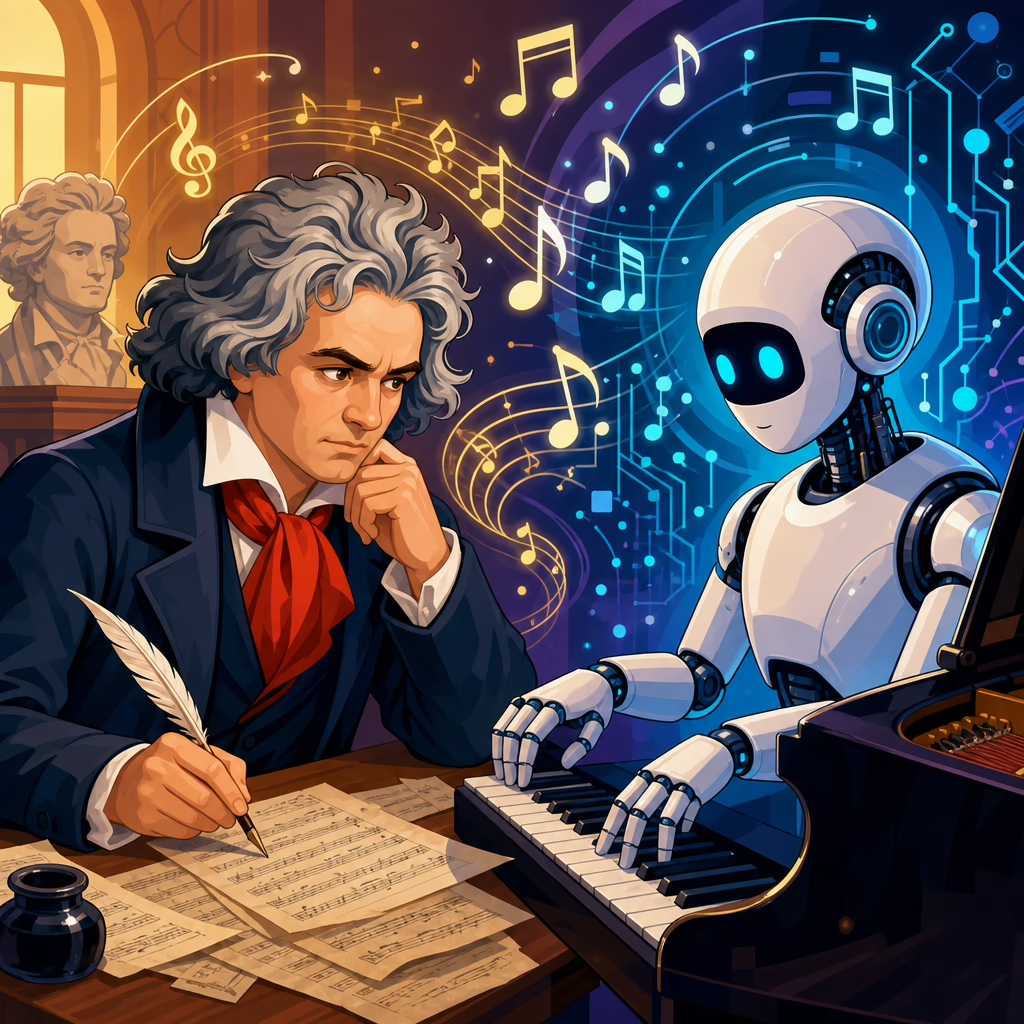
AI and Beethoven: Can Machines Replicate His Genius?
Artificial intelligence and Beethoven belong to different centuries, yet they now meet in recording studios, research labs, and composition software. The central question is simple: can machines replicate Beethoven’s genius? The accurate answer is more nuanced. AI can analyze Beethoven’s musical language, generate convincing imitations of his style, and assist performers, scholars, and educators in ways that were impossible a decade ago. What it cannot do, at least today, is reproduce the full combination of biography, cultural force, formal invention, and artistic will that made Ludwig van Beethoven singular. For anyone exploring Beethoven technology and science, this topic matters because it sits at the intersection of musicology, machine learning, creativity research, copyright debate, and practical music production.
When people ask whether AI can compose like Beethoven, they usually mean one of three things. First, can a system generate music that sounds recognizably Beethovenian, using features such as motivic development, harmonic tension, rhythmic drive, and dramatic contrast? Second, can AI help complete unfinished sketches or reconstruct missing passages in a historically informed way? Third, can an algorithm originate music that carries the same artistic weight as works such as the Eroica Symphony, the Fifth Symphony, the late string quartets, or the Missa solemnis? I have worked with style-transfer tools, symbolic music datasets, score analysis platforms, and audio generation systems, and the pattern is consistent: machines are increasingly competent at surface style and local structure, moderately useful at scholarly reconstruction, and still limited at creating long-range musical argument with genuine necessity.
Beethoven’s genius is not merely a collection of notes. It involves thematic compression, developmental rigor, strategic use of silence, architecture over large spans, and an unusual capacity to turn a tiny cell into a movement that feels inevitable. It also includes context: his studies with Haydn, his engagement with Enlightenment ideals, his response to deafness, the technical evolution of the piano, and his influence on Romanticism. Any serious article on AI and Beethoven must therefore distinguish replication from simulation. A machine may simulate stylistic fingerprints. Replication would require something closer to Beethoven’s artistic agency, which current systems do not possess. Understanding that difference helps readers evaluate grand claims, navigate new tools, and see where this fast-moving field is genuinely impressive.
How AI Studies Beethoven’s Musical Language
AI systems learn Beethoven primarily through data representations. In symbolic music tasks, researchers encode scores as MIDI, MusicXML, or piano-roll matrices and train models to predict the next note, duration, chord, phrase boundary, or orchestral texture. In audio tasks, systems analyze waveforms or spectrograms to identify tempo, dynamics, articulation, timbre, and performance timing. Beethoven is especially attractive to researchers because his catalog offers clear motivic processes, rich annotated editions, and many recordings across interpretive traditions. Projects often draw from digital archives such as the KernScores collection, MusicNet, Humdrum datasets, or custom corpora built from urtext editions and public domain engravings.
What does the machine actually detect? It identifies patterns in interval motion, cadential formulas, key relations, rhythmic motifs, phrase lengths, and voice-leading tendencies. In Beethoven’s Fifth Symphony, for example, the famous short-short-short-long pattern is not important merely as a melody; it is structurally generative. Models can trace how such cells recur in transformed forms across movements or sections. In the Piano Sonata No. 14, the “Moonlight,” systems can measure the persistent triplet texture and harmonic pacing. In late works such as Op. 131, they can map abrupt contrasts and unusual modulations, though understanding why those events matter artistically is harder than counting them computationally.
Modern methods include recurrent neural networks, transformers, variational autoencoders, and diffusion-based generation systems. Transformers have become especially useful because they model long sequences better than earlier approaches. Even so, “long” in machine learning often means dozens or hundreds of tokens, while Beethoven frequently sustains argument over an entire sonata-form movement. Analysts therefore combine models with music-theory constraints, segmentation rules, or human curation. The result is less a robotic Beethoven and more a toolkit for probabilistic style modeling. That distinction is essential for readers following this miscellaneous hub area, because many headlines blur analysis, restoration, and autonomous composition into one sensational claim.
Can AI Compose Music That Sounds Like Beethoven?
Yes, AI can produce short passages that sound plausibly Beethovenian, especially in piano writing and chamber textures. It can generate opening gestures with dramatic arpeggios, sequential development, familiar cadences, and motivic repetition. It can continue a phrase after a prompt from a Beethoven sonata. It can orchestrate in ways that resemble Classical and early Romantic scoring if the training data is well prepared. In practical tests, listeners with moderate musical background often confuse strong imitations with lesser-known Beethoven fragments when samples are brief and presented without context.
The weakness appears as duration expands. Beethoven’s music depends on teleology: themes are introduced, destabilized, reinterpreted, and resolved in proportion to the whole. Many AI outputs contain accurate local grammar but weak destination. They move from gesture to gesture rather than from premise to consequence. I have seen systems produce an excellent eight-bar opening in C minor, followed by generic sequential passagework, then a cadence that arrives because the probability curve wants closure, not because the movement has earned it. That is imitation, not invention.
Another problem is expressive contradiction. Beethoven often writes passages that seem simple on the page but derive force from dramatic timing, registral surprise, harmonic suspense, and formal placement. AI can mimic the notes without understanding the rhetorical function. Consider the opening of the “Pathétique” Sonata: the grave introduction gains meaning because of how it frames the allegro and sets up recurring tension. A model may reproduce dotted rhythms and diminished harmonies, yet miss the structural role they play. This is why AI-generated Beethoven often feels convincing in isolated clips but thinner in full movements.
Still, the technology has value. Composers use Beethoven-style generators as brainstorming tools. Educators use them to show students how motif variation works. Interactive apps let users input a melody and hear “what Beethoven might do” with it, which can sharpen listening skills when paired with score study. The most responsible use is assistive, not substitutive. AI is strongest when it helps people explore Beethoven’s craft rather than when it claims to replace it.
Reconstruction, Completion, and the Case of Beethoven’s Tenth
The most public example of AI and Beethoven is the attempt to complete an unfinished “Tenth Symphony” from sketches. Beethoven left substantial materials, but not a finished work. Musicologists, composers, and technologists collaborated to analyze the surviving fragments, infer likely continuations, and generate candidate passages using machine learning. The project drew global attention because it framed AI not just as a style imitator but as a partner in historical reconstruction.
The scholarly challenge was severe. Beethoven’s sketchbooks are not blueprints; they are working documents full of alternatives, abandoned ideas, shorthand, and revisions. Any completion must decide instrumentation, formal sequence, connective tissue, and developmental logic. AI can compare patterns across Beethoven’s authenticated works and suggest how a motive might evolve, but it cannot verify authorial intention. In other words, the machine can help answer “what is statistically plausible in Beethoven’s style?” It cannot answer “what would Beethoven have chosen here?” Those are different questions, and serious researchers keep them separate.
There are precedents for this kind of completion outside AI. Musicologists have long reconstructed unfinished works by Mozart, Mahler, Elgar, and others using stylistic inference. The machine simply scales certain parts of that process. It can search Beethoven’s oeuvre for related cadences, developmental sequences, and orchestral patterns faster than a human assistant. It can produce multiple options for experts to evaluate. Yet the final product remains a hybrid artifact: part Beethoven, part modern editorial judgment, part algorithmic synthesis. Audiences should hear it as an experiment in historical imagination, not as a newly discovered canonical symphony.
| Task | What AI Does Well | Main Limitation | Best Use Case |
|---|---|---|---|
| Style imitation | Generates short passages with Beethoven-like harmony, rhythm, and motif handling | Weak long-form architecture | Education, sketching, experimentation |
| Sketch completion | Suggests continuations from surviving fragments and comparable works | Cannot recover authorial intent | Scholarly reconstruction support |
| Performance analysis | Measures tempo rubato, articulation, dynamics, and phrasing across recordings | Interprets expression statistically, not aesthetically | Pedagogy and comparative listening |
| Restoration | Cleans audio, separates sources, improves archival access | May introduce artifacts or overprocess originals | Archiving and research access |
Where AI Is Already Transforming Beethoven Research and Performance
The strongest impact of AI is not fake Beethoven symphonies; it is better access to Beethoven’s existing work. Optical music recognition now converts old editions into searchable score files, though human correction is still necessary for dense orchestral passages. Source-separation tools help engineers isolate instruments in historic recordings for analysis. Audio restoration systems reduce hiss and surface noise from early transfers, making interpretive details easier to study. In classrooms, alignment software can synchronize score and recording so students can follow every bar in real time.
Performance analysis is another active area. Researchers compare dozens of recordings of the same sonata movement to track tempo curves, pedaling habits, articulation choices, and ornament timing. This reveals how Beethoven interpretation changes across generations. A pianist can examine how Wilhelm Kempff shapes transitions differently from Maurizio Pollini or Mitsuko Uchida. A conductor can map how Carlos Kleiber’s Fifth differs from historically informed performances in phrase pacing and accent profile. AI does not decide which reading is best, but it surfaces patterns that previously required immense manual labor.
Creative tools are improving rehearsal and composition workflows too. DAWs and notation platforms can suggest orchestrations, harmonizations, or practice accompaniments based on Beethoven-related prompts. Libraries such as Magenta, MuseScore integrations, and advanced transcription models allow students to test ideas quickly. Some conservatories use machine-assisted ear-training systems that generate Beethoven-style dictation exercises at adjustable difficulty. These applications may seem modest compared with the headline question of genius, but they deliver real educational value now.
For this Beethoven technology and science hub, the broader takeaway is that “miscellaneous” does not mean marginal. It includes restoration science, acoustic analysis, digital editions, computational musicology, generative experiments, and pedagogical software. Together, these tools change how Beethoven is heard, taught, archived, and interpreted. That ecosystem matters more in daily practice than any single publicity stunt.
Why Genius Is More Than Style
To understand why machines do not yet replicate Beethoven’s genius, it helps to define genius operationally. In Beethoven’s case, it means sustained originality under constraint, formal problem-solving at the highest level, and an ability to reshape listener expectations across entire genres. He expanded the scale of the symphony, altered the expressive ambition of the piano sonata, and treated motivic development as a dramatic engine. These achievements were not random outputs from a style model. They were interventions in a living musical culture.
AI lacks several ingredients that matter here. It has no lived experience of political upheaval, hearing loss, patronage pressures, instrument limitations, or audience reception. It has no intrinsic reason to break a formal norm unless optimization objectives reward it. It does not suffer, insist, revise with self-conception, or argue with predecessors in the human sense. Some researchers claim creativity can be reduced to novelty plus value within a domain. Even by that narrower standard, many models generate novelty, but the valuation still depends on human communities, institutions, and historical memory.
There is also the problem of meaning. The slow movement of the String Quartet in A minor, Op. 132, carries the inscription “Heiliger Dankgesang,” linking musical design to recovery from illness. The Ninth Symphony’s choral finale connects formal daring with philosophical and social aspiration. AI can imitate textures associated with reverence or triumph, but association is not equivalent to intention. The distinction matters because great art is not only patterned sound; it is patterned sound understood through human purposes.
Ethics, Limits, and What to Watch Next
Any discussion of AI and Beethoven should address ethics and limitations. Beethoven’s music is in the public domain, so legal barriers differ from those around living composers. Even so, datasets may include copyrighted recordings, edited editions, or proprietary annotations. Attribution matters when generated work draws heavily from a specific performance tradition or editorial source. Transparency also matters. If a concert presents an AI-assisted completion, audiences deserve to know what is original Beethoven, what is human reconstruction, and what is machine-generated interpolation.
There are aesthetic risks as well. Easy imitation can flatten public understanding of Beethoven into a few clichés: stormy C minor openings, abrupt sforzandi, dense development, heroic codas. Real Beethoven is broader than that, spanning humor, dance, liturgical gravity, intimate lyricism, variation technique, fugue, and radical late-style compression. Systems trained on famous excerpts alone will produce caricature. Better models require better curation and stronger musicological supervision.
What should readers watch next? First, expect stronger hybrid workflows where scholars, composers, and performers guide generation with explicit structural rules. Second, expect improved long-context modeling that better handles sonata form, variation cycles, and contrapuntal texture. Third, expect more tools for analysis rather than replacement: searchable sketchbooks, expressive performance dashboards, and interactive critical editions. If you want to explore this subtopic further, compare AI completions with Beethoven’s authenticated works, listen critically, and use technology as a lens on genius rather than a shortcut around it.
Frequently Asked Questions
Can AI actually compose music that sounds like Beethoven?
Yes, AI can compose music that strongly resembles Beethoven’s style, especially when it is trained on his sonatas, symphonies, string quartets, and sketches. Modern systems can detect recurring patterns in harmony, rhythm, phrasing, motivic development, and large-scale structure, then use those patterns to generate new passages that feel recognizably Beethovenian. In practical terms, that means an AI can produce opening themes with dramatic contrasts, develop short motifs in ways that echo Beethoven’s working methods, and even imitate the tension-and-release patterns that listeners associate with his mature style.
That said, sounding like Beethoven is not the same as being Beethoven. AI works by identifying statistical and structural relationships in existing music, not by living through the social, political, personal, and artistic struggles that shaped Beethoven’s output. A generated sonata movement may be stylistically convincing on the surface, but listeners and scholars often notice that something deeper is missing: the sense of long-range necessity, the emotional risk, and the feeling that every gesture is part of a larger human argument. So the honest answer is that AI can imitate Beethoven’s musical language surprisingly well, but replication of his genius remains far more complex than stylistic mimicry.
What does it mean when people say AI can “analyze Beethoven’s musical language”?
When experts say AI can analyze Beethoven’s musical language, they mean that machine-learning systems can process large numbers of Beethoven’s works and identify repeatable features in the way he composed. This includes the intervals he favored in certain contexts, how he used motifs to unify an entire movement, the kinds of harmonic progressions he returned to, the way he handled rhythmic disruption, and how he built tension through dynamics, fragmentation, and thematic transformation. AI can uncover patterns across dozens of works much faster than a human researcher could do manually, making it a powerful tool for musicology.
For scholars, this kind of analysis is valuable because it can reveal relationships that are easy to miss in close reading alone. For example, an AI system might detect subtle similarities between passages in different piano sonatas, map Beethoven’s evolving treatment of cadence over time, or compare his early, middle, and late styles with a level of consistency useful for research. For performers and teachers, these findings can also inform interpretation by highlighting structural pivots, repeated motifs, or expressive habits embedded in the score. In other words, AI analysis does not replace human musical understanding, but it expands it by making Beethoven’s compositional fingerprints easier to study at scale.
Why can’t AI fully replicate Beethoven’s genius if it can imitate his style?
The gap between imitation and genius is the heart of the debate. Beethoven’s greatness was not simply a matter of using certain chords, forms, or rhythmic devices. His music emerged from a distinct human life: his training, ambitions, disappointments, deafness, philosophical outlook, relationships, and historical moment. He pushed inherited musical forms into new territory because he was responding to artistic pressures and personal convictions, not because he was optimizing probabilities. AI can recombine what already exists, but it does not possess lived experience, inner necessity, or self-awareness in the human sense. Those qualities matter when people talk about genius.
There is also the issue of intention. Beethoven did not merely produce notes that fit a style; he reshaped expectations. He challenged audiences, expanded forms, and made artistic decisions that changed the future of Western music. Current AI systems do not truly understand what they are doing in that historical or aesthetic sense. They generate output based on patterns in training data, and while the results may be impressive, they do not originate in conscious artistic purpose. That is why many musicians and scholars argue that AI can simulate aspects of Beethoven’s craft, but it cannot recreate the full creative mind, cultural force, or originality that made him Beethoven.
How is AI being used with Beethoven’s music today?
AI is already being used in several meaningful ways across performance, scholarship, education, and creative production. In research settings, it helps scholars analyze manuscripts, compare variant editions, reconstruct incomplete sketches, and study stylistic development across Beethoven’s career. In audio and recording work, AI tools can clean historical recordings, assist with source separation, and improve restoration processes so that older performances become more accessible. Educational platforms also use AI to help students explore Beethoven’s works interactively, offering guided listening, score-following, and style-based composition exercises.
Creative applications are especially visible to the public. Some projects use AI to generate “new” Beethoven-style pieces or to complete unfinished material in a way that approximates how he might have continued. Others support performers by identifying interpretive patterns, suggesting phrasing ideas, or creating rehearsal tools that respond to tempo and articulation in real time. These uses are best understood as forms of assistance and experimentation rather than proof that machines have matched Beethoven’s mind. AI is highly effective as a collaborator, analytical engine, and stylistic emulator, but its strongest contributions today come from augmenting human expertise rather than replacing it.
Should AI-generated Beethoven-style music be considered authentic art?
It can be considered art, but authenticity depends on what exactly is being claimed. If an AI-generated piece is presented honestly as a contemporary work created with machine assistance in Beethoven’s style, then it can absolutely have artistic value. Listeners may find it moving, interesting, skillful, or thought-provoking, and creators can use it to explore how style, authorship, and creativity function in music. In that sense, AI-generated Beethoven-like music can be authentic as a modern artistic experiment or as a new form of composition shaped by both human and machine input.
What it should not be confused with is an actual lost work by Beethoven or a true continuation of his consciousness. Authenticity becomes problematic when imitation is marketed as equivalent to original genius. The more responsible view is that AI outputs belong in a separate category: they are reflections, reconstructions, or creative dialogues with Beethoven rather than replacements for him. That distinction matters for audiences, scholars, and musicians alike. Appreciating AI-generated music does not require pretending it is the same as Beethoven’s own achievement. In fact, the most productive way to approach it is to see it as a tool that illuminates Beethoven’s style while also reminding us why human creativity remains so difficult to reproduce.